
Topic & Content
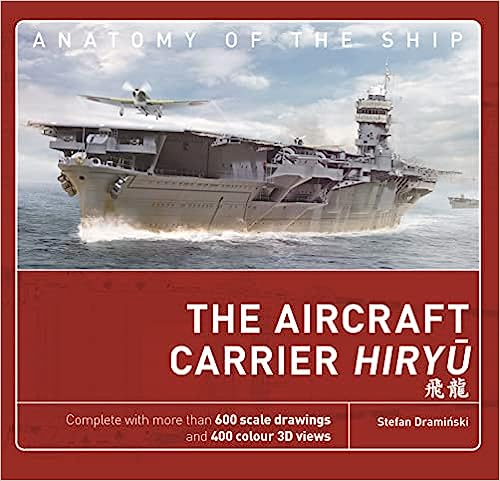
Published in 2022 as part of the Anatomy of the Ship Series, this book is a collection of line drawings and 3D computer renderings of the Imperial Japanese Navy aircraft carrier, Hiryu. The book is organized as follows:
- Section 1 (Introduction, technical description, operational history)
- Section 2 (Primary views)
- Section 3 (Drawings)
The Anatomy of the Ship series has been in publication since at least the 1980s. Recently, many of their titles have been updated (to some extent) and republished by Osprey and other publishers, in addition to new titles in the series. The new and republished titles all have red hardcovers.
Thesis
There’s no real thesis to this book, but Draminski states in the introduction that Japanese naval ships often had complex and asymmetrical designs which created challenges for the crews operating aboard them. His hope is that this book will shed some light on those difficulties and provide the reader with further insight into the layout of the ship and the struggles he had in researching her.
Author’s Background
Stefan Draminski is a Polish naval researcher and illustrator. He’s been publishing work on naval history since 2002. He’s known for his drawings of various other warships in the Anatomy of the Ship series, as well as in the Super Drawings in 3D series.
Critical Observations
Positives
It’s important to know what the Anatomy of the Ship books are, in general, and what they aren’t. The bulk of these books are line drawings (and 3D renderings, if included by the author) of the ship under examination. Due to their layout and content, the Anatomy of the Ship books read extremely fast. Most of them can be read in just a few days and the majority of the text occurs at the beginning; the rest is illustrations. They’re really just reference books for model makers and ship enthusiasts. Thankfully, this book shines through with its detailed illustrations.
Depending on the title, some of the Anatomy of the Ship books can be a bit hit-or-miss in terms of information and illustration quality. However, that’s not the case with this title. Stefan Draminski is no stranger to ship illustrations and the majority of this volume is composed of two-page spreads covering the layout of the Hiryu from stem to stern. The line drawings are very detailed and clean. Far more than just covering the exterior, Draminski goes through the ship, deck by deck, and includes layouts of the interior compartments and what purpose they serve, as denoted by the numerical keys. Additionally, most of the line drawings are complemented by computer renderings of the same spaces on the same scale. These are nice since they’re in color and they provide a 3D representation of what the line drawing shows. This gives the reader a better sense of the space.
As Draminski has noted difficulties in researching Japanese ships, given their propensity for secrecy, it’s impressive that he’s been able to glean as much detail as he has and translated it into his illustrations. This is made more impressive when one considers that the Hiryu was sunk during the Battle of Midway and the wreck still hasn’t been located, as of 2022 when the book was published. Still, Draminski writes that the Hiryu is one of the more well-documented Japanese aircraft carriers, so its selection for this book was only natural.
The book is printed on a nice glossy paper and the overall product is durable and easy to read; although the wide format of the book means it’s better situated on a coffee table or a flat surface. It does have some heft to it, so holding it up and reading it won’t be terribly comfortable.
Negatives
As is generally true for most Anatomy of the Ship books, the textual information about the Hiryu in the first section (around 40 pages long) is fairly standard and won’t impress anyone looking for an in-depth analysis or evaluation of the vessel. Then again, this is an aircraft carrier and not the battleship Yamato or the Scharnhorst. Still, only very basic design and operational histories for this ship are included. Anyone seeking a detailed operational history and account of the battles the Hiryu fought in should best seek out other sources.
Speaking of the text, the wording is occasionally a little clunky or awkward, and I suspect this might be because Draminski probably isn’t a native-English speaker and the text has been translated. Furthermore, some of the terminology is more suited for landlubbers rather than sailors, but that might be intentional.
My one final gripe, which is fairly minor, is that some of the 3D renderings can be a bit sparse when depicting the interior spaces of the ship. This is to say that what’s shown is very bare bones. For example, some chairs and a table in a large compartment might represent a wardroom or a mess area, and a bunch of racks would represent a berthing space. Storage areas are usually denoted by grey cubes. The details of the furnishings and equipment in the 3D renderings are very generic, but they could be worse. Much of this could probably be chalked up to the fact that details about the layout of the interior spaces on this ship are likely hard to come by. Hence, Draminski probably had to make some educated guesses.
Evaluation (Does the content support the thesis?)
All in all, this is a fine addition to the Anatomy of the Ship series. The line drawings are clear and complemented with colorful 3D renderings. Stefan Draminski has put a lot of work into the illustrations and the book is a visual treat for those who are interested in this ship. Any fans of the Imperial Japanese Navy would definitely enjoy this book.
Rating: 4.5 out of 5 (Great/Highly recommended!)
 Fair Winds & Following Seas
You state that ‘Draminski states in the introduction that Japanese naval ships often had complex and asymmetrical designs which created challenges for the crews operating aboard them.’ I found the comment interesting since I served in a squadron deployed on CVS18 ( Wasp) and thought immediately about how those sorts of issues could play out in terms of damage control and how the damage control teams had to operate – nice observation.
LikeLike
The biggest asymmetry you see with the Hiryu is the odd way the air intakes and the exhaust to/from her boilers to her funnels is ducted. They take up a large amount of internal space and shove a lot of things to the port side of the ship.
LikeLike