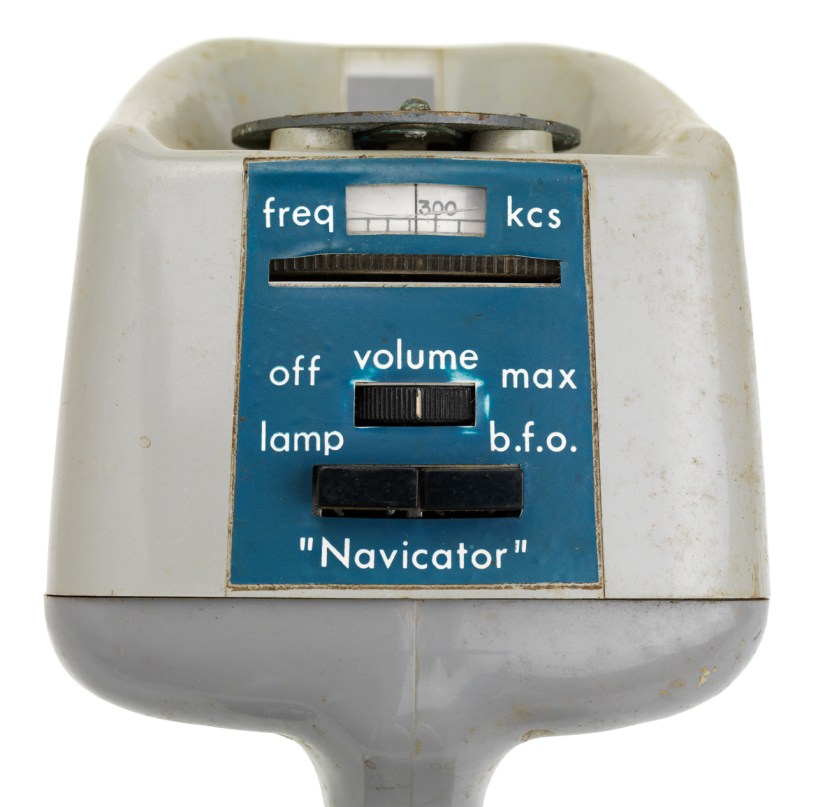

A Radio Direction Finder (RDF) is tuned like a radio receiver to a known frequency being transmitted from a Non-Directional Beacon (NDB) that is located ashore. The RDF is then panned around to acquire that signal, after which a compass bearing is taken. Therefore, taking two bearings from two different transmitters (or more) can provide a sailor with a relatively accurate fix on their position.1
While its use has largely been supplanted by GPS, radio direction finding was becoming more popular and affordable in the 1960s as a navigational aid for yachters. Donald Crowhurst, in his constant tinkering with electronics, developed and sold the “Navicator” radio direction finder. While it mildly resembles a 1950s sci-fi ray gun, in reality, there’s nothing particularly innovative about it because it doesn’t do anything that other RDFs don’t. What can be said is that it’s well-built and conveniently shaped like a pistol, so it can be held with one hand. The compass on top also allows for quick readings of the bearings.2
Crowhurst’s invention came at an opportune time, and he initially had success with sales; eventually hiring six full-time employees for his business, Electron Utilisation, Inc. Pye Radio, a manufacturer of household electronics in Britain, began negotiations with Crowhurst to buy the Navicator and paid him £8,500, which he used to buy a house in Bridgwater, England. He converted the small stable in the backyard into a workshop, which he envisioned would allow him to continue developing electronic devices. Unfortunately, his success wasn’t to last as Pye Radio backed out of the deal, and Crowhurst was forced to cut his staff to one part-time worker in his workshop. Thus, sales of the Navicator never really took off, and Crowhurst was forced to peddle it at local boat shows.3
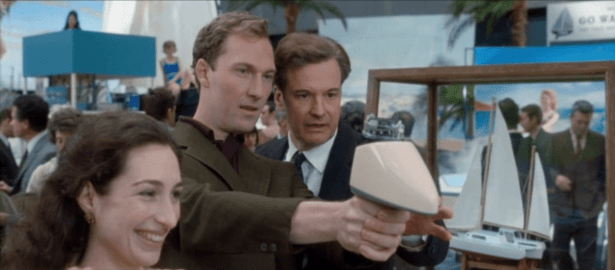

Crowhurst did carry a Navicator with him on his fateful voyage during the 1968 Sunday Times Golden Globe Race, but most of his navigational fixes were apparently accomplished using sun sights. However, he did use his Navicator once during the first two weeks of his voyage to get a fix on a radio signal.6
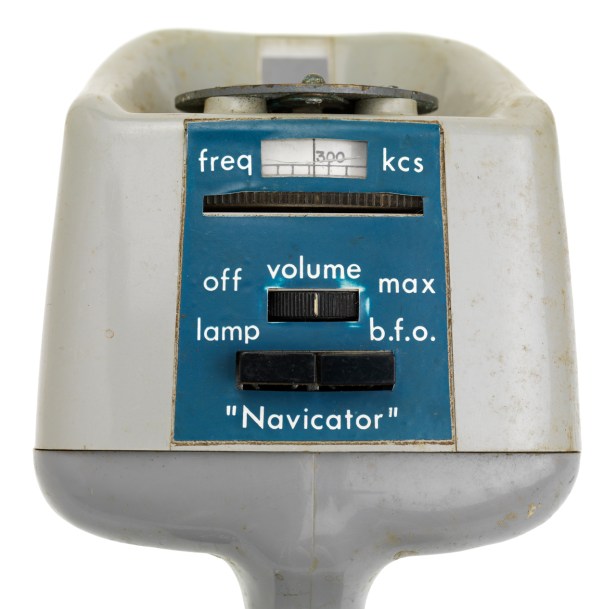

The exact functions and what sort of power supply the Navicator requires are unknown. Assuming it’s battery-powered, there appears to be no readily visible battery compartment, based on the above photos. It’s possible that the user needs to unscrew the plate on the bottom of the handle to change out the batteries. The hole in the bottom of the handle seems to be an audio jack for the earpiece to allow the user to determine signal strength when getting a directional fix (hence the inclusion of a volume control knob). What the “lamp” and “b.f.o” buttons do is uncertain. I can only speculate that the lamp function may activate a small light for use in low-light conditions. It’s likely that “b.f.o.” stands for “beat frequency oscillation” which would be used aurally to tune in to a beacon.
Notes
1.
- Peter Nichols, A Voyage for Madmen (New York: HarperCollins, 2001), 41. ↩︎
- Nichols, 42. ↩︎
- Nichols, 42 – 44. ↩︎
- The Mercy, directed by James Marsh (2017; UK: StudioCanal, 2018), DVD. ↩︎
- The Mercy, directed by James Marsh (2017; UK: StudioCanal, 2018), DVD. ↩︎
- Nicholas Tomalin and Ron Hall, The Strange Last Voyage of Donald Crowhurst (United States: International Marine/McGraw-Hill, 1995), 83. ↩︎
Bibliography
Marsh, James dir. The Mercy. 2017; UK: StudioCanal, 2018. DVD.
Nichols, Peter. A Voyage for Madmen. New York: HarperCollins, 2001.
Tomalin, Nicholas, and Ron Hall. The Strange Last Voyage of Donald Crowhurst. United States: International Marine/McGraw-Hill, 1995.
 Fair Winds & Following Seas