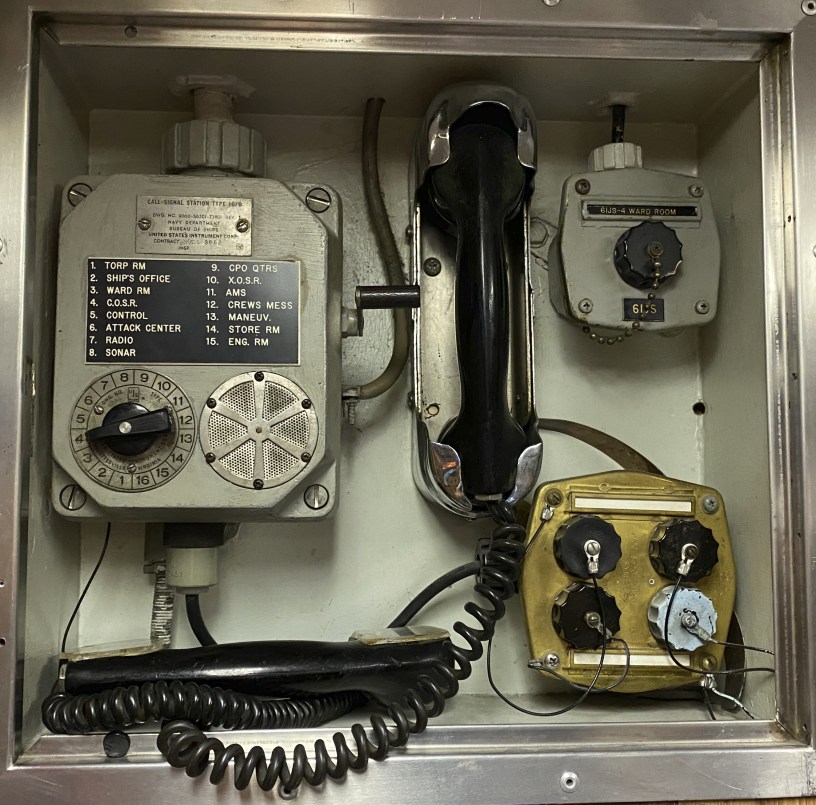

Voice communication between rooms and compartments on a warship can be accomplished through various means. Sound-powered telephones are unique in that they look like a traditional phone, but the catch is that they don’t require any external power source to operate. Let’s learn about sound-powered phones AKA growlers.
Operation
The operation of the phone depends on the vessel and model of the phone you’re using. The one shown in this post is a handset-type phone aboard a decommissioned submarine.
- Remove the handset from the bracket (obviously).
- Turn the black dial on the left to select what station you want to call.
- Turn the hand crank on the right a few times to call the station.
- Push and hold down the button on the handset to talk. Speak slowly and clearly so your voice transmits properly.
Note that some handset-type phones require that you continuously hold down the push button while both talking and listening in order for the phone to work. Also, these aren’t field telephones like those used by ground forces. They don’t run off batteries, and the hand crank isn’t powering a generator. It just operates the call buzzer for the station on the other end of the line.


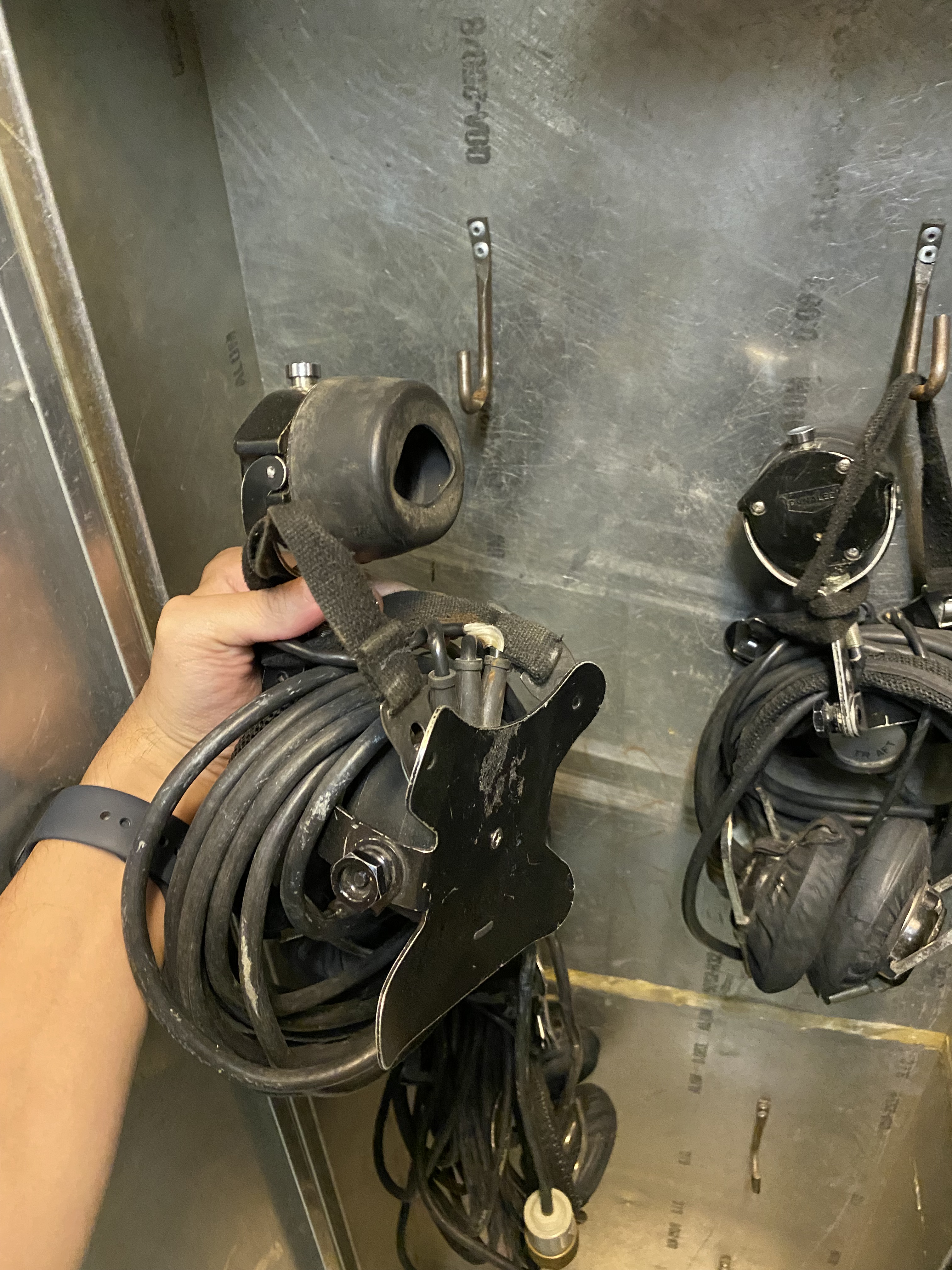
There is another type of sound-powered phone which is the headset type. Also known as a “can phone” or a “battle/deck talker phone.” These consist of headphones you wear over your ears, with the mouthpiece (the “can”) attached to a breastplate that’s hanging around your neck. This breastplate also contains the junction box that connects the headphones, mouthpiece, and corded plug which connects directly to the phone circuit in a box on the bulkhead. Unlike the handset-type phones, the push button on the mouthpiece of the headset-type phones works like that of a radio. You push and hold the button to talk, but release it when you’re finished speaking. The headset type is not directly mounted to a bulkhead. Sailors manning certain watches (such as lookouts) would be using the headset type phones due to their portability and the fact that you only need one hand to use them. The headset-type phones would be stowed when not in use, and thus don’t require the growler ringtone to alert someone that a call is coming through since they would always be manned when in use.
The “Growl”
The unique ringtone sound-powered phones make is why they are often referred to as “growlers.”
Here’s what the ringtone sounds like:
Phone Circuits
Sound-powered phone circuits are distinguished by the letter J in their designations. Common sound-powered phone circuits on U.S. Navy warships include the following:
JA Captain’s Battle Circuit
JC Weapons Control
JL Lookouts
JW Navigation
JX Communications
1JG Aircraft Control
1JV Maneuvering and Docking
1JS Combat Information Center
21JS Surface Search Radar
22JS Air Search Radar
61JS Sonar
2JZ Damage Control
The numbers preceding the J note different circuits of the same type. For example, 1JC and 2JC would note two different major weapons systems. Individual stations are designated by a number at the end of the sequence. For example, 22JS7 identifies station number 7 on the 22JS (air search radar) circuit.1
In addition to the primary circuits, there are auxiliary and supplementary circuits. Auxiliary circuits are duplicates of the primary communication circuits, but with the wiring running through different areas of the ship so that damage to one circuit doesn’t destroy the other. Supplementary circuits are direct lines to key stations; these are usually the handset-type stations. For example, a supplementary line would go from the Captain’s cabin directly to the bridge. The letter X denotes either an auxiliary or supplementary circuit. The difference is that auxiliary circuits have an additional letter following the J. For example, the XJL and X22JS circuits are auxiliaries of the JL (lookouts) and 22JS (Air search radar) primary circuits. Whereas, X1J and X8J would be supplementary circuits.2
Note that the above-listed circuits would depend on the type of vessel and what systems it operates. The first photograph in this post also shows two junction boxes for plugging in a phone. For example, the box in the upper right connects to the 61JS circuit for sonar.
The Insides of a Sound-Powered Phone


The basics of how a sound-powered phone works are similar to that of a dynamic microphone. The sound of your voice vibrates a thin metal diaphragm inside the mouthpiece. The vibrating diaphragm, in turn, causes a small iron needle (known as a balanced armature) to move inside a coil of wire held in place by a magnet. This process generates the electrical current to power the phone and transmit your voice. The earpiece has the same setup.
The genius of the sound-powered phone is that it doesn’t require any connection to external power to operate. This means that internal communications can still be conducted via these phones even if the vessel loses power. All you need to do is speak into them.
A fun go-fer snipe hunt is to send the newbie sailor/landlubber on a quest throughout the vessel to find the batteries for the sound-powered telephone.
Notes
- Thomas J. Cutler, “The Reliability of Sound-Powered Phone Systems,” Naval History Magazine 35, no. 1 (2021), accessed August 24, 2023, https://www.usni.org/magazines/naval-history-magazine/2021/february/reliability-sound-powered-phone-systems. ↩︎
- Thomas J. Cutler, “The Reliability of Sound-Powered Phone Systems,” Naval History Magazine 35, no. 1 (2021), accessed August 24, 2023, https://www.usni.org/magazines/naval-history-magazine/2021/february/reliability-sound-powered-phone-systems. ↩︎
- “Electrical Communication – The Magnetic ‘Sound-Powered’ Telephone Transmitter,” accessed May 13, 2024, http://www.vias.org/albert_ecomm/aec04_electroacoustic_devices_009.html. ↩︎
Bibliography
Cutler, Thomas J. “The Reliability of Sound-Powered Phone Systems.” Naval History Magazine 35, no. 1 (2021). Accessed August 24, 2023. https://www.usni.org/magazines/naval-history-magazine/2021/february/reliability-sound-powered-phone-systems.
“Electrical Communication – The Magnetic ‘Sound-Powered’ Telephone Transmitter.” Accessed May 13, 2024. http://www.vias.org/albert_ecomm/aec04_electroacoustic_devices_009.html.
 Fair Winds & Following Seas