
A previous post examined the design and service of the Hamilton-class U.S. Coast Guard cutters. This post specifically focuses on a unique armament feature some of them had. Specifically, anti-ship missiles. It may come as a surprise, but U.S. Coast Guard cutters, unlike U.S. Navy ships, don’t normally carry missiles.
A New Commandant and the Coast “Yost” Guard

Serving as Commandant from 1986 to 1990, Admiral Paul A. Yost, a veteran of Coast Guard operations during the Vietnam War and a recipient of the Silver Star, sought to change the nature of the service by increasing its naval warfare capabilities. Bear in mind that the U.S. Coast Guard and U.S. Navy are both sea services with very similar, if not identical, naval traditions, but Admiral Yost had seen the service transform over the years. Gone were the days of heavily armed Coast Guard cutters fighting U-boats in the Atlantic and Coast Guard coxswains putting Marines ashore in World War II, or Coast Guard cutters and boats performing riverine and coastal interdiction operations in Vietnam. Instead, the U.S. Coast Guard in the 1980s was a service focused mostly on its humanitarian missions, with a culture that was distinctly maritime in nature, and decidedly NOT the more combat-oriented U.S. Navy. This was also back when the Coast Guard was still a part of the Department of Transportation; before its post-9/11 transfer to the Department of Homeland Security.1
Upon becoming Commandant, Admiral Yost quickly began changing the service’s culture. His strict Mormon roots arguably influenced much of his efforts to mold the Coast Guard into his own image (derisively termed by Coasties as the “Yost Guard”). For example, he banned galleys serving pizza and beer on weekends, as well as wearing casual civilian clothes off-duty while underway. Additionally, it was the height of the Reagan administration’s War on Drugs. Admiral Yost instituted a zero-tolerance drug policy and stood up Coast Guard special operations teams during Operation Snowcap to infiltrate Latin American countries and take out drug production centers with DEA agents and local military forces.2
Admiral Yost didn’t stop there. One of the more bellicose changes to the Coast Guard fleet itself included putting anti-ship missiles on certain cutters.
Cutters with Missiles
In response to the potential threat from the Soviet Navy in the late 1980s, along with the U.S. intelligence penetration of Soviet leadership, the Reagan Administration and Secretary of the Navy John Lehman implemented a strategic plan for the U.S. Navy to have a fleet of 600 ships.3 Although U.S. Coast Guard vessels aren’t considered a part of the U.S. Navy’s fleet, the subsequent political tensions undoubtedly influenced policy decisions within the service, including Admiral Yost’s. Thus, it was deemed necessary for some Coast Guard cutters to have increased surface warfare capability should the Cold War go hot. As such, the largest “white hulls,” the 378-foot Hamilton-class cutters, received some substantial weapons upgrades. The color of a cutter’s hull in the U.S. Coast Guard generally denotes what missions it’s meant to carry out. Coast Guard “white hulls” are cutters normally designed and outfitted for interdiction and combat operations. For example, during the Vietnam War, several Hamilton-class cutters (as well as other patrol boats and high endurance cutters) were deployed to patrol the coast of South Vietnam to search for vessels carrying weapons to enemy forces and even conduct shore bombardment missions to support troops on the ground.4 These were operations that they were ideally suited for. That said, in their day-to-day operations, they’re not expected to be engaging in a lot of gunfights with other bonafide naval vessels, such as a destroyer or a cruiser, but they have the speed, endurance, sensors, and armament to handle most maritime law enforcement and defense readiness missions that they could reasonably be expected to encounter. This could involve anything from apprehending drug smugglers to combating pirates and other lawlessness on the high seas. Of course, they can also handle large search-and-rescue cases and other humanitarian missions.
As previously mentioned, the 378s underwent a Fleet Rehabilitation and Modernization (FRAM) program in the 1980s to extend their service life and upgrade their systems. Following their FRAM upgrades, additional upgrades to the cutter’s weapons systems included installing one Mark 15 20mm Phalanx (Close-In Weapons System (CIWS) and two Mark 141 quadruple canister launchers with RGM-84 Harpoon anti-ship missiles. These changes were completed in the early 1990s.5
The following transcript between Senator Frank Lautenberg and Secretary of the Navy Henry Garrett sheds some light on the perceived uses of the 378s with Harpoons:

The gist of Secretary Garrett’s answers seems to be that the outfitting of these cutters with missiles was meant to increase the flexibility of the missions they could undertake and increase the value of the cutters during joint exercises with the U.S. Navy. However, the number and frequency of exercises they would’ve conducted with the Navy wasn’t anticipated to change, nor does it appear that the U.S. Navy envisioned these Coast Guard cutters to replace U.S. Navy assets in certain regions.
It further highlights the fact that while these high endurance cutters (including the Famous-class medium endurance cutters) have the space and capability to mount these larger weapons systems, the availability and budget need to exist for that to happen. As Secretary Garrett also mentioned, the once-available space for these systems was eventually taken up by other systems, effectively rendering the whole issue moot.
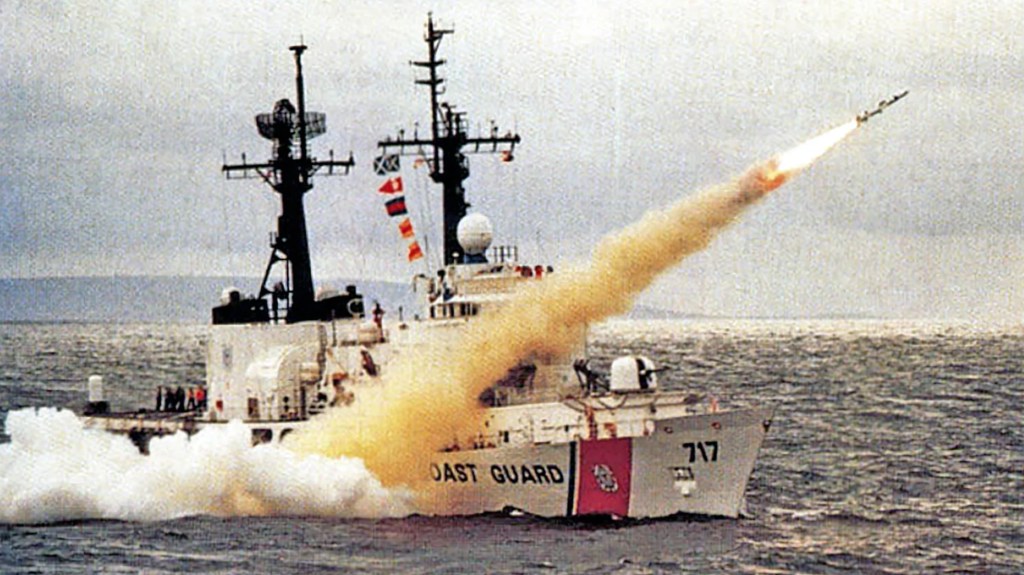
Mellon Test Fires a Missile

The weight savings from the FRAM updates to the cutters allowed the installation of these new weapon systems. Yet, it was still unknown as to how the Harpoons would perform on a Coast Guard cutter. To that end, a test firing was conducted on 16 January 1990. Admiral Yost recalls:
I flew out to the West Coast for the first exercise on the Pacific Missile Range. The Navy wants to get everything out of the shoot it can, so it had a cruiser at the other end of the range. The cruiser was going to take the missile under fire, probably with Phalanx, and shoot it out of the air.
I went down in [the combat information center] where the operation was being run. On the trigger, on the gear that actually fired the missile on the console, we had a second-class petty officer. I sat down beside him, four-star alongside the second class, and I said, “I can’t tell you, sailor, how much I want this cruiser.” This was a cocky kid. He said to me, “Admiral, don’t worry about it. Once I get this cruiser in my sights, he’s history.”
I went up on deck to watch the firing. Boom, off went the missile, and down the range it went. It got halfway down the missile range and over the circuit came the missile control officer. “The range is fouled. There’s a merchant ship that’s ventured into the range.” He said, “I’m going to destroy the missile.” The missile range officer destroyed the missile.
I said, “That’s foul play,” and I told the skipper, “Paint a cruiser on the [bridge] wing. I’m not taking no for an answer on this one.”6
Due to this test firing, one of the nicknames for USCGC Mellon became the “Mighty War Cutter.”
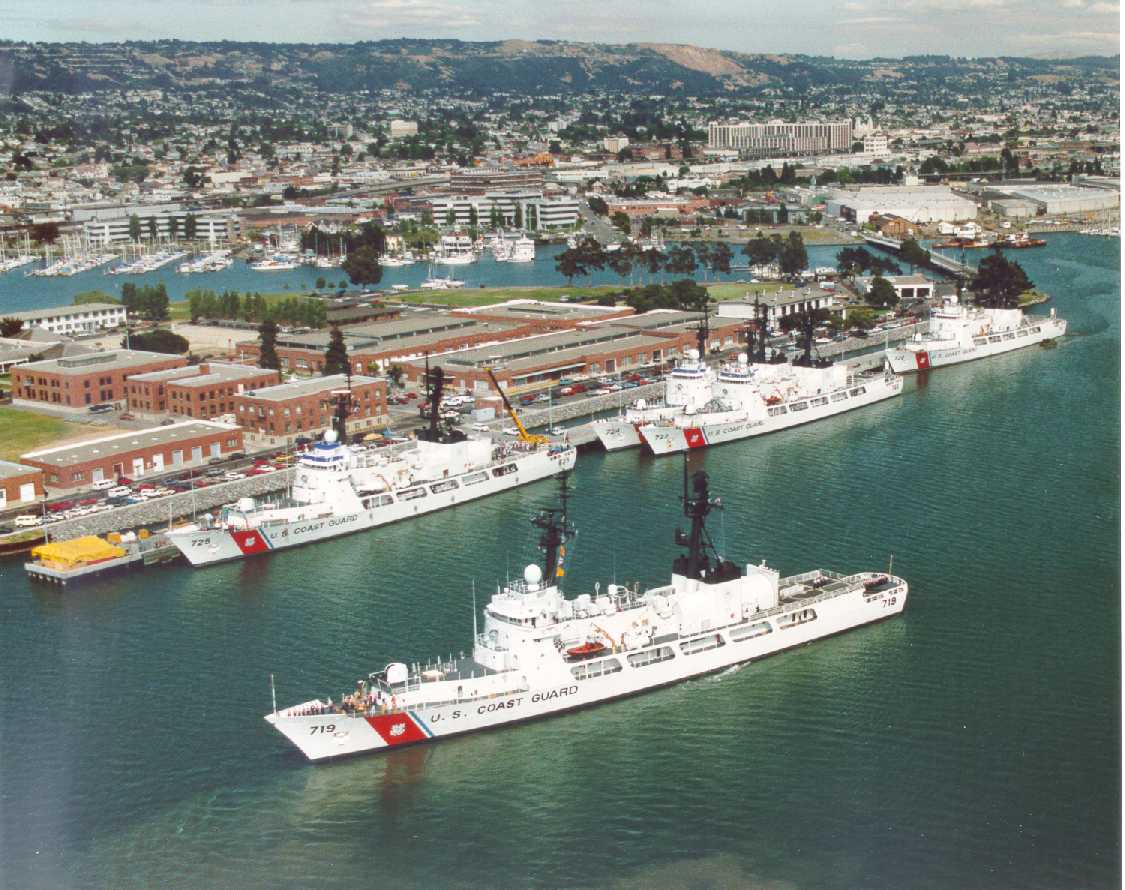
Reportedly, all of the Hamilton-class cutters were slated to receive RGM-84 Harpoons, but only five cutters got them installed, and only the Mellon did a test firing.7 The following photos show three cutters with missiles on them.

The Missiles are Removed
The missiles only spent a short time on the cutters before the entire program was scrapped in 1992. Admiral Yost says, “Well, the very sad story about this is that after I was no longer Commandant, people within the Coast Guard began to second-guess my view of what the Coast Guard was.“8 Following the end of the Cold War, the U.S. Coast Guard and U.S. Navy decided that the current military threat no longer warranted the installation of anti-ship missile systems on Coast Guard cutters. In addition to this assessment, the anti-submarine warfare capabilities of the high endurance cutters were also considered unnecessary and all associated equipment was removed, including the Mark 32 torpedo tubes, AN/SQS-38 sonar, Mk-309 Mod 0 Underwater Battery Fire Control and the AN/SLQ-25 (NIXIE) torpedo countermeasure system.9 Interestingly, Polmar notes that these cutters never received the AN/SLQ-25 NIXIE systems. He also notes that the original sonar system was an SQS-36 which was replaced with the SQS-38 (a hull-mounted version of the SQS-35 VDS in 1964.) Although the cutters did retain their 25mm machine guns amidships and their stern-mounted 20mm Phalanx CIWS guns that were installed.
Obviously, anti-ship missiles such as these have no practical application in the Coast Guard’s law enforcement missions but are more suited to defense readiness missions. The idea was to give these cutters more firepower if they encountered a higher threat while operating around potentially hostile foreign areas. Unless, of course, smugglers, poachers, and drunk boaters decide to start putting makeshift armor and naval weapons on their vessels…effectively turning them into ad hoc warships. Then the Coast Guard would probably have a reason to use the missiles.
Perhaps ironically, when the Hamilton-class cutters were decommissioned and transferred to foreign navies, their new owners often refitted and reclassified them as offshore patrol vessels or frigates. Effectively, they’ve become true naval vessels…albeit in another nation’s navy.
Yost’s Legacy
In retrospect, Admiral Yost’s emphasis on “up-gunning” the cutters with antiship missiles, standing up specialized counter-drug teams, and creating a more “militarized” Coast Guard seemed strange in the late 1980s, but would probably look much more mundane in the post-9/11 world. Effectively, he simply underscored the homeland security and defense readiness missions of the Coast Guard.10
In today’s Coast Guard, there are a variety of specialized law enforcement/special operations units, all under the Deployable Specialized Forces (DSF), formerly known as the Deployable Operations Group (DOG). These would be units such as:
- Port Security Units (PSUs)
- Tactical Law Enforcement Teams (TACLETs)
- Maritime Safety and Security Teams (MSSTs)
- Maritime Security and Response Teams (MSRT) (More specialized than the MSSTs)
- National Strike Force
- Regional Dive Lockers
That said, only the MSSTs, MSRTs, and Regional Dive Lockers are post-9/11 creations. The others existed when Admiral Yost was Commandant. Still, such modern “high-speed” Coast Guard special operations units would appear right at home in the “Yost Guard,” although the National Strike Force and Regional Dive Lockers aren’t tactical teams as much as they provide specialized capabilities like hazmat response and divers, respectively. It’s also worth noting that these DSF units are specifically oriented towards maritime security operations. They’re not large line infantry units that would be sent in to occupy enemy territory, nor are they a U.S. Army Special Forces team meant to crawl through the jungle.
While the Coast Guard has its own special operations forces, Admiral Yost would likely be enthusiastic about the Coasties serving with the Navy SEALs. Owing to a memorandum between the two services, qualified Coast Guardsmen could undergo Basic Underwater Demolition/SEAL (BUD/S) training and serve in the Navy SEAL teams; several of which currently are. However, Commandant Admiral Robert Papp terminated the program in 2011, after two years. The overall investment into the program was called into question, but unofficially, some more tradition-bound Coasties argued that the normal missions of the Coast Guard didn’t require the inclusion of them into the SEALs.11
Into the Future: Could Missiles Return to Cutters?
History has many instances of inadequate and lagging responses to a threat. The U.S. Navy in WWII, for example, would find itself adding more and more AA guns on ships to defend them against air attacks. Even then, simply adding a handful of guns was found to be too inadequate, and the once impressive 0.50 caliber machine guns and 20mm Oerlikons were ineffective at stopping determined opponents. Only the combination of improved doctrine, radar, VT fuses, and 5″ guns; a fusion of both training, technology, and weapons with substantial stopping power was found to be effective, but by the end of the war, ships were literally festooned with anti-air weapons. The same thing happened with the Coast Guard during WWII, with the Treasury-class cutters having more guns and anti-submarine weapons added, but once the cutters transitioned back to their traditional peacetime domestic duties, the extra weapons were removed. Today, we live in an age of increased accuracy and lethality. What was true for the Navy is arguably also true for the Coast Guard, and it raises the question of whether or not it’s time for Coast Guard cutters to be armed with more powerful naval weapon systems. Maybe a handful of machine guns and one deck gun are no longer sufficient for Coast Guard cutters? Maybe it’s time to put missiles back on Coast Guard cutters?
Apart from adding more weapons or upgrading the existing ones on a ship, the idea of modularity in a naval warship has been considered. The long (and arguably failed) experiment that is the U.S. Navy’s two Littoral Combat Ship (LCS) classes started out as a great idea of designing those ships with different mission modules to make them easily configurable for different roles should the need arise. If these ships could be made cheaper and more modular than the traditionally larger and more specialized vessels, then all the better. However, the reality is that continuing problems with the mission modules, engineering plants, structural failures, and lack of effective armament meant that the LCS designs became something of a lame duck. The near-continuous negative press on them certainly hasn’t improved their reputation within naval circles. In short, the LCS designs were considered too weak and too poorly armed to have any real survivability in a high-threat environment.
Comparatively, the Coast Guard’s largest combat vessels are currently the Legend-class cutters, AKA National Security Cutters (NSCs), or Maritime Security Cutter, Large (WSML). These cutters replaced the older Hamilton-class and feature weapons, sensors, and combat management systems which are very similar, if not identical, to the Navy’s LCSs. Yet, WSMLs arguably have one advantage over LCSs in that they possess a more advanced AN/SLQ-32 “slick 32” Electronic Support Measures (ESM) suite which the latter lacks. With its Surface Electronic Warfare Improvement Program (SEWIP) upgrade, this ESM suite can provide targeting data for anti-ship missiles based on passive detection of enemy emissions. While, the WSMLs, as currently outfitted, lack any over-the-horizon weaponry to fight in anything but a low-end, close-up engagement, they are intentionally built with the space and capability to add more weapon systems should the need arise.12 So in theory, they can be fitted with more powerful armament. The question is: will they?
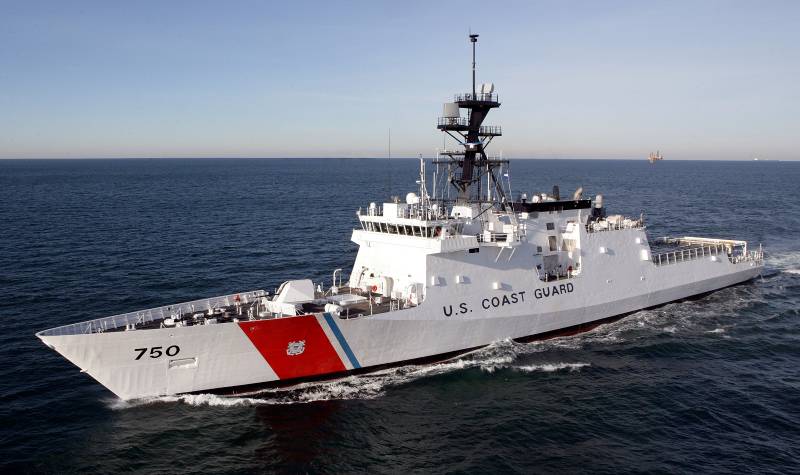
In 2018, Raytheon was awarded a contract to procure the Norwegian-designed Naval Strike Missile (under the designation RGM-184A) for use on LCSs which would give them an offensive over-the-horizon capability.13 Since the Navy and Marine Corps envision a future of distributed warfare with a variety of missile-armed vessels in position to strike targets anywhere in the world at any given time, Tyler Rogoway suggests arming WSMLs with Naval Strike Missiles, and even upgraded variants of the Harpoon if they’ll be operating in a contested area.14

On top of that, during a 2017 Congressional hearing, then-Commandant, Admiral Paul Zukunft, floated the idea of putting cruise missiles on Coast Guard icebreakers for operations in the Arctic when he said:
We need to look differently at what an icebreaker does… We need to reserve space, weight and power if we need to strap a cruise missile package on it… U.S. presence in the Arctic is necessary for more than just power projection; it’s a matter of national security… If they remain unchecked, the Russians will extend their sphere of influence to over five million square miles of Arctic ice and water.15

The thawing Arctic ice opens up the growing potential for that region to become busy with shipping traffic, and possibly a contested region in the event of a conflict. With the Coast Guard having responsibility over the country’s maritime Arctic operations, its current icebreaking fleet, consisting of the medium icebreaker USCGC Healy (WAGB-20) and the heavy icebreaker USCGC Polar Star (WAGB-10), is deemed inadequate to maintain security in the region.16
The upcoming Polar Security Cutter heavy icebreakers are expected to begin entering service in the late 2020s as the Coast Guard seeks to increase its presence in the area. In a change from the Coast Guard’s current icebreaking fleet, which only carries small arms, even the Polar Security Cutters will have an Aegis-derived combat system, and be armed with 30mm autocannons and machine guns initially, with additional space for more offensive weapons systems.17
Thus, the idea of adding additional weapons to cutters is possibly (re)gaining traction as naval threats evolve, and the U.S. Navy struggles to have assets in position throughout the globe to execute policy when the need arises. The most common argument for up-arming Coast Guard cutters still seems to be to have them act as a supplement to Navy warships.
What Good is a Cutter with More Weapons?
Much like how the armament on Coast Guard cutters increased during previous wars, missiles would likely only reappear on cutters if there was a perceived need for them. A cutter operating with a Navy task force could augment the task force’s firepower if it had Naval Strike Missiles on it. Only then would it have the capability to “reach out and touch something,” as well as benefit from the shared resources (both offensive and defensive) of said naval task force. But who knows?
Quantifying and qualifying combat power is notoriously difficult and heavily dependent on the expected opposition. In terms of combat capabilities, most U.S. Coast Guard cutters exist in a sort of limbo. They’re more heavily armed than most law enforcement vessels, but not armed to the same extent as most U.S. Navy warships. This is because the Coast Guard itself isn’t really configured for strike warfare or fleet versus fleet naval engagements like the Navy is. It acts more as a constabulary force with a primary focus on maritime security and some naval capabilities. When compared to a Navy warship of similar size, even the largest Coast Guard cutters are lightly armed in their current configuration, being more akin to corvettes or frigates. While they possess decent speed and relatively good sensors, the reality is that they wouldn’t survive for long in a high-threat environment and couldn’t stand up against any other similar-sized warship that’s armed with substantial anti-ship weaponry. A Legend-class WMSL isn’t going toe-to-toe with something like an Arleigh Burke-class guided-missile destroyer in a stand-up fight because they’re not designed that way (i.e. they’re not the Coast Guard equivalent to a Navy guided-missile destroyer in terms of weaponry). A WMSL’s main armament is a Mk 110 57mm (2.25″) Bofors gun. It’s a smaller shell size compared to the previous Mk 75 76mm (3″) OTO Melara gun mounted on Hamilton-class cutters. While it’s arguably more accurate and has a faster rate of fire, the smaller shell size gives it limited capability against anything but small surface craft (although it may have better anti-air capability). Additionally, a WMSL doesn’t have the missile armament to match an Arleigh Burke, nor do they have the capabilities to defend against an onslaught of missiles. Yes, their Phalanx CIWS, ECM systems, SRBOC, and Nulka rockets can defend them against a missile attack, but a sufficient number of missiles can penetrate that defense. Additionally, a guided-missile destroyer’s SM-1 and SM-2 missiles, although originally designed as surface-to-air missiles, can also be used in an anti-ship mode. So it won’t be a fun time when a destroyer starts hosing you down with rocket-powered, explosive-tipped, javelins of death. Furthermore, WMSLs likely aren’t designed with the same amount of internal compartmentation as a destroyer. So it may not even have the same passive survivability characteristics.
If missiles were to return cutters, then another thing to note is that the Harpoon, while still a very capable missile with modern upgrades, is an old design by 2020s standards (it entered service in 1977). It’s a subsonic missile that flies around Mach 0.71, so anything with sufficient anti-air or missile defense capabilities has a good chance of defeating the missile before it even reaches its target. Comparatively, the Naval Strike Missile is more modern (entering Norwegian service in 2012). It has a longer range of 130 nm, can be used in both an anti-ship and land attack role (discounting the air-launched AGM-84 SLAM variant of the Harpoon), and has a faster speed (though still subsonic/transonic) of Mach 0.83. However, it has a smaller warhead of 260 lbs compared to the Harpoon’s 490 lbs. Arguably, something more advanced, like an AGM-158C LRASM (Long Range Anti-Ship Missile), which can be fired from a Mk 41 Vertical Launch System (VLS), would boost the offensive anti-ship capabilities of a cutter substantially. Although I don’t know if a WSML has the space to add a VLS.18
Furthermore, even in this day and age, with the more militarized capabilities of the U.S. Coast Guard, it still isn’t configured for the same missions and capabilities as the U.S. Navy. There are many instances of the Coast Guard assets and personnel being transferred to the Navy, but they’re usually there as a supplement, not a replacement.19 The mounting of more powerful naval weapons systems (such as missiles) on cutters does provide the Navy with a small pool of trained sailors in the Coast Guard from which to draw should the need arise. However, the reality is that the sheer difference in the number of personnel, assets, and budget of the Navy when compared to the Coast Guard means that the Navy has the sea warfare domain pretty well covered.
This all reflects the U.S. Coast Guard’s duties as both a federal law enforcement agency and a military service. The outfit of their ships depends on the mission(s) they’re expected to undertake. As stated above, missiles have no utility for the Coast Guard’s law enforcement missions but may be useful in a more contested region with a more serious naval threat. However, given the density and short-sightedness of the powers that be, it may take a drastic event before that happens, such as a cutter coming under attack or being sunk in enemy action. Even then, apart from a perceived need, the missiles (and their launchers) would need to be available, and the Coast Guard would need the budget to acquire them, mount them, and train on them. Of course, only cutters large enough and with enough space to accommodate missiles would have them. Such economic realities are generally true for any weapon or sensor system. They’re not just put on ships simply because they look cool.
The inclusion of missiles on Coast Guard cutters conjures up mixed feelings for many. On one hand, missiles would provide the larger cutters with a significant increase in firepower and would be nice to have if they’re needed. The mere presence of missiles would make a definite statement and show others that the Coast Guard means business. On the other hand, it’s hard to imagine the missiles being used much, so they do seem rather superfluous. In the end, they’d probably just sit there and become another thing that cutter crews need to maintain. It’s like buying something nice and then never (or hardly ever) using it. Furthermore, the visibility of missile launchers on the cutters could be a detriment to the Coast Guard’s ability to leverage its “white hull diplomacy.” The benefit of this is that Coast Guard cutters are often seen as less belligerent than Navy ships, and some countries are more willing to let them make port calls. Hence, the Coast Guard can focus on building partnerships with other nations.
Ultimately, there are benefits and drawbacks to whether or not missiles should reappear on Coast Guard cutters. The only feasible way for missiles to end up on cutters again would be for there to be a need for them. A threat would have to exist, a budget would need to be allocated, crews trained, and space would need to be available for the weapon systems. The world changes, threats come and go, and we may or may not see a future where missiles end up on Coast Guard cutters again.
Notes
1.
- Matt Sampson, “Why the Coast Guard once put missiles on cutters and afterburners on passenger jets,” Task & Purpose, May 10, 2022, https://taskandpurpose.com/news/coast-guard-missiles-afterburners/. ↩︎
- Sampson. ↩︎
- Norman Polmar, Aircraft Carriers: A History of Carrier Aviation and its Influence on World Events Volume II, 1946 – 2006 (Dulles, VA: Potomac Books, 2008), 363 – 364. ↩︎
- Robert Scheina, U.S. Coast Guard Cutters & Craft 1946-1990 (Annapolis, MD: Naval Institute Press, 1990), 3 – 6. ↩︎
- Gene Storer III, The History and Legacy of the United States Coast Guard Cutter BOUTWELL (WHEC 719) (October 17, 2018), https://media.defense.gov/2018/Oct/17/2002052353/-1/-1/0/BOUTWELL1968.PDF.PDF., 4. Hereafter referred to as “Storer”; Norman Polmar, The Naval Institute Guide to Ships and Aircraft of the U.S. Fleet. 15th ed. (Annapolis, MD: Naval Institute Press, 1993), 554. ↩︎
- A. Denis Clift, “Harpoon Missiles with a Coast Guard Stripe,” Proceedings 144, no. 8 (2018), https://www.usni.org/magazines/proceedings/2018/august/harpoon-missiles-coast-guard-stripe. ↩︎
- Polmar, 554. Despite reports of five cutters having missiles installed, I’ve only found photographic evidence of three of them, Hamilton (WHEC-715), Mellon (WHEC-717), and Morgenthau (WHEC-722). Word of mouth suggests that the remaining two were Munro (WHEC-724) and Boutwell (WHEC-719), but I haven’t found documentation or photographs to confirm this. ↩︎
- Clift. ↩︎
- Storer, 4; Polmar, 554. ↩︎
- Sampson. ↩︎
- “Coast Guard Suspends SEAL Program,” Military.com, May 19, 2011, https://www.military.com/kitup/2011/05/coast-guard-suspends-seal-program.html. ↩︎
- Tyler Rogoway, “Coast Guard Cutters Once Carried Harpoon Anti-Ship Missiles And They Could Again,” The Warzone, December 1, 2019, https://www.thedrive.com/the-war-zone/30604/coast-guard-cutters-once-carried-harpoon-anti-ship-missiles-and-they-could-again. ↩︎
- Sam LaGrone, “Raytheon Awarded LCS Over-the-Horizon Anti-Surface Weapon Contract; Deal Could be Worth $848M,” USNI News, May 31, 2018, https://news.usni.org/2018/05/31/raytheon-awarded-lcs-horizon-anti-surface-weapon-contract-deal-worth-848m. ↩︎
- Rogoway. ↩︎
- Rogoway. ↩︎
- USCGC Polar Sea (WAGB-11) is the Coast Guard’s only other heavy icebreaker, but it’s been out of service since 2010. Instead of refitting it, it’s cannibalized for parts for Polar Star. ↩︎
- While the current icebreakers only carry small arms, previous icebreaker classes, such as the Wind-class, were armed with naval guns and depth charges. ↩︎
- Imagine a ship-launched hypersonic anti-ship missile sometime in the future being mounted on Navy or Coast Guard ships. ↩︎
- Many people often state that the entire Coast Guard is transferred to the Navy in wartime; however, this has only occurred twice in its history, during the World Wars. Still, the Navy and Coast Guard do occasionally transfer personnel and assets back and forth for short periods of time. ↩︎
Bibliography
Clift, A. Denis. “Harpoon Missiles with a Coast Guard Stripe.” Proceedings 144, no. 8 (2018). https://www.usni.org/magazines/proceedings/2018/august/harpoon-missiles-coast-guard-stripe.
“Coast Guard Suspends SEAL Program.” Military.com. May 19, 2011. https://www.military.com/kitup/2011/05/coast-guard-suspends-seal-program.html.
LaGrone, Sam. “Raytheon Awarded LCS Over-the-Horizon Anti-Surface Weapon Contract; Deal Could be Worth $848M.” USNI News. May 31, 2018. https://news.usni.org/2018/05/31/raytheon-awarded-lcs-horizon-anti-surface-weapon-contract-deal-worth-848m.
Polmar, Norman. The Naval Institute Guide to Ships and Aircraft of the U.S. Fleet, 15th ed. Annapolis, MD: Naval Institute Press, 1993.
Polmar, Norman. Aircraft Carriers: A History of Carrier Aviation and its Influence on World Events Volume II, 1946 – 2006. Dulles, VA: Potomac Books, 2008.
Rogoway, Tyler. “Coast Guard Cutters Once Carried Harpoon Anti-Ship Missiles And They Could Again.” The Warzone. December 1, 2019. https://www.thedrive.com/the-war-zone/30604/coast-guard-cutters-once-carried-harpoon-anti-ship-missiles-and-they-could-again.
Sampson, Matt. “Why the Coast Guard once put missiles on cutters and afterburners on passenger jets.” Task & Purpose. May 10, 2022. https://taskandpurpose.com/news/coast-guard-missiles-afterburners/.
Scheina, Robert. U.S. Coast Guard Cutters & Craft 1946-1990. Annapolis, MD: Naval Institute Press, 1990.
Storer III, Gene. The History and Legacy of the United States Coast Guard Cutter BOUTWELL (WHEC 719). October 17, 2018. https://media.defense.gov/2018/Oct/17/2002052353/-1/-1/0/BOUTWELL1968.PDF.PDF.
 Fair Winds & Following Seas