
Topic & Content
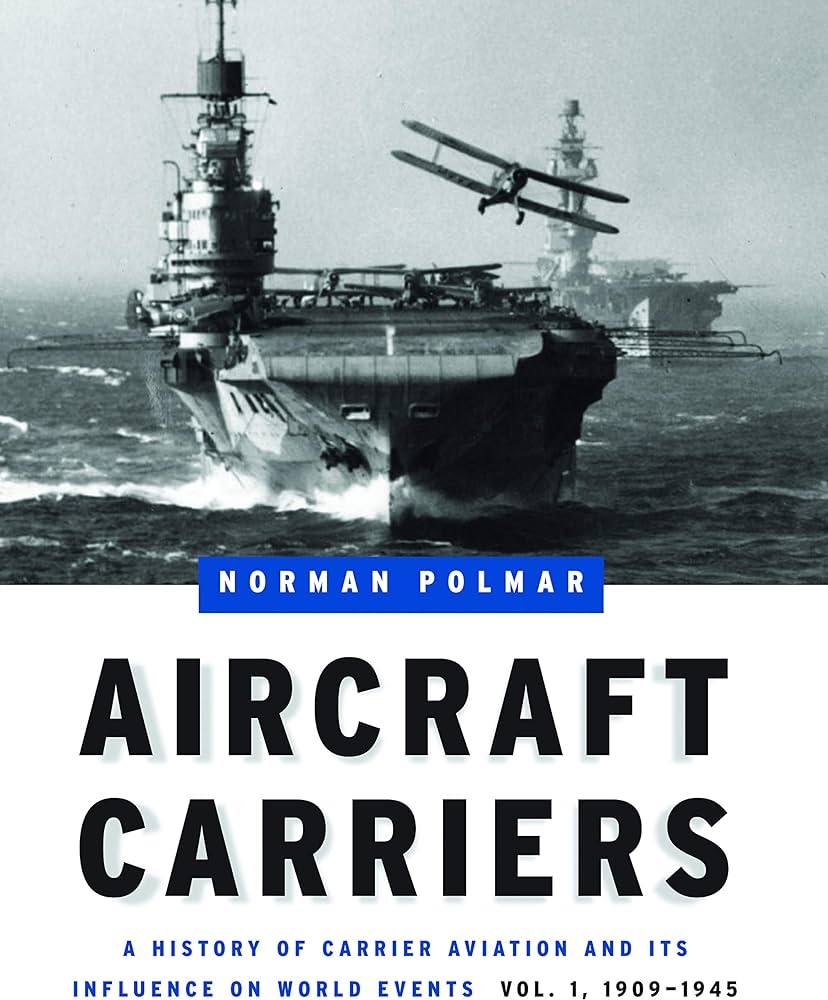
An all-encompassing narrative history of aircraft carriers, their development, and their operations from 1909 to 2006. Previously published as a single volume in 1969, this revised version breaks the narrative into two volumes. Volume 1 covers the years 1909 – 1945. Volume 2 covers the years 1946 – 2006. The revised volumes were published in 2006.
For the sake of brevity, I decided to combine both of these volumes into a single review. The books are organized as follows:
Volume 1: 1909 – 1945
| 1. Wings Over the Sea 2. The First Aircraft Carriers 3. Between the Wars 4. Building Carrier Fleets 5. Preparing for War 6. War in the West 7. War in the Mediterranean 8. War in the Pacific 9. Date of Infamy 10. Japanese Triumph 11. Offensive Defense 12. The First Carrier Battle 13. Midway 14. Midway Aftermath | 15. Building Aircraft Carriers 16. The First Assault 17. The Solomons Won 18. The European War 19. The Invasion of Europe 20. Across the Broad Pacific 21. The Biggest Carrier Battle 22. Marianas Aftermath 23. Leyte: Setting the Pieces 24. Leyte: The Battles 25. The End of the Japanese Fleet 26. The Final Battles 27. New Ships and Planes 28. Carriers to Japan |
Volume 2: 1946 -2006
| 1. The “Peaceful” Years 2. Jets and Whirlybirds 3. Atomic Bombs Aboard Ships 4. “The Wrong War” 5. “An Entirely New Year” 6. Concluding a War 7. The Cold War Navy 8. French and British Carriers at War 9. The Suez Operation 10. The Super Carriers 11. New Carrier Concepts 12. Carrier Proliferation 13. New Ships and Planes | 14. Carriers to Cuban Waters 15. Wings Over Southeast Asia…Again 16. Escalation to Escalation 17. A War Lost 18. Carrier Controversies 19. New Directions 20. Carrier War in the South Atlantic 21. Lessons and Finances 22. The Russian Experience 23. Soviet Aircraft Carriers 24. Rehabilitation and Retaliation 25. Amphibious Assault 26. Into the 21st Century |
Thesis
The general thesis of these books is to provide a narrative of the development and operations of aircraft carriers and how they influenced the conflicts they participated in throughout history. Additionally, Volume 2 notes a general trend in the post-WWII world that carriers will be deployed to the area wherever crises flare up,.
Author’s Background
Norman Polmar is a prominent naval analyst, consultant, and historian. He’s published over 40 books and has served as an advisor to three Secretaries of the Navy and two Chiefs of Naval Operations. He’s also led various projects for the U.S. Department of Defense and the U.S. Navy.
Arguably the two most prominent naval historians/theorists working today are Norman Polmar and Norman Friedman. It’s easy to get them mixed up. They’ve both published extensively and consulted with the U.S. military on various matters. In fact, they both write on very similar topics and with similar writing styles, although Friedman trends more toward technical design histories and theoretical works. Still, anyone researching modern naval history (basically from 1900 onward) will undoubtedly come across both of these men’s writings. They’re both highly regarded and ubiquitous.
Critical Observations
Positives
The biggest highlight of these two books is that they’re all-encompassing histories of aircraft carriers from every country (that has or had them) and their operations throughout history up to the time of this edition’s publication in 2006. In other words, they’re not solely focused on one specific navy’s aircraft carriers. This allows the reader to get an expansive view of the different carriers and how their respective navies used them and learned from them.
In case you’re wondering, yes, even Volume 1 contains updated information. It’s not just copied and pasted from the original edition. This is apparent because the citations and bibliography include more recent sources (from the early 2000s); sources that didn’t even exist back during the original publication in 1969. Obviously, the content of Volume 2 has likewise been substantially updated with new information and photos to cover events that have occurred up to 2006. Both books are richly illustrated with many photos of the carriers and aircraft under examination.
Despite each volume coming in at over 500 pages (if the appendixes are included), with each page having two columns of text, the books read fairly quickly…relatively speaking. Furthermore, the writing is very detailed and reasonably well-cited. It’s impressive that Polmar compiled so much information from so many sources into these volumes. That said, this wasn’t a one-man show. Polmar collaborated with several naval officers/historians from the U.S., Great Britain, Argentina, Germany, France, Russia, Australia, Japan, etc., as well as with General Minoru Genda (Yes, that Minoru Genda!) for this project. While the text is very dense with information, it surprisingly doesn’t suffer in terms of narrative flow. To be honest, having read several of Norman Friedman’s warship design histories, and finding them very informative but also very dry, I feel that Norman Polmar is actually a better writer. Polmar’s narrative is easy to follow and the text flows well when transitioning from topic to topic. (In all fairness, regarding Friedman’s books on warship design histories, it’s hard to make an enthralling narrative when writing about how many boilers a ship should have to make it go a few knots faster. The subject matter of a design history makes the reading naturally dry. In contrast, these books focus more on the operational history of aircraft carriers with some discussion on their design, whereas Friedman’s books are solely focused on design.)
The books also cover the many “pseudo-carriers” that are/were used by various nations. Polmar takes time to address that not every ship that carries aircraft is an “aircraft carrier” so he defines the term broadly as any ship fitted with a flight deck and intended to primarily operate aircraft. This includes converted ships and “semi-carriers.” For example, amphibious assault ships that carry Marines have full-length flight decks and would carry helicopters and the AV-8B Harrier II or F-35B Lightning II VSTOL jets. The purpose of these ships is to operate with an Amphibious Ready Group (ARG) (currently known as an Expeditionary Strike Group (ESG)) and put a battalion of Marines ashore with an organic air element. To the layperson, these are often mistaken for aircraft carriers, even though they’re technically not. In addition, many of the Russian (formerly Soviet) aircraft carriers (such as the Kiev-class or Kuznetsov-class) aren’t really carriers, but technically “aircraft-carrying cruisers” (and heavily armed with missiles). This distinction allows the Russian “carriers” to pass through the Dardanelles and Bosporus Straits without violating the Montreux Convention. Nevertheless, these pseudo-carriers have played a significant role in post-WWII naval history in the absence of bonafide aircraft carriers, and for some nations, they constitute the only form of carrier they have.
Negatives
The book’s subtitle “its [aircraft carriers] influence on history” stretches the term a bit. Each book does contain some examination of how carriers affected the outcome of various conflicts, but as for integrating that claim into the overall narrative, the books don’t really provide any serious thematic connection, examination, or analysis. However, Volume 2 does provide a short examination in the appendixes of Nazi Germany and Fascist Italy’s planned aircraft carriers (Graf Zeppelin and Aquila, respectively), their failure to build carriers, and how their wars were affected by a navy without aircraft carriers. In other words, these are more straightforward historical narratives, rather than lengthy in-depth operations analyses of the utility of aircraft carriers and their qualities.
Most of the other criticisms are minor. There are occasional typos, cursory details, and inaccuracies in the text. In a few places, the end notes don’t match up with the number in the text. Also, understand that the books maintain a fairly operational and strategic view of the events. If you’re looking for a super-detailed design and operational history of every carrier under the sun, then you’ll probably be disappointed. There’s just not enough space to go into that level of detail for every single carrier. If that’s what you want, then seek out other sources on operational histories.
Evaluation (Does the content support the thesis?)
All in all, these books are excellent additions to anyone’s library when it comes to the topic of aircraft carriers. The books are well-illustrated with hundreds of photos and drawings. Norman Polmar’s writing flows well, is detailed, and covers the multitude of carriers used by nations. While there are some tenuous thematic connections, typos, and cursory information, readers will ultimately get a solid understanding of how aircraft carriers and their air operations developed and were used throughout various conflicts throughout history.
Rating:
4.5 out of 5 (Great/Highly Recommended!)
 Fair Winds & Following Seas