
Topic & Content
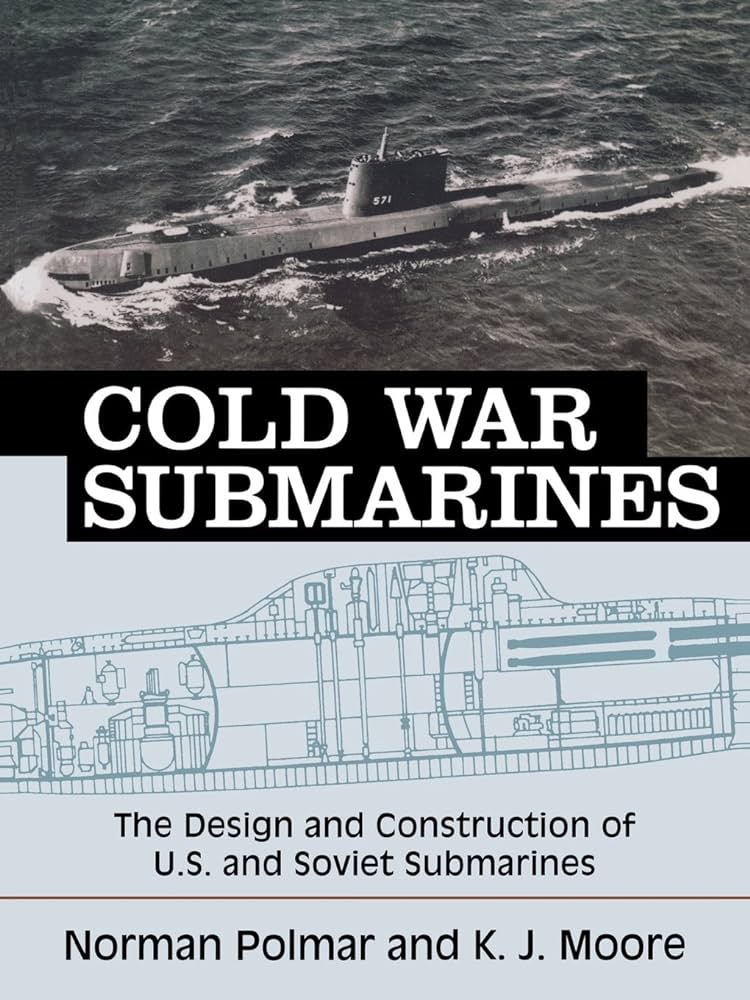
Published in 2004, this book examines the design and construction of American and Soviet Cold War-era (1945 – 1991) submarines. This includes both diesel-electric and nuclear-powered boats (attack and ballistic missile), as well as experimental/conceptual designs. The book is organized as follows: (Chapter descriptions are in parentheses)
- Genesis (German Type XXI and Type XXIII U-boats & their design influence on U.S. & Soviet designs.)
- Advanced Diesel Submarines (Tang-class, SSK hunter-killers, Whiskey & Zulu-classes.)
- Closed-Cycle Submarines (German, British, and Soviet experiments with Air-Independent Propulsion (AIP).)
- U.S. Nuclear-Propelled Submarines (First-Generation U.S. nuclear boats: USS Nautilus, Skate, & Triton-classes.)
- Soviet Nuclear-Propelled Submarines (First-Generation Soviet nuclear boats: November-class & modifications.)
- Cruise Missile Submarines (The development of early submarine-launched cruise missiles, USS Halibut, USS Grayback, Echo I & II-classes, Juliett-class.)
- Ballistic Missile Submarines (The development of Soviet submarine-launched ballistic missiles and subs, Zulu-class, Golf-class, Hotel-class.)
- “Polaris – From Out of the Deep…” (The development of the U.S. Polaris & Poseidon ballistic missiles, USS George Washington, Ethan Allen, and Lafayette-classes (AKA “41 for Freedom”).)
- The Quest for Speed (The development of USS Albacore and teardrop-shaped hull, Barbel & Skipjack-classes, Papa & Alfa-classes.)
- Second-Generation Nuclear Submarines (Thresher/Permit-class, USS Tullibee, Sturgeon-class, Victor I, Victor III, Charlie I, & Charlie II-classes.)
- The Ultimate Weapon I (Soviet second-generation ballistic missile submarines: Yankee, Delta I, Delta II, & Delta III-classes.)
- The Ultimate Weapon II (U.S. Trident ballistic missile program, Ohio-class, Typhoon & Delta IV-classes.)
- “Diesel Boats Forever” (Soviet second and third-generation diesel-electric submarines: Romeo, Foxtrot, Tango, Kilo, Beluga, & Lima-classes. U.S. DSRV program, & USS Dolphin research submarine.)
- Unbuilt Giants (Designs for cargo, transport, & tanker submarines.)
- Aircraft-Carrying Submarines (British, U.S., & (mostly) Japanese submarines that were equipped to launch aircraft.)
- Midget, Small, and Flying Submarines (British X-craft, German & Japanese WWII midgets, U.S. X-1, designs for a “submersible seaplane,” Soviet Losos/Piranya, & U.S. Advanced SEAL Delivery System (ASDS).)
- Third-Generation Nuclear Submarines (Los Angeles-class, NR-1, Oscar I & II, Sierra I & II, Akula, & Mike-classes.)
- Submarine Weapons (U.S. & Soviet torpedoes, cruise missiles, & anti-ship missiles.)
- Fourth-Generation Nuclear Submarines (Seawolf & Virginia-classes, Severodvinsk & Yuri Dogoruki submarines.)
- Soviet Versus U.S. Submarines (Overall evaluation of the similarities & differences, strengths & weaknesses of U.S & Soviet submarines, including the associated submarine industrial bases, construction programs, manpower, & training programs.)
Thesis
This book aims to examine how the two Cold War superpowers designed their respective submarines. It also assesses how they leveraged their technology and scientific innovation and translated those into capability.
Author’s Background
Norman Polmar is a prominent naval analyst, consultant, and historian. He’s published over 40 books and has served as an advisor to three Secretaries of the Navy and two Chiefs of Naval Operations. He’s also led various projects for the U.S. Department of Defense and the U.S. Navy.
K.J. Moore is a former U.S. Navy submarine officer, serving as a weapons officer, engineering officer, and operations officer. Following his time in the Navy, he founded the Cortana Corporation, and technology application firm concerned with submarine development.
Critical Observations
Positives
As I’ve come to expect from Polmar, this book is a balanced and well-written examination of the design of U.S. and Soviet submarines. Bear in mind that it covers all of the diesel-electric and nuclear-powered classes that were designed and constructed during the Cold War, not each and every submarine itself (unless it was a one-off design). Furthermore, the book also discusses the overall strategic considerations for the development of these subs, as well as the overall development of the weapons used.
As the title suggests, this book broadly functions as a comparison between U.S. and Soviet submarine designs. As technology progressed and subsequent generations of submarines were introduced, it’s possible to see a constant back and forth between the two countries in their submarines and what capabilities they were aiming to incorporate. As a general observation, Soviet submarines were faster but noisier, had more compartmentation, often incorporated more automation, and were more innovative in their designs. In contrast, U.S. submarines were quieter (stealthier), had less compartmentation, and were much more conservative in their characteristics. Additionally, the Soviet Navy used conscription in its submarine service, whereas the U.S. Navy has an all-volunteer submarine service. Yet, the operational history of U.S. submarines shows a better track record for safety, arguably because of the more conservative design philosophy (not to mention Hyman Rickover’s oversight of nuclear power plants), as well as the better training of submariners themselves. Still, Polmar and Moore credit the Soviets with accomplishing an impressive amount with their submarines.
*Author’s Note: Polmar and Moore’s inclusion of a full chapter on the Albacore and Barbel-classes is commendable. Except for Norman Friedman’s U.S. Submarines since 1945, this is one of the few books I’ve found that goes into any depth about the design of the Barbel-class, the last U.S. diesel-electric attack boats. Most books on U.S. submarine design simply mention the development of USS Albacore and its teardrop hull form, and then make a passing comment about how that submarine led to the development of the Barbel-class. This is important because the Barbel-class were the first production combat subs to feature that hull shape and the Navy has continued that trend ever since. USS Blueback (SS-581), currently a museum ship in Portland, Oregon, is the only surviving Barbel-class sub and the last diesel-electric attack boat in the U.S. Navy. As a tour guide on this submarine, myself, finding good sources on the design of the Barbel-class is very frustrating. Luckily, this book and Friedman’s, fulfill that gap.


Of course, many more classes of submarines are covered in this book which includes a few classes that were commissioned in the 1990s and early 2000s (Seawolf & Virginia-classes). Other experimental and one-off designs are also examined, such as midget subs, AIP, sailless submarines, and even a “submerged seaplane” concept (emphasis on “not a flying submarine”). In fact, this book would serve as a very good accompanying volume to Friedman’s U.S. Submarines since 1945, although that book only focuses on U.S. subs.
The best thing about this book is that it’s a detailed narrative that covers a very secretive aspect of naval construction. Many of the details of submarines and their performance characteristics are classified. Thankfully, Polmar and Moore’s writing is very well-researched and therefore backed up by verifiable facts. It’s far more in-depth than your average narrative on submarines and isn’t bound to speculation or wild theories (and there’s no shortage of wild theories out there about submarines). (I’ve also mentioned in another review that I actually find Polmar to be a slightly better writer than Friedman. Although that may be because I have no engineering background since Friedman’s work is often a bit more technical.) Each chapter is well-cited with extensive end notes and a bibliography to support the authors’ statements. Additionally, the book contains many clear photographs and excellent line drawings of the submarine classes under discussion.
Negatives
As with other books I’ve really enjoyed, I don’t have many criticisms; however, there are a few.
While there is some discussion on the strategic logic behind designing these submarines and their weapons, if you’re looking for a book on U.S. and Soviet Cold War submarine operations, then this isn’t the book for you. It’s largely focused on the designs of the submarine classes under examination; however, some submarine operations (and accidents) are mentioned if they’re directly related to the design of the boats.
Additionally, there are occasionally cursory details on certain submarines and their systems. However, this could be due to there being little publicly available information on them. Mostly, this is evident in the Soviet submarines, but when the narrative moves into the post-Cold War era of the 1990s, then it can also apply to U.S. submarines. In reality, many of the characteristics of submarines, such as their speed, test depth, or the range of the weapons, are classified. Hence, many of the numbers used in publicly available publications are nice and round.
Evaluation (Does the content support the thesis?)
All in all this book is a detailed and well-written examination of the design of U.S. and Soviet Cold War-era submarines. The writing a technical, but accessible enough for the layperson to understand, and the narrative flows well. Polmar and Moore show how the strategic and technological rationale influenced the building of the various submarine classes and how submarines themselves evolved over time. The biggest drawback of this book is that it’s focused on submarine design and technology, as opposed to Cold War submarine operations. Additionally, the secretive nature of submarines themselves means that some information may feel very shallow; leaving the reader wanting to know more. Despite those flaws, this book is one of the few to offer an exhaustive and comprehensive look at how U.S. and Soviet submarines were designed during the 40 years of the Cold War.
Rating:
4.5 out of 5. (Great/Highly Recommended)
 Fair Winds & Following Seas