
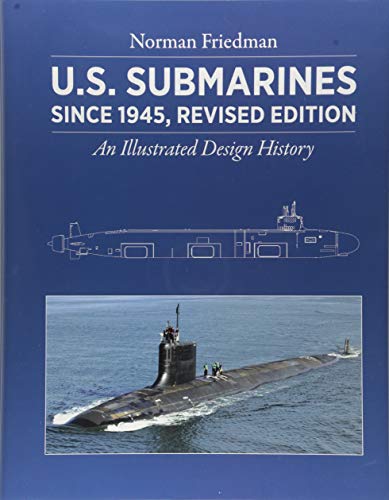
Topic & Content
Originally published in 1994, this updated volume, published in 2018, follows U.S. submarine development from 1945 up to the late 2010s. The book serves as a continuation of Norman Friedman’s previous volume on U.S. submarine design through 1945. The book is organized as follows:
- 1. Introduction
- 2. The Postwar Attack Submarine
- 3. The Fast Submarine
- 4. The ASW Submarine
- 5. New Missions
- 6. The Nuclear Revolution
- 7. The ASW Crisis: Nobska and After
- 8. From Nuclear Prototypes to Production
- 9. Nuclear Submarines: The Second Generation
- 10. Los Angeles and Her Successor
- 11. Strategic Submarines
- 12. Beyond the Cold War
Appendices
- A. Midget Submarines
- B. U.S. Post-World War II Submarines
- C. Submarine Data
- D. New Information
Thesis
While the submarine force survived the end of World War II, the missions for what they were designed for (strategic scouting and anti-shipping) effectively ceased to exist. During the Cold War, submarine operations pivoted to anti-submarine warfare and strategic (nuclear) deterrence. In the post-Cold War world, Friedman postulates that submarines will not only continue their Cold War missions but again take on new missions, as well as some of their older secondary missions, such as intelligence gathering.
Author’s Background
Norman Friedman is a prominent naval analyst and theorist. Earning a Ph.D. in physics from Columbia University, Friedman specializes in strategic and technical issues, has consulted with various U.S. government agencies, and has served as the deputy director of national security studies at the Hudson Institute. His eight-book series on U.S. warship designs, of which this book is part, has been highly regarded as a standard reference on U.S. naval warship development.
Critical Observations
Positives
As with all of Friedman’s design histories, this book is a very detailed look at the design and development of U.S. submarines post-WWII. Be warned, however, that these books are not examinations of operational history. In addition to covering how submarine hulls changed, this volume also examines the development of associated systems related to submarines, such as propulsion, sensors, and weapons systems (nuclear reactors, sonar, torpedoes, missiles, etc.).
The book is well illustrated with extensive use of photos and line drawings. Friedman even goes so far as to identify individual masts and sensors on submarines. This is especially valuable since most other works don’t point out such details and many submarine systems are classified. To naval historians researching submarines, the lack of specific information on these systems can be very frustrating. Submariners tend to be very hush-hush about their boats’ operations and capabilities. It’s one of the many reasons it’s called the “silent service.” In contrast, this book is an excellent reference for those looking for more detailed information on identifying specific sensors and systems on these submarines. Compared to Norman Polmar’s Cold War Submarines, this book is an even more detailed examination of the design of U.S. submarines, and I learned even more about their design and systems than that book. Of course, unlike Polmar’s book, Friedman’s doesn’t cover Soviet/Russian subs.
To some extent, changes in U.S. submarine doctrine are also examined as the technology improves. Friedman revised this edition to include new information on the Virginia-class SSNs, Columbia-class SSBN-X, and newly declassified information on the Skipjack, Thresher/Permit, and Sturgeon classes. For example, he examines updated theories on what caused the sinking of USS Thresher and USS Scorpion in 1963 and 1968, respectively.
Negatives
As with just about every of Friedman’s books I’ve read, my biggest issue is the writing and editing. There’s nothing inherently wrong with Friedman’s writing, but I find it to be fairly dry and with abrupt transitions. It just doesn’t flow very smoothly and the organization leaves something to be desired. The narrative tends to jump from subject to subject without much in the way of transitions and there’s a complete lack of subheadings to inform the reader of the topic. One minute you’ll be reading about a new reactor that’s being developed, and the next paragraph will jump into a discussion on whether or not to use a particular type of steel for the hull.
Additionally, Friedman will spend lengthy amounts of time discussing the technical features of certain systems, such as sonar or fire control, only to suddenly move into a discussion on whatever submarine class is under examination. Truth be told, a submarine is really just a steel tube that serves as a platform for the sensors, nuclear reactor, and weapons, but the narrative goes off on long tangents to talk about these things when the reader may be wondering when they’re gonna get back to talking about submarines.
While there’s the economic reality that warships, especially submarines, aren’t cheap, it seems like so much of the narrative is dominated by fiscal and budgetary discussion. It’s an endless parade of government officials and agencies who want certain features, but ultimately end up playing a game of quid pro quo for money and construction contracts. The problem is that after a while, it gets really bland.
The book is surprisingly short, at only 270 pages if the appendices are included. It does seem rather skimpy for such a technical subject as submarines. While I’ve never read the original edition, for being a revised volume, the new material is simply included in an appendix. It would’ve flowed better if it had been organically integrated into the narrative. Furthermore, while Friedman is known for his extensive research, there are only endnotes and no bibliography for this book. A list of sources for quick reference would’ve been appreciated.
My final critique is that the revised printing must have lost some details in the photos and technical drawings. Some of the photos appear muddy, and certain details in the line drawings are clearly missing. Given that the book isn’t printed on glossy paper also doesn’t help bring out any detail.
Evaluation (Does the content support the thesis?)
All in all, the revised edition of this book adds enough to make it a worthwhile read. However, readers looking for a light or enthralling read about submarine operations should probably look elsewhere. Norman Friedman’s design histories on U.S. warships are highly detailed but tend to be rather dry reads for those not interested in how and why ships (submarines, in this case) are designed the way they are. The narrative tends to be rather choppy and could use another round of editing, but this book is even more detailed than others on the same subject.
Rating:
Very good/worth your time
 Fair Winds & Following Seas