Disclaimer: The views expressed here are the presenter’s own and do not necessarily reflect the official policies or positions of either the Oregon Museum of Science and Industry (OMSI) or the United States Government. While strong efforts are made to ensure accuracy, all information is subject to change without notice. All personal statements, opinions, omissions, and errors are the commentators’ own.
A fire on land or on a surface ship is enough of a problem, but a fire on a submarine is a serious emergency. Picture yourself being hundreds of feet underwater in a giant steel tube, surrounded by all kinds of equipment, high-voltage cables, high-pressure air lines, explosive weapons, a nuclear reactor, and no means of escape. The very thought of being trapped in a submarine with a fire breaking out is absolutely terrifying.
Movie Myths
First of all, let’s dispel any movie myths you may have about fires on submarines. The 1995 Tony Scott film Crimson Tide depicts this scene where a massive fire breaks out in the galley of the Ohio-class ballistic missile submarine, USS Alabama.
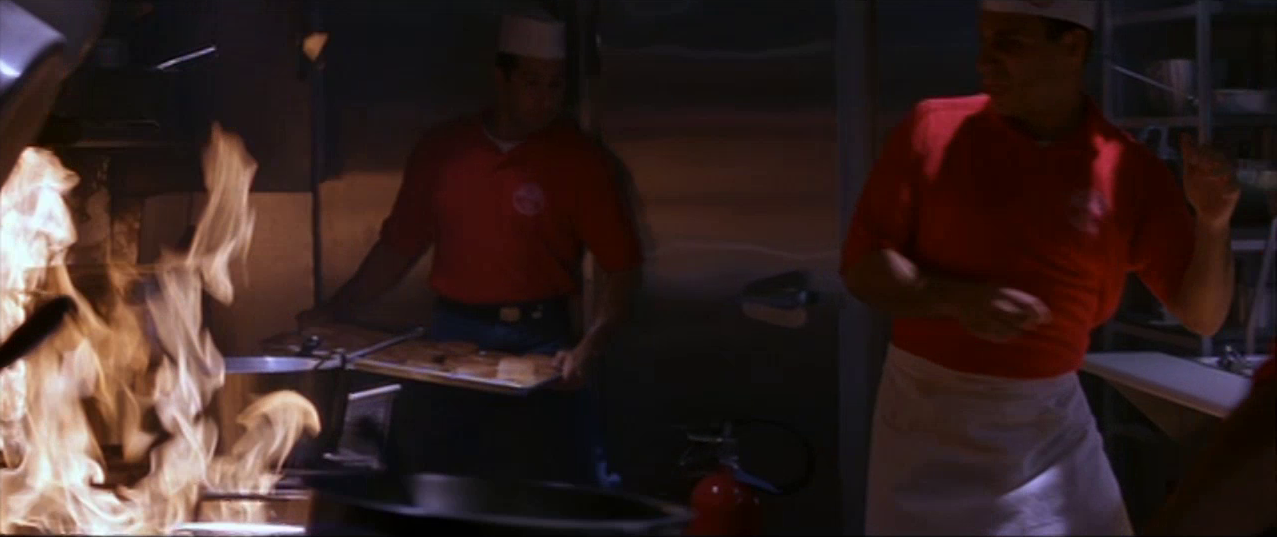
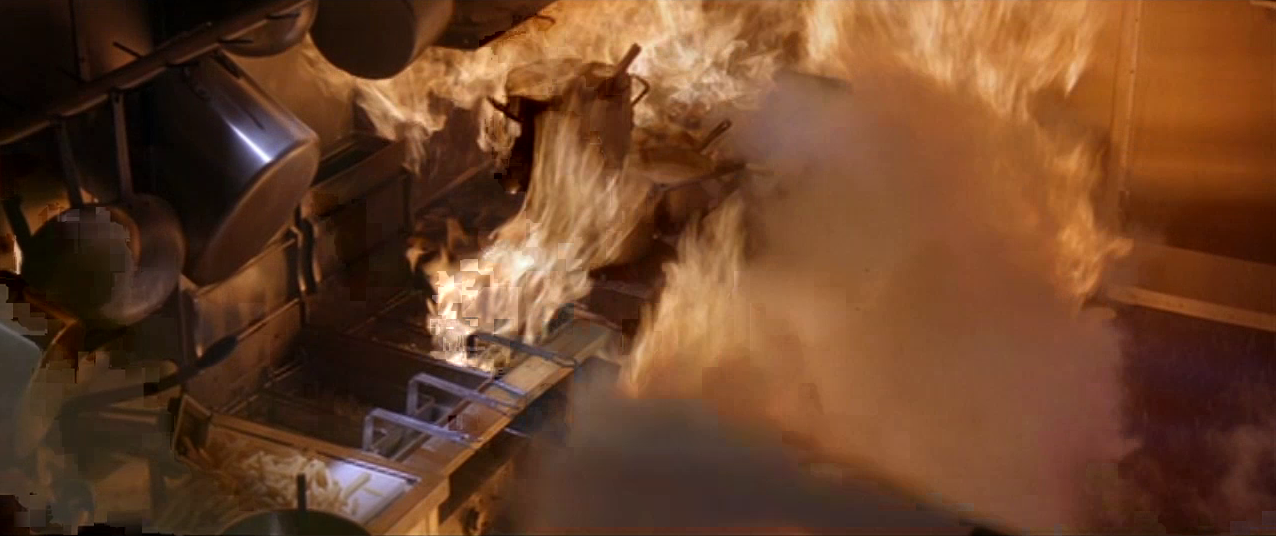


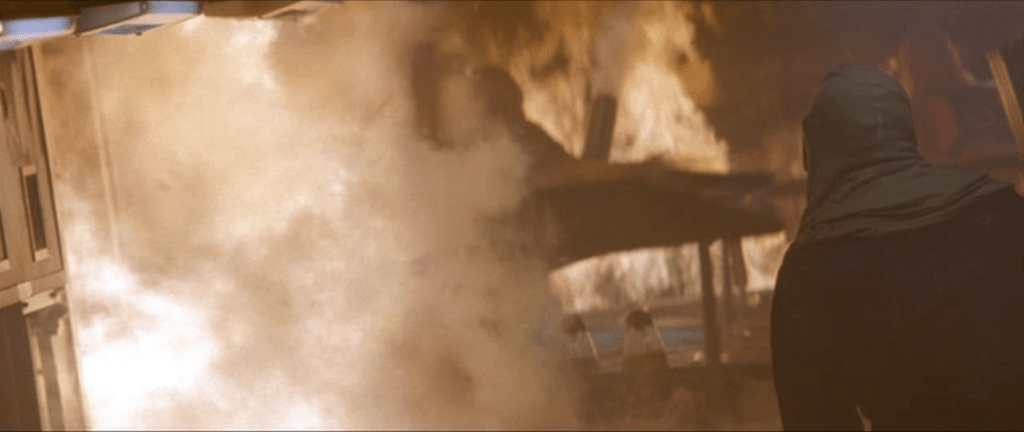
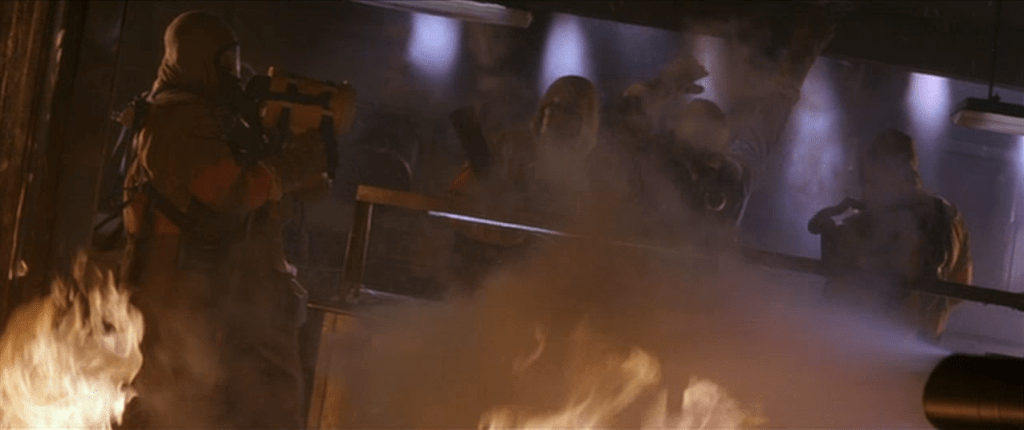
Gene Hackman’s character, Captain Ramsey, then begins a missile drill the very second the fire is extinguished.
Make no mistake that fires on surface ships and submarines do happen, but Rick Neault’s recollection of the fire on Bonefish in 1988 tells us that the actual experience would be far worse. The fire on Bonefish got into the high-pressure air lines and was fueled by other chemicals like refrigerants and lubricants. It also burned the cork insulation which created copious amounts of thick, black smoke and reduced all visibility to zero in mere seconds.
Anyway, let’s break down why the Crimson Tide movie scene is unrealistic.
Firstly, a fire that big on a submarine isn’t entirely outside the realm of possibility, but it’s very “Hollywood” and extreme. It appears to have started around the deep fryers; possibly in the grease trap. Submarines are reportedly the only U.S. naval vessels allowed to have deep fat fryers aboard since good food is a big morale factor on submarines; despite the fire risk they create. This begs the question, were they cooking with gasoline or something on the film’s submarine? (I guess high-octane fuel really brings out the flavor of the french fries.) The fire on-screen also looks fueled by gas which doesn’t make sense because all cooking appliances on a submarine, including the range, are electric. It wouldn’t be a good idea to have gas ranges on a submarine. The fire risk on naval vessels also means that every sailor is a trained firefighter.
Secondly, there would’ve been no need for the XO to heroically run into the fire to activate the galley’s fire suppression system. It can be activated from other places in the boat, and a fire that huge (and that hot) would’ve triggered it automatically, in any case. Thirdly, the entire crew (not just those fighting the fire) would’ve donned EABs, and those directly responding to the fire would probably don OBAs because a fire that big would rapidly consume all of the oxygen and fill up the entire submarine with smoke once everything else started catching on fire. Lastly, for the above reasons, all activity on the submarine would come to a screeching halt and the crew would rig the ship for fire. The captain would never run a drill during (or immediately after) a fire like that, especially one that claimed the life of a crewman and probably caused some damage to the boat.
It was Marichek’s 300 pounds that killed him, not the fire.
Capt. Ramsey
Captain Ramsey’s logic for running the drill immediately after the fire is that there may be times when multiple emergencies and casualties in combat are occurring simultaneously, and thus the crew needs to be tested and ready for that eventuality.
Lest you forget, Mr. Hunter, we are a ship of war; designed for battle. You don’t just fight battles when everything is hunky dory. What did you think, son? I’m just some crazy old coot putting everyone in harm’s way as I yell, ‘YEE HAW!’
Capt. Ramsey
Umm…yes, actually. He’s putting the entire crew at undue risk which could possibly jeopardize their ability to carry out their mission. The entire purpose of a ballistic missile submarine, such as USS Alabama, is to go hide in the water, not be detected, act as a nuclear deterrent, and be ready to launch their missiles should the orders arrive. They have torpedoes for self-defense, but they’re not attack boats. If they’re detected, such as happens in the film, then they’ve basically failed their mission.
Submarine Fire Fighting Equipment
Now, let’s discuss some of the emergency firefighting equipment on submarines.
Emergency Air Breather (EAB)
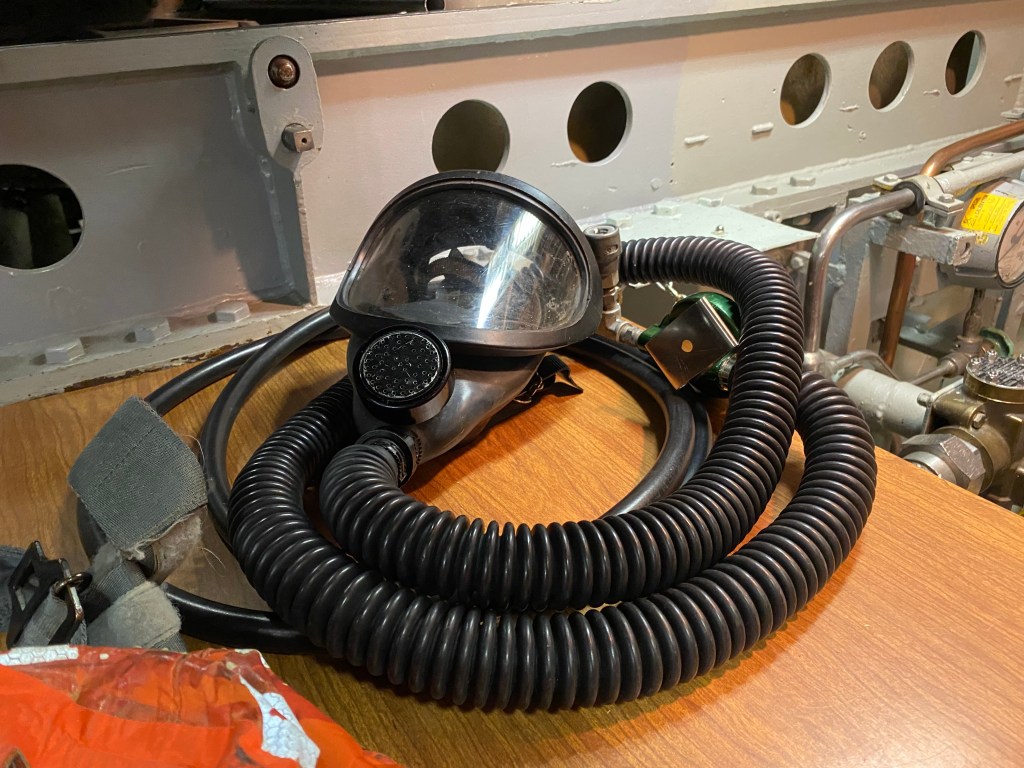
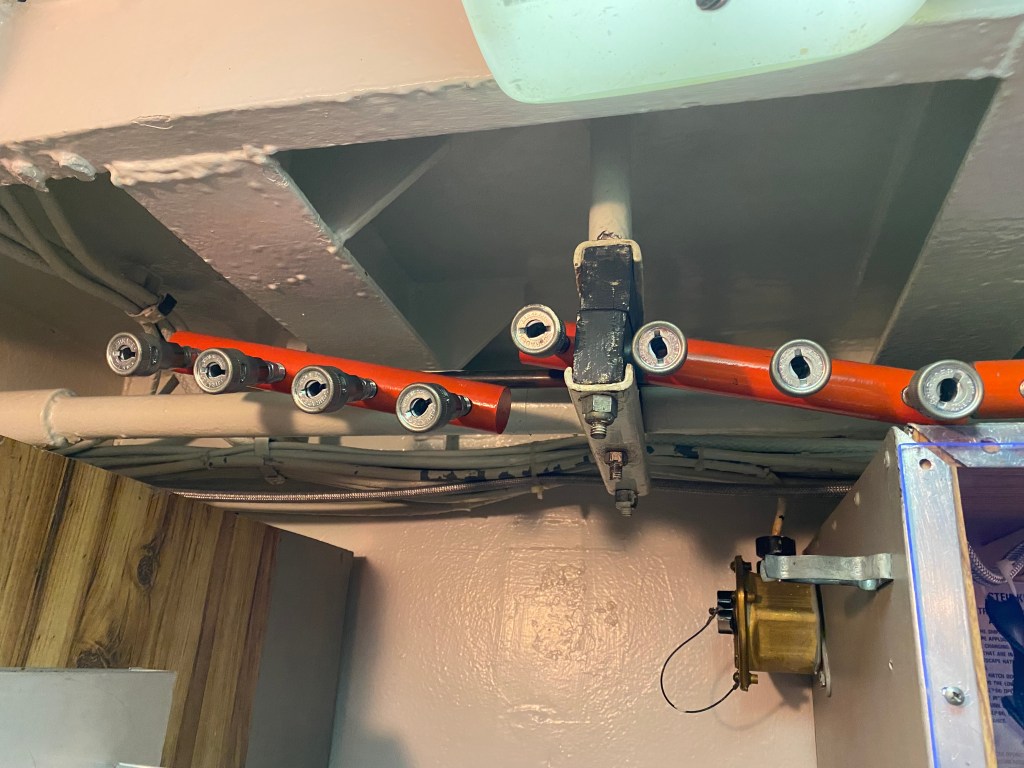
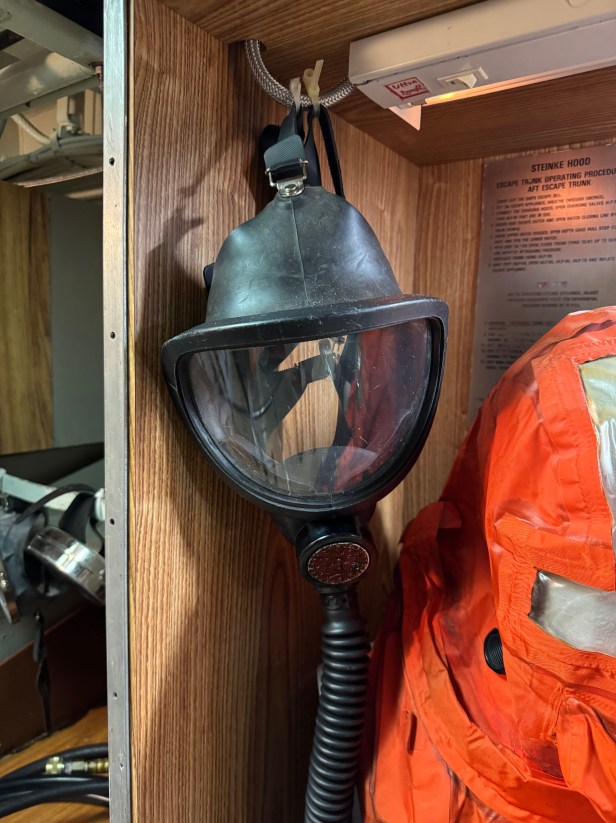
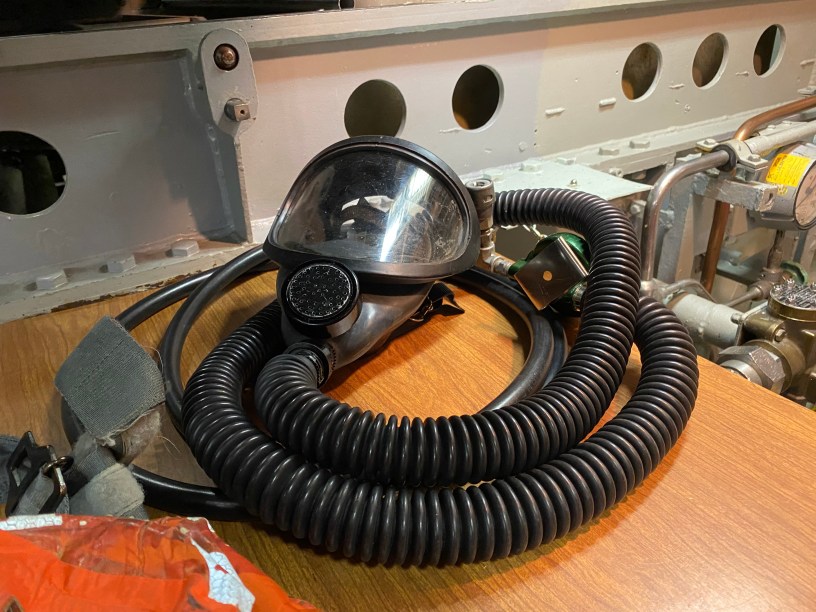
The black mask with a long hose is called an Emergency Air Breather (EAB) mask. In each room or compartment are red emergency oxygen manifolds. In the event of a fire or toxic atmosphere, you’d an EAB mask and plug it into the manifold so you can breathe and start dealing with the fire. There’s also an air regulator on these that clips to your belt, but this one seems to be missing the regulator. Since a submarine can rapidly fill with smoke and reduce all visibility to zero, you would need to memorize the exact location of all these manifolds throughout the sub and identify them by touch.1 Obviously, you are now tethered to this manifold by the hose, so if you have to go anywhere else, then you’re going to have to take a deep breath, unplug it, and run to the next manifold before you run out of breath.
Additionally, the regulator has a connector to allow other EAB wearers to daisy chain themselves to you. There may not be enough connections on the manifold itself for everyone in the compartment, and you may need to reach an area that’s beyond the manifold and the length of the hose.
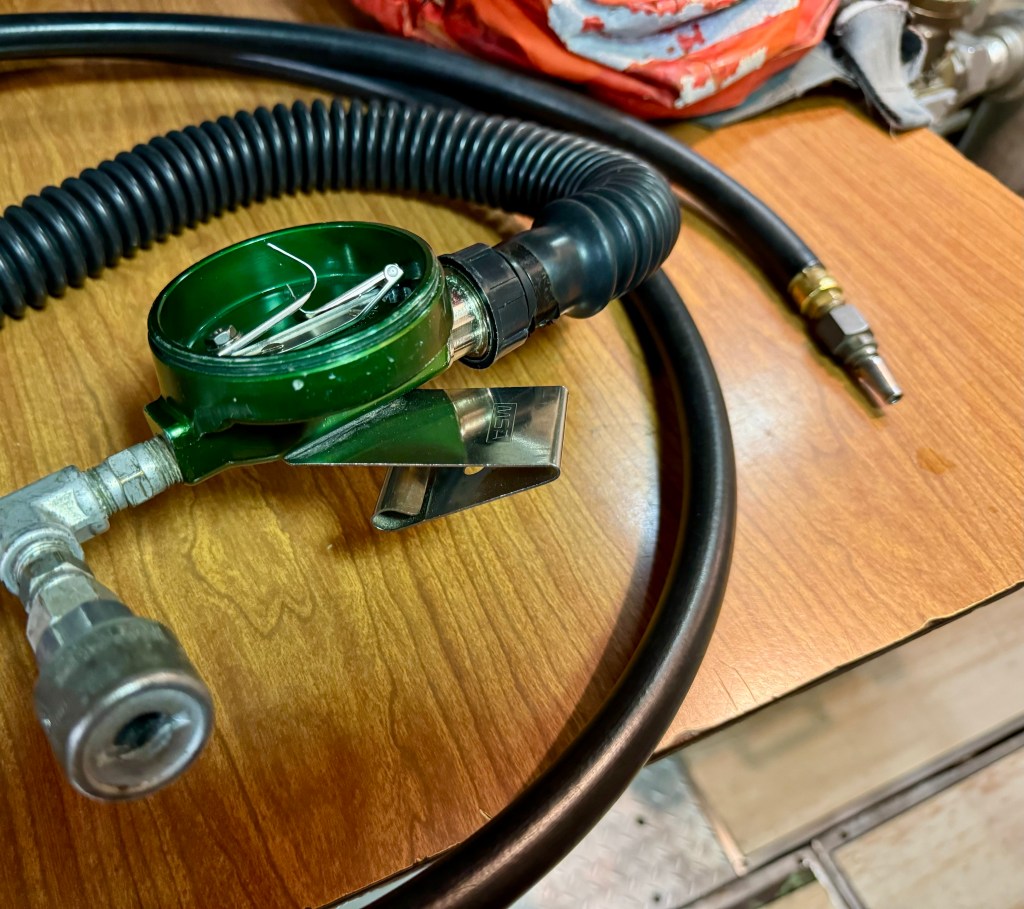
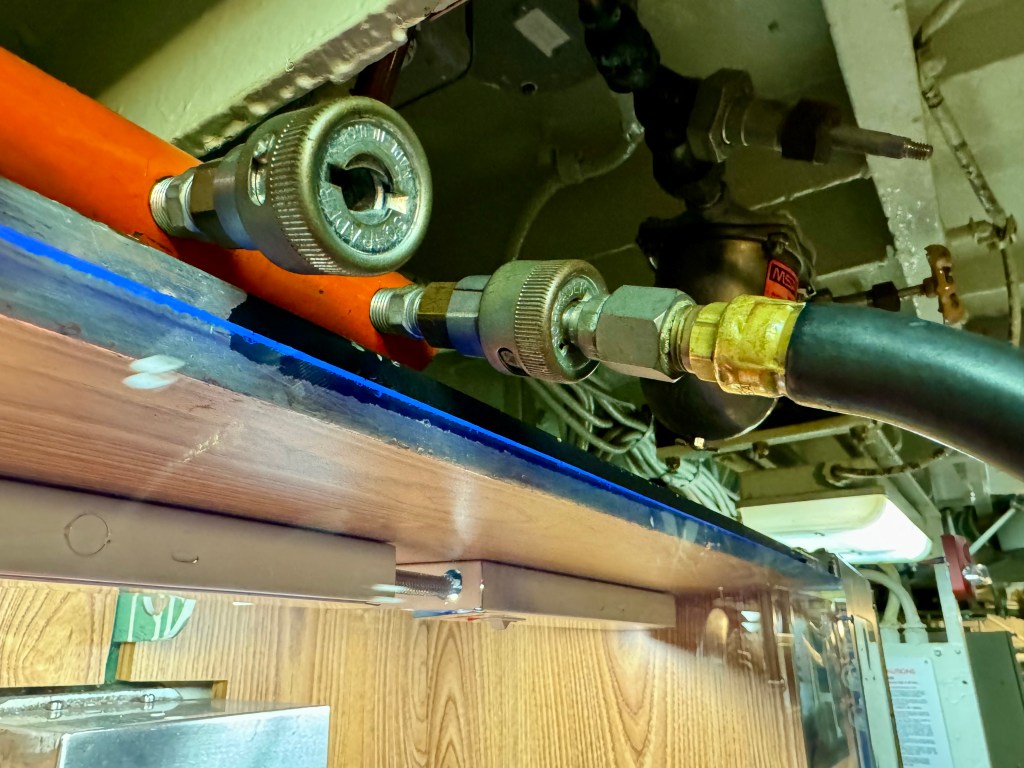
Rick Neault mentioned how the belt clip got caught on his clothes, which briefly hindered his escape. Now imagine that you’re making a 25-foot climb up the sail while trying to hold your breath and being blinded by smoke after taking your EAB off. You can’t see anything, and you’re feeling around for the rungs of the ladder. I don’t care how tough you think you are or how good your lung capacity is. This would be the most nightmarish escape room you’ve ever done because you’re probably in a state of near panic, you can’t see, and if you do try to breathe, then you’ll be choking for lack of air.2 I’m in decent shape, and I couldn’t make this climb while holding my breath.
Submarine crews sometimes do an activity called “EAB/Damage Control Olympics.” This may consist of teams or be done by departments, but the basic premise is that crewmembers assemble at one end of the sub, are blindfolded, and don EAB masks. Their task is to then make their way to the other end of the sub, identifying all of the oxygen manifolds. Other “events” in these Olympics could relate to other damage control procedures, such as rolling up fire hoses, locating all the fire extinguishers, or fixing an imaginary leak in a certain amount of time.
Oxygen Breathing Apparatus (OBA)

The other black mask isn’t SCUBA gear; it’s an Oxygen Breathing Apparatus (OBA). Essentially, a closed-circuit rebreather. Unlike the EABs, this is a portable oxygen mask, so you can put this on and move around without having to plug it into the air manifolds. Inside the bag around your chest is a green canister filled with potassium superoxide that scrubs out carbon dioxide and creates oxygen as you breathe into it. At the base is a sodium chlorate candle that creates oxygen upon startup because the canister has to reach an appropriate temperature before it starts working. The reaction of the potassium superoxide with the moisture in your breath is exothermic, which means the canister in the bag will get very hot, and you’ll need thick gloves just to handle it after it’s been used. The air bladders along the sides of the unit cool the air mixture before it enters the mask. This way, you’re not breathing in a lung full of hot air. In any case, it beats choking on caustic smoke as the submarine burns around you. The OBA will give you about 1 hour of breathable oxygen. In the early 2000s, the Navy replaced these with the Self-Contained Breathing Apparatus (SCBA) that firefighters use. Those are heavier and bulkier than an OBA (because you’re strapping an oxygen tank to your back), but they’re cheaper and don’t produce hazardous waste.
The Battleship New Jersey Museum Ship has an excellent video on how OBAs are used, including curator Ryan Szimanski using one.
Modern nuclear-powered submarines generate their own oxygen through a process called electrolysis. An electric current is run through seawater, which breaks the hydrogen bonds between the hydrogen and oxygen atoms. The hydrogen is put through a diffuser and vented overboard, and the oxygen is kept. The air we breathe is composed of roughly 21% oxygen, but on modern submarines, the amount of oxygen in the air is intentionally kept around 19% to reduce the risk of fire.3 One downside is that this lower oxygen level will make you drowsy. One submarine sailor who served aboard a Los Angeles-class boat also said that the low amount of oxygen also justifies coffee being available 24 hours a day to help keep the crew awake, and hence why the coffee maker is considered “a vital piece of electrical equipment.”
Fire Fighting System
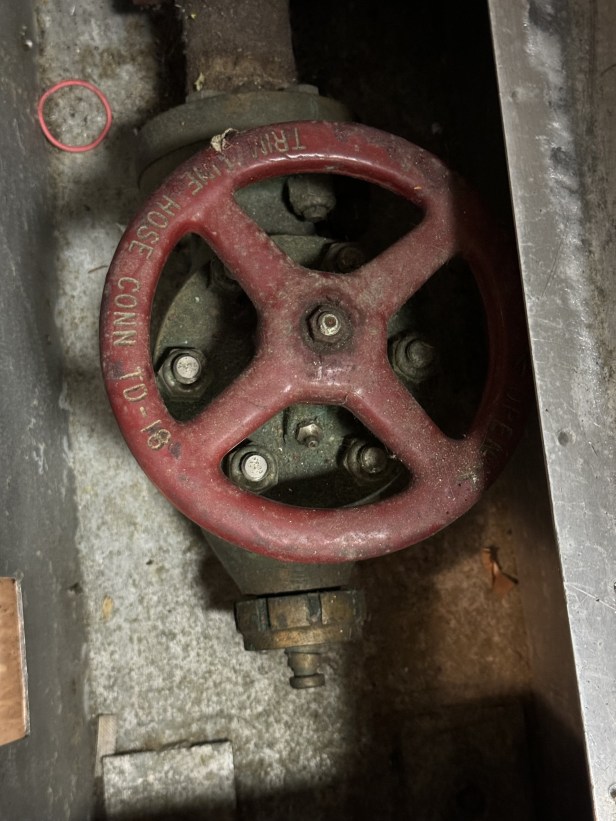
Submarines (and surface warships) also have fire hoses that connect to a pump system and use pressurized seawater to fight fires. A recent search indicates that Blueback has six fire hose connections, which are all on the port side connected to the trim pump system. So it stands to reason they had some fire hoses on board.4 We managed to locate one fire hose in the engine room, but it looks pretty new, and we’re not sure if it’s part of the original equipment. In any case, the trim pump system isn’t working, so you wouldn’t be fighting any fires with it. It also wouldn’t be a good idea to have a bunch of fake/display fire hoses that don’t work in case someone tries to use them in the event of a real fire.
Currently, the most readily available piece of firefighting equipment on Blueback is a fire extinguisher. Even today, as tour guides on Blueback, we need to know the location of all of the escape routes (there are four), fire extinguishers, and fire alarm pull stations. Fire is still very much a concern, even though Blueback is a museum ship.
Notes
- On the deck beneath each of these manifolds is a piece of non-skid, which allows you to feel where one would be with your foot or hand in a smoke-filled environment. Once you feel the non-skid, you will know the manifold is directly overhead. ↩︎
- The average age of most of the crew is probably in their early 20s. Still, escaping from a burning submarine is a serious challenge. ↩︎
- D. R. Knight et al., “Submarine Atmospheres,” Toxicology Letters 49, no. 2–3 (December 1989): 243–51, https://doi.org/10.1016/0378-4274(89)90035-0. ↩︎
- Rick Neault, who served on both USS Bonefish and USS Blueback, doesn’t recall either submarine having fire hoses when he was on them in the late 1980s. On the other hand, Bonefish‘s former XO, LCDR Pete LeStrange, recalls that the firefighting pump system may have been previously contaminated with diesel fuel, which meant they were unable to use seawater to fight the fire on Bonefish in 1988. This would imply that there were fire hoses onboard at the time. However, the XO could also be misremembering things. ↩︎
Bibliography
Knight, D. R., D. V. Tappan, J. S. Bowman, H. J. O’Neill, and S. M. Gordon. “Submarine Atmospheres.” Toxicology Letters 49, no. 2–3 (December 1989): 243–51. https://doi.org/10.1016/0378-4274(89)90035-0.
 Fair Winds & Following Seas