
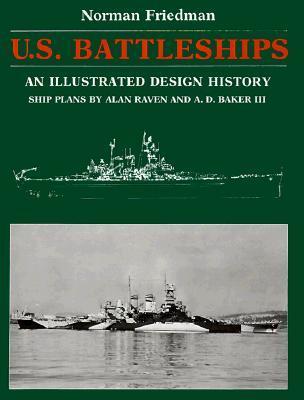
Author’s note: This will be the fourth book I’ve read thus far in Norman Friedman’s eight-book design history series. As of May 2024, I still have to read the following: U.S. Cruisers, U.S. Submarines Through 1945, U.S. Small Combatants, and U.S. Amphibious Ships and Craft. Most of these have been republished with white covers, but I’ve read mixed reviews with many saying that they’re just poor reprints. For that reason, I prefer to find original copies of these books whenever possible. Also note that Friedman makes multiple references in this book to the volume U.S. Cruisers, showing that the development of battleships and cruisers is related.
Topic & Content
This is the fourth book of Norman Friedman’s design history series. Published in 1986, this book follows U.S. battleship development from the 1880s until their culmination at the end of World War II, followed by a short discussion on their upgrades and use postwar. The book is organized as follows:
- Beginnings: The Pre-dreadnoughts
- The All-Big-Gun Ship
- Theodore Roosevelt’s Fighting Machine, 1907 – 09
- The Wyoming and New York Classes, 1910 – 11
- The Standard Type: Battleships, 1912 – 17
- Alternatives to the Standard Type
- The Last Dreadnought: The South Dakota Class
- World War One
- The Washington Treaty
- Reconstruction
- Design Studies, 1928 – 34
- The North Carolina Class
- The South Dakota Class
- The Iowa Class
- The Montana Class
- Battleships at War, 1941 – 45
- Postwar
Appendices
- A. The Monitors
- B. Damage at Pearl Harbor
- C. List of U.S. Battleships
- D. Battleship Data List
Thesis
This book (like others in Norman Friedman’s design history series) traces the design and development of these vessels themselves, as opposed to their operations. Friedman writes that battleships were both the primary instruments of sea power and national symbols for over 50 years. Even today, they evoke naval power and glamour, despite having been eclipsed by more powerful vessels, such as aircraft carriers and submarines.
Author’s Background
Norman Friedman is a prominent naval analyst and theorist. Earning a Ph.D. in physics from Columbia University, Friedman specializes in strategic and technical issues, has consulted with various U.S. government agencies, and has served as the deputy director of national security studies at the Hudson Institute. His eight-book series on U.S. warship designs, of which this book is part, has been highly regarded as a standard reference on U.S. naval warship development.
Critical Observations
Positives
Like the other works of this series, this book is a very detailed look at the design and development of U.S. battleships. Friedman chronologically goes through each battleship class starting in the late 1880s and concludes with the planned (but ultimately canceled) Montana-class. Not only does he cover the extant vessels, but also ones that were canceled, purely design studies, or theoretical. In some ways, this book is comparable to Garzke and Dulin’s three-book series on World War II battleships. However, Friedman is solely focused on the design history of the vessels (not their operations) and he covers pre-WWII battleships, as well. Of course, Friedman’s book only examines U.S. battleships, but if you’re looking for information on pre-WWII battleships (for example Standard Type battleships) this is a great place to start.
The book is well illustrated with extensive use of photos and crisp, clean line drawings by the well-known naval illustrators Alan Raven and A.D. Baker. However bear in mind that most of the drawings (and all of the photos) show the exterior of the ships, and the only indication of what occupies an interior space is denoted by abbreviations on the drawings. For example, “BR” would indicate that that compartment is a Boiler Room, but there’s no indication of what the boilers looked like.
More of a personal preference, but this book read much more quickly than others in the series. I speculate that this is because battleships are largely singular-purpose warships. Traditionally, a battleship is simply a warship that mounts heavy caliber naval guns and is designed to destroy other vessels with gunfire. Yes, they did get used mostly for shore bombardment and fleet anti-air defense in World War II, and the reactivated Iowa-class battleships would carry missiles later on. But when you think of battleships, you think of big guns! They’re not really multipurpose vessels like destroyers or cruisers. They don’t have all sorts of different aircraft like carriers. They don’t have many specialized roles like submarines. Battleships shoot stuff with their guns…plain and simple.
As a result, Friedman’s narrative, while occasionally clunky, is straightforward. Most of the text is devoted to what size of guns should be mounted, how thick to make the armor, and how much horsepower the powerplant needs to develop to get the ship to move at a desired speed.
Negatives
Unlike other design history books in this series, I don’t have many major criticisms of this volume. Perhaps that’s because I’m getting used to Friedman’s writing style and know what to expect. Still, my standard criticism of Friedman’s writing holds with this book, as well. The writing is a bit clunky and needs better editing. There’s nothing inherently wrong with Friedman’s writing, but I find it to be fairly dry and with abrupt transitions. It doesn’t flow smoothly and the organization leaves something to be desired. The narrative tends to jump from subject to subject without much in the way of transitions and there’s a complete lack of subheadings to inform the reader of the topic. Thankfully, it wasn’t much of an issue in this book as in others.
In all fairness to Friedman’s writing, his research involved pouring over who knows how many pages of naval documents, including technical drawings, papers, meeting transcripts, and so on. None of which could be called literature. So he couldn’t possibly divine what these people were thinking at the time. Hence, this is probably why Friedman’s writing comes off as very dry.
That said, this abruptness and lack of transitions is very evident in Chapter 5 on the Standard-Type battleships. These were a series of 13 battleships in five different classes. These were all meant to operate as a battle line, and thus have fairly similar characteristics. While the progressive development of each succeeding battleship class is discussed, the problem is that all five classes are simply mashed together into a single chapter, with no subheadings to indicate where each subsequent class design began. As a result, the reader really needs to pay attention to how the subtle changes in their designs are being decided upon.
Another interesting omission of this book is the almost complete lack of discussion of the aircraft battleships carried (floatplanes or helicopters). The advent of long-range gunnery necessitated the need for catapults and spotting aircraft, but they received hardly any mention (even if they were never used for their intended purpose).
Those looking for a discussion on battleship operations, tactics, or weapons will be disappointed. Even chapter 16, which covers U.S. battleships in World War II, is mostly devoted to the weapon and sensor upgrades they received during the conflict. There’s very little discussion on what they did during the war apart from a few paragraphs. But that’s to be expected with Friedman’s design history books.
Finally, the text ends very abruptly. Chapter 17 briefly covers what became of the U.S. Navy’s battleships after WWII. It addresses the (then) current recommissioning of the Iowas and their upgrades in the 1980s, but any overall conclusion is almost non-existent. Of course, Friedman didn’t have a crystal ball, and given that the book was published in 1986, he anticipated that the recommissioned and upgraded Iowas would serve until at least the year 2000; in reality, the last one was taken out of service in 1992.
Evaluation (Does the content support the thesis?)
Despite my criticisms, this is another good Norman Friedman design history on U.S. warships. The text is highly detailed but tends to be rather dry. The narrative is fairly clunky, could use another round of editing, and ends rather abruptly. However, this book is second to none when it comes to researching the design of U.S. battleships. Overall, Friedman’s book serves as an excellent complement to Garzke and Dulin’s three-volume work on battleship history.
Rating:
4 out of 5. Very good/worth your time
 Fair Winds & Following Seas