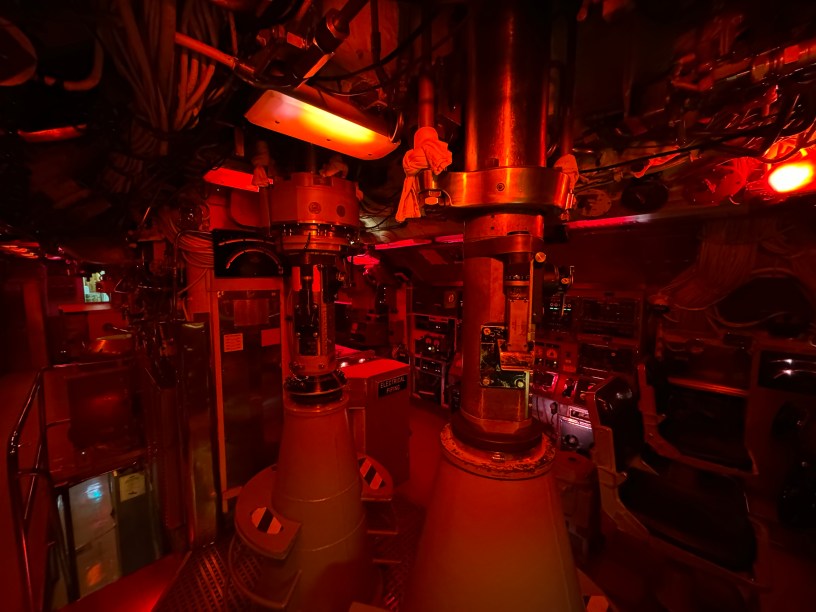
Various types of lighting are used in military services for various purposes depending on the time of day and weather conditions, and red light is one such type of lighting. In the sea service, both surface ships and submarines use white, blue, and red light. This post will specifically focus on the use of red lighting on submarines.
A common question we get on USS Blueback as tour guides is, “Why are the lights red in the control room?”
Well, it’s pretty simple. Let me explain.
The red lighting allows the tachyon emitters of the reactor core of the submarine to create a highly localized gravimetric distortion field which increases the photonic emissions into the reactor core. This creates a higher warp resonance with the sonic inducers which transduce into the field array and allows the submarine to reach higher speeds. A greater amount of tactical clairvoyance with the emission field is attained which creates a highly stealthy submarine. Therefore, by altering the phase resonance of our sonic hyper torpedoes, we create a better attack wave…

I’m kidding, of course!
Before discussing lighting, let me describe some realities of being on a submarine.
A conspicuous lack of windows
For those who don’t know, a Navy submarine is a big windowless steel tube that can go down hundreds or thousands of feet, depending on the design. The further down you go, the darker it gets. The ocean is very deep and almost no sunlight penetrates below the 200m (656 ft) Euphotic Zone (AKA Sunlight/Epipelagic Zone).1
“But wait!” you say. “Those Atlantis submarines in Hawaii, the Caribbean, and Guam, have big windows!”
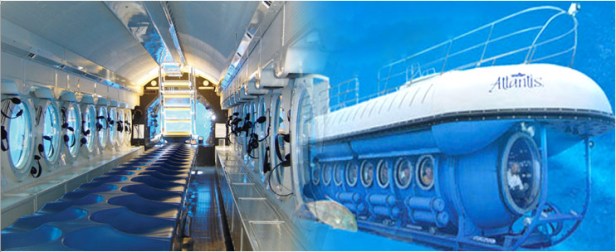
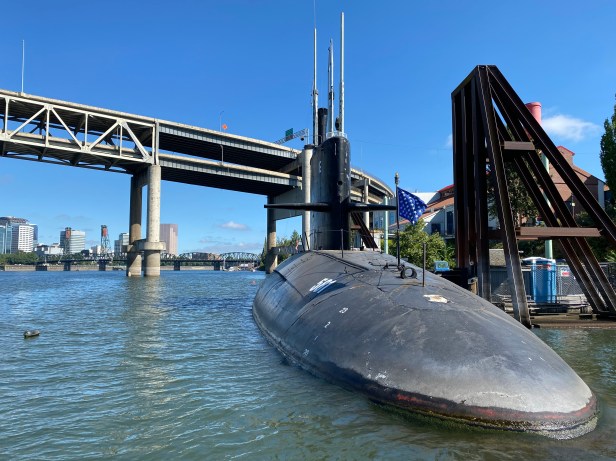
Yes, but that’s a 65-foot-long tourism submarine (technically a submersible) that can only dive to 150 feet. In contrast, Blueback (a 219-foot-long Navy attack submarine) can dive to a test depth of 712 feet, with a crush depth of about 1,050 feet. Both of those are below the Euphotic zone. It’s so dark down there that even if there were windows on the submarine, there would be nothing to see unless you had artificial lighting. Guess what? It’s mostly just water.2 Even a Deep Submergence Vehicle (DSV) (including bathyscaphes), designed to go down tens of thousands of feet, has small windows that are inches thick. In fact, some don’t even have windows, but cameras instead. Plus, these are non-combat vessels that are purely meant for scientific research, rescue, and espionage. The lights that they have only illuminate a small area in front of them, and all of them need the support of a surface ship.
Given this lack of windows, this begs the question: why would a submarine even need different colored lights in areas like the control room?
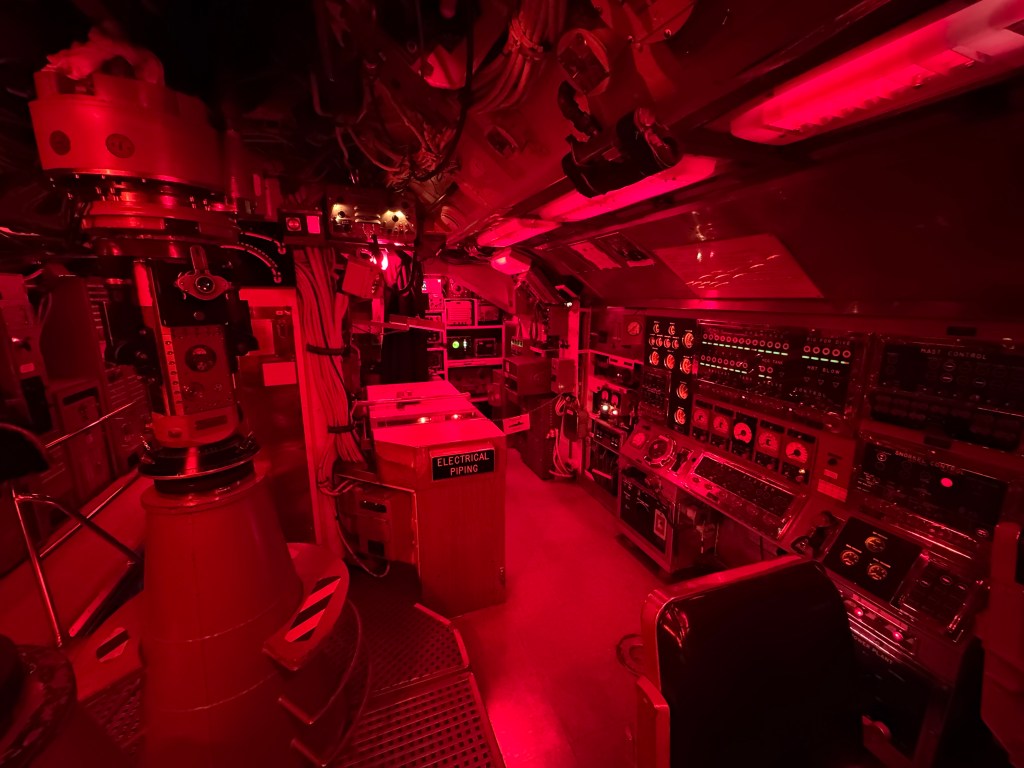
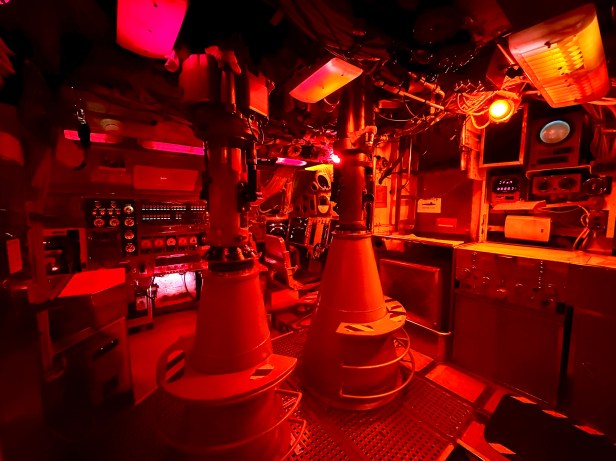
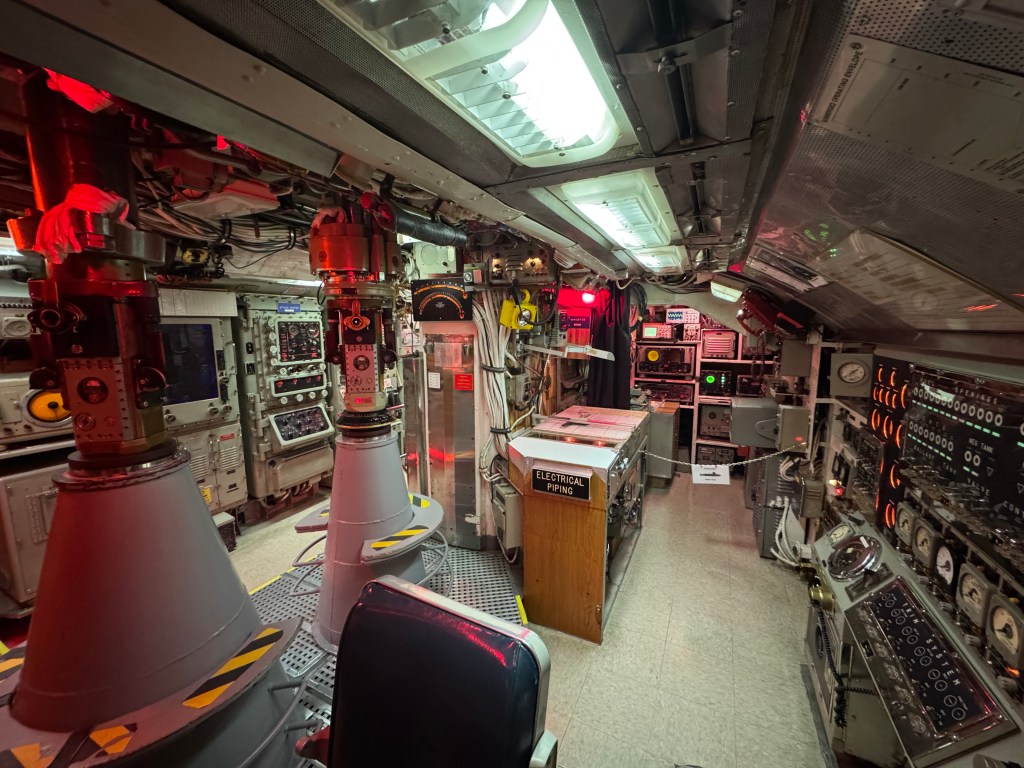
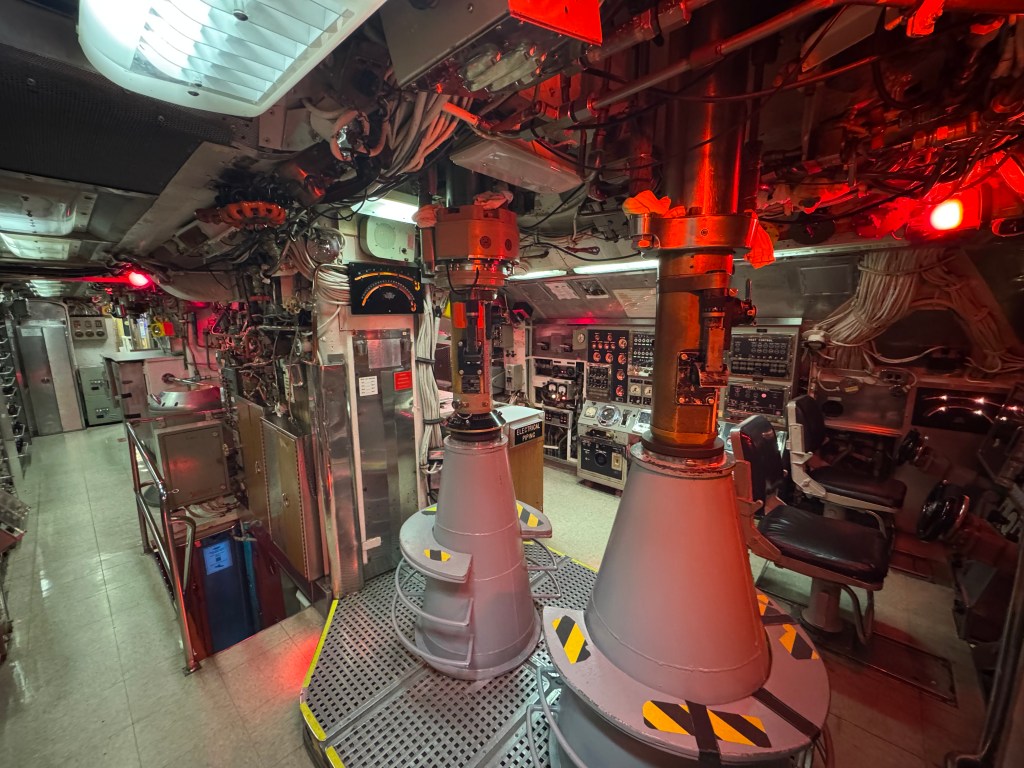
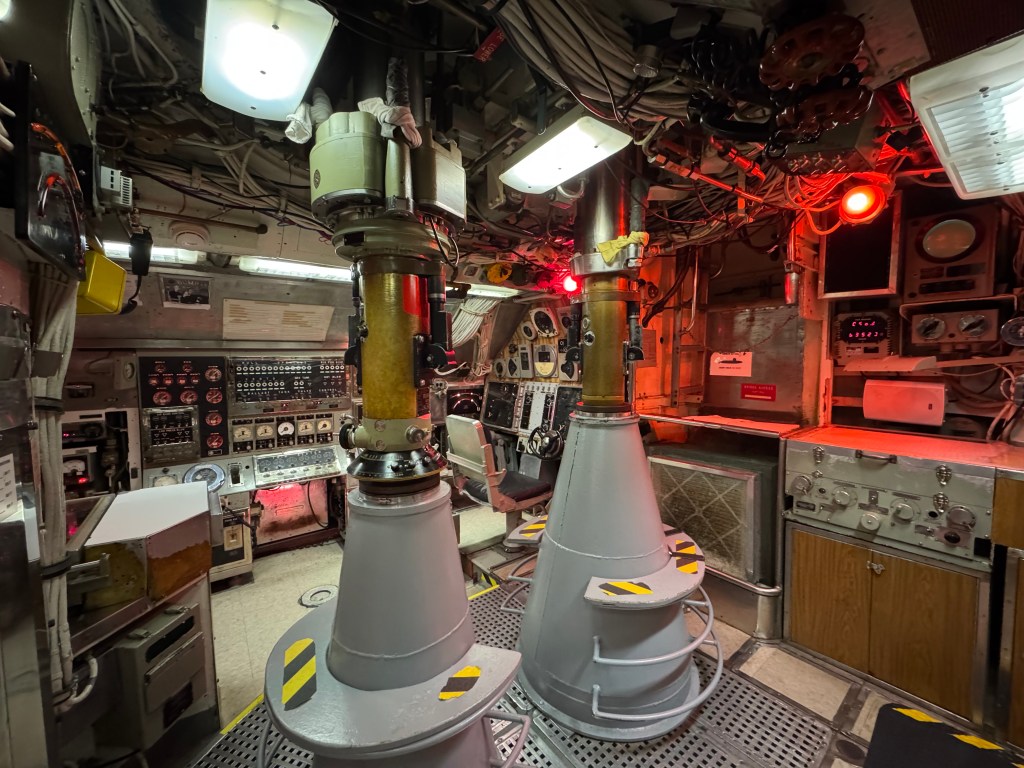
Rigged for Red – The real purpose of the red lighting
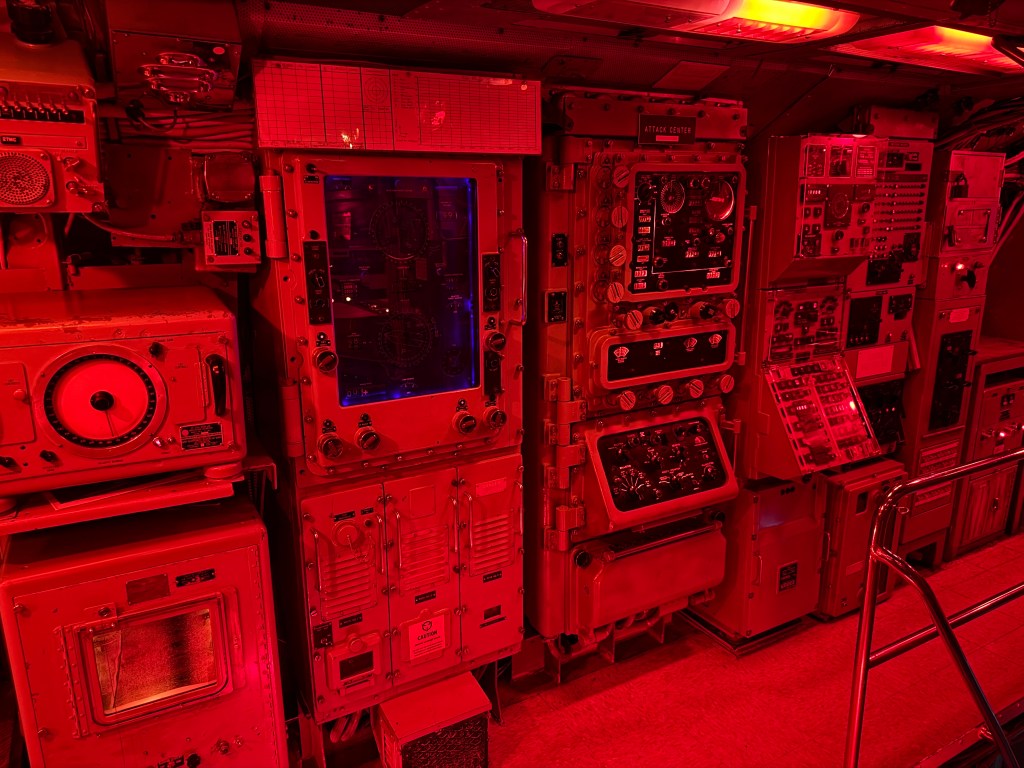
Many movies and TV shows would imply that red lighting has something to do with a warship being at battle stations. In reality, it doesn’t, and the reason for the red lighting is much more mundane. Also known as “rigged for red,” the red lights on the submarine serve several purposes. First of all, since night and day have no meaning on submarines, it basically tells the crew it’s nighttime. Secondly, if the submarine is at periscope depth (59 feet below the surface), and you’re looking through the periscopes when it’s nighttime out, the red lights provide darkened conditions on the boat, which helps your eyes adjust to the dark. Have you ever walked from a brightly lit room with white light into a dark room? It takes time for your eyes to adjust. In contrast to white light, red lighting preserves your natural night vision and helps your eyes adjust to the dark more quickly. Anyone who has gone stargazing will see people with telescopes using red filters over their flashlights. It’s for the same reason.
Thirdly, the red lights are for light emission control. Even with no windows, there are still ways for light to escape from the submarine. Any opening on a submarine, such as an open hatch when on the surface, means that light can escape. On Blueback, the bridge access trunk that leads to the top of the sail is at the forward end of the control room. Additionally, when at periscope depth, white light will travel up the periscopes and be seen for miles at sea (optical periscopes work both ways, you know). That gives away the sub’s position. In contrast, red light has a longer wavelength, making it difficult for the human eye to detect. The biggest strength of submarines is that they’re stealthy; stealthier than an F-35 or F-22 fighter jet. So you don’t want to be detected, and red light helps with that.
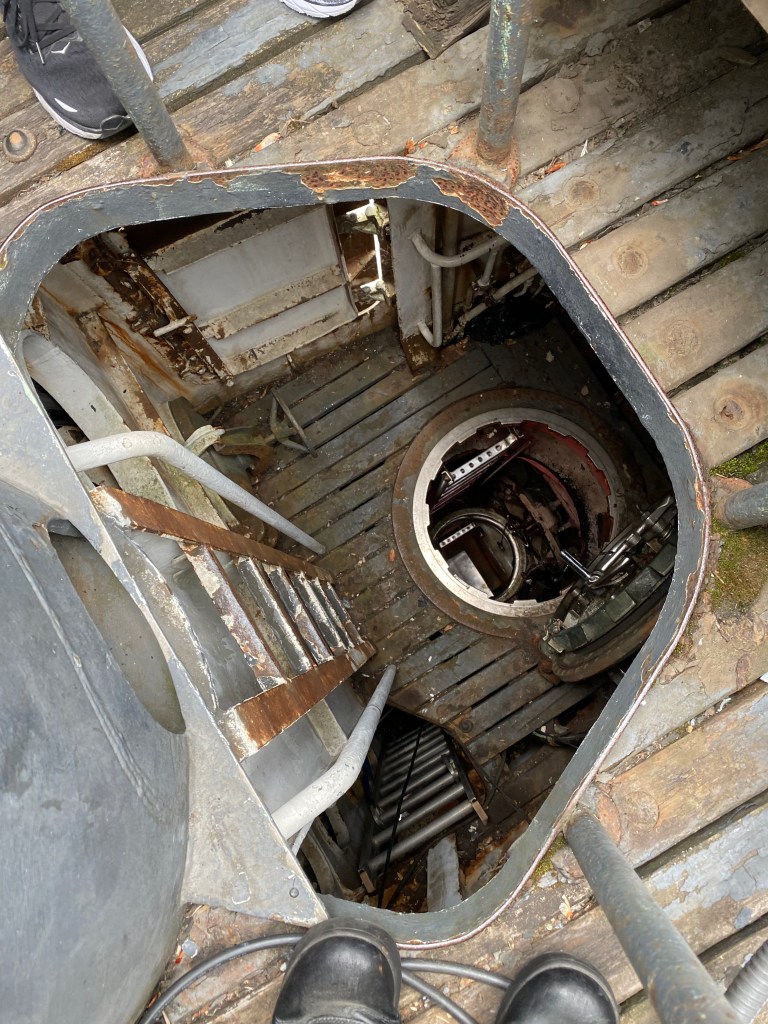
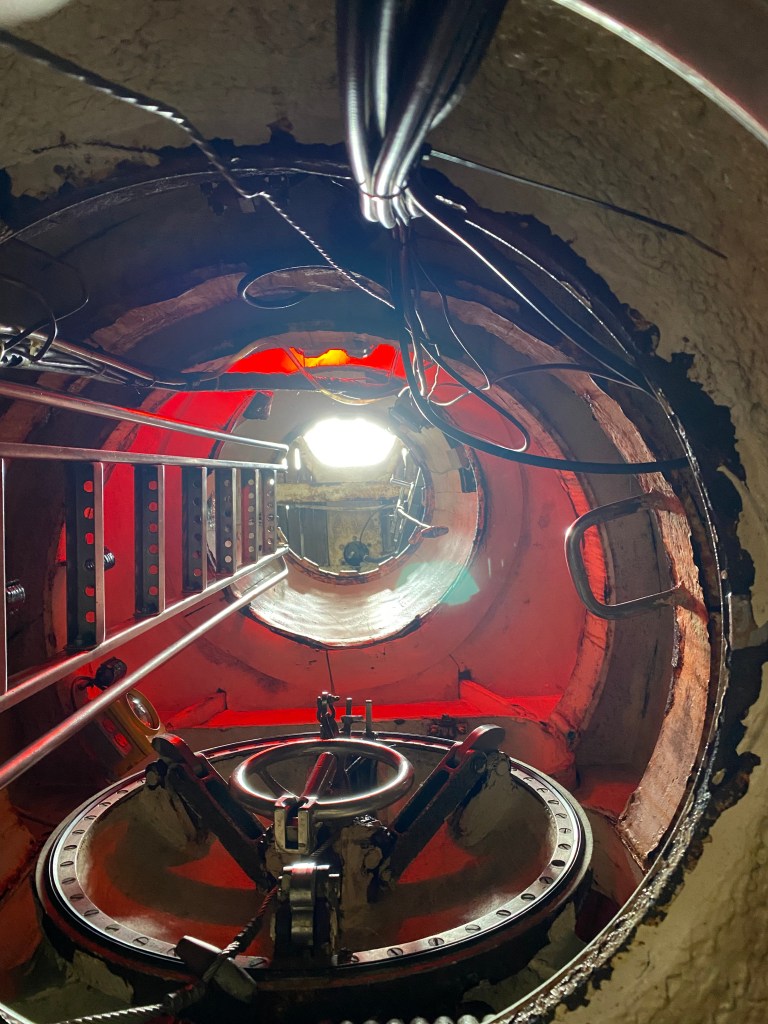
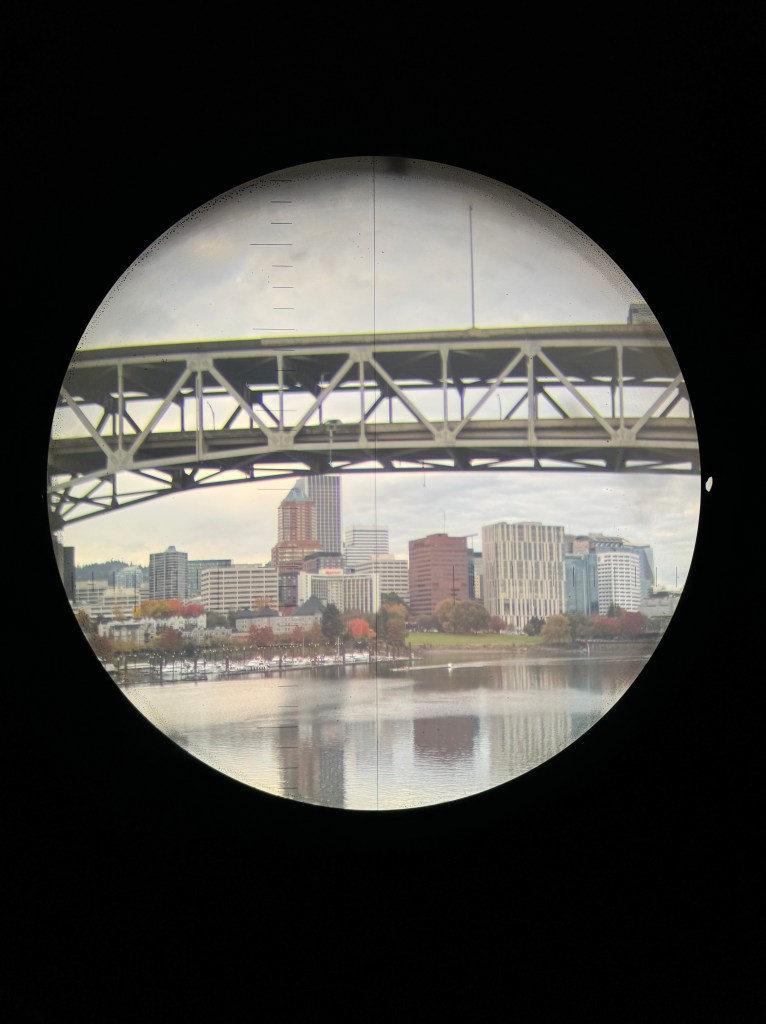

Red lights aren’t exclusive to the control room. Berthing areas have red lights to create dim lighting so people can sleep.
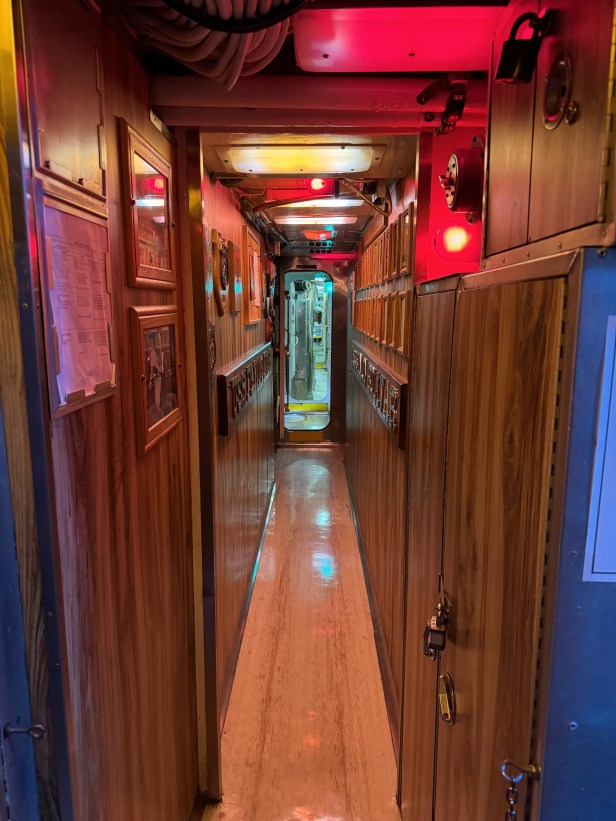
If the submarine is operating in a highly sensitive patrol area, then all of the lights in the control room can be turned off (known as “rigged for black”), which will prevent any light from escaping at all through the periscopes. Similarly, the berthing areas can be rigged for black to help the crew sleep. U.S. submarines, like Blueback, used to operate on an 18-hour day broken up into three 6-hour watch rotations.3 So about one-third of the crew would always be sleeping in the berthing areas. The only time the berthing areas would be rigged for white is when the crew is doing an all-hands evolution, like a “field day” (i.e. cleaning).
Other Lighting
Even then, the use of dim lighting in certain areas of a vessel isn’t restricted to red or white. Blue lighting is common in areas where glare needs to be kept to a minimum. Also known as “rigged for blue.” If you enter the Combat Information Center (CIC) of a surface ship, you’ll notice many blue lights, as well.
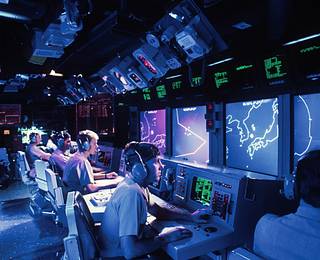
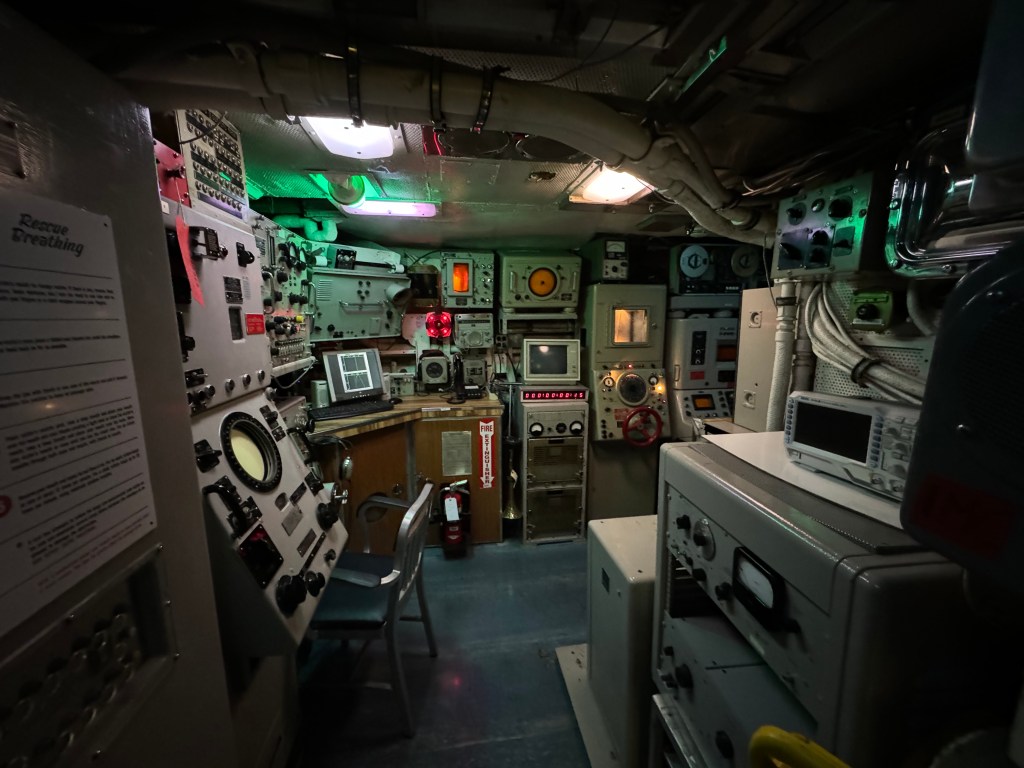
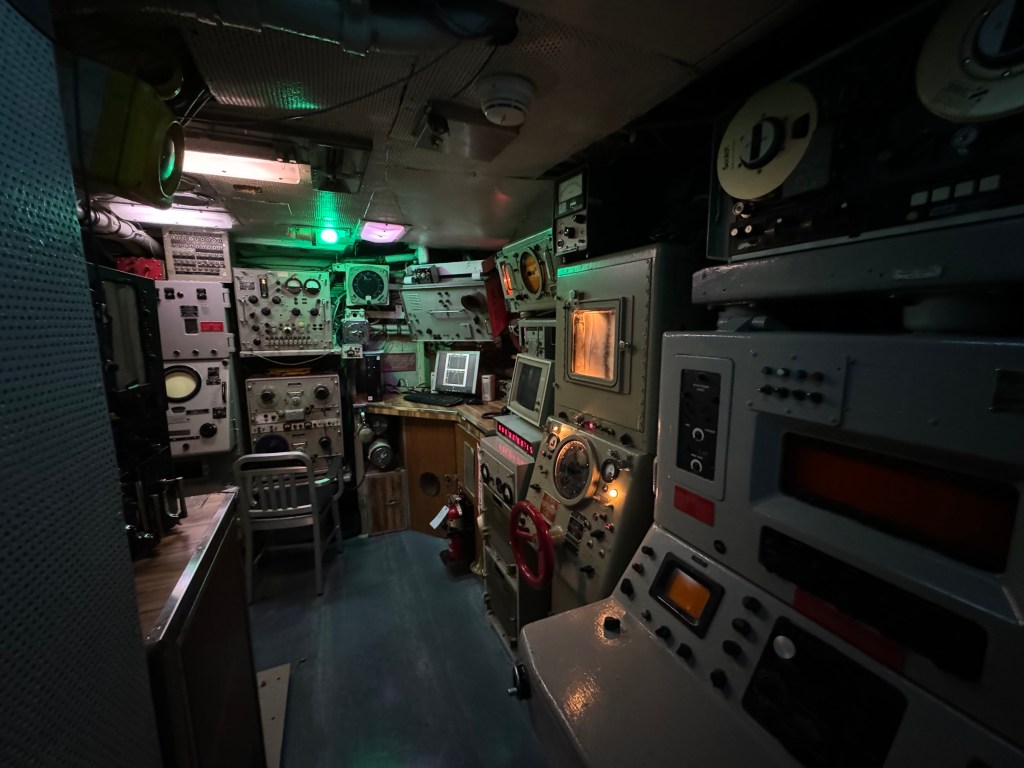
According to Timothy Mauch, a former Chief Sonar Technician on submarines in the U.S. Navy, the reason for the introduction of blue lighting is that CRT (Cathode Ray Tube) screens, with a long-lasting phosphor, were predominantly amber or green in color. Therefore, white lighting created an enormous amount of reflection and glare and made the screens impossible to see. These were used from the 1950s onward. The screens for the combat systems (such as radar, sonar, ESM, ECM, etc.) would need dim lighting, such as blue or red lights to see clearly (otherwise they would have a curtain that could be pulled around the space to block out white light.4
You see, kids, early TV and computer screens were bulky and heavy boxes with lots of glass in them. Assuming the monitor wasn’t black and white or RGB color, they were either green or amber text displays. Ahh…the pre-2000s! None of these fancy, lightweight flat-screen LED monitors we have today. Additionally, screens were far less prevalent than they are today.
The solution was to take advantage of the human eye’s light sensitivity. Under normal lighting conditions, the eyes are sensitive to green and yellow lights, but in low light, they’re more sensitive to blue. Since most of the screens were amber or green, a dim blue-lit environment helped with seeing the screens.5
Originally, operators were supposed to wear amber-colored goggles to filter out the blue light and still have the screens visible. That was the theory, anyway. However, the goggles made little difference, and someone eventually realized that the glare was caused by the sloping angle of the screens and the light directly over the heads of the operators. So the solution was to have two banks of lights and turn off the forward bank over the screens. Each fixture also had blue and white lights in it. This practice continued into the 1980s.6
In 1983, Naval Sea Systems Command (NAVSEA) and Commander, Submarine Development Squadron Twelve (COMSUBDESRON TWELVE) in Groton, CT, decided to do a study using various types of lighting with the Pre-Commissioning Unit (PCU) of USS Henry M. Jackson (SSBN-730), which was under construction at the time. Testing with various colors and combinations in the spring of 1984 found that the color made no difference, but the brightness did. Since the color of the lighting is achieved simply by changing the colored plastic sheath that slips over the fluorescent tube, the Navy substituted a gray sleeve and called it “Low Level White.”7
Can modern submarines rig for red?
Blueback is a fairly old Cold War-era submarine, in service from 1959 – 1990. Given this older design, the control room is directly beneath the sail. The sail is the large rectangular structure that sticks out of a submarine’s hull. The purpose is to house the masts (including the periscopes) that can retract down into it.

In contrast, modern submarines in countries such as Britain, China, France, Japan, Russia, and the United States don’t use periscopes as we think of them. Instead, they use photonics (AKA optronics) masts. Essentially, these are telescoping masts that stay within the sail of a submarine and have a sensor package on top of them. They can mount a variety of sensors such as high-resolution color cameras, low-light cameras, IR sensors, laser rangefinders, and Electronic Support Measures (ESM) arrays. Others can accommodate other types of sensors. The main benefit of photonics masts is that they are non-hull penetrating and don’t compromise the hull’s integrity; the only thing that penetrates the pressure hull is the fiber optic cabling, which makes a much smaller hole and is much easier to seal off against water pressure. Therefore, the feed from the sensors is digitally displayed on screens.

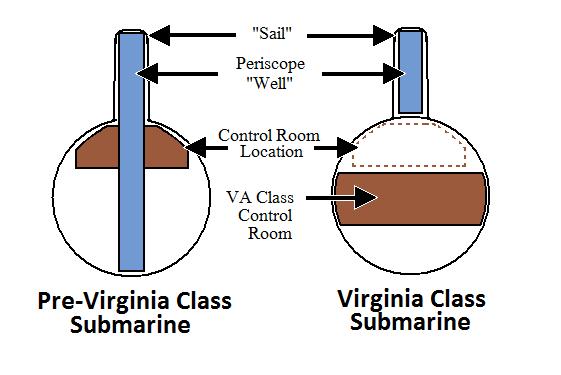
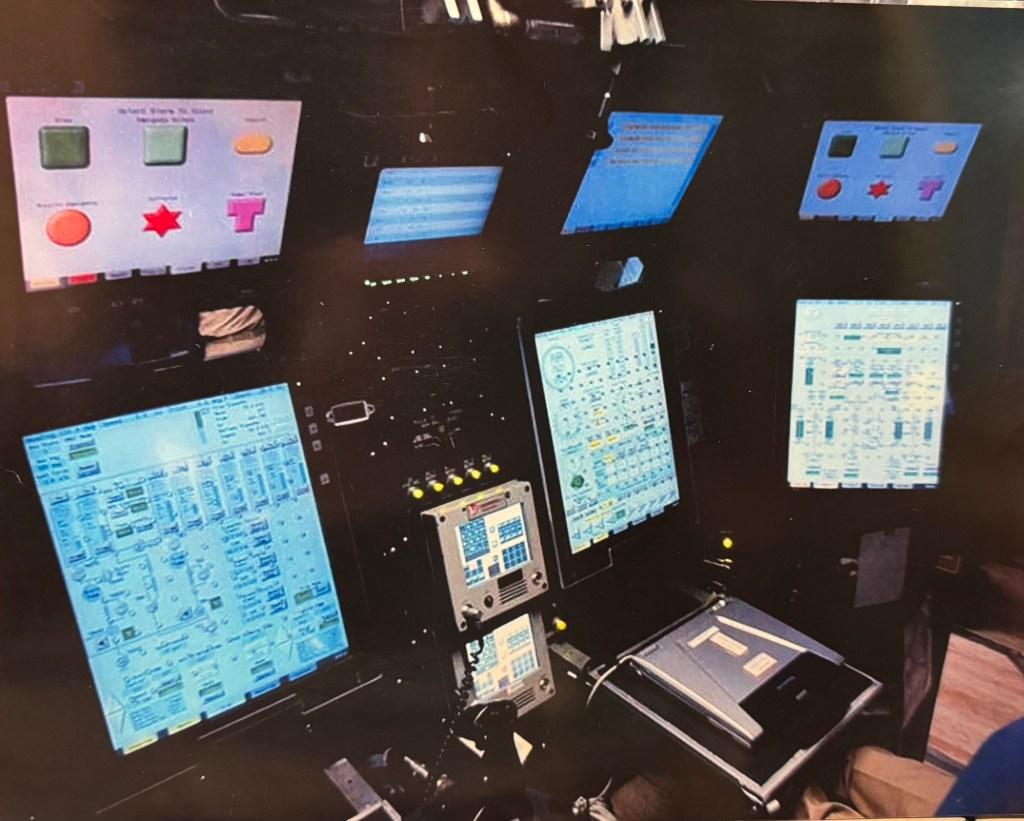
Since modern U.S. Virginia-class submarines use photonics masts, they allow the control room to be situated further down inside the hull as opposed to on the deck directly beneath the sail. According to a volunteer tour guide on Blueback who served on USS South Dakota (SSN-790), the control room of the Virginia-class submarines has no red lighting because there’s simply no need to rig for red (as I suspected) because the masts don’t penetrate the hull and they’re not optical.9 The only place on a Virginia-class submarine that has red lighting is the crew’s berthing areas. However, he did mention that, in addition to the white fluorescent lights in the control room, there are dim purple-ish lights directly over the screens to reduce glare.
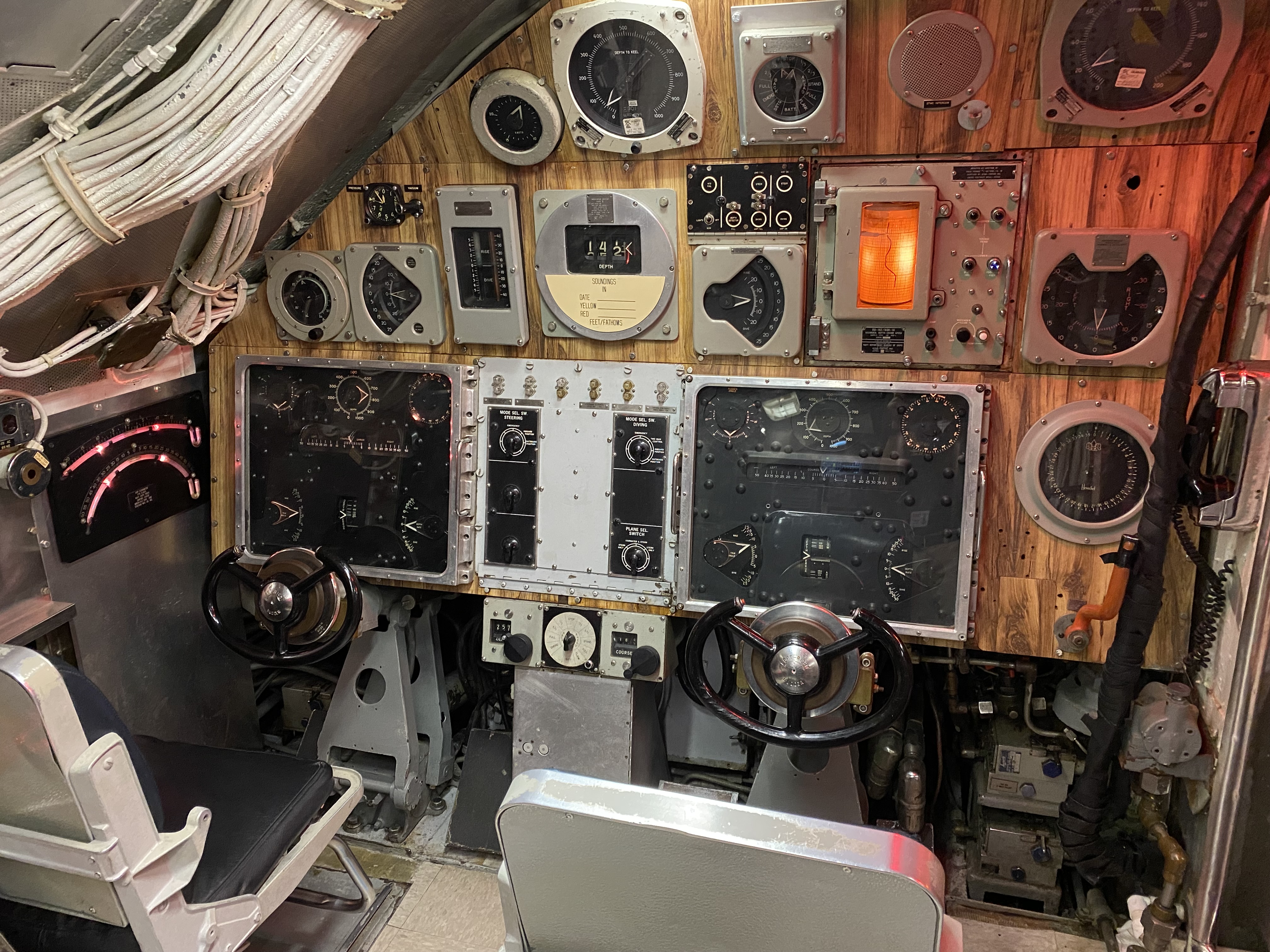

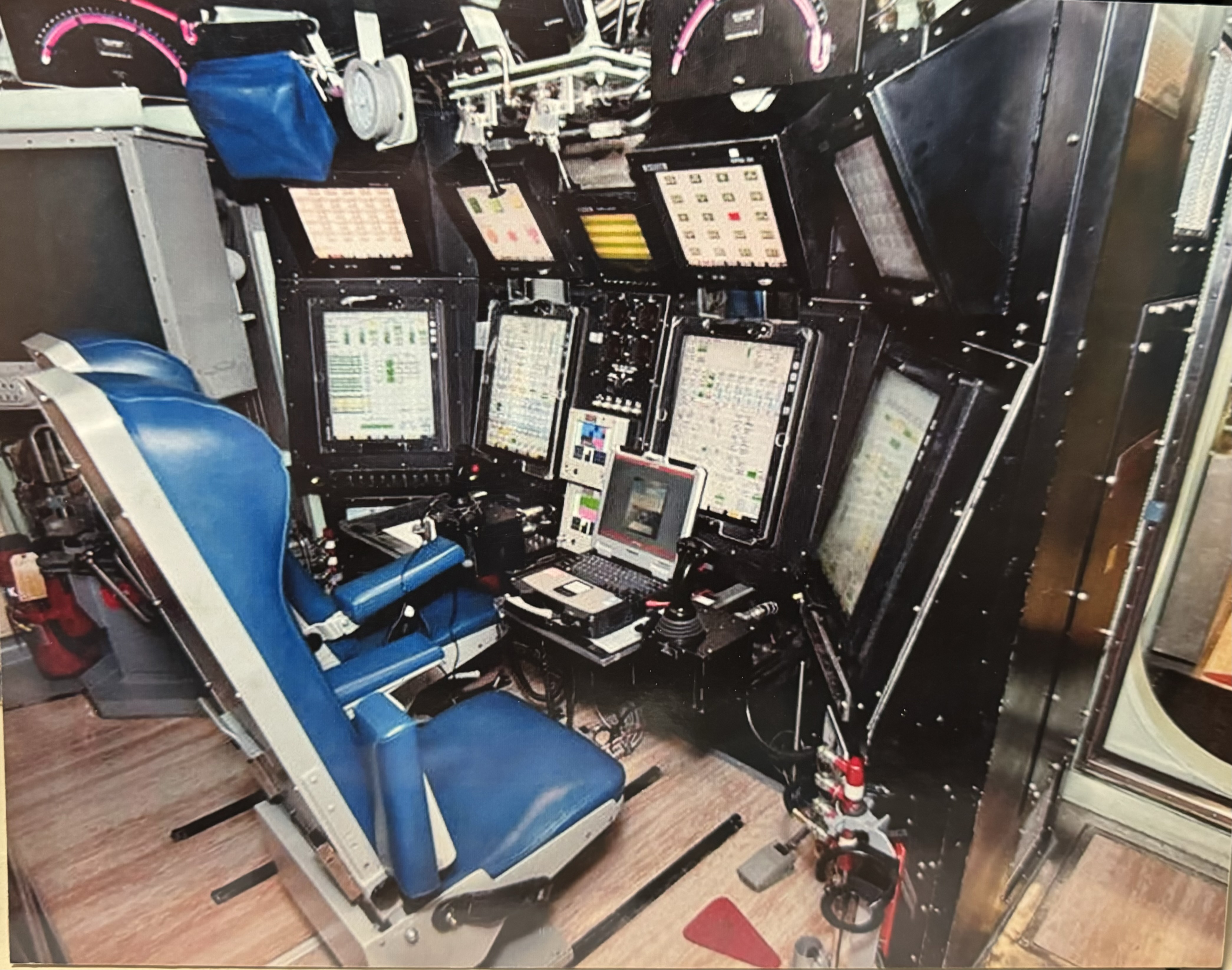
In contrast to Blueback which has no digital displays (apart from maybe the radar scope and some ECM/ESM equipment), as well as a newer Seawolf-class sub (from the 1990s), which has some digital displays, the control room of a Virginia-class sub is filled with over 50 digital screens and reflects the massive advance in technology and digital integration in newer submarines. Given the better screen technology and the placement of the control room deeper within the hull with no hull penetrations, the need for different colors of lighting is drastically reduced, with no colored lights apart from the dim white lights and purple-ish lights, as mentioned by one of our volunteer tour guides who served on a Virginia-class boat.

Thus, while red lighting (along with other colors) can still be found on modern submarines, the differences are becoming less distinct due to different operational and technological needs. However, back in the day, it was to help your eyes adjust to the darkness and to prevent white light from giving away the position of the submarine. That’s why submarines have red lighting.
Notes
- “How Far Does Light Travel in the Ocean? : Ocean Exploration Facts: NOAA Office of Ocean Exploration and Research,” NOAA Ocean Exploration, accessed September 8, 2024, https://oceanexplorer.noaa.gov/facts/light-distributed.html. ↩︎
- One of the most common questions we get from kids as tour guides on Blueback is, “Why are there no windows on the submarine?” They don’t understand how dark the ocean is at depth, or that windows would be a weak point in the hull of the submarine. Additionally, Blueback isn’t a research submersible, so it’s not going down to survey shipwrecks or archaeological sites. ↩︎
- In 2015, the U.S. Navy switched submarines to a 24-hour day composed of three 8-hour watches. ↩︎
- Timothy Mauch, “Why Does a Submarine Rig for Red Lighting as Part of Battle Stations?,” Question and Answer, Quora, accessed September 8, 2024, https://www.quora.com/Why-does-a-submarine-rig-for-red-lighting-as-part-of-battle-stations. ↩︎
- Mauch. ↩︎
- Mauch. ↩︎
- Mauch. ↩︎
- By Sparkygravity – Own work, CC BY-SA 3.0, https://commons.wikimedia.org/w/index.php?curid=4233653 ↩︎
- Another thing he mentioned is that the original controller for the photonics masts was a joystick, but that was replaced with an off-the-shelf Xbox controller. Yes, really! He said you could pick up the controller and figure out the controls for the photonics masts in about a minute. It’s very intuitive. I’ll save further discussion and stories of photonics masts for another post on periscopes. ↩︎
Bibliography
“How Far Does Light Travel in the Ocean? : Ocean Exploration Facts: NOAA Office of Ocean Exploration and Research.” n.d. NOAA Ocean Exploration. Accessed September 8, 2024. https://oceanexplorer.noaa.gov/facts/light-distributed.html.
Mauch, Timothy. n.d. “Why Does a Submarine Rig for Red Lighting as Part of Battle Stations?” Question and Answer. Quora. Accessed September 8, 2024. https://www.quora.com/Why-does-a-submarine-rig-for-red-lighting-as-part-of-battle-stations.
 Fair Winds & Following Seas