

Here’s another classic submarine sea story (and another one of our favorites) from our good Captain! Like many sea stories, the proper opening line would be, “This is no shit!” Now, given the details of this story, it had to have occurred before the Captain’s time in service, and there’s almost no way to verify it. So like any sea story, take it with a grain of salt, and the facts have most likely changed as the story has been passed down through time, but it wouldn’t surprise me if some version of this event did occur in real life. It’s so outrageous that there must be some element of truth to it.
Featured Tour Guide – The Captain – CAPT (ret.), U.S. Navy
Note: The interviewee has asked to remain anonymous for reasons of privacy.
The Captain, as his title implies, is a retired O-6, having spent some 30 years in the U.S. Navy. While he didn’t serve on any of the Barbel-class submarines, he is still eminently qualified to discuss submarine operations, having served as the Commanding Officer (CO) of two nuclear-powered submarines. One was a Los Angeles-class fast attack and the other was an Ohio-class ballistic missile submarine. Given his experience, he has a great many sea stories to tell us, some of which are true.


Interview – That Time a Submarine Crashed into a Car
Captain:
Diesel boats and lots of smoke.
The skippers of many submarines would pride themselves on their ship-handling skills. Of course, back then submarines had two screws, so it could turn very easily stationary which is harder to do on a nuclear submarine unless it has an outboard motor or secondary propulsion motor. Then it may be a little easier.
So one of the things that they would do to show off their skill is called a “one bell landing.” Which meant you came into port and you lined up and brought your ship in and just had one backing bell. At the right time and with the right amount so it would stop your ship only inches from the pier or dock. That’s a one bell landing. So guys would certainly try to do that.
Now in this case (or in one case anyway), and this is New London, [Connecticut], they had a number of piers that were submarine piers that were sticking out from the main dock. The dock there had parking spaces. The premier parking spaces, of course, were reserved for the commanding officers, so they had close access to their boat.
In this one case, the skipper comes in for his one bell landing, and for one reason or another, the backing bell was not answered or not answered in a timely manner. The ship continued on and didn’t stop until it hit the dock.
Now, the diesel submarines at that time had a high bow, and the pointy part of the bow was higher than the dock. Well, the place where it hit was where a car was parked. And the car happened to be the skipper’s car.
Tim:
[Laughing]
Captain:
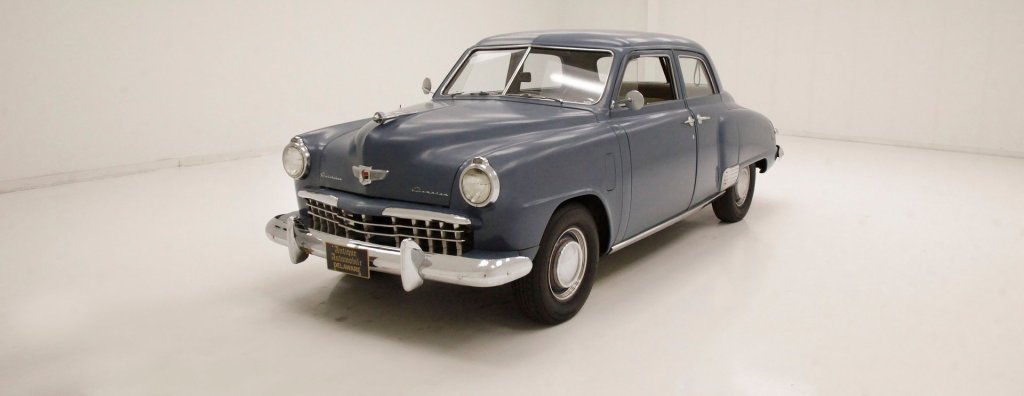
So this is a case where the submarine’s CO had a collision, not with another ship, but with his own automobile. And I think it was, maybe a ’49 Studebaker.
Tim:
[Laughing]
I think it would be interesting to hear the conversation he had with the insurance company on that one.
Captain:
Well, he probably had a conversation with the insurance company and the Commodore.
Tim:
Well, thank you for that story, Captain.
[End of Interview]
A Few Comments
In the story above, we should be thankful that nobody was injured or killed, and that the most significant damage (apart from the Captain’s pride) likely occurred to the car. Unfortunately, I have no information on the specific submarine, the Captain, or the exact model of Studebaker that was involved in this story. However, for the sake of argument, let’s say that the CO’s car was a 4-door 1949 Studebaker Champion De Luxe with a curb weight of approximately 2,879 lbs.1 Furthermore, let’s also assume that the submarine was a Balao-class boat which displaces about 1,525 tons standard when surfaced.2 Simply put, the Studebaker got the worst of the collision.

At the risk of being pedantic, what occurred in this story is technically termed an “allision.” The difference between a collision and an allision is that the former involves two vessels striking each other, while the latter involves a vessel striking a stationary object, such as a bridge or a pier.
Of course, these two events fall under the general term of what the U.S. Coast Guard refers to as a “marine casualty.” This could include groundings, strandings, fires, flooding, foundering, etc. All of which can cause damage to property and the environment.
A lot of people are under the impression that because the ocean is vast, it’s somehow empty. On the contrary, there’s a lot of stuff, both on and in the ocean. Collisions (even on the open ocean) are more common than you might think. The number of accidents only increases when vessels are operating around congested waters and ports.
Oceans, currents, weather, etc. can be unpredictable. Combined with fallible technology, poor situational awareness, and the general propensity for humans to act stupidly (often when combined with hubris, alcohol, and drugs), then it’s only a matter of time before accidents occur.
Notes
- “1949 Studebaker Champion 4-Door Sedan Full Range Specs,” http://www.automobile-catalog.com, accessed September 26, 2024, https://www.automobile-catalog.com/make/studebaker/champion_2gen/champion_2_sedan_4d/1949.html. ↩︎
- John D. Alden, The Fleet Submarine in the US Navy: A Design and Construction History (Annapolis, Md: Naval Inst. Pr, 1979), 105. ↩︎
Bibliography
Alden, John D. The Fleet Submarine in the US Navy: A Design and Construction History. Annapolis, Md: Naval Inst. Pr, 1979.
http://www.automobile-catalog.com. “1949 Studebaker Champion 4-Door Sedan Full Range Specs.” Accessed September 26, 2024. https://www.automobile-catalog.com/make/studebaker/champion_2gen/champion_2_sedan_4d/1949.html.
 Fair Winds & Following Seas