
i.e How some facts got decontextualized and had a sprinkle of the Mandela Effect added to them…because documenting evidence and details is pointless. If we see it on TV or the internet, it must be true! Right?
Many visitors on USS Blueback ask the tour guides about her role in the 1990 film, The Hunt for Red October.
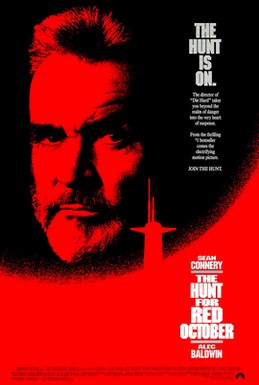
It’s true, Blueback did appear in that film, and most people think it’s this particular scene:
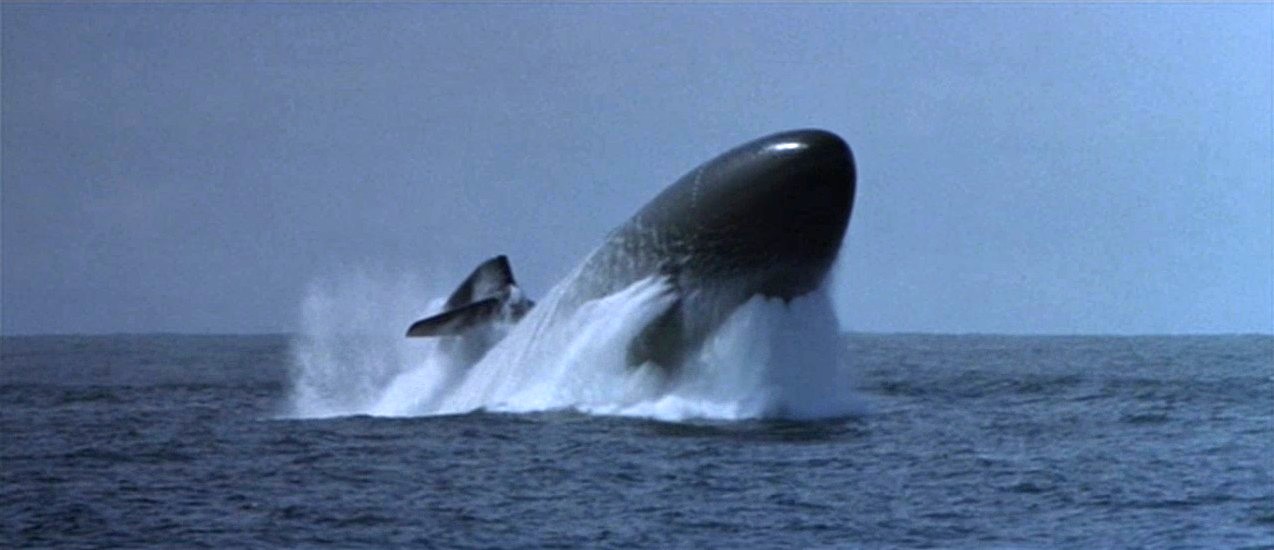
The Emergency Blow Scene
The most common misconception I hear is that Blueback is the submarine performing the emergency blow, and I believed this for a long time, as well. This myth has been perpetuated in articles throughout time and there are a lot of incorrect and misremembered details regarding this scene. One (very old) OMSI brochure shows a series of stills from this shot claiming that this submarine is Blueback. Even newspaper articles from 1994, when Blueback was nearing opening as a museum ship, completely misidentify the type of submarine in this scene. An article from the The Oregonian dated 19 February 1994 by Norm Maves Jr. says:
It [Blueback] even had a significant role in the 1990 moving “The Hunt for Red October.” Shots simulating the USS Dallas in the movie were taken on the Blueback. The classic scene where Red October explodes nose-first out of the water was actually Blueback.
Similarly, an article from The Columbian by Thomas Ryll, dated 23 March 1994, notes “When the Soviet submarine Red October blasts out of the water in the movie, “The Hunt for Red October,” it is actually the USS Blueback.”
I have to ask. Umm…did we watch the same movie? Now bear in mind that the film came out in March 1990 and these articles were written four years later, so it’s likely that the authors were misremembering details in the film.
Submarine size comparison
Not all submarines are the same, even if they all look similar from afar. So let’s dig into this and start by looking at some different submarines and their sizes.
The eponymous Red October is a fictional Typhoon-class submarine, like the one seen below.

USS Dallas in the film is a Los Angeles-class fast attack submarine. It’s the one that shoots out of the water in the climactic battle at the end.
Notice any differences? Typhoons were the largest submarines ever built (by any nation), at 564 feet long and over 74 feet at the beam.1 They have a submerged displacement nearly as much as the Titanic.2 Early in the film, Jack Ryan (portrayed by Alec Baldwin) states that Red October is a larger fictional variant in the film at 603 feet and 84 feet at the beam. Strangely, later in the film, Ryan states that it’s roughly 650 feet long with a submerged displacement of ~32,000 tons. “Roughly the same size as a WWII aircraft carrier.”3
The Submarine That Was Not Blueback
Obviously, the submarine performing the emergency blow stunt is not a Typhoon, but it’s not actually USS Blueback, either. Just to be clear…IT’S…NOT…USS BLUEBACK!
In reality, that was the Los Angeles-class submarine USS Houston (SSN-713) that portrayed USS Dallas (SSN-700) in the scene. I’ve actually had a former submarine sailor (a sonar technician) on one of my tours who was serving on USS Houston when they filmed that scene. According to him, they spent all day going deep and doing emergency blows some 27 times so the camera crew filming the scene could get just the right shot. That said, according to Wikipedia (citing an AP article), Houston actually performed over 40 emergency blows, both for rehearsal and for filming that day.4
Reportedly, Houston performed the emergency blow so many times that the fiberglass dome on the bow of the submarine that covers the sonar dome eventually cracked. The production company had to pay the U.S. Navy some $5 million to fix it.
Let’s compare some details regarding the shapes of the Barbel and LA boats.
Hull Shape & Length


The following are 3D models of USS Memphis (SSN-691) and USS Blueback (SS-581). (Courtesy of Ken Gross)
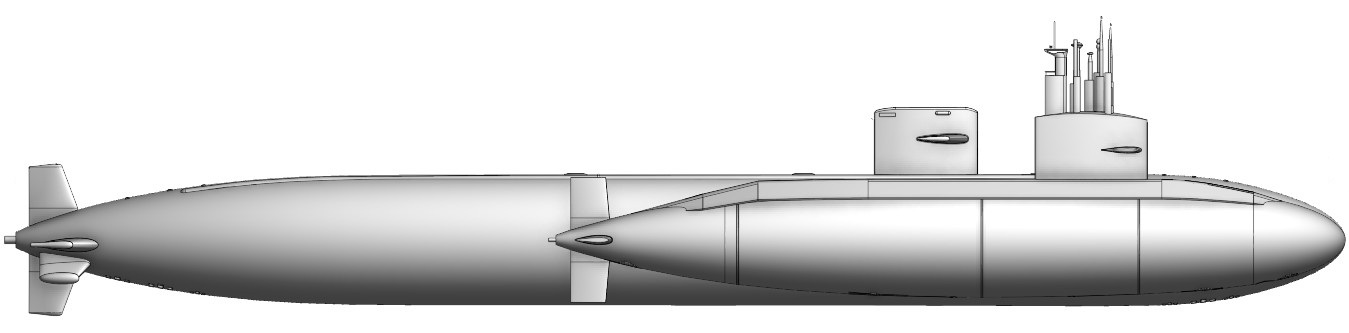
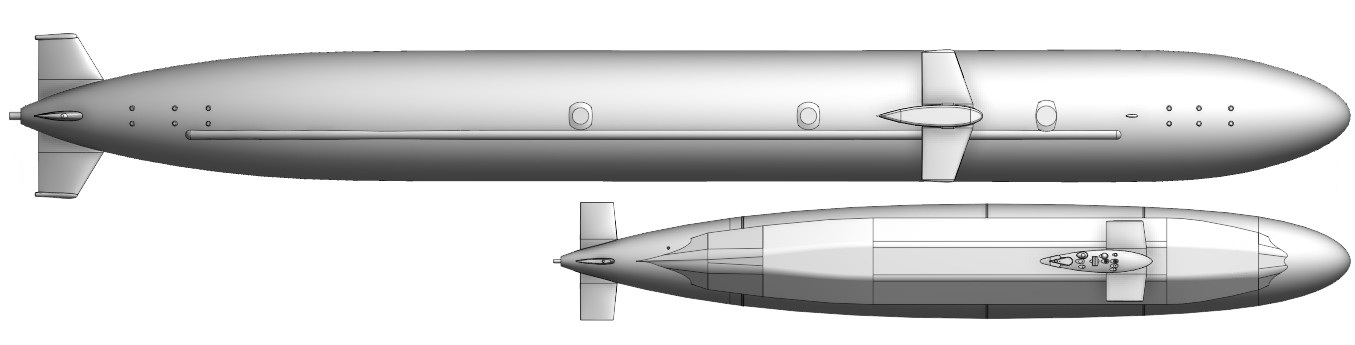
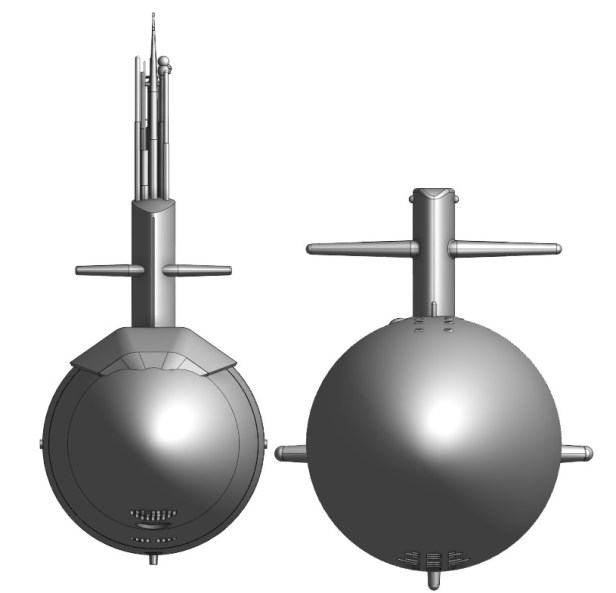
The Barbel-class, of which Blueback is one of three, were the first attack submarines with a teardrop-shaped hull. This hull shape makes the submarine very hydrodynamically efficient and was revolutionary at the time in 1959.5 In fact, other countries have copied this design. Being diesel-electric, at the time of their commissioning, they were some of the smallest combat submarines in the U.S. Navy in the post-WWII era and the last class of diesel-electric submarines built and in service in the U.S. Navy. As time went on, the addition of a reactor compartment and more advanced equipment meant that submarine hulls became more elongated. As is apparent with the Los Angeles-class, which began coming into service in the mid-1970s, they are now much more tubular in shape with conical ends.
Sail Planes
The square structure that sticks out of the top of a submarine’s hull is known as a sail or fairwater (fin in British English). The little wings sticking out of the side of the sail are known as sail/fairwater planes. If we compare the size and position of the sail planes, there’s a noticeable difference.
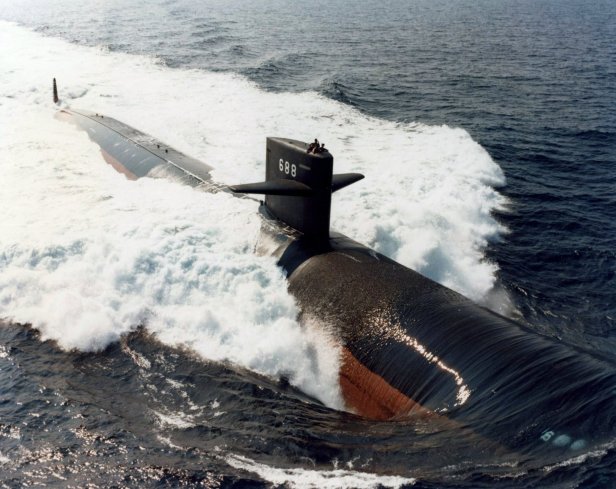
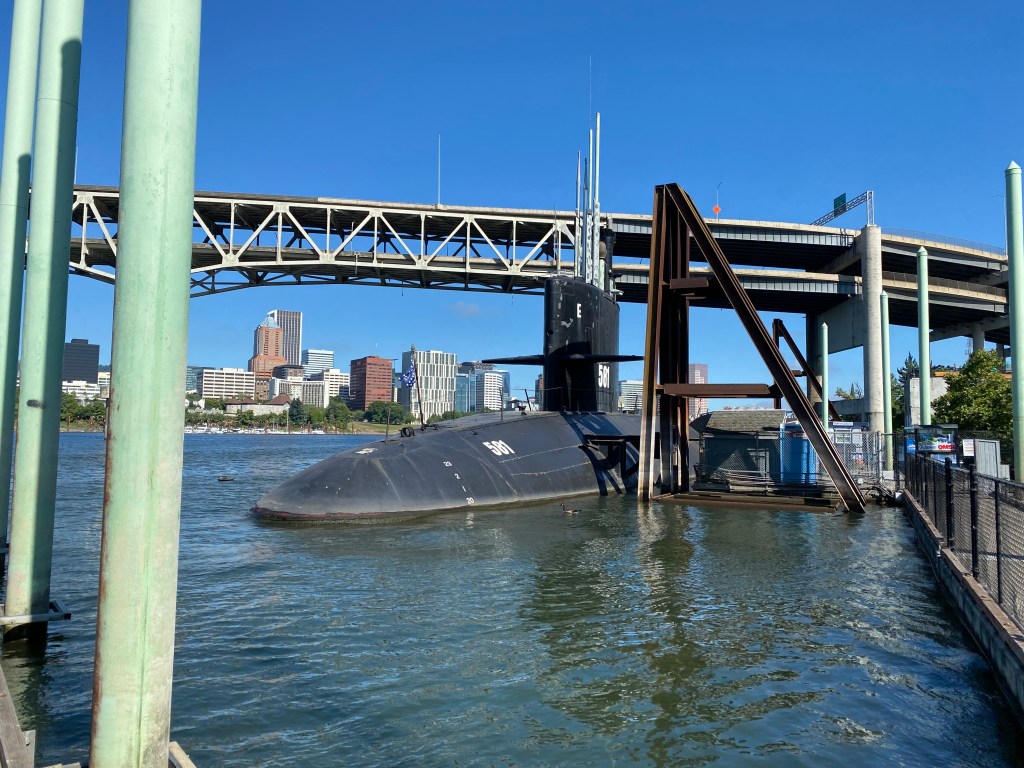

Compared to a Barbel-class sub, a Los Angeles-class sub has larger sail planes, and they’re higher up on the sail. Furthermore, the sail is somewhat further back from the bow on a Los Angeles boat.
Understandably, people could confuse the two if they didn’t know what to look for. Most U.S. submarines simply look like non-descript black tubes.
Blueback‘s Actual Role – The Four-Second Shot
Blueback‘s time on the big screen in the film is actually just a measly four-second shot, which occurs at approximately the 28:12-minute mark.6 While the shot in the film is nondescript, in reality, it’s in Blueback‘s torpedo room.

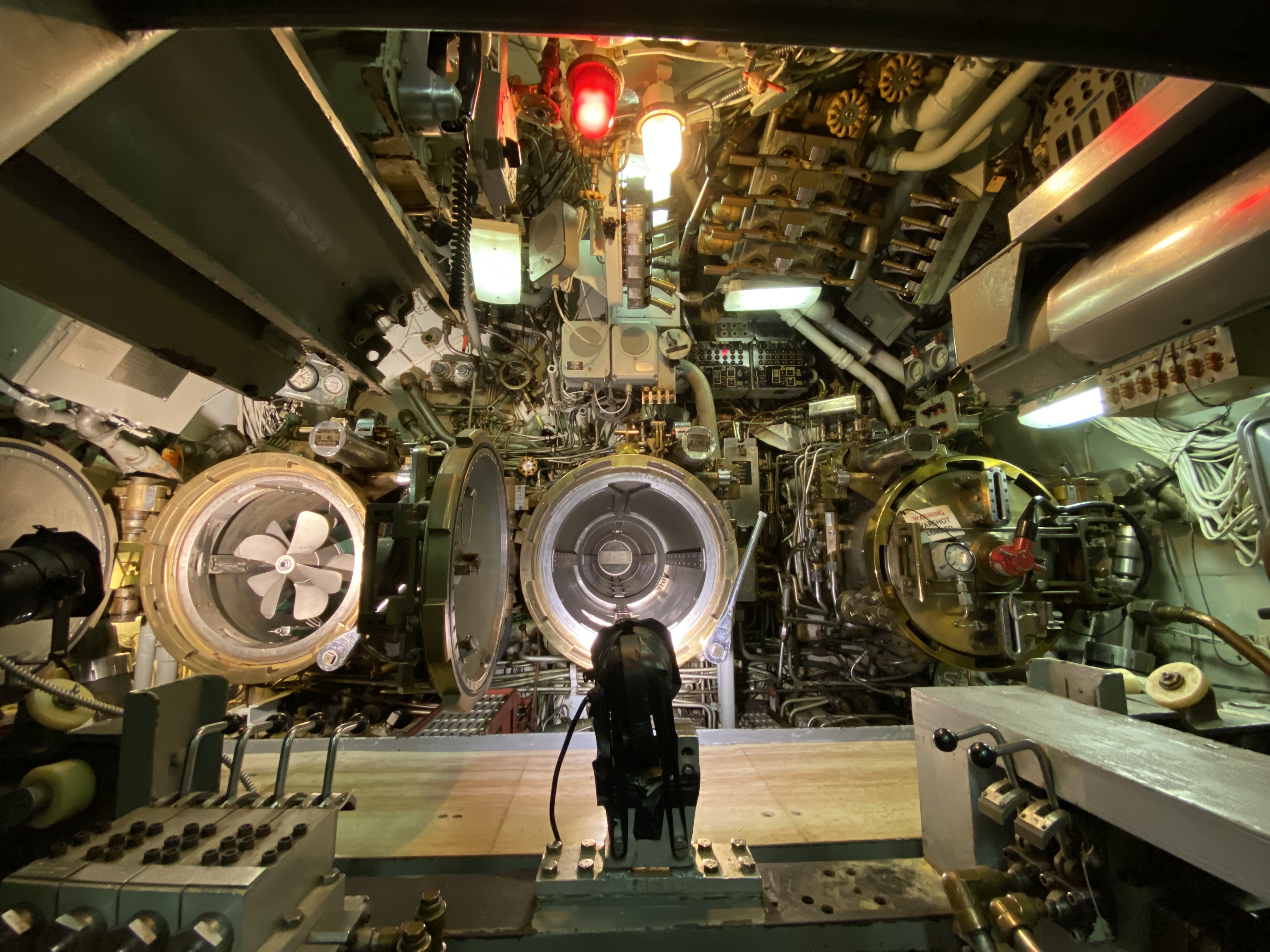
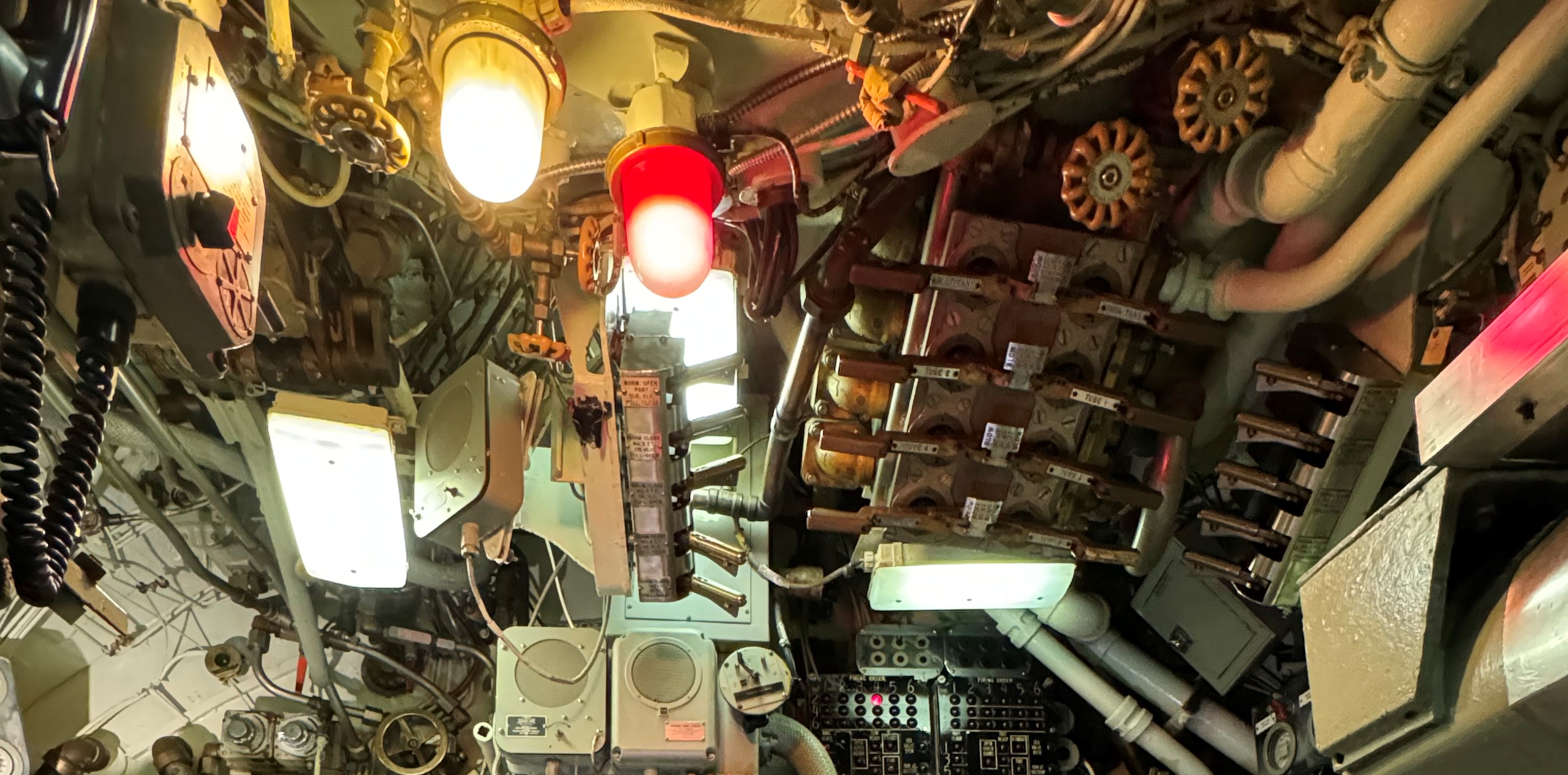
Comparing the two shots, it’s possible to see identical light fixtures and valves overhead.
The Cutting Room Floor
Aside from this four-second shot, there was more of Blueback filmed for the movie. Blueback‘s last Chief of the Boat (COB), Master Chief Machinist’s Mate Charles Wormwood, provided more insight into what filming was really like. He said that Blueback was chosen for the film because she was the only boat with six bow torpedo tubes.7 Several days of filming took place on Blueback which included filming the crew topside loading and unloading torpedoes on and off the submarine; with the Russian torpedo room scenes being filmed in Blueback‘s torpedo room. Blueback‘s torpedomen were each paid a small amount of money, had their heads shaved, dressed in Soviet naval uniforms, and had to learn Russian songs. Additional footage was shot that included people running down the passageway into the torpedo room. Master Chief Wormwood also noted that his old submarine Permit was the one filmed when Alec Baldwin entered the drydock.8
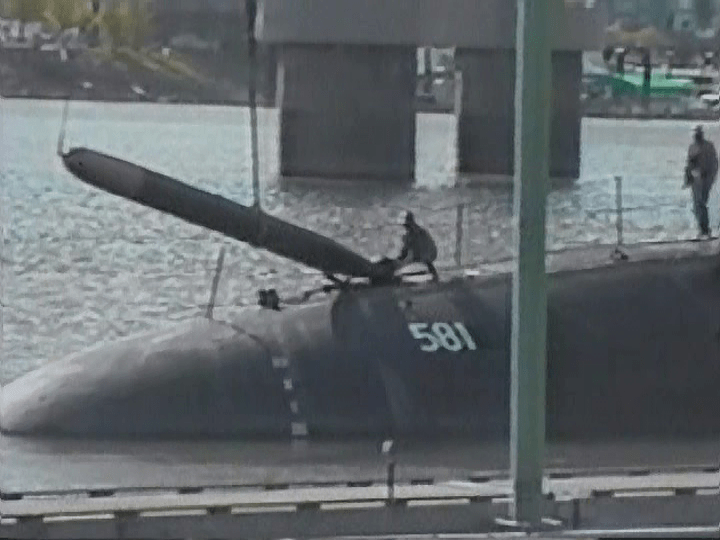


That said, films are shot and edited intentionally, but many of the shots are decontextualized, moved around, and used for other scenes. Recall that there are two Soviet subs depicted in the film. The titular Red October and the Alfa-class submarine V.K. Konavolov. While both engage each other in combat at the end of the film, only Konavolov fires torpedoes during that sequence. Now, this is purely conjecture and I have no evidence to confirm this, but I suspect Blueback‘s extra torpedo room scenes that ended up on the cutting room floor were actually intended to depict Konavolov‘s torpedo room. If there were scenes depicting the loading and unloading of torpedoes on the boat, it could be that they were scenes of Konavolov loading torpedoes, since Blueback is far closer in size to an Alfa-class sub than a Typhoon. But who knows? This footage is likely lost to time or sitting in some vault at Paramount Studios and slowly deteriorating.
Setting the Record Straight
Hopefully, this clears up some misconceptions about Blueback‘s actual role in The Hunt for Red October. While it’s not the submarine that performed the famous emergency blow stunt, she did have at least four seconds of fame on the big screen! While it may feel somewhat anticlimactic, we can at least say this submarine was in that film and it doesn’t detract in any way from our enjoyment of it. The Hunt for Red October is still loved by many as an excellent depiction of submarines in the Cold War and one of the best submarine thrillers out there, as my reviews of the book and film attest. The next time you’re watching the film and looking for Blueback, my suggestion is, don’t blink or you’ll miss it!
Notes
- For comparison, the largest U.S. submarines, the Ohio-class, are 560 feet long and 42 feet at the beam. The upcoming Columbia-class, which will replace the Ohio-class are the same size, but 1 foot wider. Nearly two of these side-by-side will fit inside the outer hull of a Typhoon! ↩︎
- Titanic displaced roughly 52,000 tons, and a Typhoon has a submerged displacement of roughly 48,000 tons! ↩︎
- Ryan is likely referring to an Essex-class aircraft carrier that displaces over 32,000 tons; however, his statement of Red October being comparable in submerged displacement is way off. Since Red October is even larger than a regular Typhoon, it would probably be closer to Titanic than a WWII aircraft carrier. Although he may have made that comparison to give his audience an easy mental comparison. ↩︎
- “The Hunt for Red October (Film),” in Wikipedia, October 17, 2024, https://en.wikipedia.org/w/index.php?title=The_Hunt_for_Red_October_(film)&oldid=1251746985. ↩︎
- The nuclear-powered Skipjack-class has a very similar teardrop-shaped hull design. Subsequent submarine designs (particularly attack boats) have a far more tubular shape. ↩︎
- For some strange reason, the USS Blueback page on Wikipedia says that this wasn’t in the film. It most definitely is. ↩︎
- Most Russian submarines have their torpedo tubes in the bow, whereas U.S. submarines moved them back behind the sonar dome and angled them outboard port and starboard. Blueback is one of the last submarines to feature bow tubes. ↩︎
- Paul Stillwell, ed., Submarine Stories: Recollections from the Diesel Boats (Annapolis, Md: Naval Institute Press, 2013), 269-71. I haven’t found any documentation regarding how much they were paid, but I’ve been told it was about $50. What would be more interesting is how much money the production company paid the U.S. Navy to film their submarines. ↩︎
Bibliography
Stillwell, Paul, ed. Submarine Stories: Recollections from the Diesel Boats. Annapolis, Md: Naval Institute Press, 2013.
“The Hunt for Red October (Film).” In Wikipedia, October 17, 2024. https://en.wikipedia.org/w/index.php?title=The_Hunt_for_Red_October_(film)&oldid=1251746985.
 Fair Winds & Following Seas