
Published in 1986, this is Tom Clancy’s second novel and one of two that doesn’t take place within the “Ryanverse” (i.e. it doesn’t feature the character Jack Ryan). Clancy also co-wrote the book with Harpoon wargame designer Larry Bond. The novel depicts a fiction World War III between NATO and the Warsaw Pact following the destruction of an oil refinery which disrupts the Soviet economy and causes massive fuel shortages.
Author’s Background
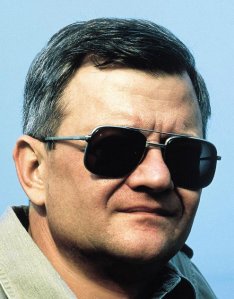
Tom Clancy (1947 – 2013) was born in Baltimore, Maryland. He attended Loyola College (now Loyola University) and majored in English Literature. While in school he enrolled in the Army Reserve Officer Training Corps (ROTC) program, but he was ineligible to serve due to his poor eyesight. Upon graduating, Clancy worked as an insurance agent and wrote in his free time. The Hunt for Red October started his career as a novelist. Clancy would go on to write or co-author nearly 20 fiction books, most of which feature the character Jack Ryan. Additionally, he would author numerous non-fiction works on military topics and technology.
Tom Clancy passed away in 2013 near his home in Baltimore due to heart failure at the age of 66. Even before then, his name was licensed to endorse movies, TV shows, and video game series; particularly those dealing with espionage, military intelligence, and technical topics. Despite not having any professional background in intelligence or as a naval officer, Clancy was known for doing extensive research for his works and popularizing the military fiction and techno-thriller genre.
Plot
After Muslim militants destroy an oil refinery in Nizhnevartovsk, the resulting oil and fuel shortages threaten to wreck the Soviet economy. Unwilling to request aid from the West, the Soviet Politburo decides to invade the oil-rich countries of the Middle East, but knowing that the United States would move to defend those countries, they must first neutralize NATO forces.
Unable to invade the Middle East without provocation, the Soviet Union decides to engage in maskirovka (military deception), which includes publicly agreeing to dismantle several obsolete nuclear ballistic missile submarines for arms reduction. Observing from the Western perspective, Naval Reservist and NSA analyst Robert Toland notices some odd (and seemingly unrelated) trends in the Soviet economy. Specifically, despite the increase in production, there’s a shortage of car and truck batteries since they’re being prioritized for military use. Several Soviet colonels and conscripts are shot for falsifying readiness reports which isn’t normally a capital offense, but indicates that the Soviet Army is brutally enforcing discipline and getting rid of ineffective soldiers. Additionally, a large amount of collectivized farmland is redistributed to individual farmers which hints that military-aged men are being drafted for service. All of these trends indicate that the Soviet Union is gearing up for a major conflict.
Believing that the U.S. would more willingly defend West Germany and get their oil from the Western Hemisphere the KGB stages a false flag operation by bombing a Kremlin building which kills several innocent Soviet citizens and blames a KGB sleeper agent in West German Intelligence for the attack. With the public outraged and supporting calls for war, the Soviet government now has cause to invade and occupy West Germany.
An attack on a NATO communications station in Lammersdorf, West Germany is foiled when a Spetznaz officer is killed in a traffic accident and several other trucks with Spetznaz commandos are captured, but despite this, the Soviet Army advances on West Germany. NATO’s initial defense of Germany is a success with stealth bombers successfully destroying crucial bridges, as well as Soviet air defenses, and many of their fighters. Meanwhile, the Soviets stage a surprise invasion of Iceland and overwhelm the NATO airbase at Keflavik. U.S. Air Force 1st Lieutenant Mike Edwards, a meteorologist, escapes the Soviet invasion with several U.S. Marines and hides on a hill overlooking the area. After establishing radio contact with NATO forces, they operate under the codename “Beagle” so they can radio intelligence concerning Soviet activity on Iceland. The initial B-52 raid on Keflavik airbase only achieves mixed results and the Soviets quickly repair the runway. Eventually, Edwards and his group are forced to head north to recon the town of Stykkisholmur, and on the way, rescue a pregnant Icelandic woman named Vigdis Agustdottir who was being assaulted by Soviet paratroopers.
With the Soviets now controlling the Greenland – Iceland – United Kingdom (GIUK) Gap, the U.S. Navy sends a naval task force, including the aircraft carrier USS Nimitz, French aircraft carrier Foch, and the amphibious assault ship USS Saipan to retake Iceland. However, Soviet bombers armed with antiship missiles successfully damage Nimitz and sink several other ships, forcing NATO to halt the retaking of Iceland for the time being. Additionally, NATO convoys crossing the Atlantic to resupply forces in Germany encounter stiff resistance from Soviet submarines. Some of the escorts, such as USS Pharris (FF-1094), under Commander Edward Morris, are successful at sinking some submarines, but Pharris later gets ambushed and has her bow blown off by a torpedo and has to be towed back to port. Morris survives and is later given command of USS Reuben James (FFG-57).
NATO and Soviet air and ground forces engage in heavy fighting in Germany with both sides taking heavy losses. At first, the battle seems like a stalemate, until Colonel-General Pavel Alekseyev, the de-facto ground commander, achieves a breakthrough in a tank battle at Alfeld and crosses the Weser River. Meanwhile, to reopen the GIUK Gap and relieve Iceland, U.S. forces focus on destroying Soviet satellites and bombers. The submarines USS Chicago (SSN-721), USS Providence (SSN-719), and USS Boston (SSN-703) successfully conduct a cruise missile strike on four airfields at Kirovsk, Murmansk as the Soviet bombers are returning to base. However, Providence is damaged in an attack by a Grisha-class frigate as the three subs make their escape back to the icepack to the north. Just before reaching the ice, the three submarines are ambushed by several Soviet subs, including an Alfa, which sinks Providence and Boston. Just as Chicago is about to be attacked, they’re saved by HMS Torbay which sinks the Alfa.
Edwards and his group of U.S. Marines link up with a group of British Royal Marines who parachute in near Stykkisholmur just prior to U.S. amphibious forces arriving to retake Iceland. However, while observing the town, the group is discovered by Soviet paratroopers and is nearly wiped out. Edwards and Vigdis survive just before being overrun by the timely arrival of U.S. aircraft which provide close air support and are evacuated to the nearby carrier USS Independence (CV-62). Unable to hold Iceland against the superior American forces, the Soviet commander capitulates.
With Iceland retaken, the U.S. supply convoys successfully reach Europe. After NATO forces target their fuel supplies, Soviet forces are forced to surrender in Germany. Meanwhile, the Soviet General Secretary contemplates using nuclear weapons to end the war which infuriates Pavel Alekseyev, the Soviet commander in Germany, who is criticized for his slow progress, despite preparing for a counterattack. Alekseyev, the KGB chief, and other members of the Politburo organize a coup that overthrows the Soviet government and the new government negotiates a ceasefire with NATO.
Having survived their ordeal, Michael Edwards and Vigdis marry, with her child being born healthy. Despite being a U.S. Air Force officer, Edwards is awarded the Navy Cross for his actions in leading the Marines. USS Reuben James and Edward Morris also return home to Norfolk.
Critical Observations
Tom Clancy gives credit to Larry Bond as his cowriter in the author’s note of this book. Larry Bond is most well-known in the wargaming community for creating the Harpoon and Command at Sea wargames. These were originally tabletop wargames, but Harpoon has been adapted to a PC wargame which is still available today (as of January 2025).1
The title of this novel would later inspire the video game development company Red Storm Entertainment which would publish many Tom Clancy licensed games, including many games of the Rainbow Six and Ghost Recon series up to roughly 2012. Speaking of games, according to the author’s note, Larry Bond’s wargame, Harpoon, was used to plan out the campaign and events of this book (along with serving as a primary source for his earlier novel The Hunt for Red October, as well).
Positives
Although I don’t know exactly how much of the book Larry Bond wrote, and his name isn’t credited on the book’s cover, it does add some verisimilitude to the naval action in the book. Accordingly, Clancy’s writing has definitely improved since The Hunt for Red October. The pacing of this novel is much better and the narrative flows much smoother. Overall, it’s a much more mature effort.
Regarding the characters, Clancy’s novels have never really been character-driven, so I didn’t expect this one to be either. That said, the major characters in this novel do get some degree of characterization. I found myself most interested in the story arcs of Michael Edwards on Iceland and Edward Morris in command of USS Pharris and USS Reuben James. This is simply because the reader has more time to actually get inside their heads and learn what they’re thinking. The Soviets aren’t treated as outwardly evil or malicious, either, with some exceptions. Even the main Russian character, General Pavel Alekseyev, is portrayed sympathetically as a soldier doing his job. Again, the reason for the better characterization probably ties into the writing of this novel being stronger than Clancy’s earlier work.
The narrative of the book is interesting and keeps moving at a steady pace throughout the novel, without bogging down too much. In contrast to The Hunt for Red October, Red Storm Rising feels appreciably broader in scope and much more epic. It’s fairly interesting to see how this war between NATO and the Warsaw Pact is playing out. While many of Clancy’s works have been adapted to the screen, I can’t really see this book working well as a film. There are just too many narratives going on to condense the story into a single film. It would only work as a film series or as a TV miniseries.
Negatives
One of my biggest issues with this novel is that there’s no real timeline. Even the exact year isn’t mentioned, apart from being sometime after 1984. There are very few specific dates noted in the book, which are as follows:
- On January 31st, the Associated Press reports on the oil refinery explosion and fire at the start of the book.
- On June 15th, the Supreme Allied Commander, Atlantic (SACLANT) orders all Atlantic warships to commence unrestricted air and sea warfare against Warsaw Pact forces.
- On June 19th, a Warsaw amphibious force departs Kola, and the submarine USS Chicago is later ordered to intercept them north of Narvik, Norway in the Norwegian Sea.
Apart from these handful of dates, the reader has no idea as to how long the war actually lasts once Iceland and Germany are invaded and the shooting starts. It could be a few weeks or a few months, but based on the events from Edwards’ perspective on Iceland, it probably happened over a few weeks at most…which seems incredibly short for a war of this magnitude. Then again, all of the fighting takes place in the Atlantic and Europe with no mention of any part of the conflict spilling over into East Asia or the Pacific.
I don’t have any real problems with the overall narrative, but the war (and book) ends a bit abruptly. The Politburo is overthrown in a coup, the American characters return home, and everything returns to the status quo ante bellum. That’s it. The issue here is that this book almost seems like a hypothetical wargame; a novel-length “What if the Cold War went hot?” (Without the nuclear exchange.) These kinds of scenarios are nothing new and have been done to death. It’s like Clancy wanted to get his two cents in, as well. Clancy is also better at writing naval combat scenes than ground warfare. I found the geography of the ground fighting in Germany to be somewhat poorly described, and I didn’t care much about the events in Europe. They seem to have less detail and main characters involved in them, anyway.
While I found the characters to be better written in this novel, it’s still just one book, and it still suffers somewhat. I simply wasn’t very invested in the Soviet characters. In contrast, Clancy had many novels to gradually develop his Jack Ryan character, but since this book doesn’t take place within the “Ryanverse,” it effectively occurs in isolation. There’s not much payoff in terms of the story arcs of the characters and the reader has very little knowledge of what happens to anyone and the state of the world after the war.
Other commentators and reviewers have noted that Clancy’s novels tend to feature the latest “conflict du jour.” In other words, whatever is floating around in the geopolitical zeitgeist at the time. This novel is no exception, and there was no shortage of trepidation about the Soviet Union during the Reagan Era in the 1980s. Many point out that Clancy’s books are a reflection of the Western perception of the Soviet Union at the time. Similarly, Clancy tends to feature the most speculative military hardware of the times. This novel has a stealth aircraft by the designation of the F-19A Ghostrider (AKA “Frisbee”). Stealth aircraft were a brand new thing and there was much speculation about their development. Model companies even sold toys of what they thought this aircraft was going to look like. Sadly, most people fell for this one hook, line, and sinker, and Clancy was no exception. What would become the F-117 Nighthawk, developed by Lockheed Skunk Works, looked nothing like what this novel (and the toy companies) depicted.
Verdict
Overall, Red Storm Rising was a well-written effort and clearly shows that Clancy’s writing has improved. While the story isn’t anything new, it’s much more sprawling and the stakes felt much higher than The Hunt for Red October. The main issues are that the timeline of the novel’s events is muddy, the characterization during the events on land is lacking, and the narrative ends somewhat abruptly. While there are no deep thematic elements to this book and it won’t change your view on Clancy as an author, it’s still a fairly fun military fiction look at World War III.
Rating: 4 out of 5.
Very good/worth your time
Notes
- A “spiritual successor” to Harpoon also lives on in the form of the PC wargame simulators Command: Modern Air/Naval Operations (AKA CMANO) and its successor, Command: Modern Operations (AKA CMO), both developed by Warfare Sims and published by Matrix Games. ↩︎
 Fair Winds & Following Seas