
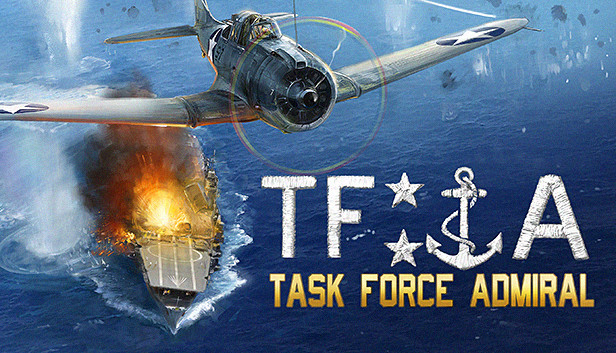
Well, kids, the first actual playable demo of Task Force Admiral (TFA) has been released! Those of us who were brought in for the beta had their games updated and we can now get a taste of how this game plays!
For those who don’t know, Task Force Admiral is an upcoming naval warfare simulation/war game that puts the player in command of an American carrier task force in the Pacific in 1942. With a focus on historical realism, the game aims to recreate the carrier task force operations of that period, with the player taking the role of a flag officer and making operational decisions that could affect the course of the gameplay. Since I’m an amateur naval historian focused on the Pacific War, well, this game is clearly right up my alley and one that I’ve been highly anticipating for some time now. In fact, I first wrote an article on the development of this game back in 2020 and then got the “viewable” beta build in the summer of 2023. It’s crazy to think I’ve been following this game for roughly 5 years now!
Video
Here’s a video I made of the gameplay using the battle generator:
I’ll briefly summarize my overall initial impressions. Most of what I cover below is mentioned in the video during my commentary.
Critical Observations
Positives
- The depiction of WWII aircraft carrier air operations is exceptional…at least to my knowledge. It’s the best I’ve seen in any video game!1 This is pretty much a given since it’s the core gameplay mechanic. For example:
- The carrier turns into the wind to launch and recover aircraft.
- The deck operations for spotting, launching, and recovering aircraft are well-modeled.
- Aircraft enter the recovery pattern realistically and even catch different wires when they land.
- The planners for setting up searches, strikes, and Combat Air Patrol (CAP) are fairly intuitive and easy to set up.
- The A.I. routines are very good. Given that the player takes the role of a task force flag officer (essentially Adm. Frank Jack Fletcher at this point in 1942) means that the player is more hands-off when it comes to the action. Your role is just to oversee the operations of the task force and you don’t do any real “trigger-pulling.” This necessitates that the game has good A.I. that behaves in a historically realistic manner. Thus far it seems to work very well! The aircraft and ships maneuver realistically (for the most part), but more importantly, they use historically accurate tactics. All this without the player’s input! It doesn’t feel like you need to micromanage your forces.
- The details on the ship and aircraft models appear to be better compared to the ones in the earlier build.
- The randomization and variability built into the game are excellent and ensure that no game plays exactly the same. For example, when the enemy knows they’re detected, they’ll begin maneuvering their task force randomly to attempt to throw you off.
- The music is dynamic and appropriate for setting the mood of the game.
- The game camera works well and allows for very cinematic shots.
Negatives
Keep in mind that this is still a work in progress, and I certainly don’t expect a flawless product. However, I hope that the developers will take this as constructive critique in the hopes that they can create a better product for us to enjoy.
- The aircraft occasionally collide with each other when dogfighting (this is a known glitch and has been disabled for now).
- I still see some artifacts or texture glitches, particularly with clouds. The shadows also behave incorrectly at times.
- Some animations are still incomplete.
- An option to lower the volume of the game’s sound effects would be appreciated.
Other Things to Mention
- The use of kilometers on the map scale is a bit weird. Being naval-focused, they’d measure distances in nautical miles (nm), not kilometers. The use of the metric system in the U.S. military didn’t become widespread until the 1950s. However, the U.S. Army has been using the term “klicks” (for kilometers) since WWI.
- The ships do a good job of maneuvering to avoid collisions, but I had two instances of what would have been collisions. Once between the carrier and a destroyer and the other between the carrier and a heavy cruiser. Damage from collisions is apparently not modeled yet. The ships also maneuvered incredibly well for their size when they came close to colliding. I’ve never seen 25,000 tons of aircraft carrier turn that sharply.
Final Thoughts…So Far
This game is clearly a passion project for these people and I commend them for their hard work. Granted that there are still things to complete and lots of bugs and glitches to work out, but I see a game with solid mechanics to build off of.
The developers were wise to pick a very specific period in the Pacific Theater (1942 and only the Central and South Pacific) for which to model the game. This allows them to focus more on getting details about the ships, aircraft, and events accurate, and also to avoid “feature creep” in the game. A major problem with many games of similar scale is that they essentially bite off more than they can chew. Had the developers tried to model the entire Pacific Theater, then we would’ve ended up with a game that models a lot of things, but not very well or very accurately.2
I’m extremely impressed with what the Drydock Dream Games team has created so far. I was previously “cautiously optimistic” about how this game would turn out, but from what I’ve played so far, I’m now very optimistic that they can deliver an extremely good product. Once this game is completed, I feel that the developers will have a solid platform (and developing experience) to expand this game out to future titles, such as later in the war. Recreating the massive naval battles of the latter part of the Pacific War (Philippine Sea, Leyte Gulf, Okinawa, etc.) would be amazing.3 Not to mention that the game could potentially accommodate other theaters, such as the Mediterranean or the Atlantic. But let’s not get too far ahead of ourselves. The question is: could the game engine handle it?
Notes
- Carrier Command 2 doesn’t really count since that takes place in a science fiction setting, but it does have fairly accurate carrier air ops. ↩︎
- Compare the current state of the similar game Sea Power: Naval Combat in the Missile Age by Triassic Games as of February 2025. That game models the entire world and multiple countries’ naval and air forces. However, the artificial intelligence routines for the aircraft are very poor and require a lot of micromanagement from the player. That said, the comparison isn’t really fair since these are two different games from two different developers with different scopes and gameplay mechanics. ↩︎
- From my understanding, a lot of what happens with the development of a video game series is that once the first game is released, subsequent games in the series essentially reuse the original game’s code as a template, but feature new assets and modified mechanics. This allows subsequent games to be released much more quickly. ↩︎
 Fair Winds & Following Seas