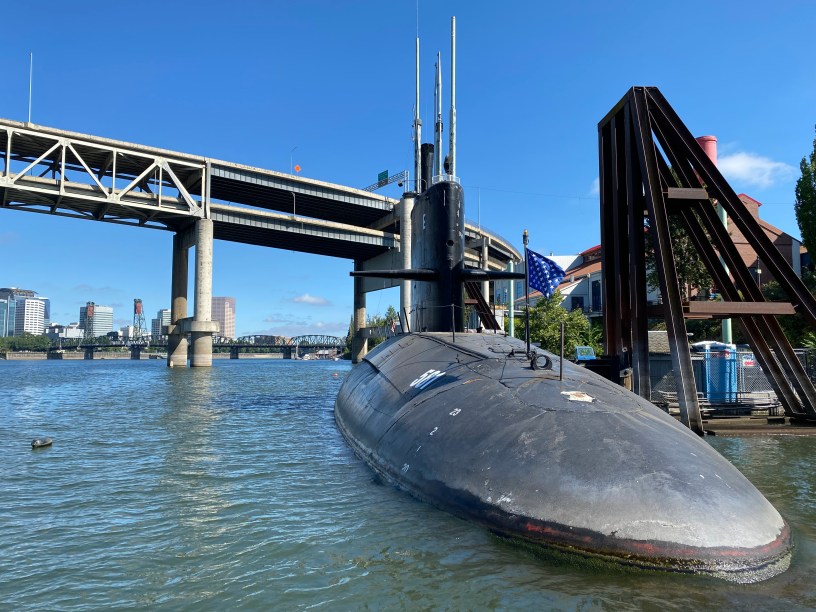
The Oregon Museum of Science and Industry (OMSI) is located in Portland, Oregon on the east bank of the Willamette River. In addition to the featured exhibit(s), the museum also features the decommissioned U.S. Navy submarine, USS Blueback (SS-581) on permanent display. Daily 45-minute guided tours are offered several times an hour, and for those looking for a more in-depth experience, 3-hour technical tours are offered several Sundays each month.
The accompanying video below is a highly detailed version of my regular tour, and this blog post will be an even more detailed breakdown of the submarine, its systems, and life aboard submarines, in general. No doubt more information will be added to this post as I learn more about the submarine and its systems.
Table of Contents
- Table of Contents
- Author’s Note & Disclaimer
- Video
- Barbel-class
- Exterior
- Interior
- Conclusion
- Notes
- Bibliography
Author’s Note & Disclaimer
I should establish that I am approaching this museum ship with a definite bias since I have experience as a tour guide on this submarine. Every museum has a particular interpretation of its exhibits, and OMSI is no different. As a museum, OMSI has displayed Blueback in a certain way and wants the interior to be kept as close to the original as when she was in service.
All of the tour guides on Blueback operate off a basic set of information about the boat and the experiences of the sailors who served on it. Many of the tour guides are Navy veterans and qualified submariners. Others, such as me, are not. As of 2025, there are only two (volunteer) tour guides on the staff who served on the three boats of this class, so their understanding of this submarine is far beyond any of ours. Contrary to what some people think, naval/sea/submarine experience is not required for this job (or to be a volunteer), and it really has little bearing on the quality of the tour. No, we DO NOT memorize a script. You will hear different stories from different tour guides because we each make the tour our own. The technical information about the boat will be (mostly) the same and it only constitutes a small fraction of the tour. Most of what we talk about is the life of submarine sailors. In fact, there is so much to talk about that you could easily take the tour with five different tour guides, and you will get five different tours. Our job is to provide “interpretive tours” to the visitors. My interpretation is by no means the final say, and I will try to make it clear when I am incorporating information from other tour guides or sources in this article.
Some people have a problem with guided tours because they cannot go at their own pace, but the interior of the boat is not conducive to self-guided tours. Furthermore, the tour guides are trained to keep the tours to around 45 minutes, so you will spend no more than about 5 minutes in each area, with additional time allotted for moving from room to room. Simply put, there is no way for the tour guide to put all the information and stories about this submarine into a single tour. One thing a tour guide does not want to do is to go so slow and let the incoming tours back up behind them. So we cannot just stay in one place and talk for an hour about whatever; we need to keep the tour moving because another tour is coming up right behind us.
For those desiring a longer and more detailed tour, I recommend buying tickets for a Technical Tour.
A word on historical research: One of the biggest frustrations historians encounter when doing research is determining what sources to use and their reliability. I have tried to source information from official published sources, as well as the submarine itself. However, I have also had to rely on my fellow tour guides for additional information that may not be in published sources. The problem with any kind of hearsay or oral history (which is essentially what a guided tour is) is that there is always the danger of misattribution. Given that only two guides served on the Barbel-class boats (and only one of them on Blueback herself), I usually take what I hear with a grain of salt. Just because they say it happened on their submarine does not mean it applies to this submarine. Memories change over time; some of the recollections of these tour guides are decades old, and some stories based on personal experiences may only apply to that particular person. The reality is that our memories are extremely fallible and prone to influence from other sources despite our best efforts. Hence, I am very wary of believing everything I hear from an oral history unless I can verify the details from a published source. In other cases, the oral history is all I have to go on.
Disclaimer: The personal statements, opinions, omissions, and errors expressed here are the author’s own and do not necessarily reflect the official policies or positions of either the Oregon Museum of Science and Industry (OMSI), the United States Navy, or the United States Government. While strong efforts are made to ensure accuracy, all information is subject to change without notice.
Video
(I’m redoing the video to correct some inaccuracies in it.)
I have only found a handful of videos on YouTube with decent camera work and audio that feature an entire tour. So I decided to make my own. I shot it in segments and added some notes in post-production. What is shown in the nearly 2-hour-long video is an extremely detailed version of what would be my own 45-minute tour. Bear in mind that this is a general tour and not a 3-hour-long technical tour because I am not qualified to give those (only qualified submariners give those tours). I also included a lot of information in this video that I would not include on my normal tour because I am not limited by a 45-minute long time constraint here. Additionally, this video is not meant as a substitute for an actual tour. I encourage anyone interested to book a tour of the submarine and visit the museum if you happen to be in Portland, Oregon. There is nothing quite like seeing the real thing up close and personal. You will get to see, touch, hear, and smell the real submarine, and you will hear different stories from our different tour guides. Each of us gives a unique tour!
What I discuss in this video is down below; however, the blog post contains even more detailed information about the submarine, its systems, and naval history that would not be on any tour.
Barbel-class
USS Blueback (SS-581) is one of three Barbel-class submarines constructed; the other two are USS Barbel (SS-580) and USS Bonefish (SS-582).1 These were the first production attack submarines in the U.S. Navy with a teardrop-shaped hull (AKA body of revolution, or Albacore hull, after the experimental USS Albacore (AGSS-569)). Blueback was built by Ingalls Shipbuilding Corporation in Pascagoula, Mississippi for a cost of $21 million.2 Her keel was laid down on 15 April 1957, she was launched on 16 May 1959, and commissioned on 15 October 1959. After 31 years of service, she was decommissioned on 1 October 1990 becoming the last diesel-electric attack submarine in the U.S. Navy. When she was decommissioned, she left the Navy with an entirely nuclear-powered submarine fleet.3 I will withhold any further discussion of her service history for an article on the Barbel-class itself.
Following her decommissioning, she was laid up in the Pacific Reserve Fleet in Bremerton, Washington. Through a community effort led by Oregon Senator Mark O. Hatfield, OMSI acquired the submarine, upon which she was towed up the Willamette River and permanently moored at the dock in February 1994. She was opened up to public tours on 15 May of that year.4
Exterior
Approximately 90% of the Blueback (both exterior and interior) is original; however, all classified materials and equipment were removed by the Navy before turning her over to the museum. Additionally, roughly 62% of the submarine’s systems are still operational…and the tour guides are not going to tell you which ones are because they do not want you touching any of the buttons, switches, knobs, or valves. Some of them do set off alarms, and you could damage the equipment.
While the Navy technically still owns the boat it would never be put back into service for several reasons. First, a submarine’s hull is only good for about 30 years (give or take) before it needs to be decommissioned due to metal fatigue. Second, the museum cut a big hole in the side of the hull for the visitor’s entrance, which compromised the hull’s structural integrity. Third, the screw was unshipped and placed next to the museum building as a monument. Fourth, the electric motor was damaged in a fire at the end of her service life and would require replacement. Fifth, the flood ports (and other hull penetrations) on the bottom of the hull were plated over because they were found to be clogged with river silt during her last drydock period. Sixth, the torpedo tubes were welded shut.5
Sail
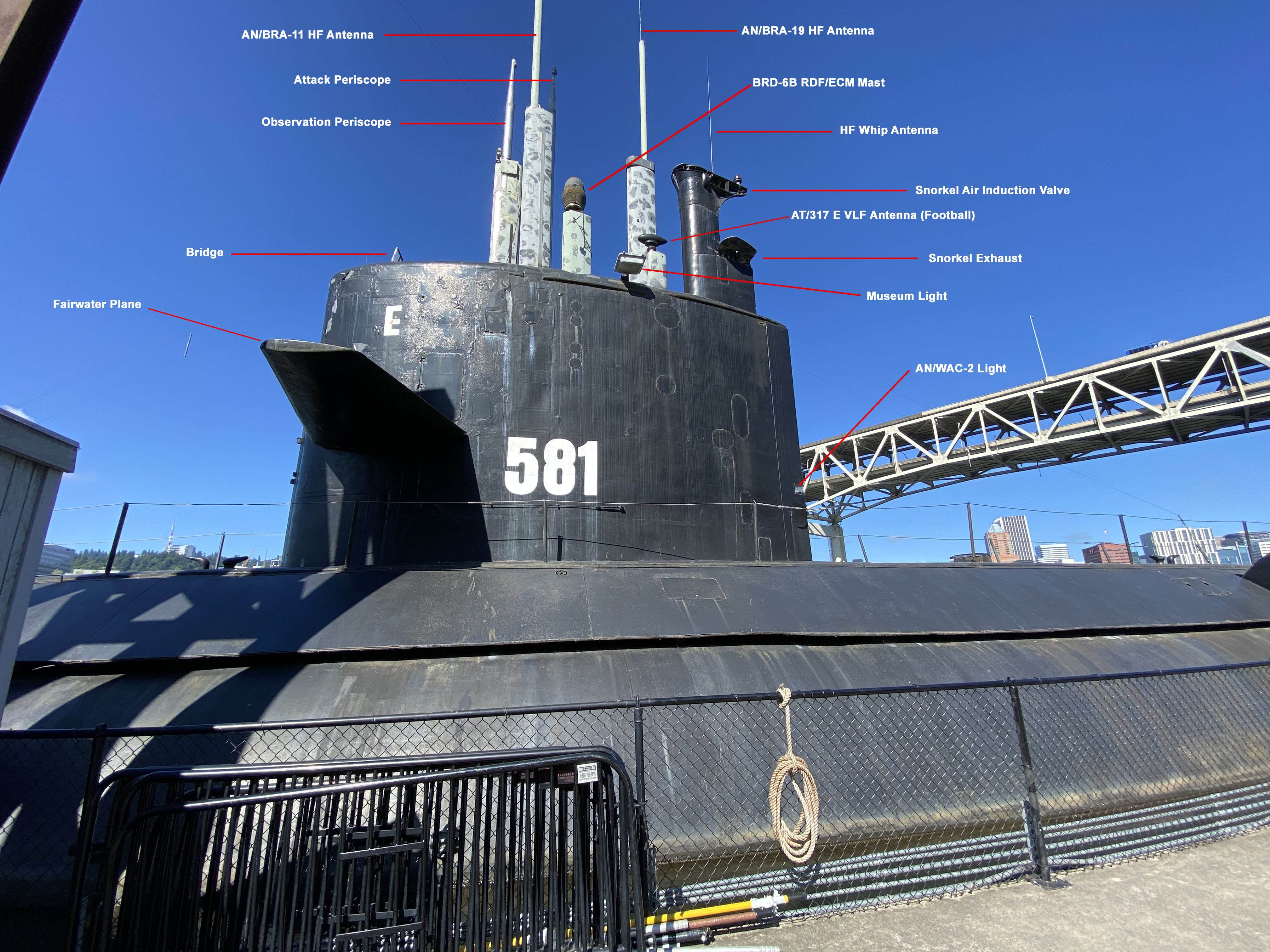
The large rectangular structure sticking out of the hull with the “581” on it is known as the sail. The number 581 means that she was the 581st planned submarine commissioned by the U.S. Navy. So “SS-581” means “Ship Submersible number 581.” This number will never be used again and the newer Virginia-class attack submarines currently under construction will go into the 800s.
The sail has nothing to do with wind power, but the Navy likes using old words for things. Rather, its purpose is to house the masts of the submarine. Blueback‘s sail contains the submarine’s two periscopes, radar antenna, high/low-frequency antennas, ECM/DF antennas, and the snorkel. They are currently displayed in their extended position, but they would fully retract down into the sail when the submarine submerged.
Here are the masts that are currently extended:
- Observation Periscope – The forward-most periscope. It would be the larger of the two, but this is not the original Type 8 observation periscope from my understanding. (The original observation scope was removed because it had classified ECM intercept equipment on it.)
- Attack Periscope – This is a Type 2 periscope. It is physically smaller in profile to make it harder to detect. It would also have an Ultra High Frequency/Identification Friend or Foe (UHF/IFF) antenna operating in the 200 – 500 MHz frequency range. (This is also not the original attack scope.)
- AN/BRA-11 & AN/BRA-19 – The BRA-11 is a helical antenna and the BRA-19 is a telescoping whip antenna. These are High-Frequency (HF) transmitters operating in the 2 – 32 MHz frequency range. Both are capable of receiving in the low, medium, and high-frequency ranges.
- BRD-6B – This is a Radio Direction Finder (RDF) and Electronic Countermeasures (ECM) mast. It can be used for navigation and radio surveillance.
- AT/317E (AKA the football) – This is a Very Low Frequency (VLF) loop antenna capable of receiving signals up to 90 feet underwater.
- Snorkel – This contains the air induction valve at the very top and the exhaust just under the plate (AKA batwings) about halfway down. There is also an AT-497/UHF whip antenna on the top of the snorkel.
There are two more masts in the sail that are currently not raised. One would be the AN/BPS-12 surface search/navigation radar antenna next to the BRD-6B antenna. The other would be the AN/BLR ECM/ESM mast (for radar interception and direction finding) between the AT/317E and BRA-19 antennas. This mast is distinct from the BRD-6B antenna. The reason these masts are no longer extended is that they lost hydraulic pressure during Blueback‘s last drydocking in 1998. (Further discussion of the ECM/ESM system below.)
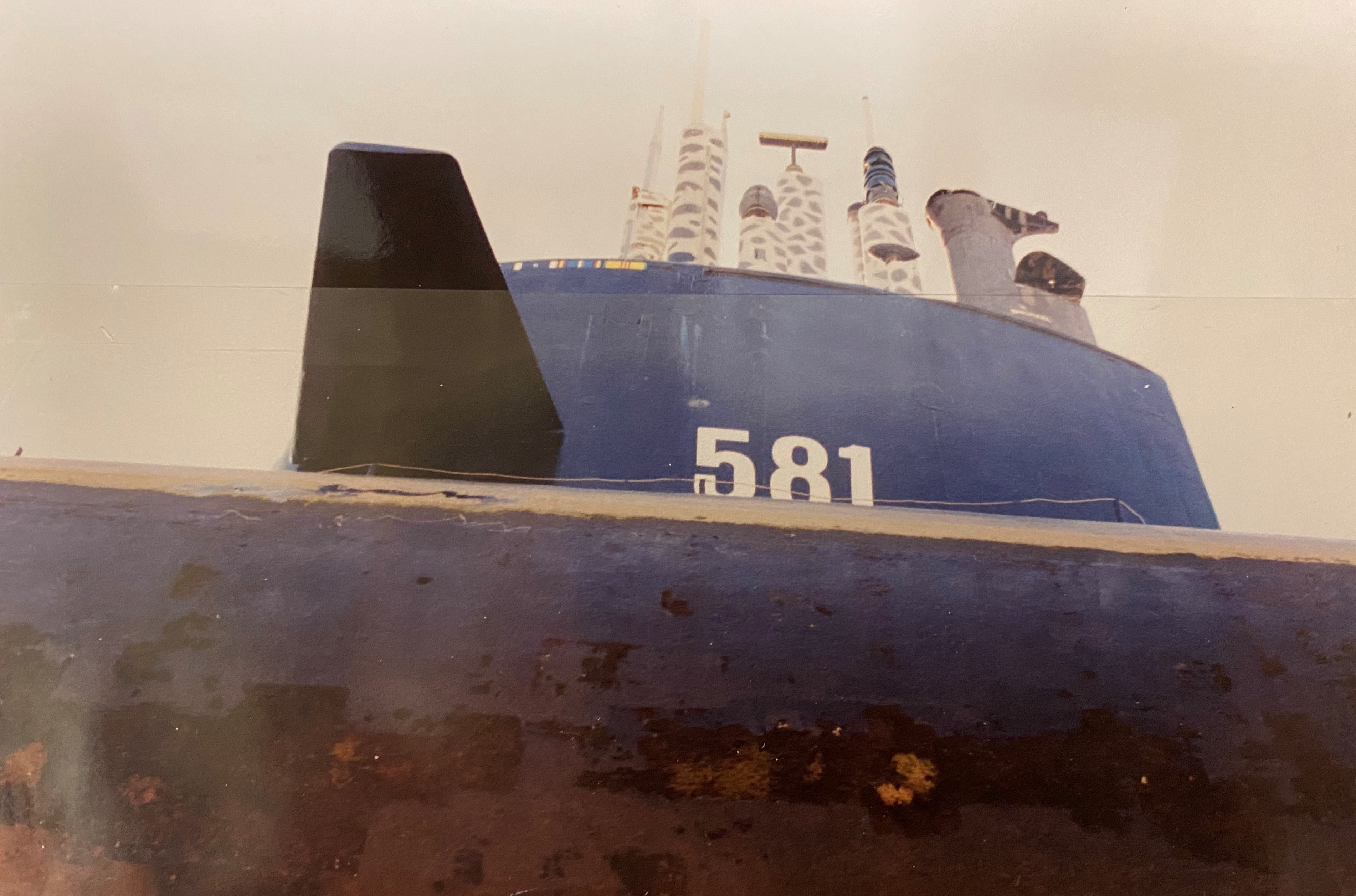
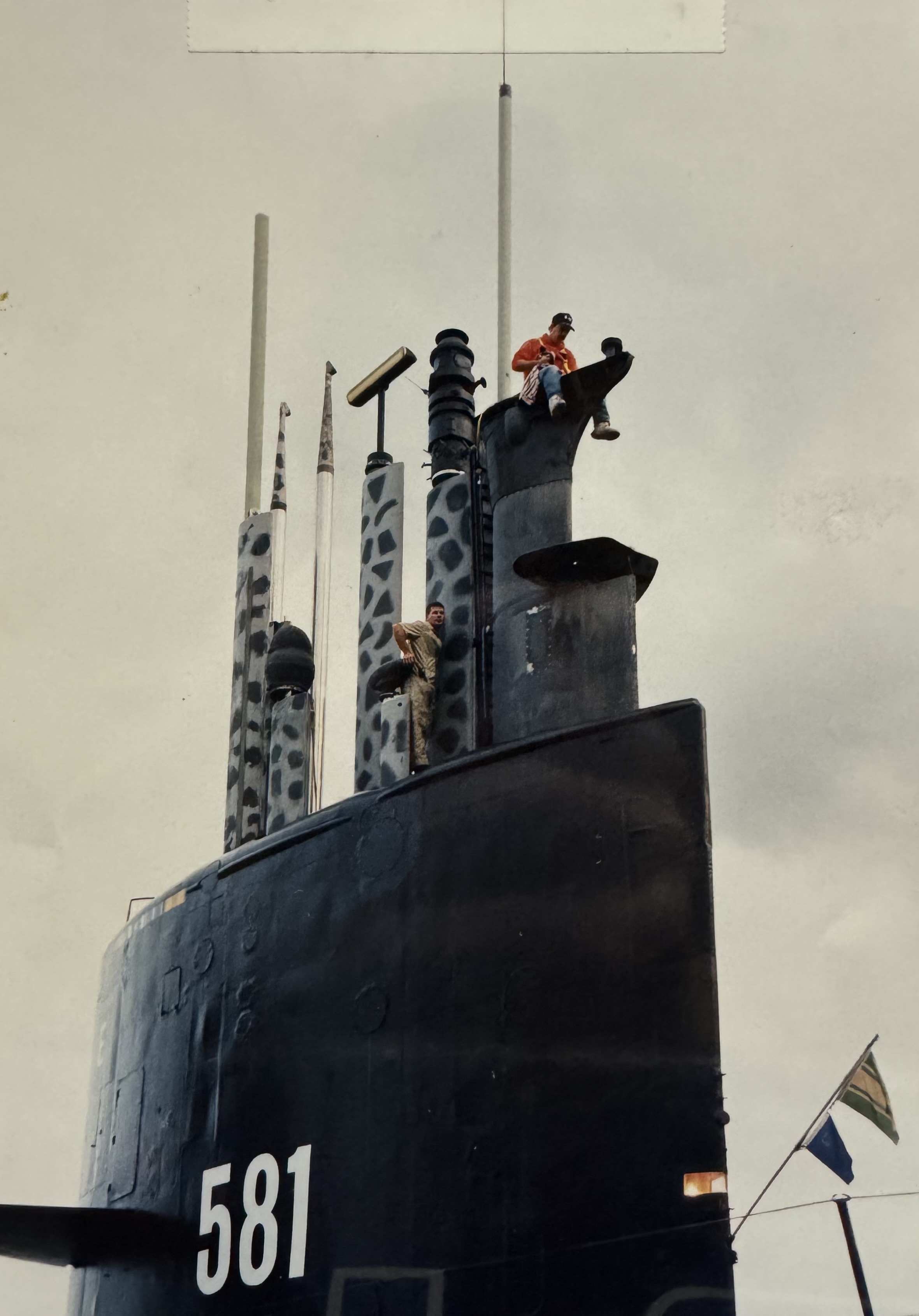
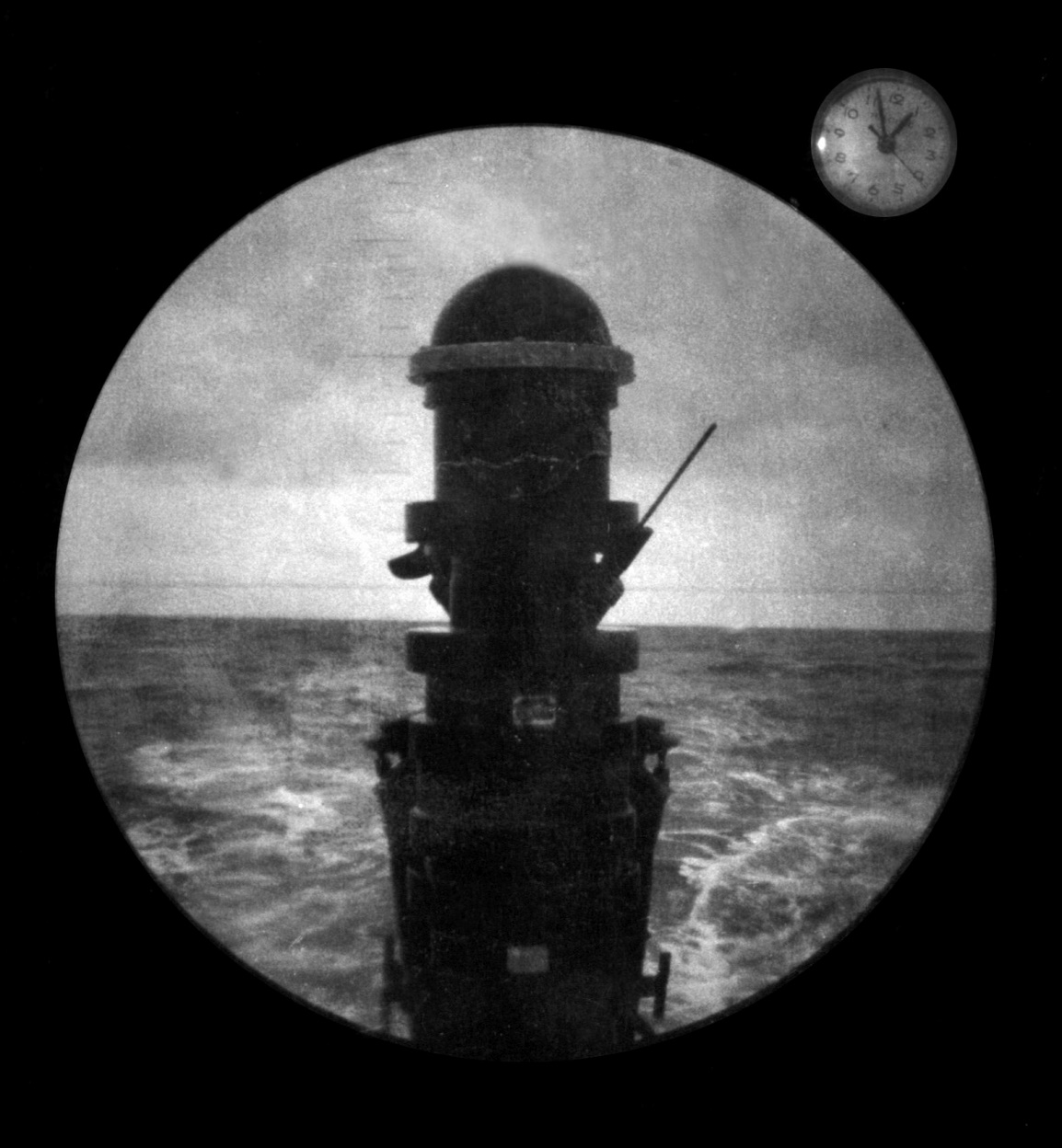
There is also an access trunk in the forward part of the sail which leads to the bridge at the top. It is about a 25-foot climb to the top of the sail from the control room, but the sail is not a conning tower like on WWII fleet boats, and it is not a habitable space. The interior of the sail that houses the masts is actually free-flooding. The bridge trunk can be accessed from inside the control room, just forward of the periscopes. (Tours are not allowed up in the sail or on the bridge given the vertical ladders and lack of space. The only reason staff go up to the bridge is to perform maintenance.) This is also not an entrance/exit to the submarine, either today or when it was in service, because there is no way to get to the top of the sail from the outside without lowering a rope ladder.
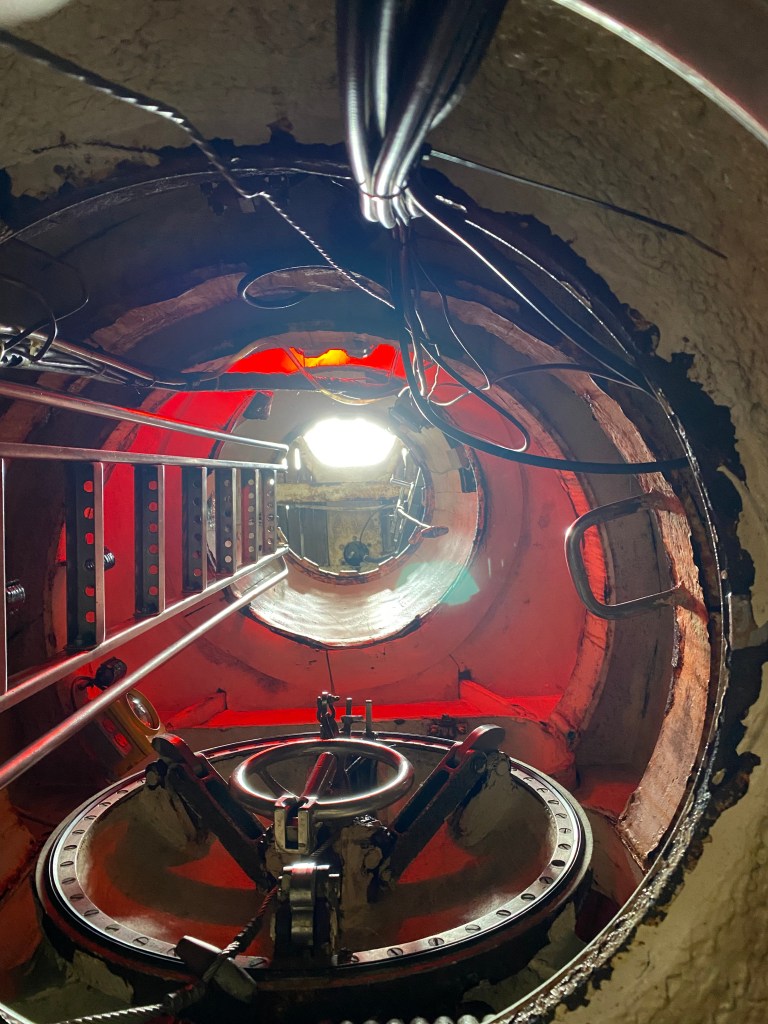
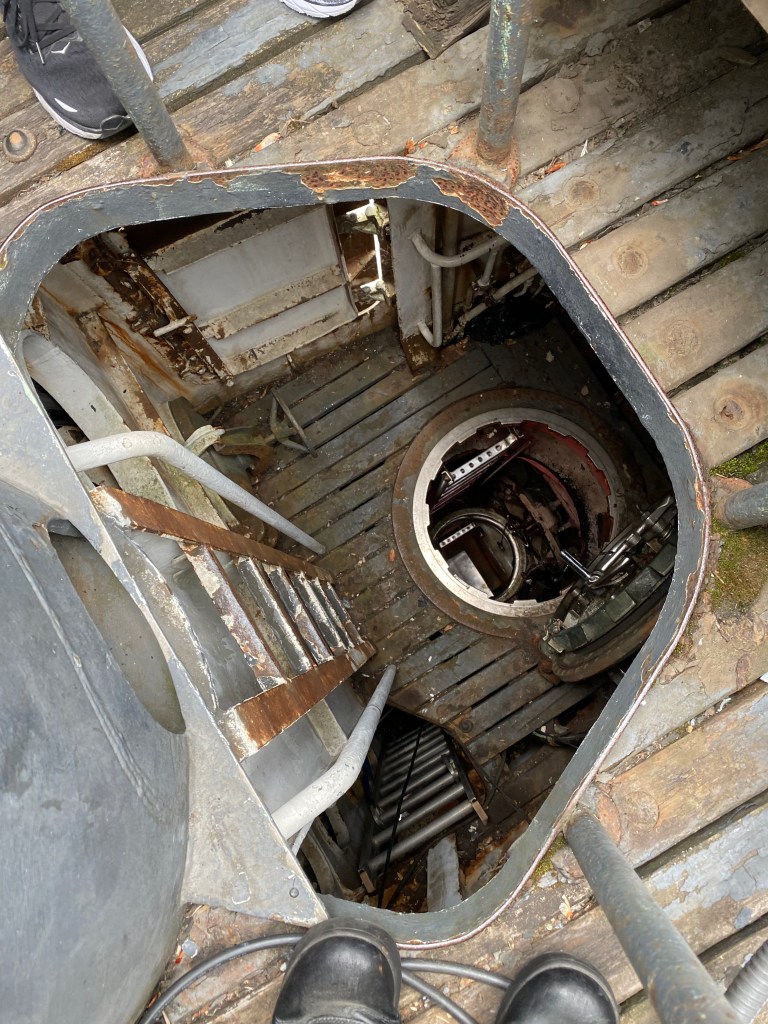
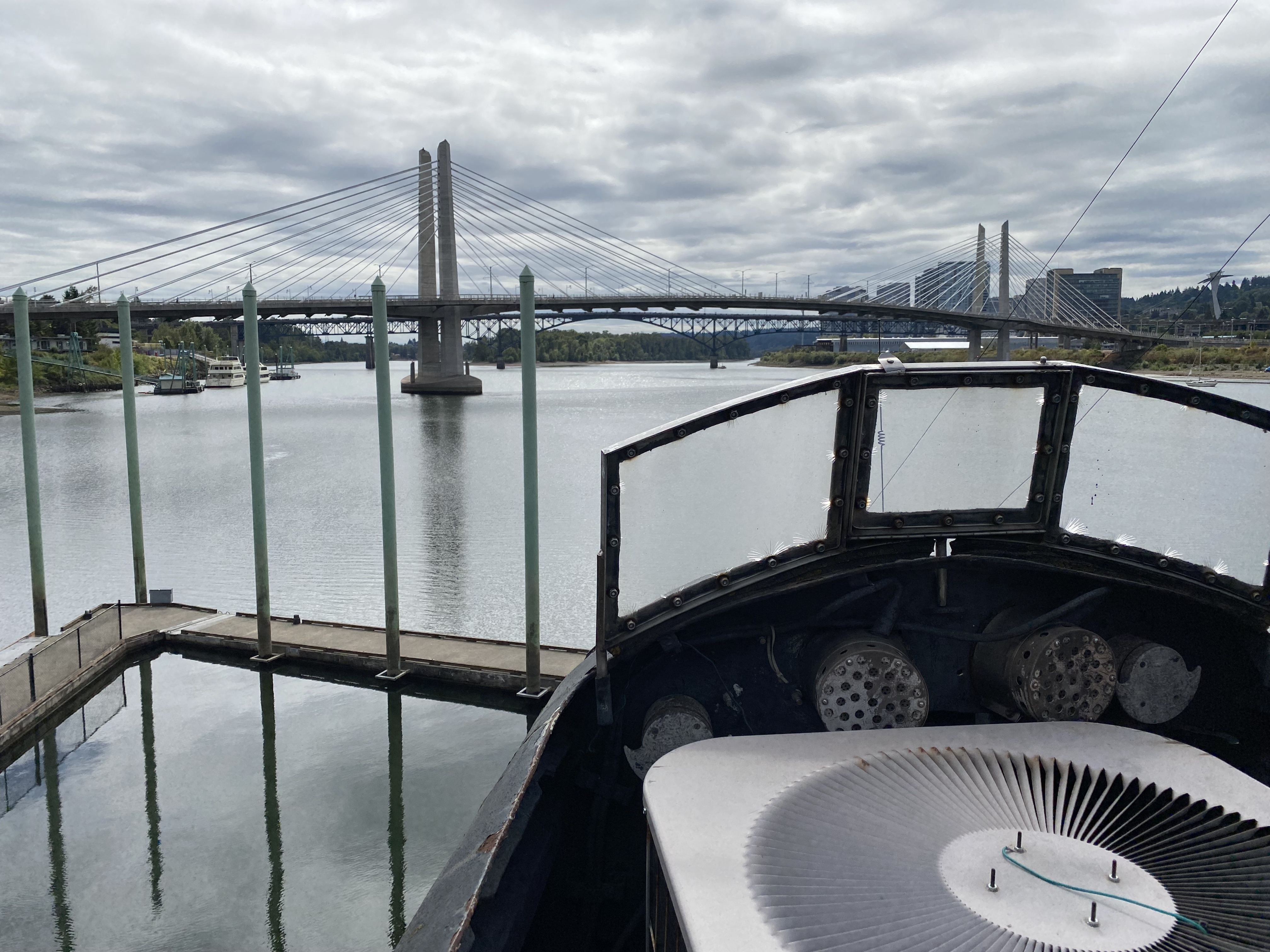
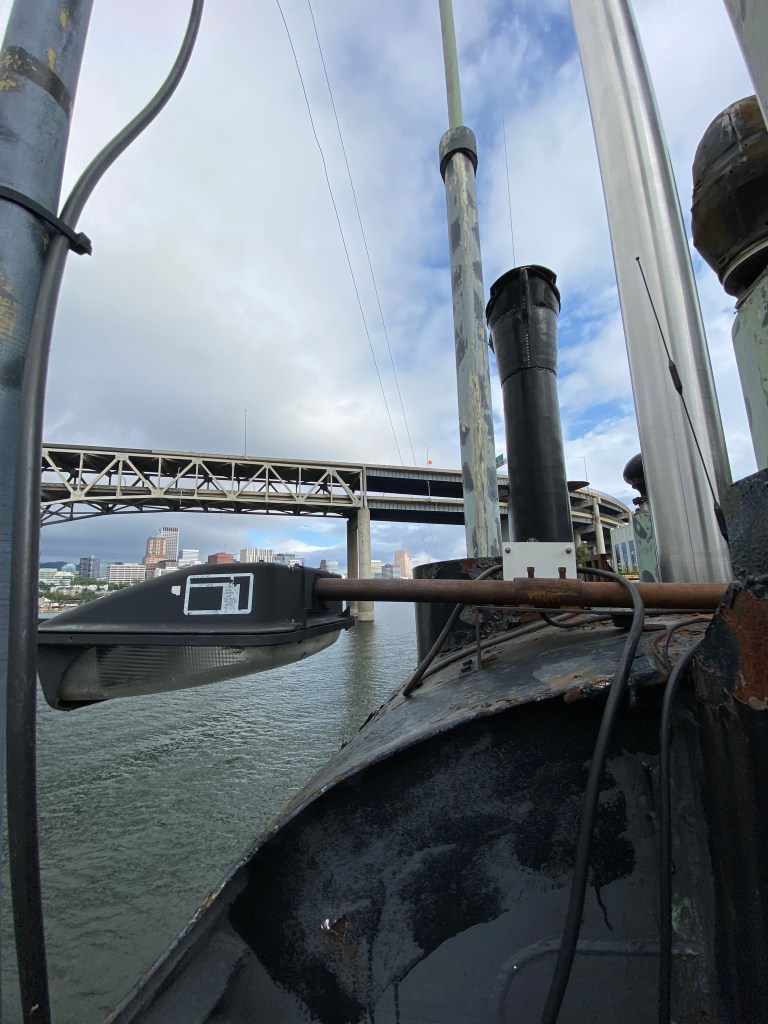

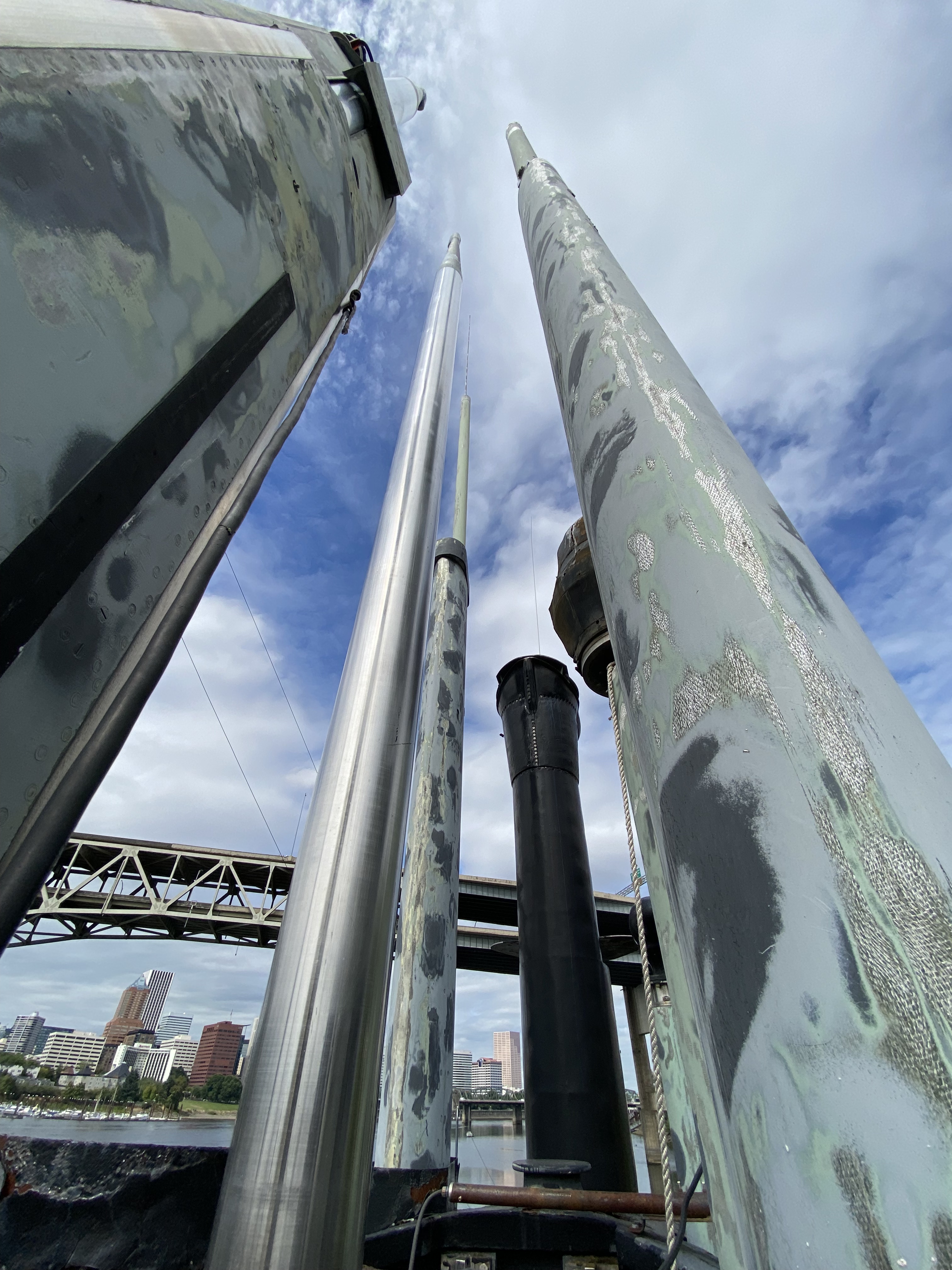
After climbing up through the two hatches in the trunk, you come to a small landing that has two doors on the port and starboard side. These lead out to the fairwater/sail planes. Another small ladder from that landing goes up to the bridge. Currently, most of the space on the bridge is taken up by a heat pump that is part of the museum’s HVAC system for the submarine. From the keel to the top of the sail is 48 feet 2 inches. (The distance from the keel to the main topside deck is 29 feet 3 inches.)
You may notice that the sail has various circular or oval plates on the side. These are placed in specific areas to access the masts (either when raised or lowered) when they need maintenance and repair. The sail itself is free-flooding since air bubbles would create noise as the sub dives. Only the access trunk would need to remain watertight and withstand the water pressure at depth.
Hull

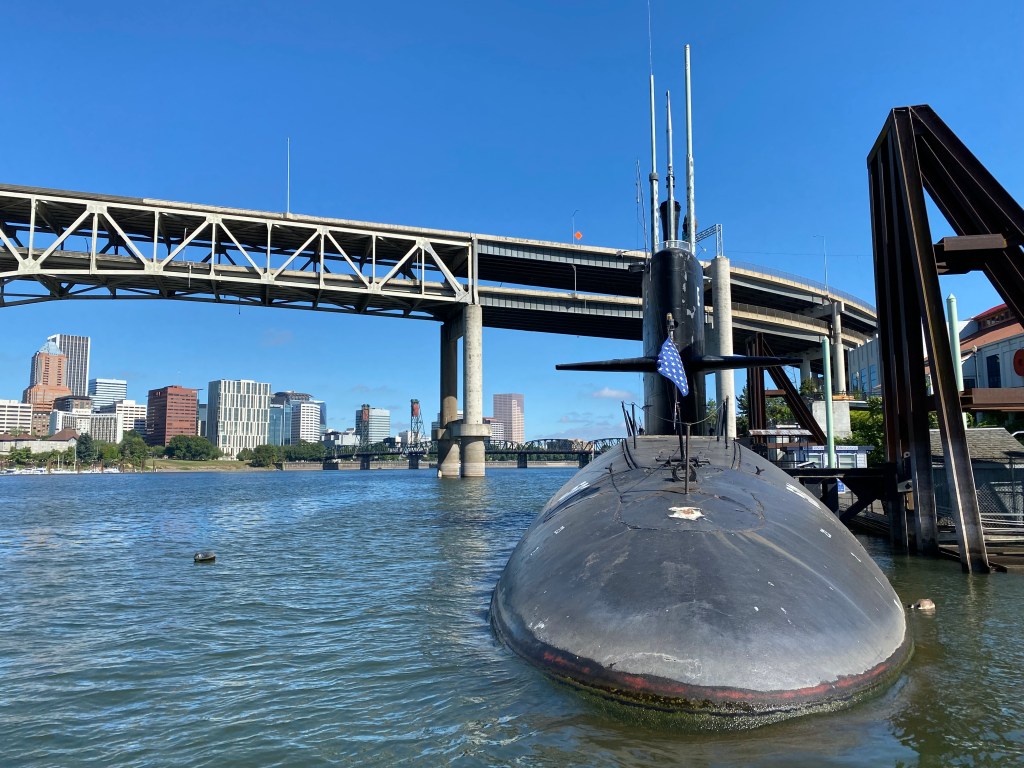
Physically Blueback is 219 feet 6 inches long and 29 feet wide at the beam. She displaces around 2,158 tons on the surface and 2,649 tons submerged. The hull is made of HY80 which is a high-tensile, low-carbon steel composed of a combination of nickel, chromium, and molybdenum (along with various other trace elements). “HY” means High Yield and “80” means it can withstand 80,000 pounds of pressure per square inch.6 Blueback is a double-hulled submarine with the outer hull being 0.75 inches thick, and the inner pressure hull being 1.5 inches thick. Her normal operating test depth is 712 feet, with a calculated 50% margin of safety, so it can go deeper. However, around 1,050 feet the submarine is going to implode. It does not necessarily mean that once you hit 1,050 feet, the hull will automatically just give way and collapse, as the actual crush depth is not really known, but you do not want to find out exactly where that is. If it is any consolation, the implosion of a submarine would occur instantaneously. You would not even know what hit you.
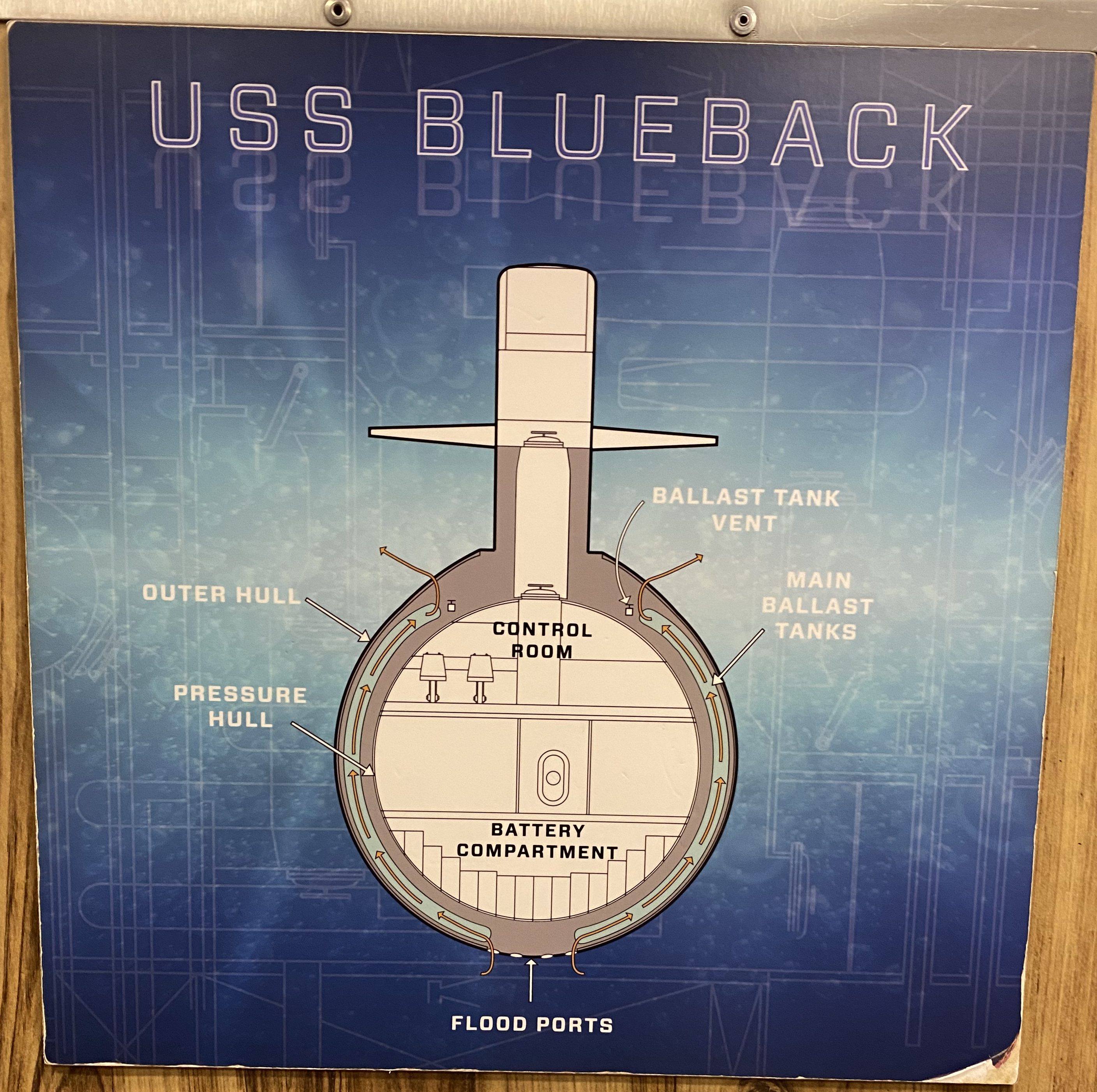
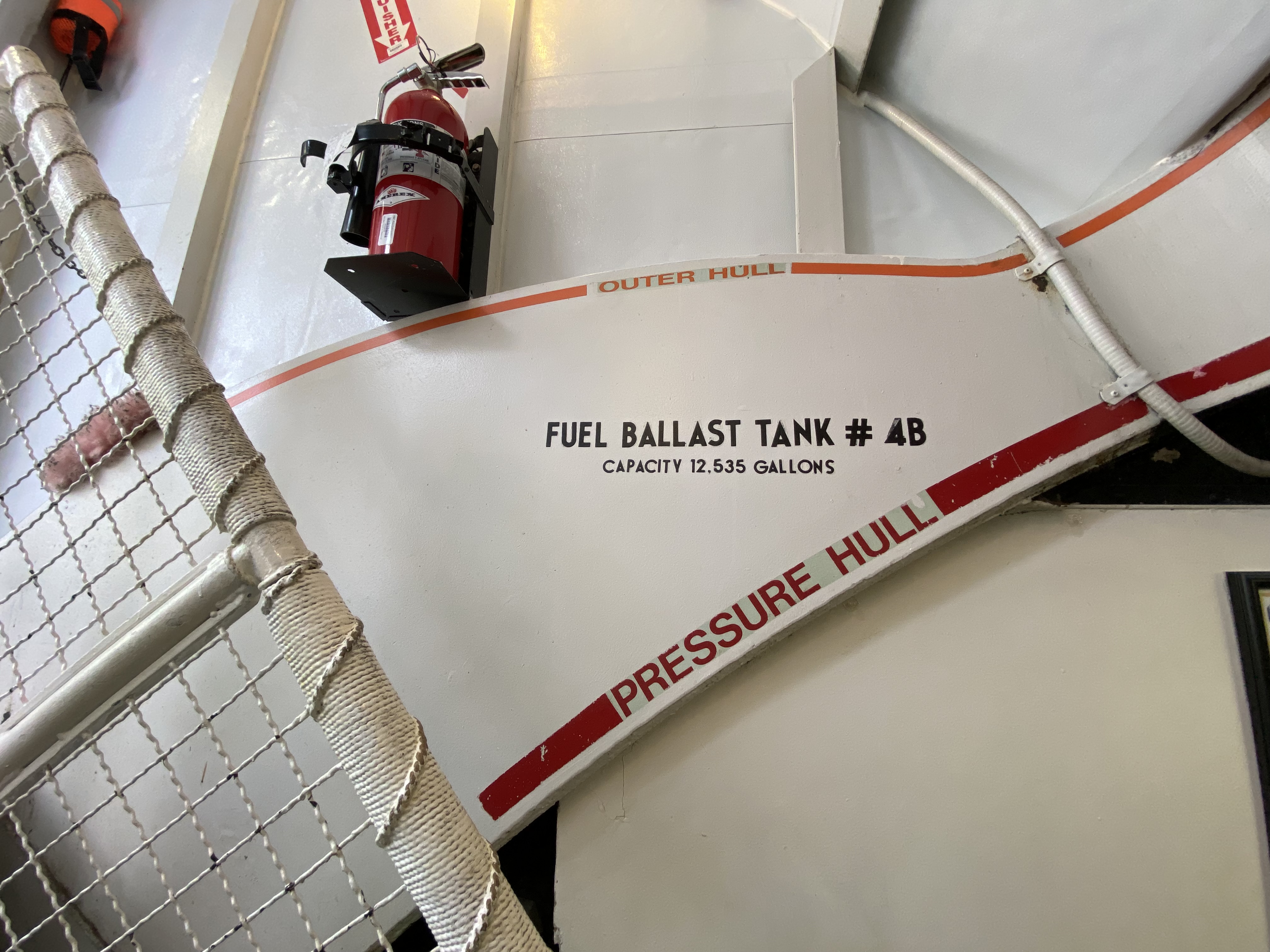
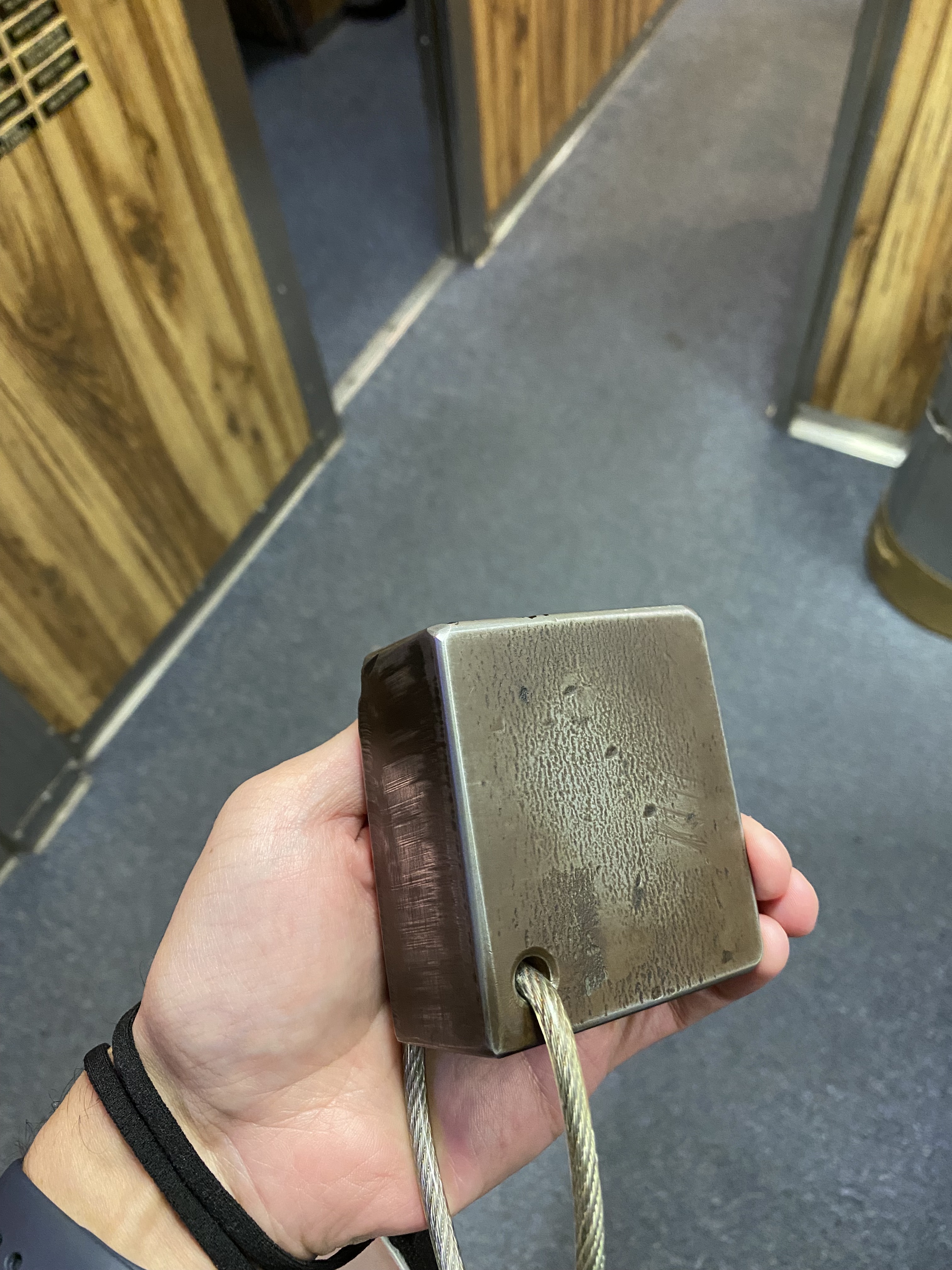
Between the two hulls are various tanks; six of which are the main ballast tanks. There are a series of flood ports on the bottom of these tanks that are open to the sea at all times and a series of vents on the top of the hull. When the vents are open, the air inside the ballast tanks escapes, and seawater floods in. Blueback takes on about 490 tons of seawater for ballast, and then the submarine will dive or submerge. It does NOT sink; that is considered a bad thing. “Sink” is what Titanic did after it found the iceberg in the Atlantic. That is a one-way trip and submarines want to avoid that scenario.

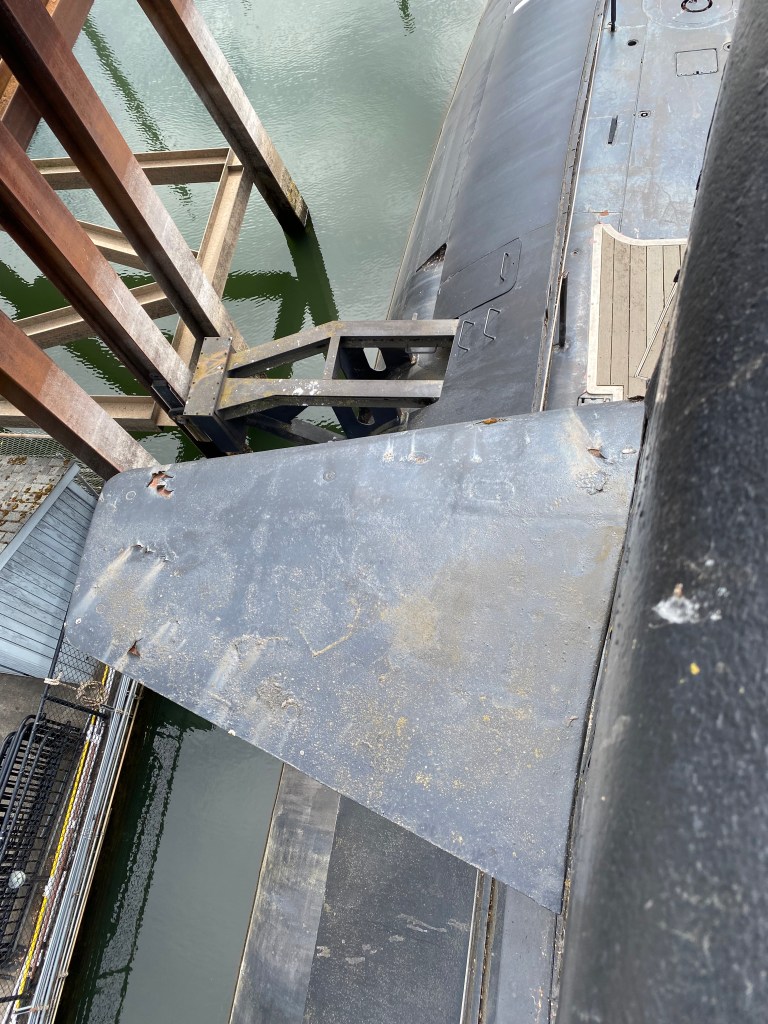
The sub is controlled underwater via a rudder and two sets of planes. The rudder is actually two symmetrical parts (upper and lower) that go through the centerline of the stern. The rudders have a maximum angle (left or right) of 37 degrees, but normally 35 degrees. Sticking out of the side of the sail are the fairwater planes (AKA sailplanes). These pivot up and down along their long axis and are used to control the depth of the submarine underwater. Originally, she had bowplanes, but these were moved to the sail in 1964, a few years after her commissioning.7 The fairwater planes have a maximum angle of travel of 22 degrees (up or down), but normally 20 degrees, with an average rate of travel of 5 – 9 degrees/second. The other set of planes, called the stern planes, are on the back of the submarine perpendicular to the rudder; although they cannot be seen because they are underwater. The stern planes control the angle of the boat when she is submerged. They have a maximum angle of travel of 27 degrees (either rising or diving), but normally 25 degrees. Both sets of planes move together since they are linked via the hydraulic rams. In other words, the sailplanes cannot move independently of each other (same with the stern planes).8
The gap along the length of her hull is called a turtleback.9 Essentially, it is a fairing that covers the upper portion of the outer hull and provides a flat surface to walk on when the submarine is on the surface. Otherwise, the outer hull is a completely cylindrical tube. Beneath the turtleback are pipes and other deck equipment that are stored there. If you look at a modern Ohio-class ballistic missile sub, you will also notice a turtleback that covers the tops of the missile tubes. The turtleback also means that Blueback is (technically) not a true Albacore-type hull. If you compare the two submarines, the USS Albacore‘s hull is distinctly more streamlined.
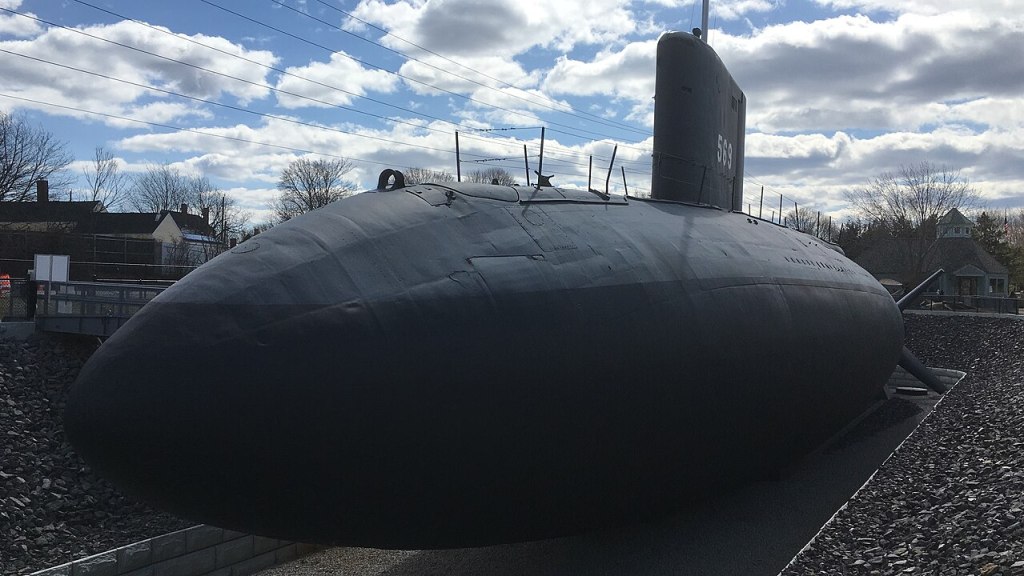

The hull of Blueback had pylons welded onto it which are secured into railings within triangular steel pilings that are sunk into the riverbed. Since the submarine (along with the dock) is floating on the river, this allows it to move up and down along the pilings with the water level. This is important because, in late January and February 1996, the Willamette River flooded. The water level became so high that it went over the bank of the esplanade and flooded the basement of the museum! The ramp that allows access to the sub was submerged. (The dock floated up along the green pilings in the river.) Blueback remained afloat, but she nearly reached the tops of the steel pilings and reportedly a tugboat had to be brought in to make sure she did not break free and float down the river. Following that flood, the tops of the green pilings were extended an additional four feet.
Admittedly, the boat does look a little grimy (as of 2025). It is technically overdue for drydocking where the hull will be cleaned, repainted, etc. The last time Blueback was drydocked was in 1998 and museum ships are generally drydocked around every 20 – 30 years. However, the sheer expense means that it is unlikely she will be drydocked anytime soon.10
Hawaii Five-O
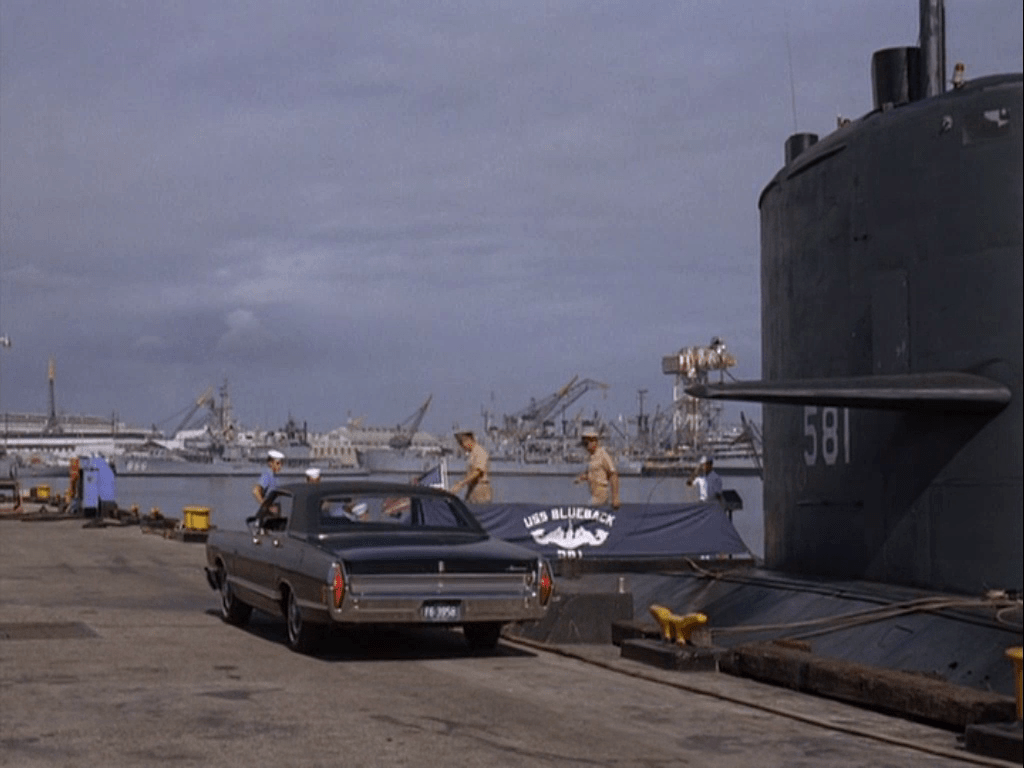
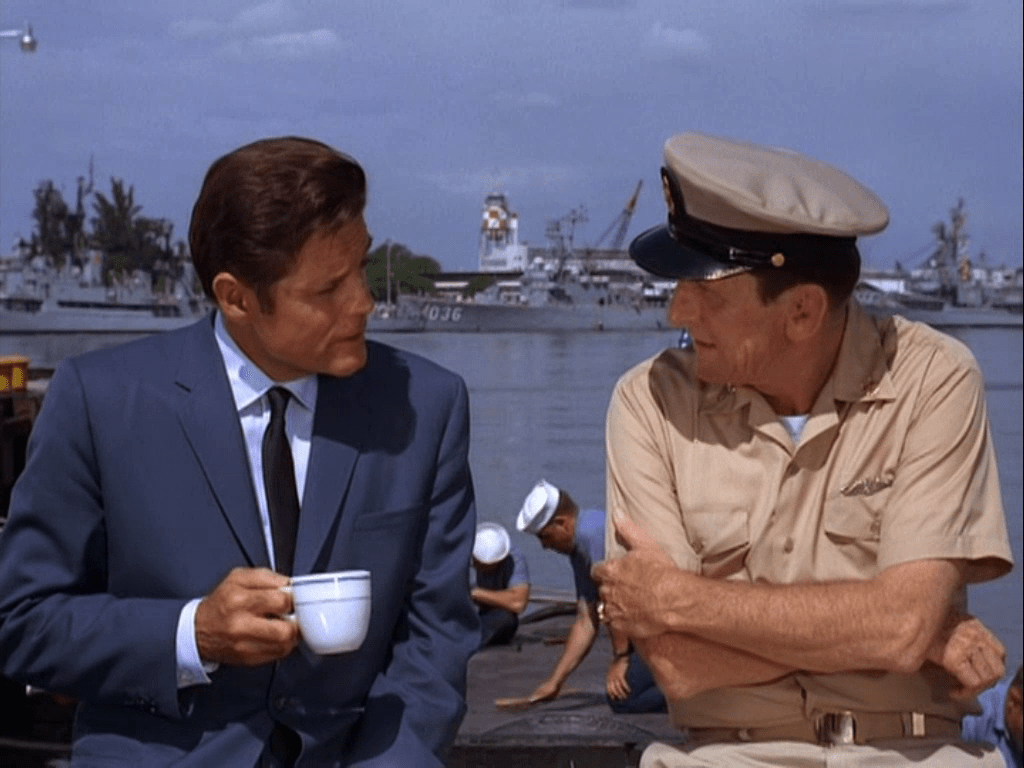
Blueback had a short cameo in the 1968 TV series Hawaii Five-O in Season 1, episode 5, titled “Samurai.” She was homeported in Pearl Harbor at the time. Reportedly, the show’s producers wanted to film a nuclear-powered submarine, but the Navy said:

Instead, they allowed them to film on Blueback, which looks similar to many nuclear fast-attack boats. In the episode, Steve McGarrett (played by Jack Lord) drives up the pier and goes aboard to talk to a Chief Petty Officer. He drinks some coffee and then heads back ashore.
The Screw

Next to the main building of the museum is the submarine’s fixed-pitch 5-bladed screw. This propeller is 11,002 lbs. of aluminum, manganese, and bronze, making it corrosion-resistant, and is 12 feet 6 inches in diameter.
Currently, the screw serves as a memorial, and on the bricks around the base are the names of the U.S. submarines that have been lost in service. One brick directly behind the screw notes that there is a time capsule beneath the screw that will be reopened on 24 August 2050. However, I have no idea what is inside it.
Prairie-Masker System
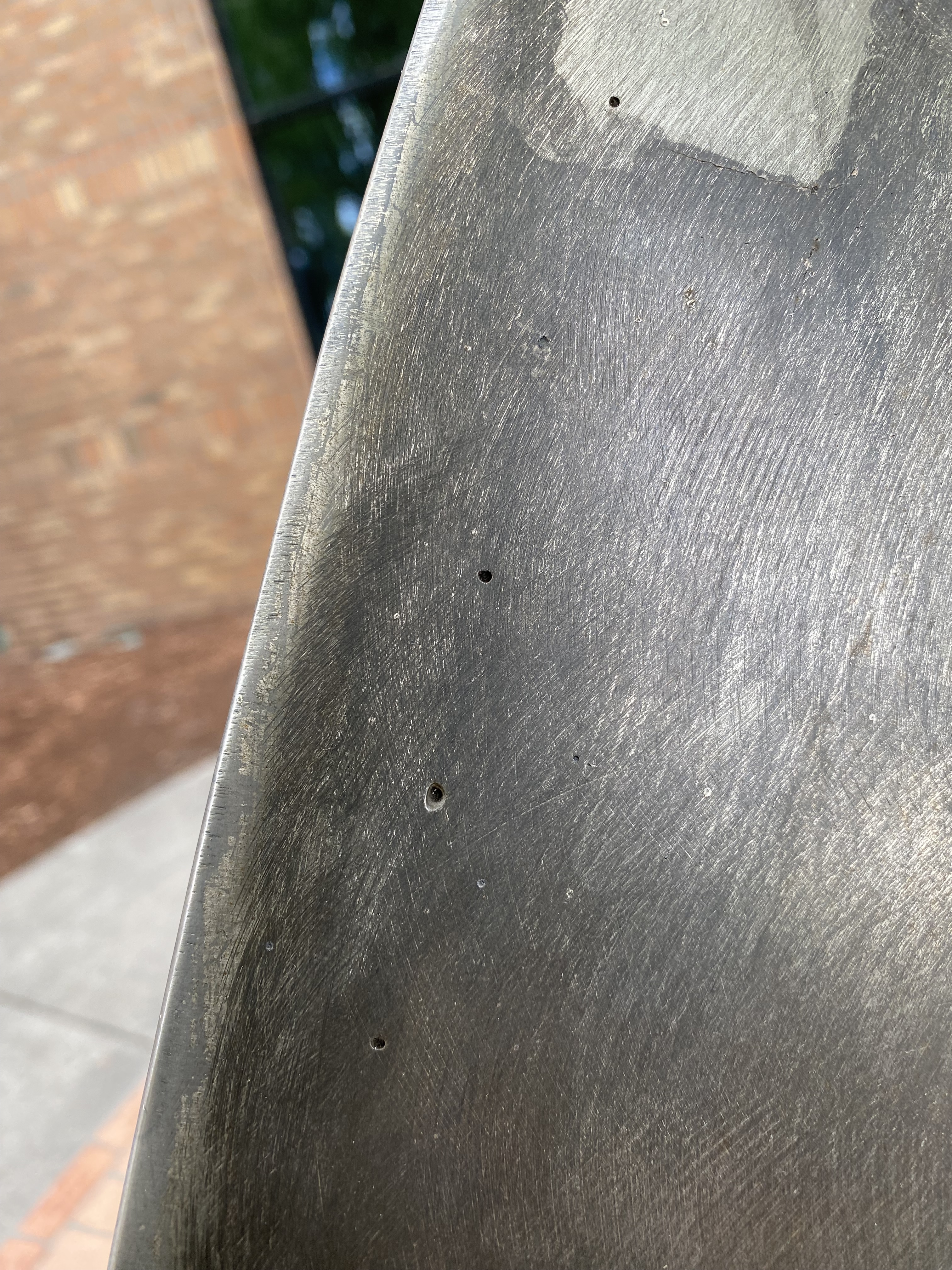
Note that the blades have small holes around their edges. This is actually the PRAIRIE part of the Prairie Masker system. PRAIRIE is an acronym for Propeller Air-Induced Emission. Compressed air is pumped through tiny holes on the edges of a propeller blade to reduce the noise of cavitation. Cavitation occurs when a moving propeller blade creates an area of low pressure behind it, which is less than the vapor pressure of water at that particular depth. Essentially, the lower pressure area is causing the water to boil at a lower temperature. This causes water vapor bubbles to form, which then collapse when they leave that low-pressure area and move into a high-pressure area. These collapsing bubbles create a loud noise, and they can also cause damage to the propeller over time. However, if the edges of the propeller are emitting air bubbles themselves, then the bubbles resulting from cavitation will have some air inside them, so the collapsing water vapor doesn’t completely close the bubble. This creates far less noise.
As further explained by a former submarine captain:
For a given propeller, cavitation is a function of its depth (pressure), speed (RPM), and water temperature. The blade moving closest to the surface is at the lowest sea pressure, so its cavitation, if present, will be greater. Counting the pulses of sound will allow a Sonar Technician to determine the blade rate. By determining the number of blades, he/she can calculate RPM. Deformities or nicks in one propeller blade may cause an earlier onset of cavitation than in the others. The implosion of the bubbles may also cause pitting or erosion of the blades at the points of cavitation, a major problem with some surface ships. Since nuclear submarines mostly operate fast only when deep, cavitation is usually not a major concern except when accelerating.11
The masker system is a series of bands around the hull and on the leading edge of the boat’s sail that also emit a curtain of bubbles around the sub. The idea with the masker system is to cause any radiated sound from the boat to be dampened or reflected back by the bubble curtain.
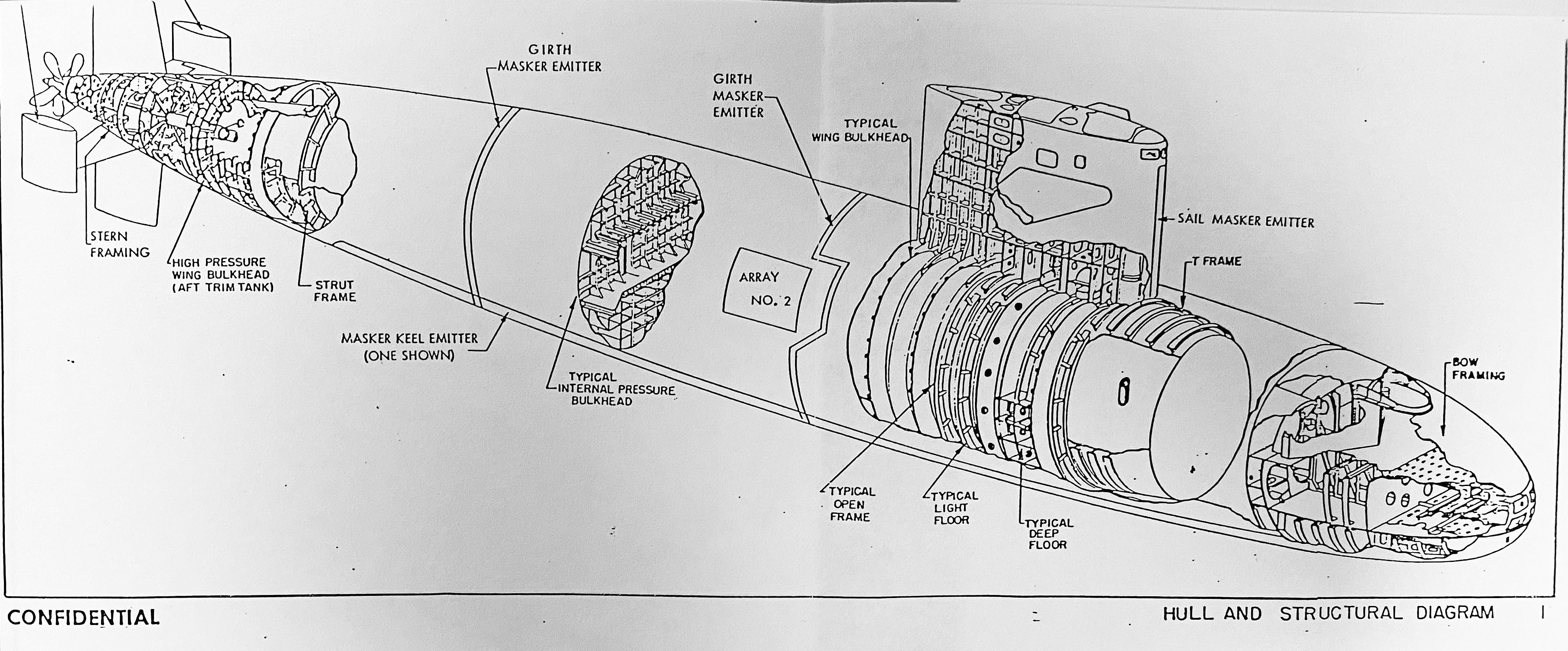
According to the piping tab, Blueback‘s masker system is composed of three girth emitters around the hull at frames 22, 44, and 51. There are also emitters on the keel from frames 21 to 74, as well as an emitter on the front of the sail. These all use 60 psi air.
The Prairie-Masker system did have limitations. Firstly, it could only be used when the submarine was snorkeling since it needed to intake a lot of air for the air compressor to run this system. Secondly, it was reportedly a maintenance nightmare and did not really work as advertised. Thirdly, a sonar technician hearing the Prairie-Masker system will not likely be fooled by it. While it is intended to sound like a rain squall, the issue is that the sound covers a very narrow area of only a few degrees, whereas an actual rain squall will cover something like 20 degrees. It is also moving in a very specific direction and speed, and you can still count the blades and number of screws on a contact and be able to classify it as a certain type of vessel (merchant, destroyer, etc.). That said, there is reportedly at least one account of an ASW exercise where the organizers asked the submarines to turn off their Prairie-Maskers so the surface sonar technicians could better hear them. So either these sonar techs were inexperienced, or there was some value to the Prairie-Masker system. The use of Prairie-Masker on U.S. diesel-electric submarines ended sometime in the 1970s. Former crewmember Rick Neault notes that when he reported aboard USS Bonefish (SS-582) in 1984, she no longer had that system.12 Today, Blueback still has some components of the Prairie-Masker system, such as the air compressor in the engine room.
Interior
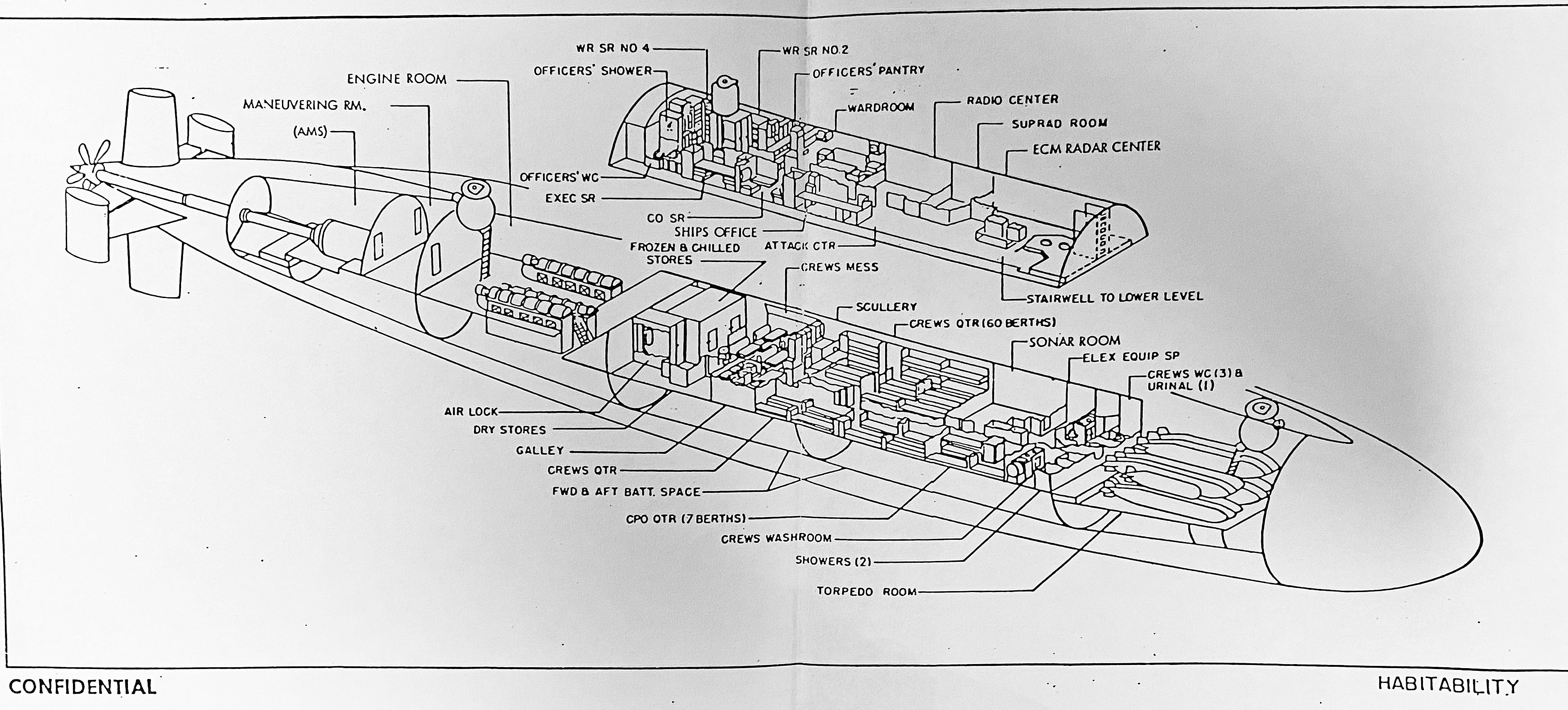
The interior of the submarine is divided into three watertight compartments which contain the various rooms. The midship compartment is the largest and houses the habitable areas of the submarine, along with the control room, radio room, yeoman’s shack, sonar room, heads, showers, galley, scullery, crew’s mess, store rooms, and battery compartments. The forwardmost (and smallest) watertight compartment is the torpedo room. The aftmost watertight compartment is the machinery compartment. It contains the engineering spaces of the sub, including the diesel engines, maneuvering room, pump room, and auxiliary machinery space with the electric motor and propeller shaft. Nominally, the submarine would have a crew of 85 men (8 officers and 77 enlisted).
Officer Country
The first area upon entering the boat is Officer Country. You can tell because of the blue carpet. This is the most comfortable area on the boat, and throughout the rest of the boat, every piece of equipment was placed intentionally, and often simply because there was space to put it there. Anyone on the submarine will quickly realize that the Navy prioritizes the accessibility of equipment over comfort.
All the wood paneling you see in the submarine is actually Formica laminate with a wood pattern. It was certainly nice for the time, but now it makes the area look like an RV that got stuck in the 1970s. There were originally four officer’s staterooms in total. Two three-man staterooms for the junior officers, the Executive Officer’s (XO) stateroom, and the Commanding Officer’s (CO) stateroom. The museum’s entrance and exit stairs to the submarine go through what used to be one of the three-man staterooms, and the other one has been converted into an office. The XO’s stateroom is currently used by the museum staff as a break room. Only the CO’s stateroom is made up to appear as it would have been when the boat was in operation. The CO’s stateroom is the largest; roughly the size of a small walk-in closet. It is the only stateroom with a lock on the door, as well as a single bed. The CO also has the largest bed (about 6’5″ long and 2’9″ wide), and it is also the only built-in bed that you can sit up in and not hit your head on anything. The CO is the only person on board who would have his stateroom all to himself. Even if an admiral or visiting dignitary, such as the President, was aboard, they would share the XO’s stateroom which has an additional fold-down rack in it. (An attack sub like Blueback would have a Lieutenant Commander or Commander as the commanding officer. The Commanding Officer of a vessel, regardless of rank, is always addressed as the “Captain.” Even if a higher ranking officer is aboard, they are a guest on the submarine and do not supersede the captain’s command.) At the very aft end of Officer’s Country, on the starboard side, is one head and one shower, specifically for the officers.


Also in this area are the officer’s pantry and the wardroom. The food for the officers is prepared down below in the galley and sent up via a dumbwaiter to the pantry, where an enlisted steward prepares and serves it to the officers in the wardroom. The pantry is not a galley (kitchen), and no food is cooked in there except coffee and snacks. The original equipment in the pantry would be as follows:
- 1 warming oven
- 1 hot plate
- 1 toaster
- 1 coffee maker (12 cup capacity)
- 1 five-cubic-foot refrigerator
- 2 sinks
The steward would be the only enlisted man allowed in officer country; all the other enlisted men would need to have some reason for being there; probably because one of the officers wants to have a “chat” with them. (Even today, the pantry continues to serve as a meal prep location for the museum tour guide staff. It has an industrial-grade microwave and a highly advanced coffee machine…also known as a Keurig, but obviously, that is not original to the submarine. It is so complex that I once taught a retired submarine captain on the tour staff how to use it.)
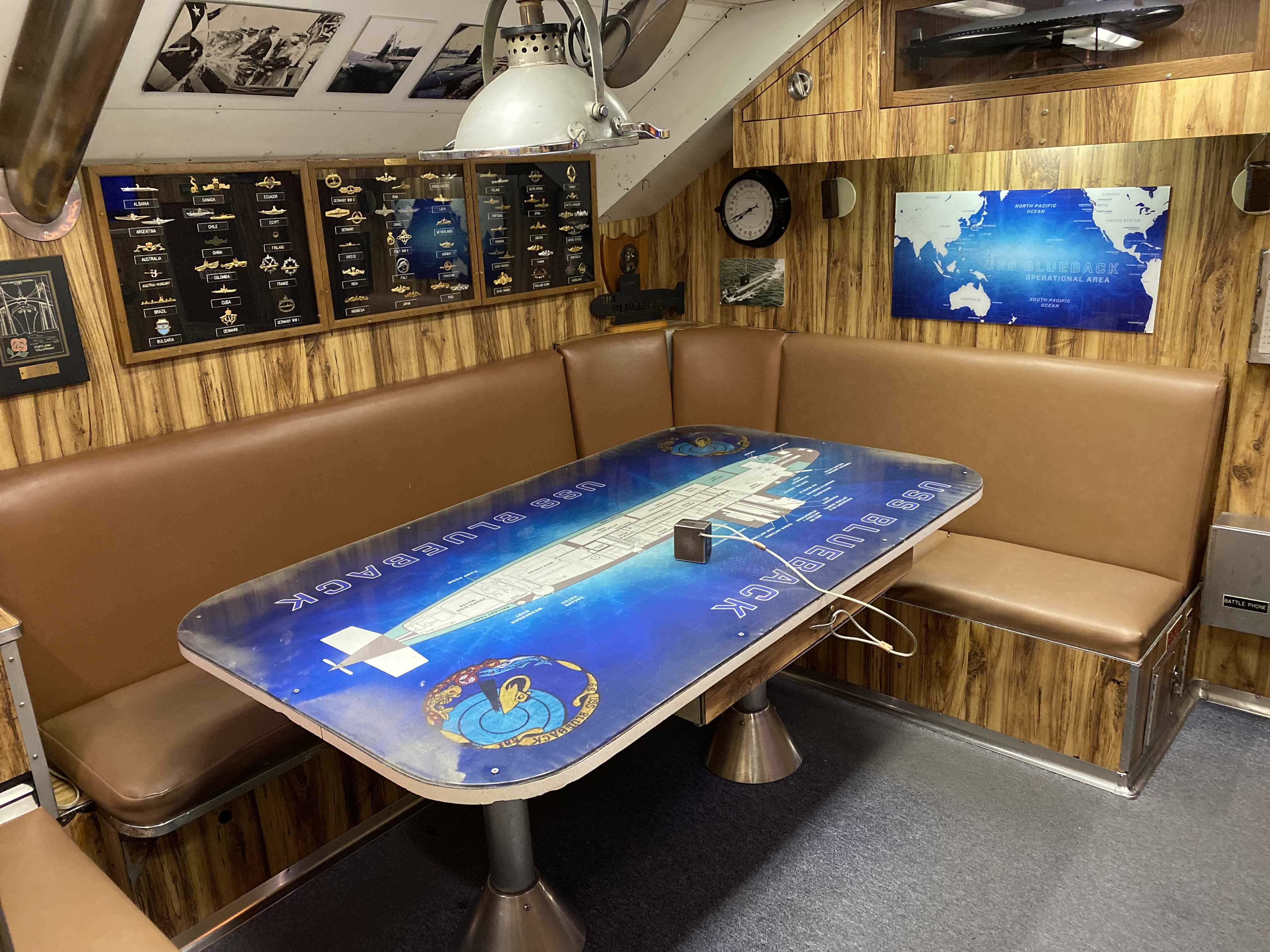
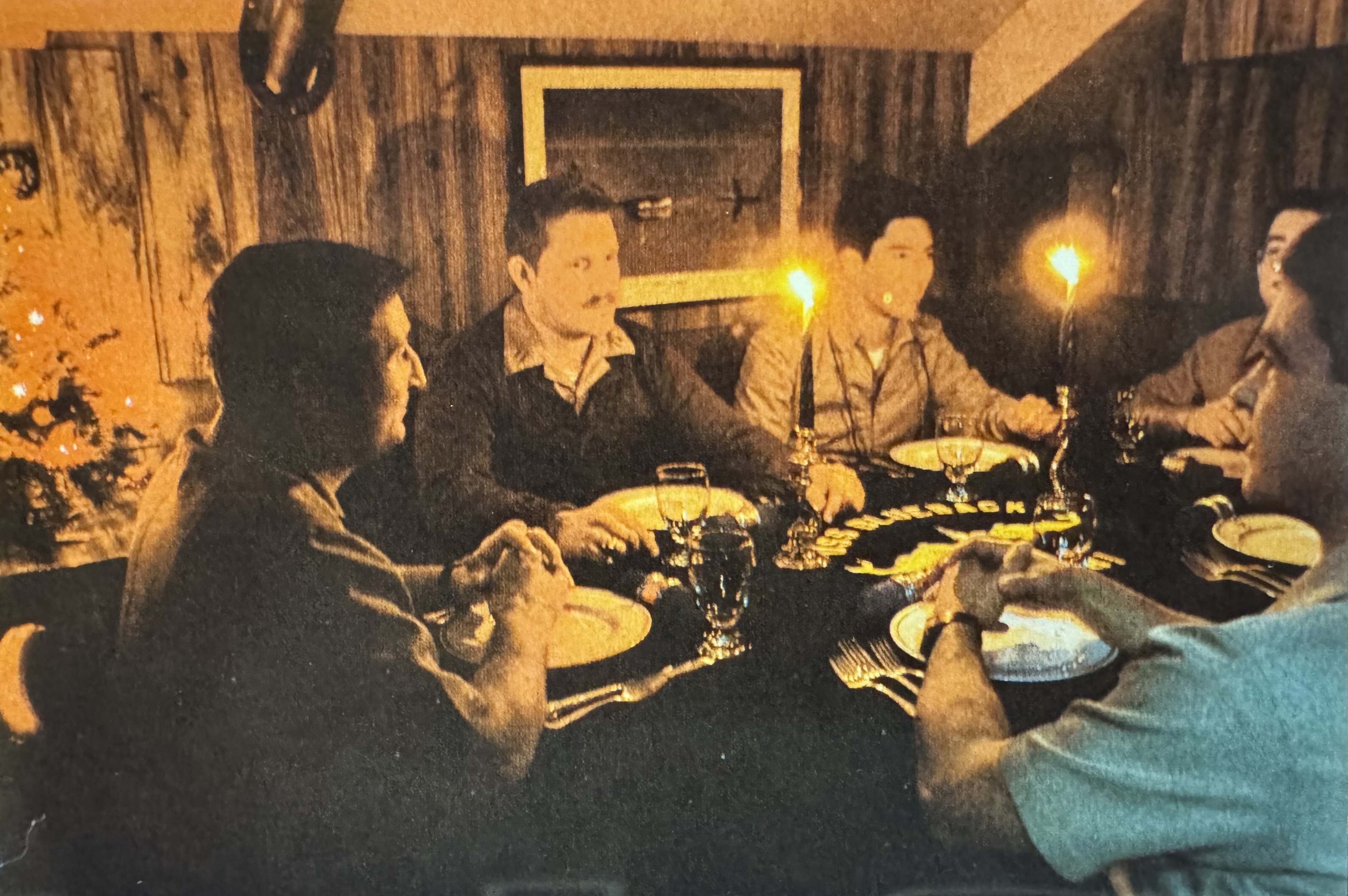
The wardroom is the dining and recreation area for the officers. It is just a large table. There used to be a bench on the inboard side, but that was removed when she was converted into a museum ship. (We tour guides often say that the wardroom table seats up to 27 people. This seems like hyperbole, but one of us actually managed to do that with a school group of first graders. So as long as everyone is six years old, then it will work.) Normally, the Commanding Officer would sit at the end closest to the pantry while the Executive Officer sat next to him and the Supply Officer sat at the other end of the table. During meal times, nobody would start eating until the senior officer took the first bite.
The wardroom table is also the largest table on the sub and serves as the operating table and battle dressing station in medical emergencies or when at battle stations. The large lamp overhead is an operating lamp. The problem is that there would be no doctor on board the sub. There is only a Hospital Corpsman. The basic training for a corpsman is an intensive 14-week program teaching the basics of emergency medical procedures, disease pathologies, and nursing techniques. According to the Navy Medicine website, to become a corpsman on a submarine requires the corpsman to be at least an E-5 (Petty Officer 2nd Class), they must pass the physical to serve on subs, then go through a further year-long training program to become an Independent Duty Corpsman (IDC). This includes 6 weeks at the Basic Enlisted Submarine School (BESS), 8 weeks of schooling in radiation health, and 44 weeks of studying clinical and operational health procedures to manage a submarine crew’s medical needs.13 They are essentially a combination of an EMT and a physician’s assistant. Most of what the corpsman does is patch up bumps, bruises, and cuts, which are the most common injuries aboard a submarine. They would also monitor the mental health of the crew. Even then, they can do everything from dispensing aspirin and suturing wounds to removing a person’s appendix. Reportedly, an appendectomy has been performed in the wardroom on Blueback. The corpsman was operating on the patient while an assistant was next to him and reading the procedure out of a medical textbook. There was also a phone-talker with a direct line to the Captain. Once the corpsman finished up the stitches, the phone-talker informed the Captain, who ordered the submarine to be surfaced, and the man was medevaced to a hospital.
Possibly the first instance of an appendectomy performed on a submarine occurred during WWII in September 1942 when Pharmacist Mate Wheeler Lipes removed Seaman Darrell Rector’s appendix aboard USS Seadragon (SS-194). While Rector survived the operation, he did not survive the war; he was killed when USS Tang (SS-306) was sunk by her own circular running torpedo in October 1944.14
Another surgery done on the wardroom table of Blueback was the treatment of a foot injury. The deck log from 18 February 1970 indicates that QM3 Verdel Myers was working up in the sail on the magnesyn compass while the sub was surfaced. Myers got his foot inadvertently caught in one of the hydraulic rams for one of the sail planes (which were moving for some reason even though the sub was surfaced), and suffered a “traumatic amputation of his right toes.” Ouch! The corpsman treated his foot wound and reportedly had to perform a partial amputation. Myers was later medevaced via a Coast Guard helicopter to Tripler Army General Hospital.
Becoming a Submariner
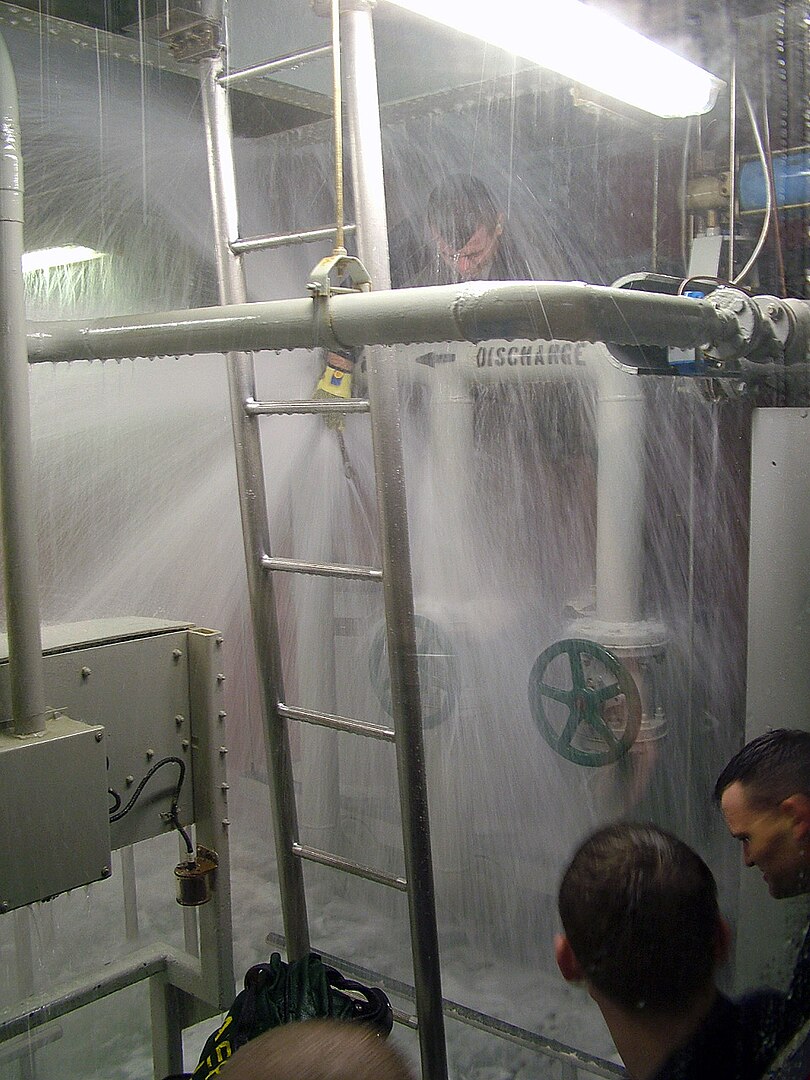
Everyone on a U.S. Navy submarine, both officers and enlisted, are volunteers. Nobody is just assigned to a submarine. After boot camp, selected enlisted personnel go to eight weeks of Basic Enlisted Submarine School (BESS) in Groton, Connecticut. That school teaches you just enough about submarines to make you dangerous. Most of the curriculum is focused on basic submarine organization, operation, damage control, and escape procedures. During BESS, students go through three damage control trainers to simulate three specific casualties. These are the firefighting, flooding, and submarine escape trainers. In addition, you will have to pass the psychological and physical screenings to ensure you are fit enough to serve on submarines. Obviously, claustrophobia would not be a great thing to have for prospective submariners.
For officers, the submarine service gives a higher preference to people with degrees in hard sciences because they are required to know about metallurgy, mathematics, physics, nuclear reactors, etc. Following their commissioning program, officers go through a series of interviews with a panel that includes the Director of Naval Reactors (a 4-star admiral) to assess their knowledge and ability to handle stress. If selected, they go through a more intensive training pipeline than enlisted personnel. Since all U.S. Navy subs are nuclear-powered, this involves 6 months at the Naval Nuclear Power School (NNPS), which is basically a graduate-level course on the science and mathematics behind nuclear power, followed by another 6 months in a Nuclear Power Training Unit (NPTU), AKA a “prototype.” These are the land-based nuclear reactor prototypes before the design was installed in submarines. Here, the officers apply the concepts they have learned to an actual reactor. Then comes 3 months in the Submarine Officers Basic Course (SOBC). This is basically the officer’s version of BESS, and this is all before they even get to their first boat! (The only enlisted sailors who attend NNPS are those who will work on the reactors, such as on submarines or aircraft carriers.) Upon being assigned to their first boat for 2 – 3 years, the officer has to qualify and earn their dolphins. They’ll also stand watches and lead a division of sailors under them. Eventually, the officers will have to pass the engineering exam, which will qualify them as the chief engineer of a submarine. This is the first major test to see if the submarine force wants this officer to stay or go do something else in the Navy. Assuming they pass, they then work their way up the pipeline in their careers on submarines. Following their first tour on a submarine, the officer, by now probably a Lieutenant (O-3), will head to a shore assignment, perhaps teaching at a naval school or on the staff at a sub squadron.
Officers who want to command a submarine enter a long pipeline that includes the 6-month-long Submarine Officers Advanced Course (SOAC), which will prepare them to act as a department head on a boat. This is followed by a 3-year-long tour as a department head, after which the officer must attend a 3-month-long Prospective Executive Officer’s (PXO) course. By now, this officer is likely a Lieutenant Commander (O-4) and they’ll then serve as the XO of a boat. Another shore assignment awaits the officer, which includes graduate-level education at a joint billet, for example, a staff college or the Naval War College. Upon being selected and promoted to Commander (O-5), the officer will attend the 6-month-long Prospective Commanding Officer’s (PCO) course, during which they’ll practice the intricacies of commanding a nuclear submarine, practice approaches, fire several live weapons (torpedoes and missiles), and learn about additional missions of a submarine, including strike warfare, intelligence gathering, mining, etc. If they pass, then one day they’ll become the Commanding Officer (CO) of a submarine. These steps all occur over the, say, 15 – 20+ year career of an officer. They are not designed to be easy, and they weed out those who will not make good skippers.15 The process is similar for those who wish to become commanding officers of other military units in other services (air, naval, or ground forces).
Once you get to your first boat, your next task is to qualify on it. At this point, you are what is known as a “non-qual,” or more colloquially/derisively as a “NUB” (Non-Useful Body), a “puke,” or an “oxygen stealer”. (i.e. you are a danger and a liability to this submarine and its operations.) On average, it takes approximately 9 to 12 months to qualify on a Barbel-class boat. (A former sailor on USS Barbel told me he managed to qualify in just over 60 days!) To become qualified, you need to know every system on the submarine and the basics of everyone else’s job. This includes the buttons, switches, valves, pipes, wiring, how to use the equipment, and what to do in various emergencies. You are walked through the boat, you have to identify various pieces of equipment by sight, explain what it does, and get signed off on a qualification sheet, which can easily have upwards of 100 signatures. Much of the information is based on the safety equipment and damage control. You will then go before a board of officers and enlisted and answer their questions for several hours. You will have to draw out diagrams of things like piping and wiring to the satisfaction of the panel, who then decide whether or not to recommend you for qualification to the Commanding Officer. The qualification process for officers is similar, but more involved, and includes knowledge of engineering and how to drive and fight the sub.
So if you know what is good for you, you will spend all your free time with your nose in one of the many technical manuals. If you are reading something for pleasure, someone will snatch that book out of your hands and replace it with a technical manual. In fact, you probably would not be allowed to eat any ice cream, watch movies, or do any of the “fun” stuff until you get qualified. The reason for this qualification process is to build redundancy into the training of the crew. Everybody knows the job of everyone else. Yes, you have your rating that you specialize in (like a sonar technician, quartermaster, machinist mate, etc.), but you need to have a working knowledge of all the systems on the sub. If you go to a different class submarine, you must requalify, but it is generally considered easier the second time around.

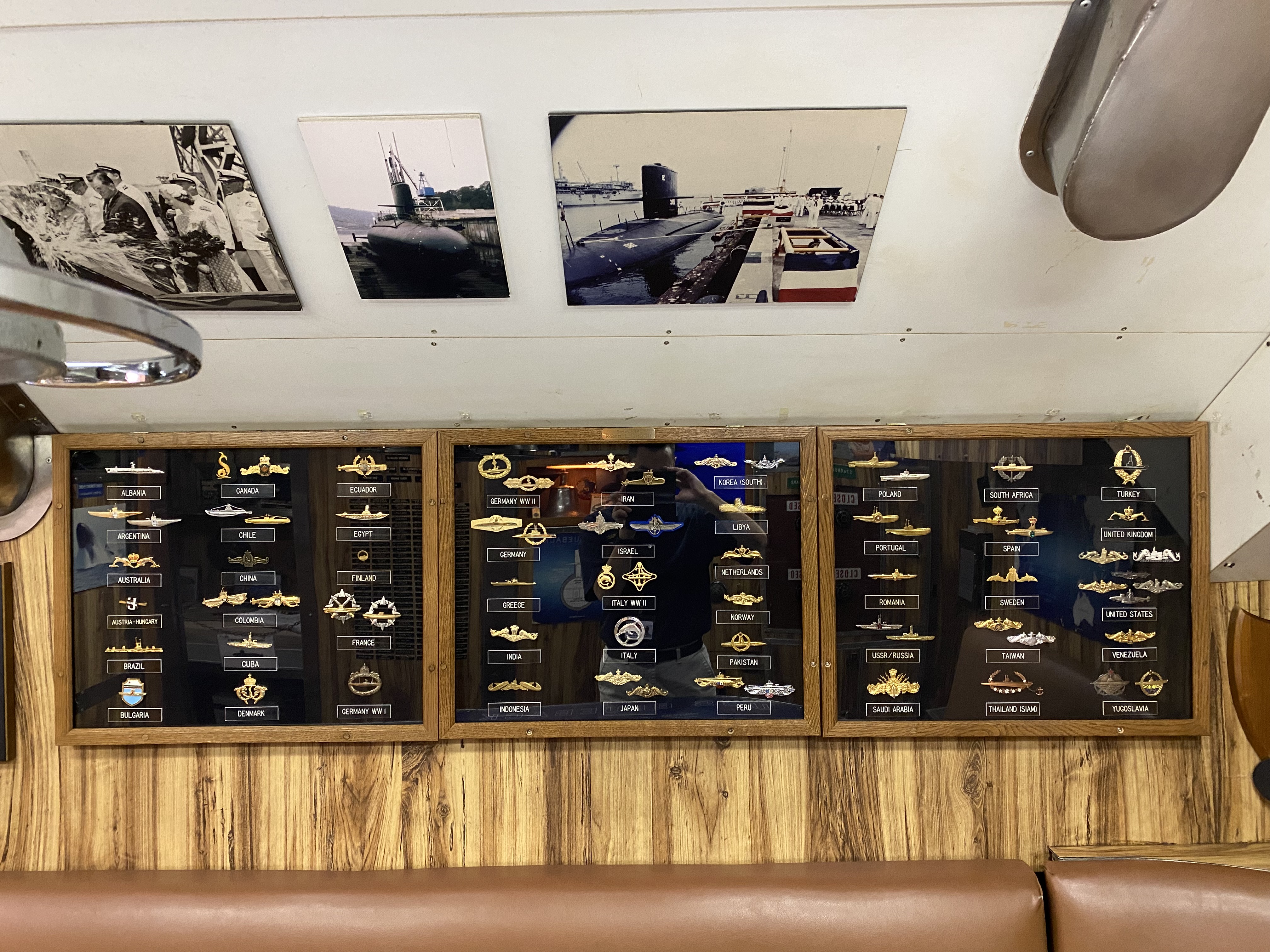
Upon successfully getting qualified, you earn your submarine warfare pin, AKA “dolphins” or “fishies,” as they are sometimes called. Gold is for officers, and silver is for enlisted. You officially become a member of the crew and a qualified submariner. If you are wondering why the dolphins on the pin look strange, it is because they are not the dolphin mammal. They are dolphinfish AKA mahi-mahi. There is a display on the back wall in the wardroom that shows the submarine warfare pins of 48 countries that have or had submarines in their navies.

The blue-paneled display in the wardroom shows seven scale model submarines. Blueback is second from the top and one of the smallest submarines. Below is a Gato-class WWII fleet boat. These are 311 feet long and displace roughly 2,400 tons submerged with a crew of roughly 60 men. The Barbel-class, with its teardrop hull design, replaced the fleet boats. The big one at the top is an Ohio-class nuclear-powered ballistic missile submarine. These are the largest submarines in the U.S. Navy at 560 feet long (about 2.5 Bluebacks long) with a submerged displacement of about 18,000 tons; they have a crew of roughly 150 or more. 18 were made, but the 4 oldest ones were converted into guided-missile subs. Third from the bottom is a nuclear-powered Los Angeles-class fast attack submarine.16 These are 362 feet long, displace about 6,900 tons submerged, and have a crew of roughly 130. The LA boats are the workhorses of the U.S. submarine fleet. 62 were built, but they are being slowly decommissioned and replaced with the newer Virginia-class boats. Second from the bottom is the Block V Virginia-class fast attack submarine. These are 460 feet long and displace roughly 7,800 to 10,200 tons. The first Block V boat, USS Oklahoma (SSN-802), was laid down in August 2023 and is under construction as of January 2025. At the very bottom is a Soviet/Russian Typhoon-class ballistic missile submarine. At 564 feet long, 76 feet at the beam, and with a submerged displacement of roughly 48,000 tons, these were the largest submarines ever built. All six were commissioned in the 1980s, and as of February 2023, we believe all have been taken out of service.17 The small submarine model on the left is the first submarine commissioned by the U.S. Navy in 1900; USS Holland (although technically the 4th sub owned by the Navy).18 Named after its inventor, John Holland, it is 53 feet long and had a crew of 6 men. One important thing we learned from USS Holland is not to use gasoline engines in submarines because the fumes are too explosive. To put all of these boats in perspective, a 40-foot city bus is beneath the Holland.

Radio Room & Yeoman’s Shack
Moving forward, just beyond the door from the wardroom are two rooms on either side of the passageway. These are the radio room on the port side and the Yeoman’s Shack on the starboard side.
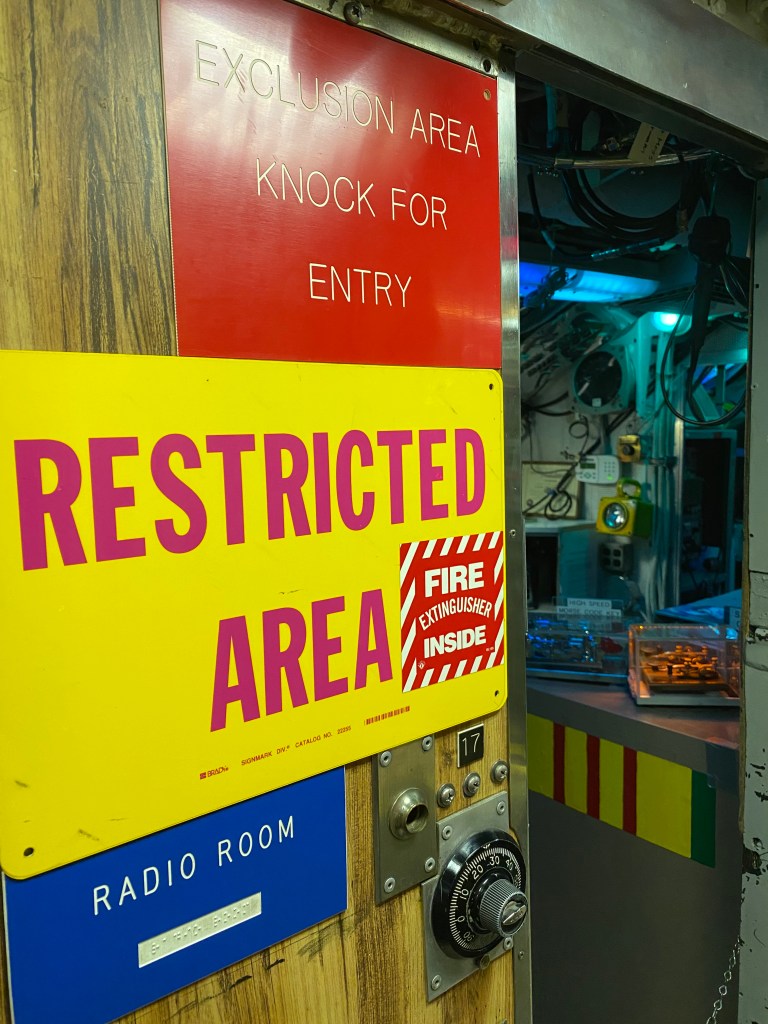
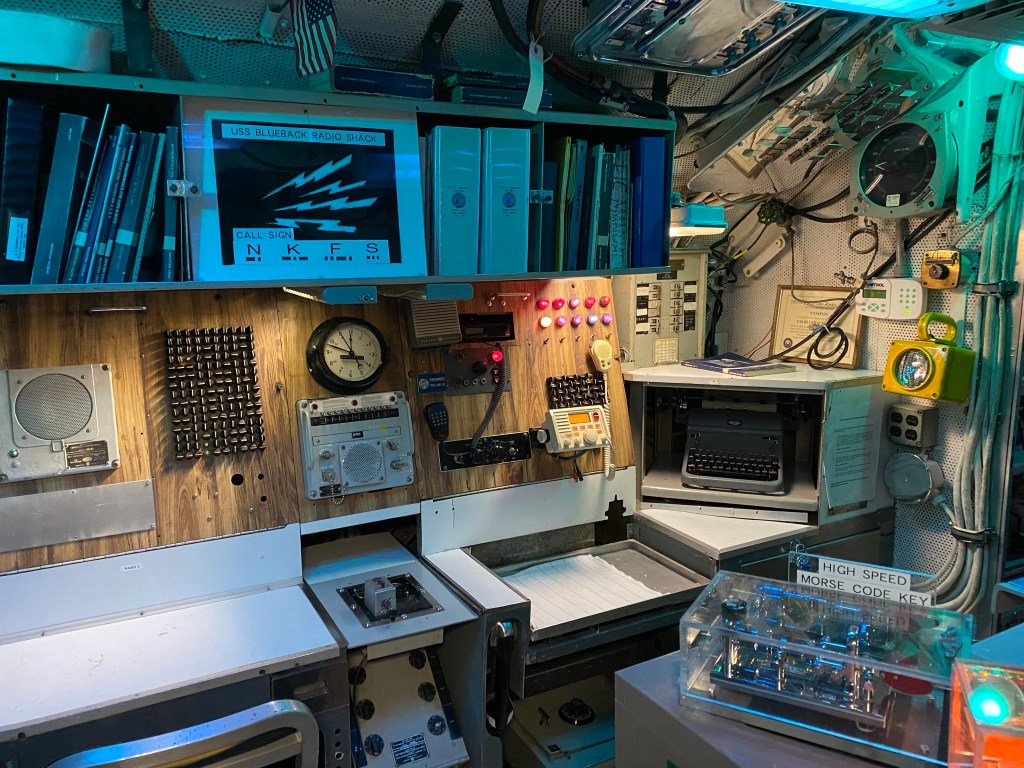
The radio room would operate the various high-frequency and low-frequency transmitters and receivers. All communications with the outside world would go through this room. Further forward inside the radio room, behind a curtain, is the “crypto room.” This room houses the cryptographic equipment. If there were “spooks” (Cryptologic Technicians or intelligence officers) onboard, they would be working in the crypto room to decode/encode secret and top-secret communications. According to the late Commander “Stu” Taylor, a former engineering officer on Blueback, about 6 – 8 spooks might be aboard. In fact, the entire radio room is a restricted area and most crew would not be allowed near it because it contains some of the most top-secret equipment on the boat. If you had to work in here for some reason and you were not a radioman, then you would need to have an escort to keep an eye on you while you did whatever work was needed in here.
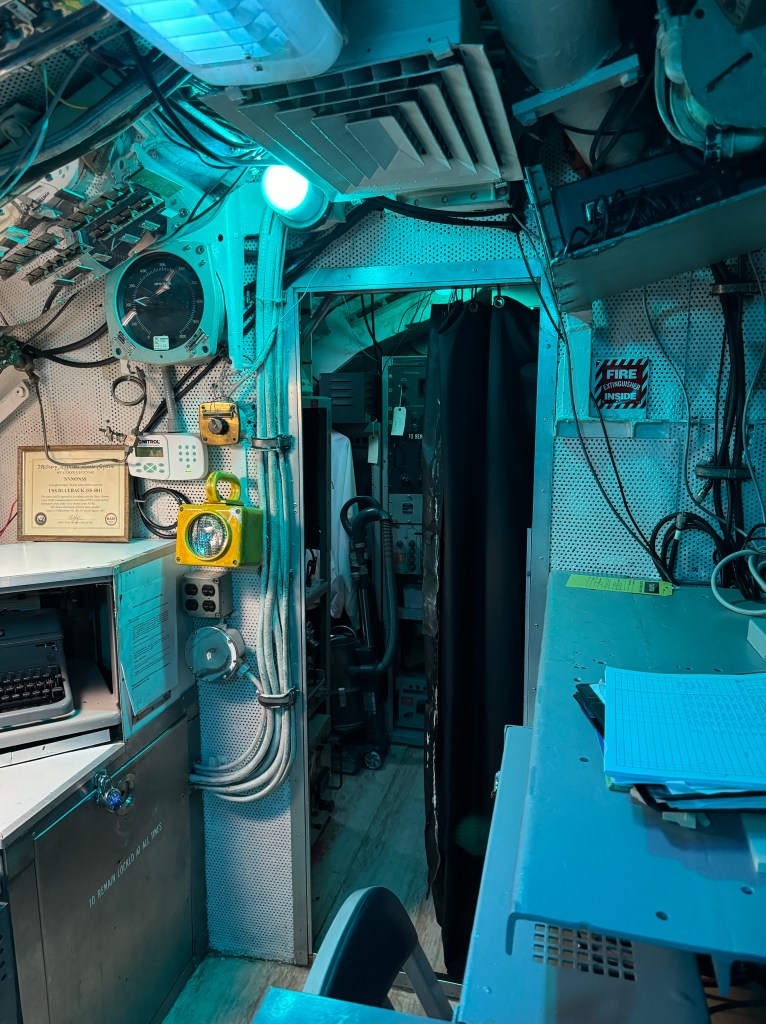
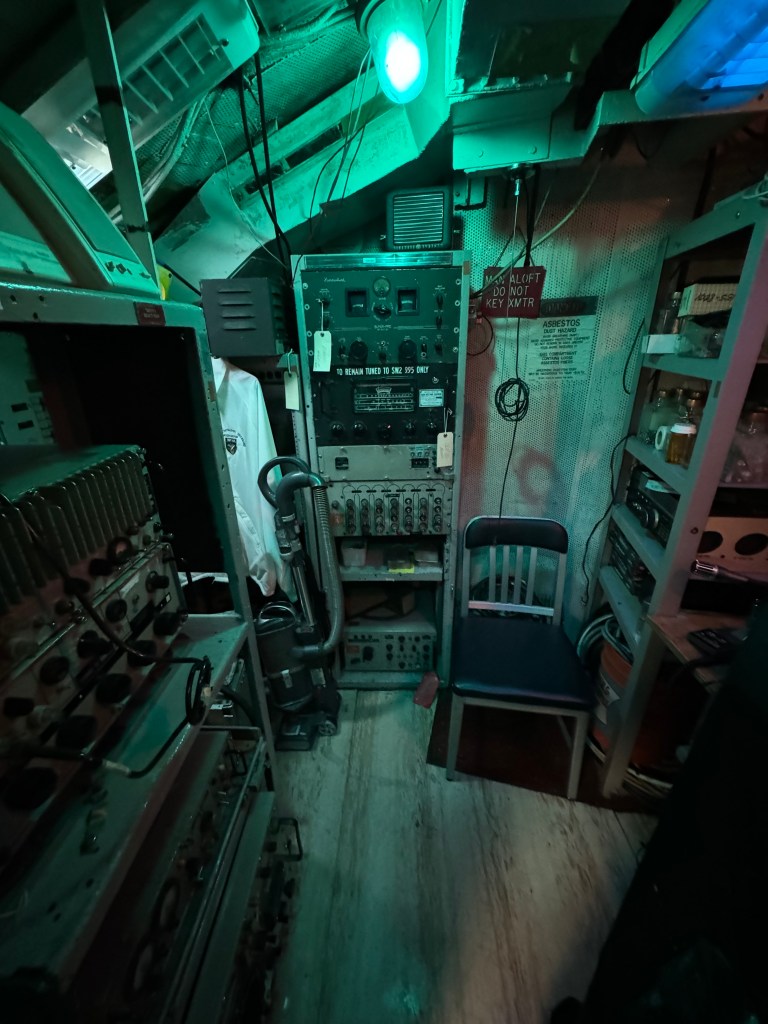
Much of the original radio equipment has been removed, but currently, the radio room still functions as an active transmitting station for a local amateur radio club with the callsign W7SUB, and it does use the submarine’s radio antennas (at least partially). While it was not used much during the pandemic, OMSI radio operators have recently begun using it more frequently. They can contact museum ships around the United States, and one operator said he even briefly contacted a station in France.
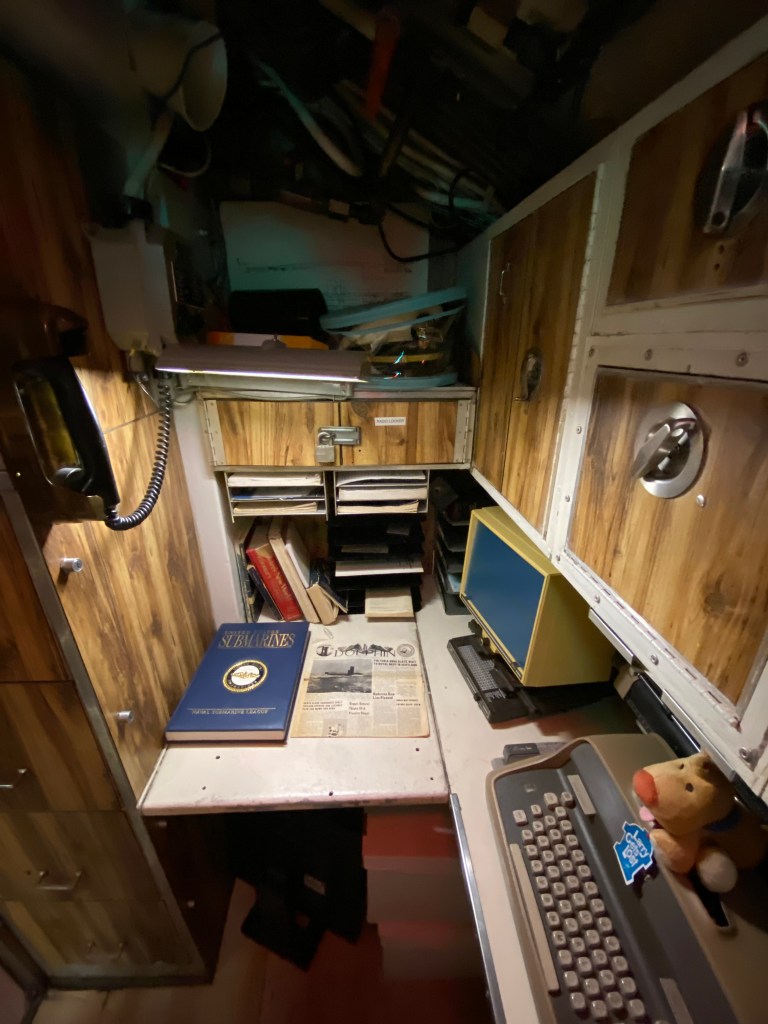
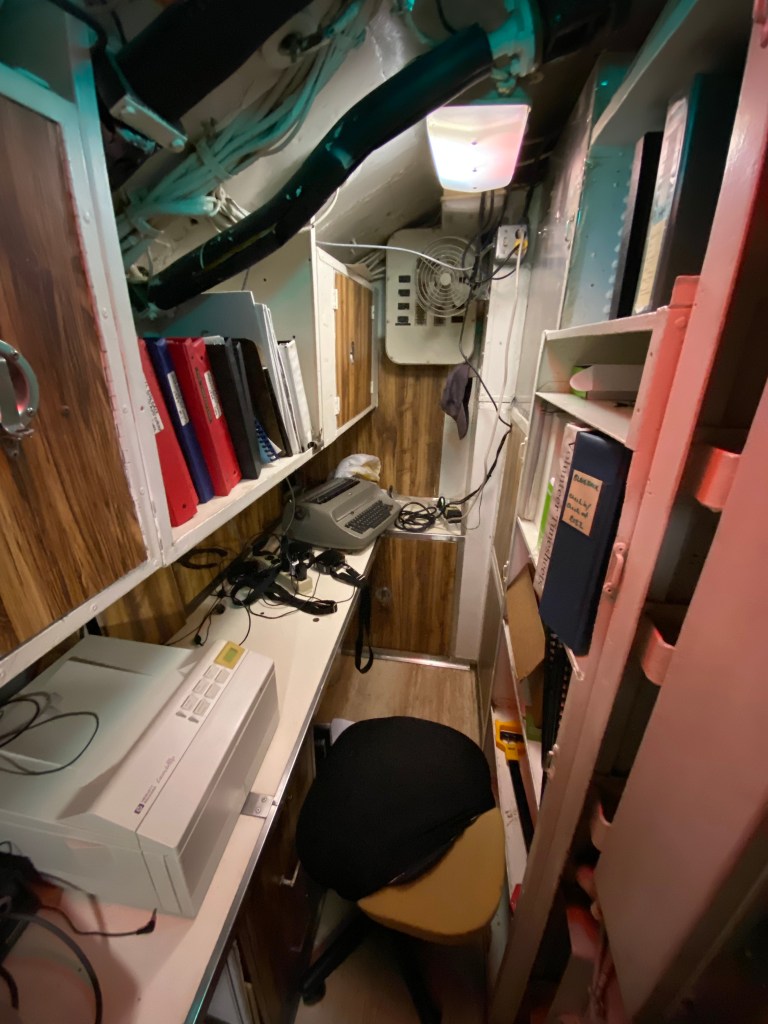
The Yeoman’s Shack is simply the ship’s office. A Yeoman handles the vessel’s clerical and administrative work. In some ways, the Yeoman is one of the more important behind-the-scenes people on any vessel. They handle all the paperwork and documentation for everyone onboard. Much like the secretaries/administrative assistants in large organizations, they know everything about what goes on. Be nice to the Yeoman because they make sure you exist on paper and get paid. If you want to request leave, then they might be able to expedite your paperwork…if they like you.
IC Alley
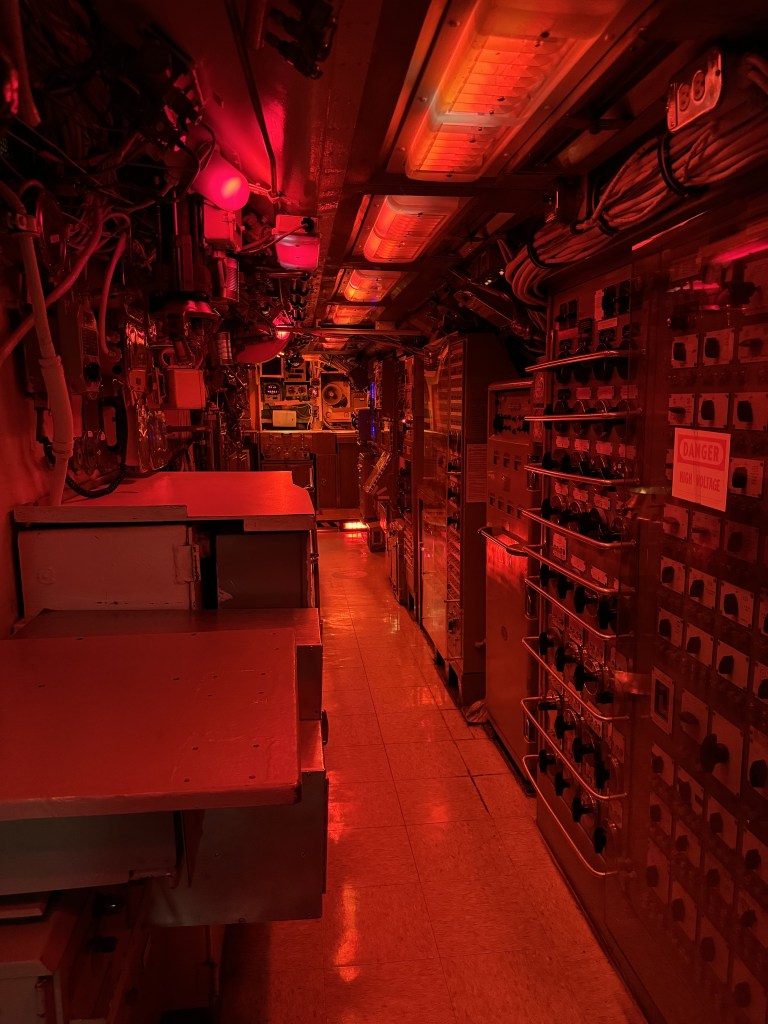
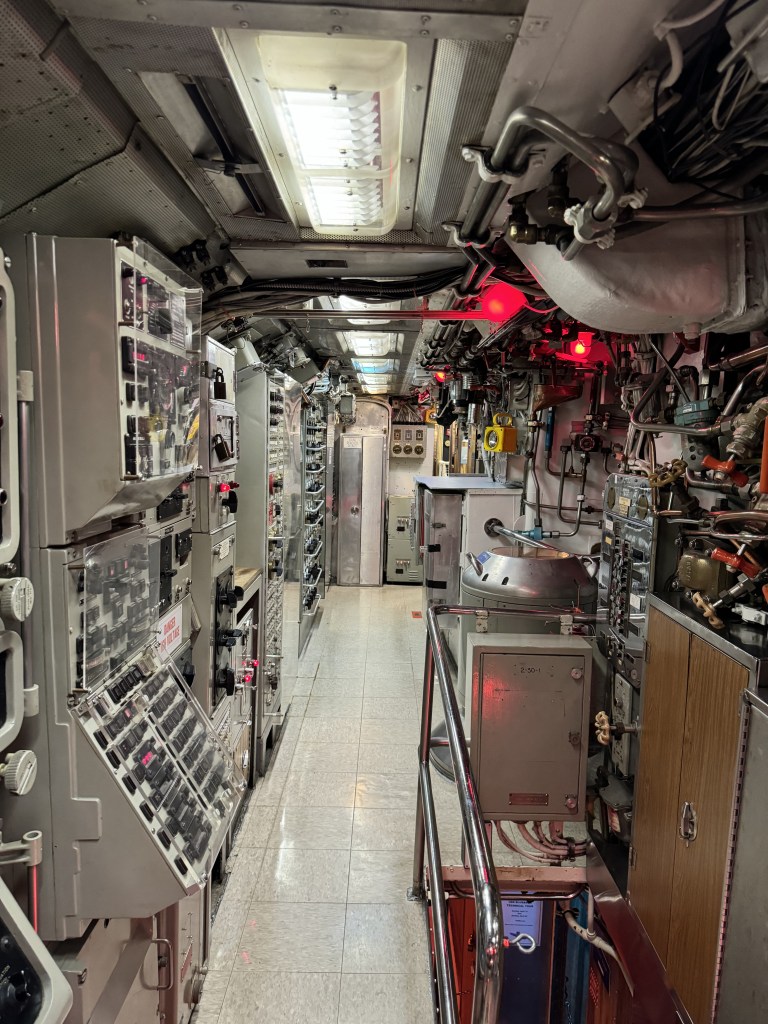
The passageway that connects the wardroom to the control room is colloquially referred to as “IC Alley.” It houses the switchboards for the interior communications equipment, alarm and signal systems, lighting, and fire control. Basically, anything on the sub that was powered electrically, including the Mk 19 gyrocompass, would have switches here to energize or de-energize them.
Since this submarine operated in the days before computerized voyage management systems, navigation was done with a traditional sextant, paper charts, radio, and early satellite navigation. According to tour guide Tony Capitano, our former USS Barbel sailor (a former IC electrician/Missile Technician), the main gyrocompass was very accurate and rarely needed to be reset.
Behind the main gyrocompass is the winch for the Very Low Frequency (VLF) radio cable. This 1,000-foot floating cable could be streamed behind the submarine when it was submerged down to test depth to receive communications. It would float just below the surface so as not to give away the position of the submarine.
Tony Capitano also notes that the layout of IC Alley and the Control Room was significantly different on his sub compared to Blueback. For one thing, the crypto room was not connected to the radio room. The radio room on USS Barbel simply had a bulkhead where the door to the crypto room was on Blueback. Next to IC alley, and accessible behind the main gyrocompass, would be the sonar room. Where Blueback‘s sonar room is, at the bottom of the ladder below the control room, was the Chief Petty Officer’s quarters on Barbel. Apparently, the three boats had slightly different internal layouts since they were built by different shipyards. Additionally, Barbel was reportedly outfitted as a radar picket sub, and Bonefish was outfitted as a missile guidance sub for Regulus missiles.19
Control Room
The control room is the nerve center of the submarine, and all operations are conducted from this space. During normal operations, there are eight men in this room. However, when at General Quarters (AKA battle stations), there could be 14 – 17 men in this room. This room is directly beneath the sail, and the layout vaguely resembles an inverted horseshoe when facing toward the bow.
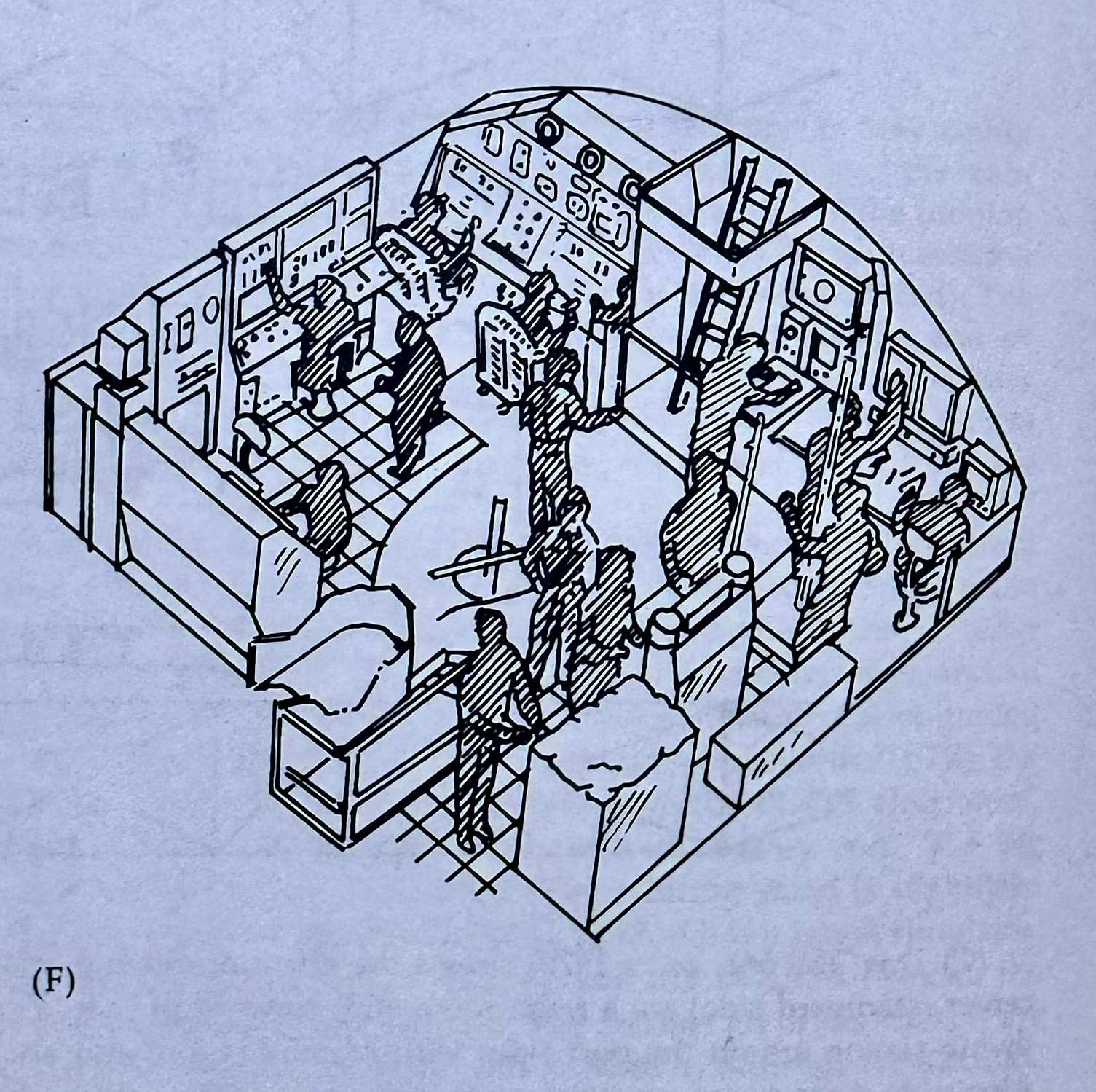
The earlier Tang-class submarines were the first to eliminate the conning tower and move the fire control equipment down into the control room to create an attack center, but this made their control rooms more cramped. This was alleviated with the Barbel-class, which were arguably the first boats to introduce the more modern layout of control rooms.21
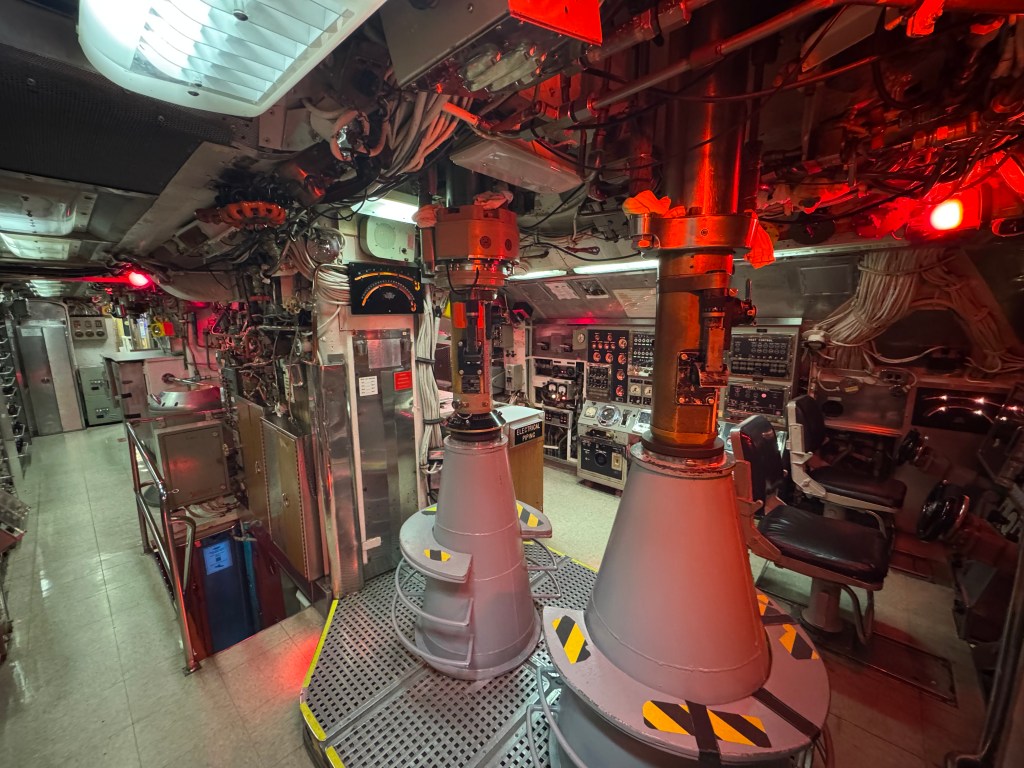
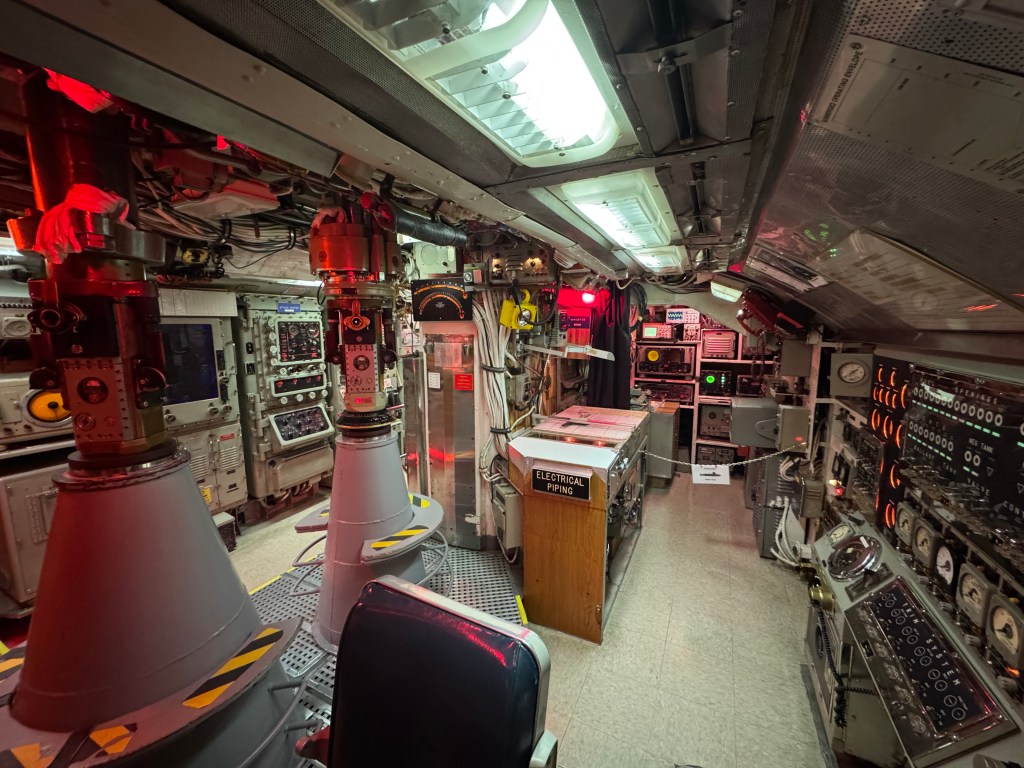
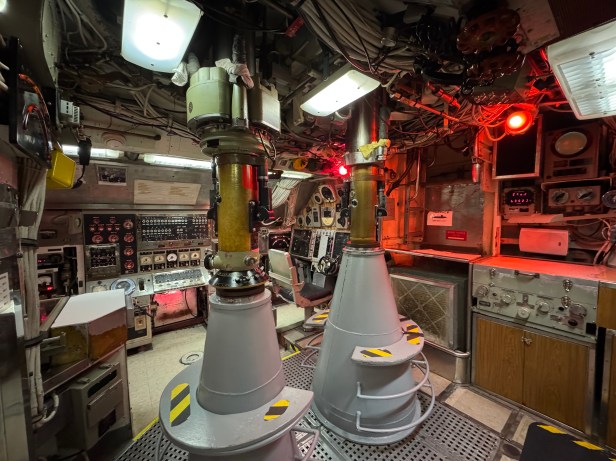
According to Tony Capitano, the basic positions in the control room are as follows:
- Officer of the Deck (OOD) (at the periscope stand)
- Chief of the Watch (ballast control panel)
- Helmsman (diving station, inboard seat)
- Planesman (diving station, outboard seat)
- (Diving Officer would be standing behind the diving station)
- Standby helmsman
- Quartermaster (navigator’s station)
- Interior Communications (IC) electrician
- Machinist Mate Auxiliary (MMA)
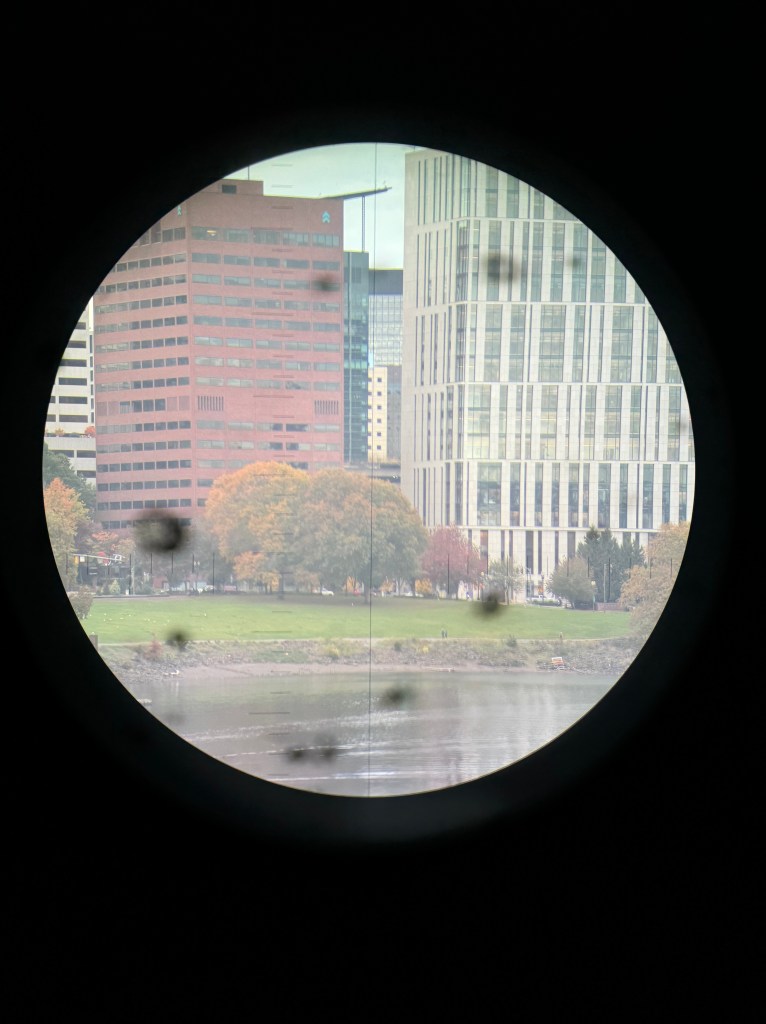
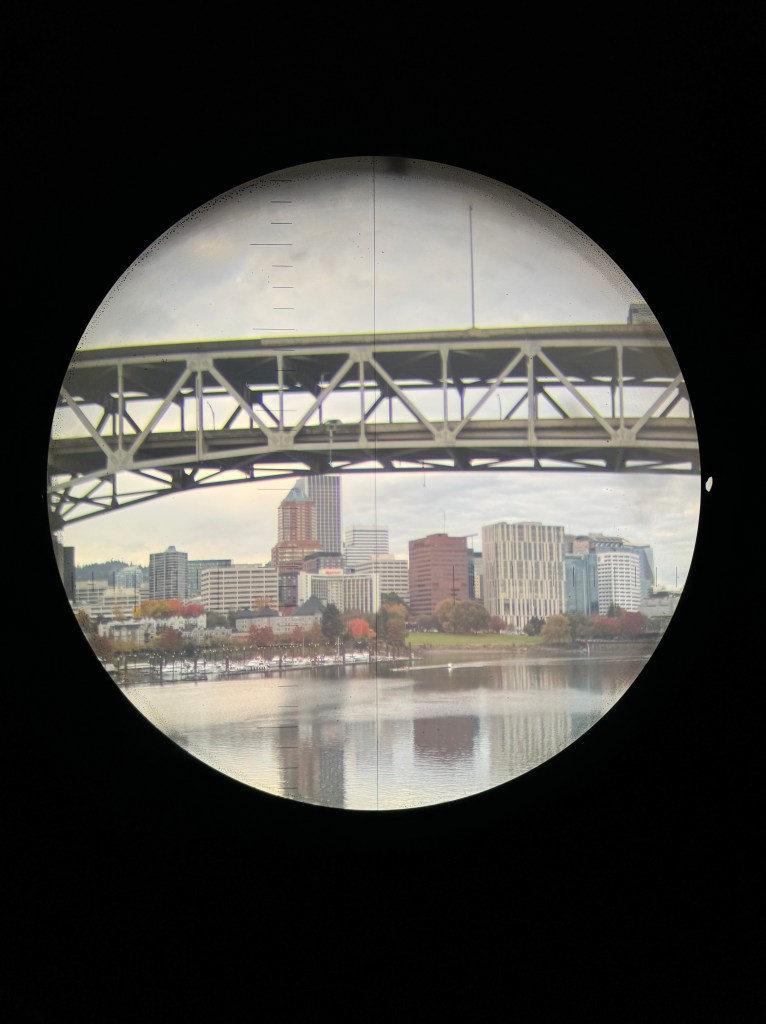
There are two periscopes in the center of the control room arranged in tandem. For whatever reason, the Navy removed both periscopes from the boat before turning it over to the museum, probably because they had sensitive ECM intercept equipment on them. So the veterans’ groups working to refurbish the submarine had to scrounge up two attack periscopes from somewhere.22 The forward one was the observation periscope. The Type 8 was a 36-foot periscope that was power-trained and had adaptors for the ECM equipment and ST radar on it. The head of this periscope is larger at about four inches in diameter. The AT-822/BLR is an omnidirectional communications intercept antenna operating in the 15 KHz – 265 MHz range. The AT-863/ULR is a microwave intercept antenna capable of receiving signals in the S or X-band range in the 1550 – 12,000 MHz range, allowing for rough direction finding. It would also have a Target Bearing Transmitter (TBT) on it. The rear periscope was the attack scope. This was a Type 2 periscope, which is 40 feet long, includes a stadimeter, and is manually trained. Smaller than the observation periscope, its head was physically smaller in profile (about one inch in diameter) to make it harder to detect when it is on the surface. There would also be an Ultra High Frequency/Identification Friend or Foe (UHF/IFF) antenna that is not visible on the outside. This antenna would be operating in the 200 – 500 MHz frequency range. Both periscopes have bearing transmitters for feeding information to fire control, sonar, and radar.
The periscope eyepieces also have mounting brackets to allow a camera to be mounted to them for taking photos through the periscopes. Rick Neault told me how he had to go to periscope photography school in Groton, CT, to learn how to use the camera. Since you cannot see what exactly the periscope is pointed at, you need to rely on the officer training the periscope to tell you when to hit the shutter release button. The film negatives would then be developed on the boat to determine if the photos came out well. Additionally, the observation periscope could tilt straight up, and a modified aeronautical sextant could be attached to the eyepiece to allow for star shots to be taken for celestial navigation.
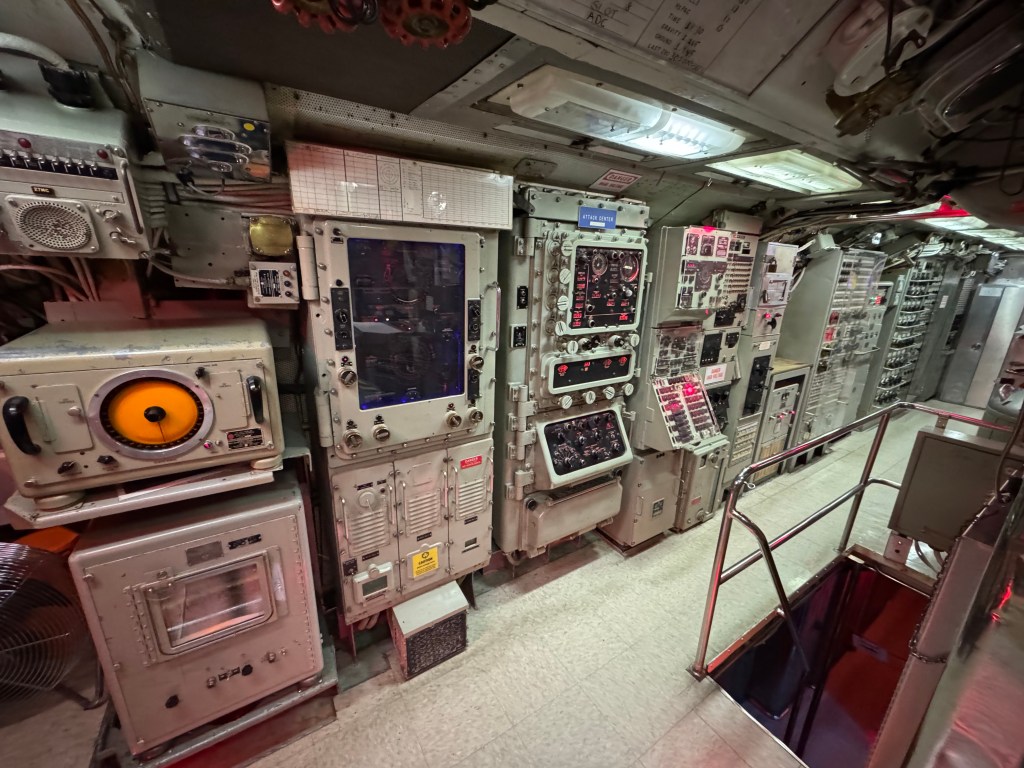
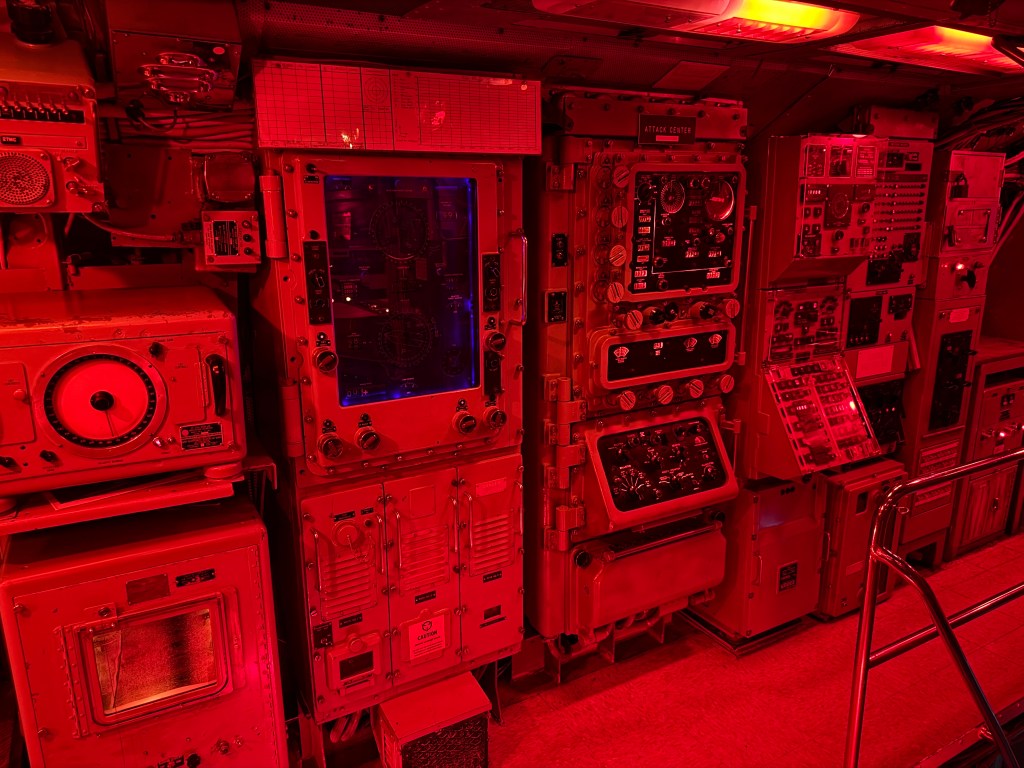
The consoles on the forward starboard side of the control room are the attack center. This is the Mark 101 mod 20 fire control system for the torpedoes. The Barbel-class were some of the first attack submarines to feature the modern layout of a control room. The size of the Mark 101 fire control system meant it could no longer fit inside the conning tower of a submarine. Since the Barbel-class subs have a sail and not a conning tower, this necessitated having a dedicated space within the control room for the fire control systems. The Mark 101 system also reflected the shift to sonar, rather than periscopes, becoming the primary sensor of a submarine.23
The Torpedo Data Computer (TDC) is an electro-mechanical analog computer. This thing is a bunch of gears, cams, shafts, and wires. It does one thing: calculate a trigonometric firing solution, taking into account the course and speed of our submarine, and the range, course, speed, and position of a target relative to our submarine, and then computing a firing solution for our torpedoes so they will intercept that target at a point and time in the future. This TDC is essentially the same thing used on WWII submarines, but there are upgrades and additional consoles in the attack center to allow for the control of the newer post-WWII torpedoes. While your PC or smartphone is basically 500,000 times more powerful than this thing, in 1959, this computer was state-of-the-art. Modern nuclear-powered submarines use all digital fire control computers, but do not make the mistake of thinking that just because the TDC is old, it is somehow primitive; it worked at the time, and it can still work today. Hence, the Navy still used it up through the 1980s. It is extremely accurate, reliable, and rugged.
The blue-lighted window on the TDC is the Mark 101 position keeper, which receives information from radar, sonar, or visual sources and plots the position of the target vessel in relation to our own. The information from the position keeper is fed into the Mark 18 angle solver, which is just aft of it. The angle solver computes a solution so that the torpedo will intercept the target. Wire-guided torpedoes can also be steered using the controls on the angle solver. Information from the angle solver is fed into the Mark 66 torpedo control console (just aft of it) which alters settings for the Mark 48 torpedoes and converts the analog signal into a digital one. Then, the tone signal generator (just below it), which feeds the information from the TDC directly into the torpedo itself through a wire. Directly aft of the Mark 66/tone signal generator is the firing panel, which is used to select which torpedo tube is going to be fired and in what sequence. The torpedo would be fired from this panel, but at the same time, it would also be manually fired from the torpedo room in the event that there is a malfunction and the firing panel does not operate. The skinny console aft of the firing panel is a switchboard to select which sensor is feeding information into the TDC.
Unlike earlier systems, the Mark 101 used a pair of analyzers that could be fed up to three sets of data observations (one of which would be from passive sonar bearings). This made for quicker firing solutions in place of simply guessing. Unlike earlier TDCs, the Mark 101 could also account for the target making an evasive turn by allowing the operator to input a target’s tactical diameter.24
Forward of the attack center on the starboard side of the control room is one of the two chart tables. This would normally be the weapons officer’s station. It does the same thing as the navigator’s station but would be manned during battle stations when using torpedoes.
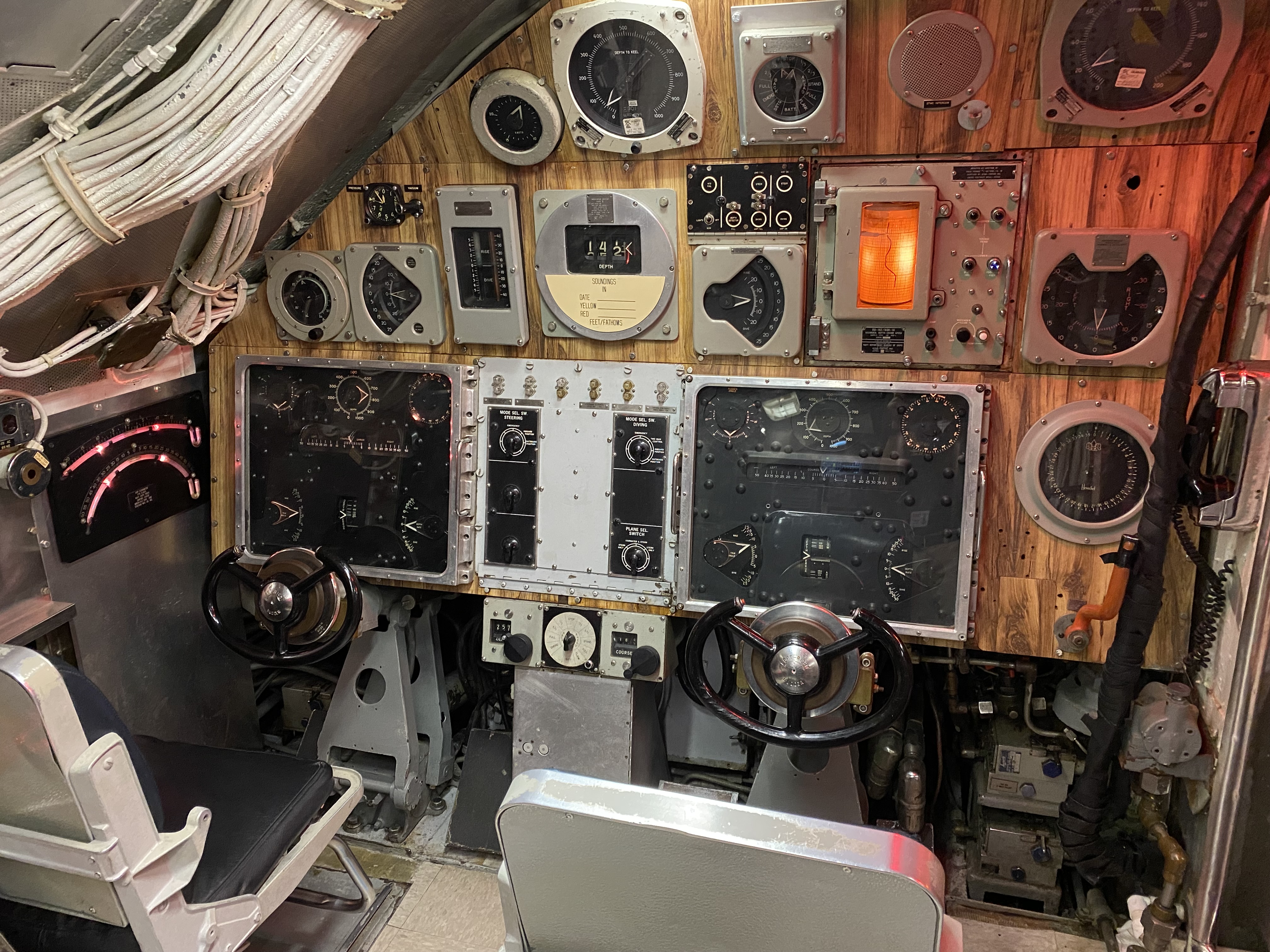
The two seats on the forward port side of the control room are the diving station. The inboard chair on the right is the helmsman/pilot’s seat. He controls the fairwater planes and rudder (i.e. the depth and direction of the sub). The outboard chair on the left is the planesman’s seat. He controls the stern planes (i.e. the angle of the sub).25 The gauges directly in front of their seats tell them the attitude of the submarine. Additional repeater gauges are on the bulkhead above them, which would be used by the diving officer, who would be standing behind them, and the conning officer/OOD. The selector switches on the panel between the helmsman and planesman’s gauges allow for either station to control any or all of the diving and steering functions (except emergency steering). Generally, junior enlisted sailors would be manning these controls because all they have to do is follow orders and steer the proper course. Just behind the two chairs of the diving station is the Mk. 27 magnetic gyrocompass. The orange-lit graph on the panel in front of the diving station is a bathythermograph. (Apparently, the exact same model is used on Los Angeles-class boats.) Water temperature is measured because a temperature gradient, known as a thermal layer or thermocline, can exist deeper down. Below this layer, the water is colder, and active sonar can bounce off it, allowing a submarine to hide below the thermocline.26
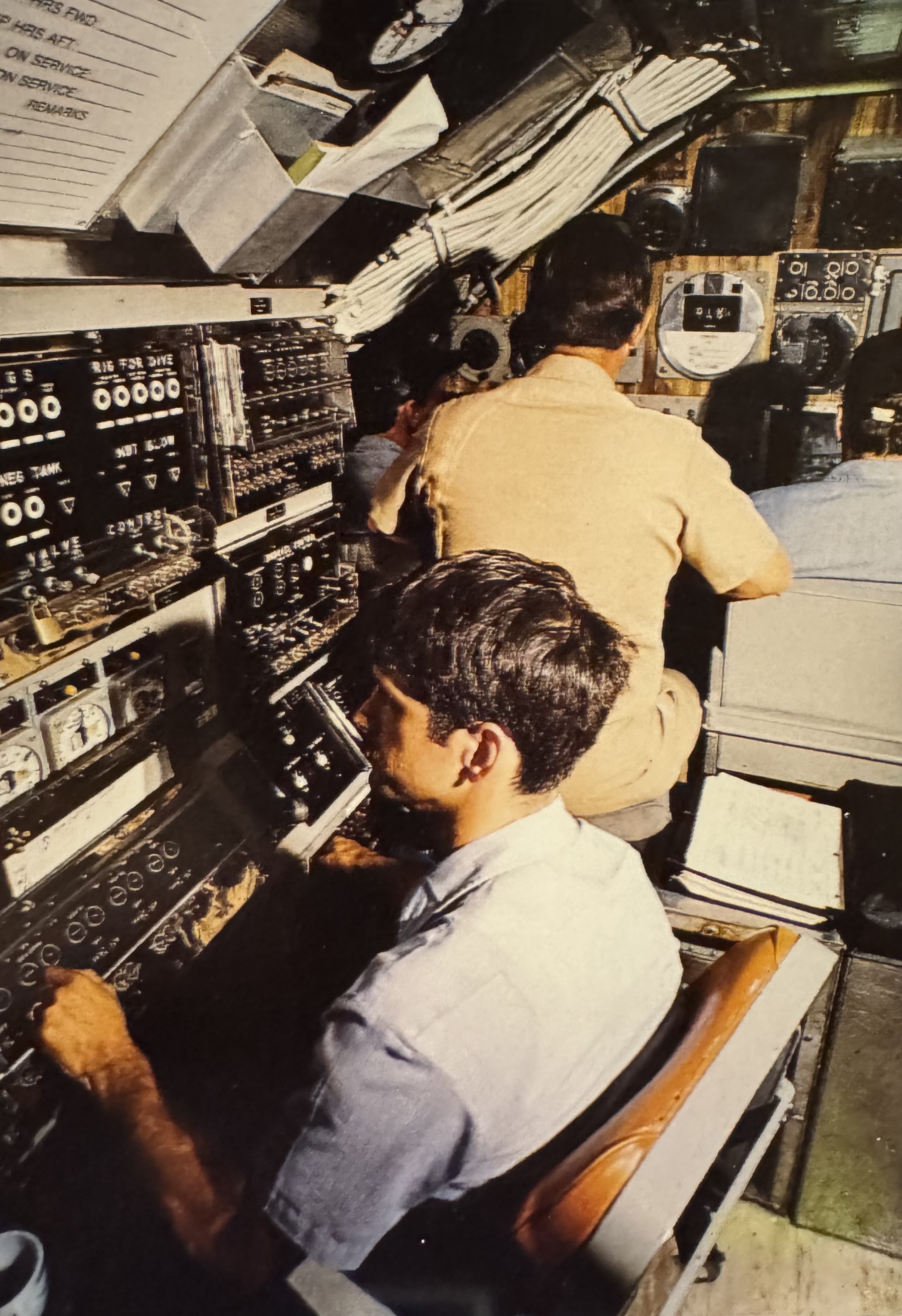
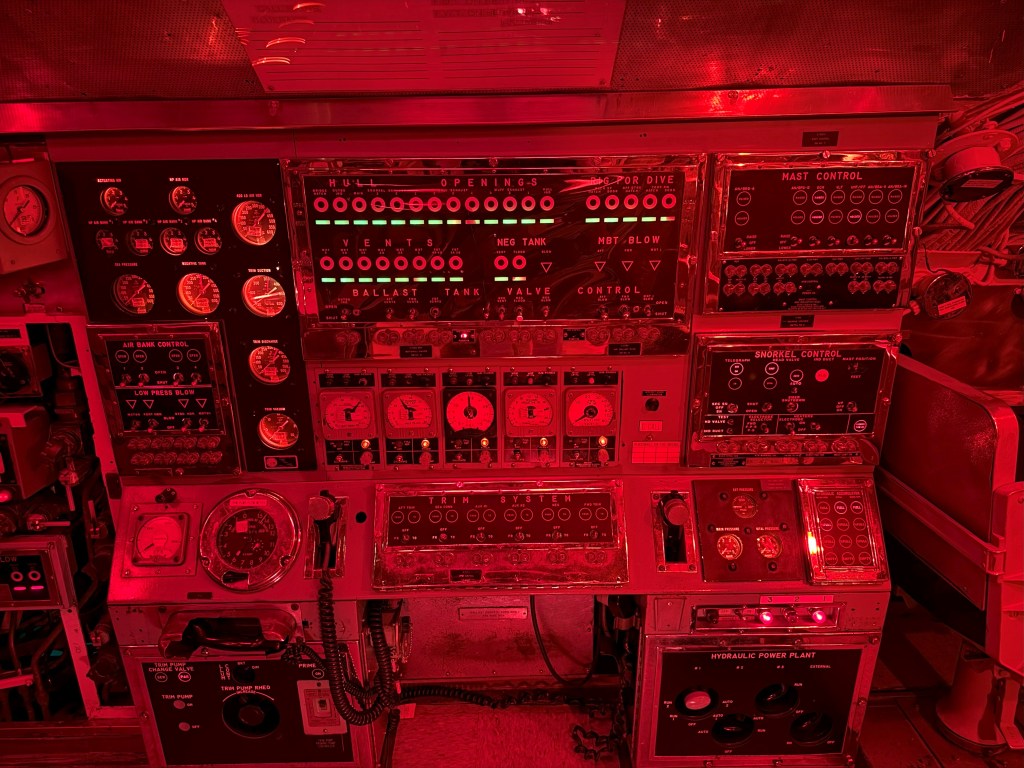
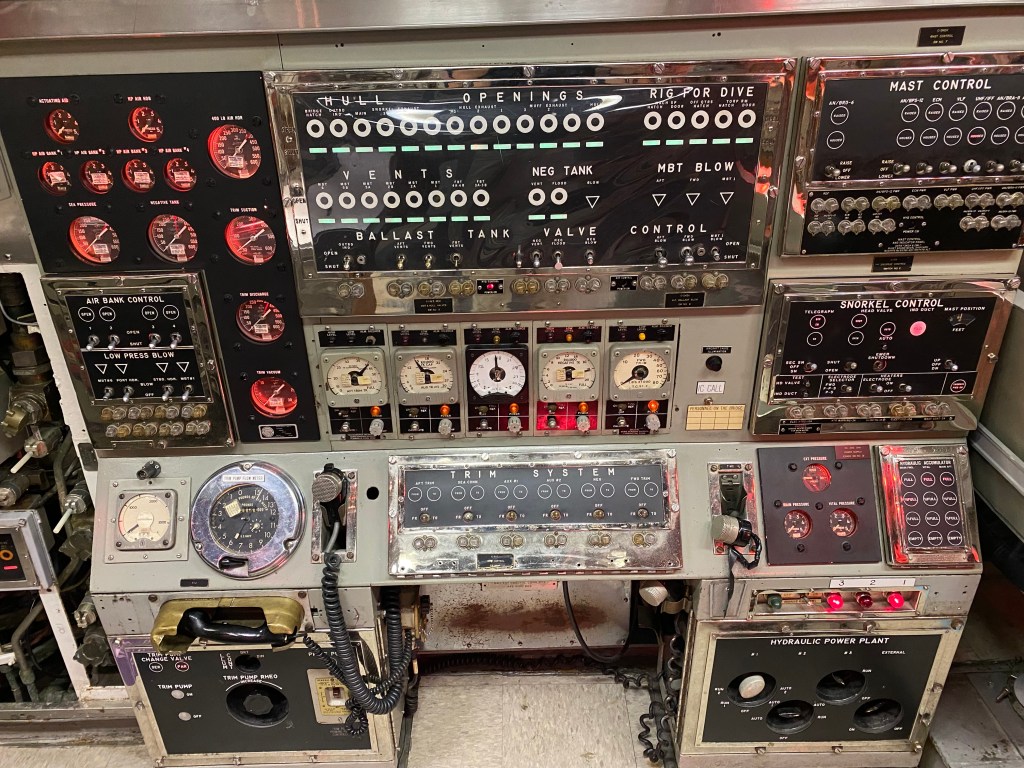
The board behind the diving station with all the green lights is the Ballast Control Panel. It is colloquially known as the “Christmas Tree,” due to its festive colors. Unlike older subs, the Barbel-class were the first to introduce push-button controls (rather: toggle switches) for the Ballast Control Panel.27 Divided up into several sections, in the center of the console are the indicators and switches for controlling the ballast tanks and vents. Green lines indicate closed, while red circles indicate open. A green/straight board would indicate that the boat’s openings are secure and rigged for diving. On the right side are the controls to raise and lower the masts (except the periscopes). Just beneath the mast controls are the hydraulic plant controls. Three hydraulic systems would be operating at all times, with another on standby. Beneath the Christmas Tree in the center are the controls for the trim system for the variable ballast tanks. On the left side are the gauges and controls for the air banks on the submarine.
Diving the Boat
Once the boat has crossed the 100-fathom line (600 feet of water beneath the keel), the captain or the Officer of the Deck would order the diving officer to submerge the ship. The diesel engines would be secured, all external hatches in the pressure hull would be closed, and the propulsion would be switched over to the batteries. Then the boat can dive. The Chief of the Watch, manning the Ballast Control Panel, would confirm that all hatches are secured and announce “green/straight board!” He would then announce over the 1MC “Dive, Dive!” and sound the dive alarm twice.28 He would then open the ballast tank vents, and 490 tons of seawater would flood in through the flood ports on the bottom of the boat, filling the ballast tanks between the outer hull and inner hull. The helmsman and planesman would push forward on their controls, providing a 6 – 8 degree down angle, and the submarine would go from the surface to underwater in about 58 seconds.29 Once getting below about 150 – 200 feet, it would be a very quiet and smooth ride. A diesel-electric submarine on battery power is actually quieter than a modern nuclear-powered submarine. Not to mention much cheaper. A modern nuclear-powered Virginia-class fast-attack submarine with all the bells and whistles costs upwards of $4 billion…with a B! Give or take a billion.
Once the boat had reached the ordered depth, the helmsman and planesman would level off their controls, and the Chief of the Watch would have to trim out the boat by pumping water through the trim system to add or pump out seawater, or shift it fore or aft to maintain neutral buoyancy and an even keel.
Surfacing the Boat
There are a couple of ways to surface the submarine. When the submarine is neutrally buoyant, then the boat can simply be driven to the surface by angling the planes. Another way is by either a low-pressure or high-pressure blow. A low-pressure blow uses 400 psi air and can also use the exhaust from the engines with about 15 lbs. of pressure to create positive buoyancy, and the engines would be used for the final trim of the boat. A high-pressure blow with the forward and aft main ballast tank blow switches uses 3,000 psi air to rapidly force the water out, and the sub will ascend to the surface quickly. According to the Ship Information Book, this submarine can store 588 cu. ft. of this high-pressure air in four banks (28 flasks) around the hull.
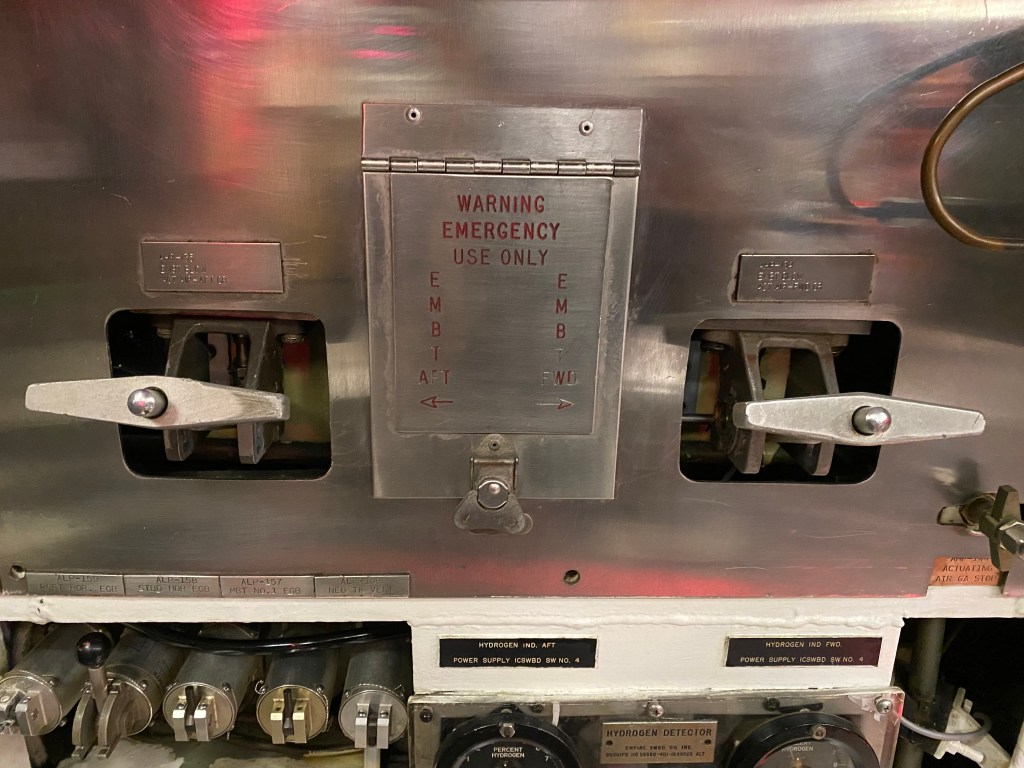
The last way to surface is via an Emergency Blow. Aft of the ballast control panel are the two switches for the Emergency Main Ballast Tank Blow. Also known as “chicken switches.” Upon activating these, 3,000 psi air would be blown into the ballast tanks, all the water would be rapidly evacuated, and the submarine would immediately rise to the surface. Submarines would practice this maneuver, but obviously, it is not the normal way to surface the boat. It is done in emergencies only…as in, if we do not get this submarine to the surface now, then we are never getting back up.30 Reportedly, the last time Blueback performed an emergency blow, she went from about 700 feet to the surface in approximately 58 seconds.
And no, your ears do not pop, and you do not need to worry about decompression sickness (AKA the bends) when submarines do this. The inner pressure hull is completely sealed and maintained at one atmosphere. You would just hold on to something. Depending on who you talk to, an emergency blow is either a terrifying event (if there is a genuine emergency) or the lamest roller coaster ride ever. It has also been described as a fast elevator ride that only goes up. One former Fire Control Technician on USS Haddock (SSN-621) said his boat would usually practice emergency blows about twice a year. Another who served on ballistic missile subs for 12 years said he only did this twice in his entire career.
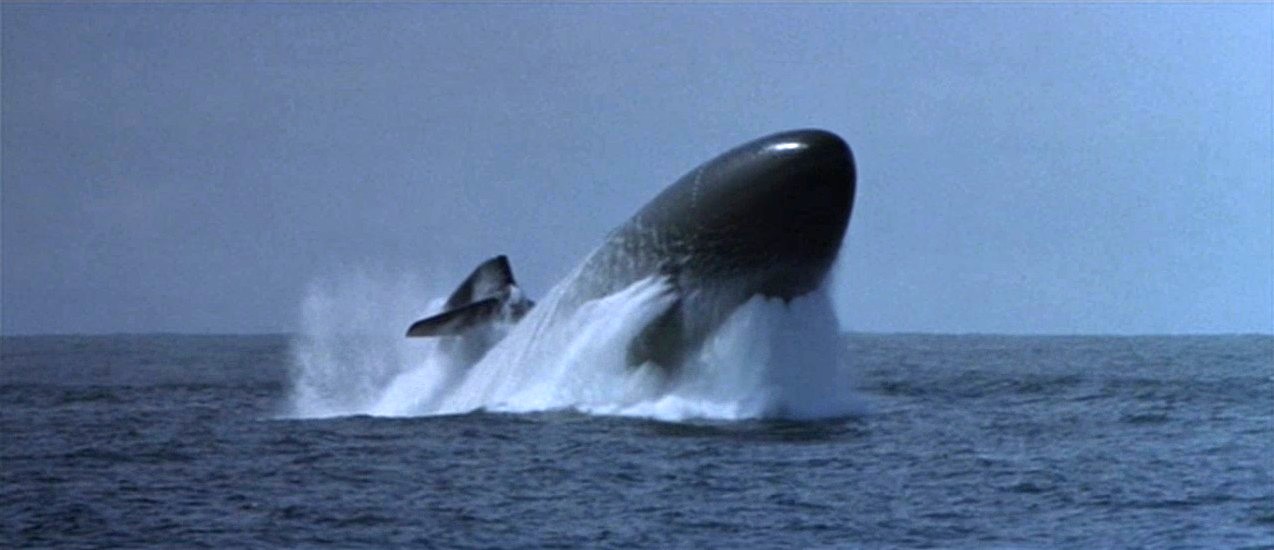
Blueback DID NOT perform the famous emergency blow scene near the end of the film, The Hunt for Red October, as some people erroneously claim. That was actually USS Houston (SSN-713). According to a sonar technician on one of my tours who was aboard USS Houston when she performed that stunt, this shot required numerous takes, and they spent most of the day going deep and then doing emergency blows over and over. This is because the camera helicopter did not know exactly where the sub would surface, so it took multiple tries to get the shot you see in the film. Ultimately, it got kind of boring. One of the shots, possibly the last one, resulted in the fiberglass dome on the bow that covers the sonar array cracking when the bow came down after breaching the surface. This ultimately resulted in the film company paying the Navy $5 million to get the fiberglass dome fixed or replaced.
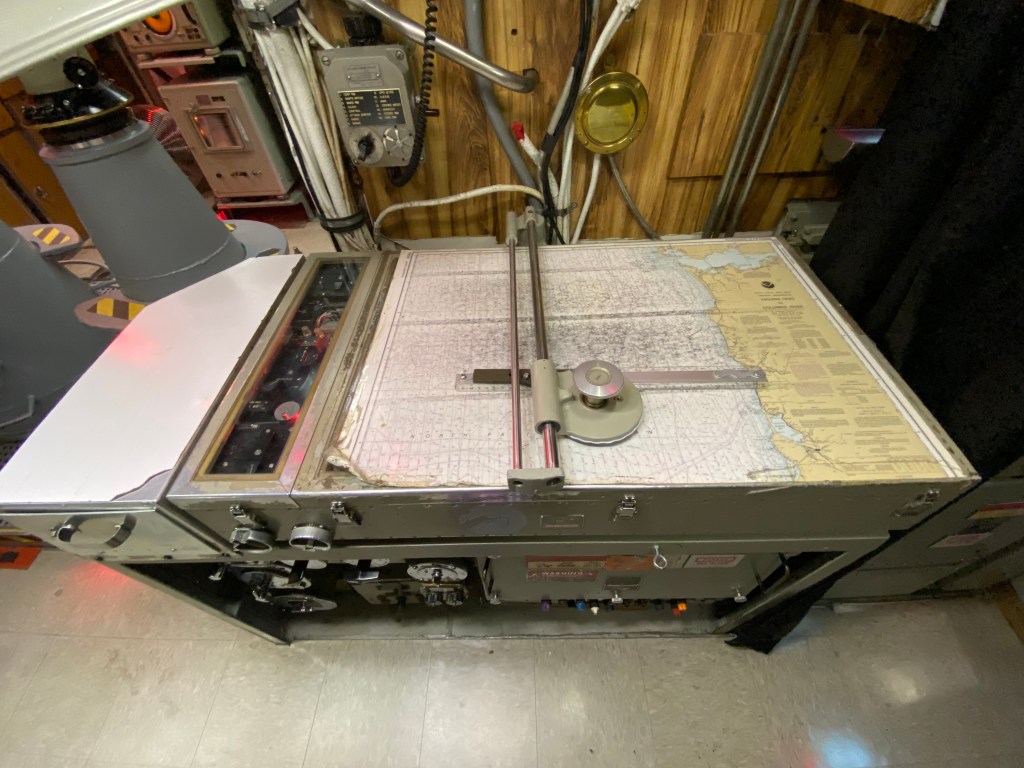
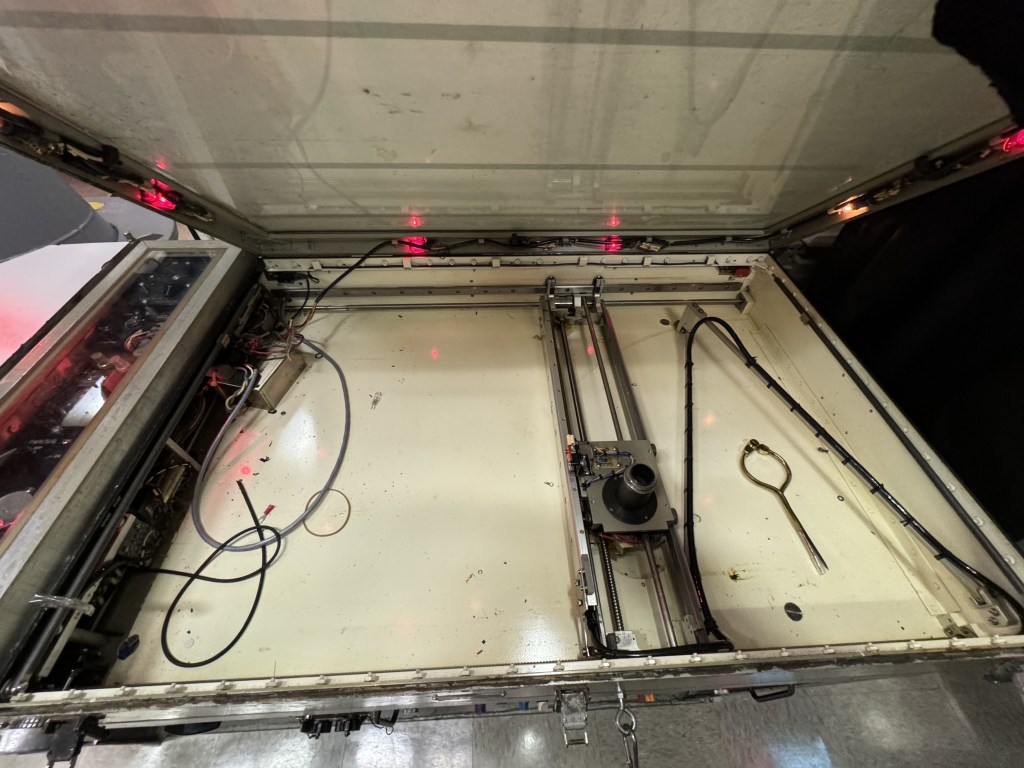
Just opposite the chicken switches, and abaft the periscopes, is a chart table. This is the navigator’s station. The Quartermaster of the Watch would be here, and this is where the submarine’s course is normally plotted. A positional fix could be taken either on the surface or when submerged down to about 60 feet with the radio masts extended. Once their position is calculated, that information, along with information from the gyrocompass, could be inputted into the dead reckoning tracker on the plotting table. There was no internet connection and no Google Maps or anything like that for the sub. Instead, they would rely on traditional paper charts of the ocean, celestial navigation with a sextant, and terrestrial-based radio navigation (like LORAN). However, Blueback did have satellite navigation near the end of her career (Transit AKA NAVSAT).31 Upon successfully getting a fix on their position, they could input that information into the Dead Reckoning Tracker on the plotting table. Under the plotting table is a small light that shines upward and shows the rough position of the submarine.
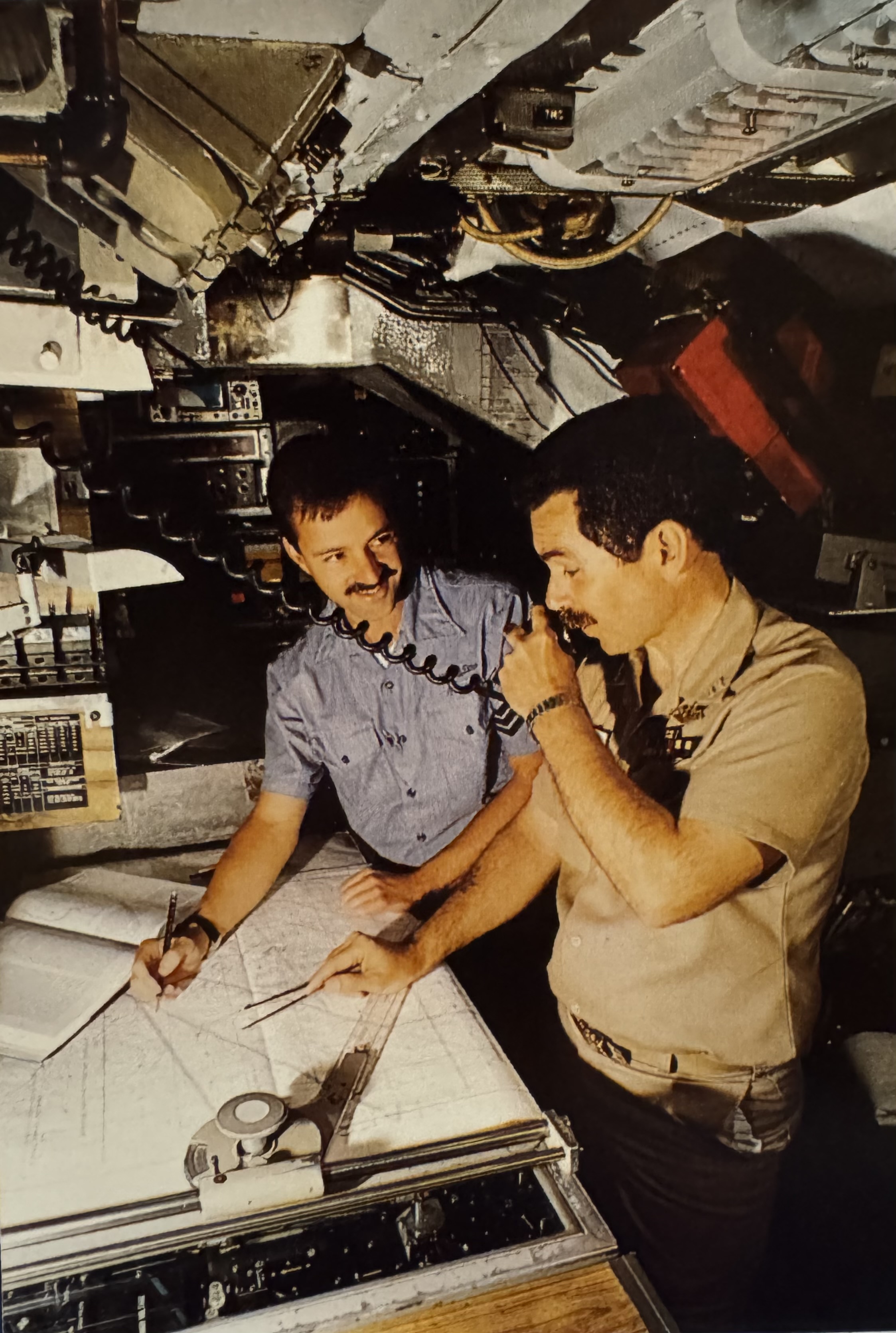
Navigational errors are to be expected, and positions are not absolute. It depends on the method used. Modern GPS (like on your smartphone) gives a very accurate fix of your position to within a few feet, but submarines like Blueback had earlier satellite navigation late in their service. Former U.S. Navy Quartermaster, Blueback crewman, and tour guide, Rick Neault, told me that a satellite navigational fix on Blueback was accurate to roughly 50 feet, and he rarely used LORAN-C because it was so unreliable.32 A radio navigation fix could expect errors of several hundred feet to several hundred yards. A celestial navigation fix using only the sun or stars could be off by several miles or more.

The area in the very back of the control room on the port side contains the radar scope and Electronic Support Measures/Countermeasures (ESM/ECM) equipment. This would be used for intercepting, locating, classifying, and identifying signals (radar, radio, etc.). According to the boat’s documentation, the ESM suite includes the WLR-1 and WLR-3 receiving sets and the BLR-6 microwave intercept receiver.
The WLR-1 set is a high-resolution, high-sensitivity, superheterodyne receiving system used for analyzing radio and radar signals in a range of 50 – 10,750 MHz. It has a 37-second sweep and a long persistence scope, allowing for a good probability of intercept. The system makes use of nine RF tuners, which break the frequency spectrum down into nine bands. By prepositioning one of the nine RF tuners to a given frequency, it can store from 1 – 10 signals.
The WLR-3 is a countermeasures receiving set using a wide-band, crystal video receiver. It can be used in conjunction with the WLR-1 and monitor other bands of frequencies while the WLR-1 scans a single band or analyzes a specific contact. Using the BLR antenna, the WLR-3 set operates in two bands: 2,300 – 5,200 MHz and 4,800 – 11,000 MHz. It can give a rough frequency, bearing, and pulse repetition rate.
The BLR-6 microwave intercept receiver uses the AT/863/ULR spiral antenna in the Type 8 periscope to provide wide band coverage in the ranges of 2,000 – 4,500 MHz or 8,000 – 11,000 MHz or both. It provides signal parameters to give a rough bearing, S or X band, and pulse repetition rate. This information can be fed to the WLR-1 for additional analysis.
The following antennas can be used with the ESM suite:
| Antenna | Frequency | Remarks |
|---|---|---|
| AS-1071/BLR | 2,300 – 10,750 MHz (Bands 7 – 9) | Direction Finding Low side 2300 – 5200 MHz High side 4800 – 10,750 MHz |
| AS-962/BLR | 1,000 – 2600 MHz (Band 6) | Direction Finding |
| AS-994/BLR | 550 – 1,100 MHz (Band 5) | Direction Finding |
| AS-371/BLR (Door Knob) | 1,000 – 4,000 MHz (Bands 6, 7) | Omnidirectional |
| AS-693/BLR (Dipole) | 30 – 1,000 MHz (Bands 1 – 5) | Omnidirectional |
The frequency spectrum would be broken down into the following nine bands:
| Band | Frequency |
|---|---|
| 1 | 50 – 100 MHz |
| 2 | 90 – 180 MHz |
| 3 | 160 – 320 MHz |
| 4 | 300 – 600 MHz |
| 5 | 550 – 1,100 MHz |
| 6 | 1,000 – 2,600 MHz |
| 7 | 2,300 – 4,450 MHz |
| 8 | 4,300 – 7,350 MHz |
| 9 | 7,050 – 10,750 MHz |
In a normal search plan, the ECM operator would use the WLR-3 for bands 7 – 9 and the WLR-1 for bands 1 – 6, with occasional sweeps through bands 7 – 9. When a signal is detected on the WLR-3, it is determined if it is on the low band (2,300 – 5,200) or high band (4,800 – 11,000), or both (4,800 – 5,200), and then analyzed using the WLR-1. While at periscope depth, the BLR-6 on the periscope can be used to detect signals in the S or X bands, while the WLR-1 would search bands 1 – 3. If no contacts are obtained, the BLR mast would be further raised, and the WLR-3 would search bands 7 – 9. If still no contacts were obtained, the BLR mast would be fully raised, and the WLR-1 would sweep all nine bands. If a contact was detected on the BLR-6 antenna, but it was undesirable to raise the BLR mast, then the information would be fed to the WLR-1 to determine the pulse repetition rate.
Most of Blueback‘s career was used for intelligence gathering, and many of her operations regarding that are still classified. We have met several officers and about 6 of the captains, but they are still tight-lipped about the details of her operations. She did three patrols off the coast of Vietnam and patrolled off the coast of northern Russia. One tour guide told me that the largest number of men on board this submarine during one patrol was around 130. In addition to the 85 crew, there were teams of Navy SEALs, Recon Marines, and a group from the CIA. The sub was operating off the coast of Russia… and by off the coast, we mean inside Vladivostok Harbor.
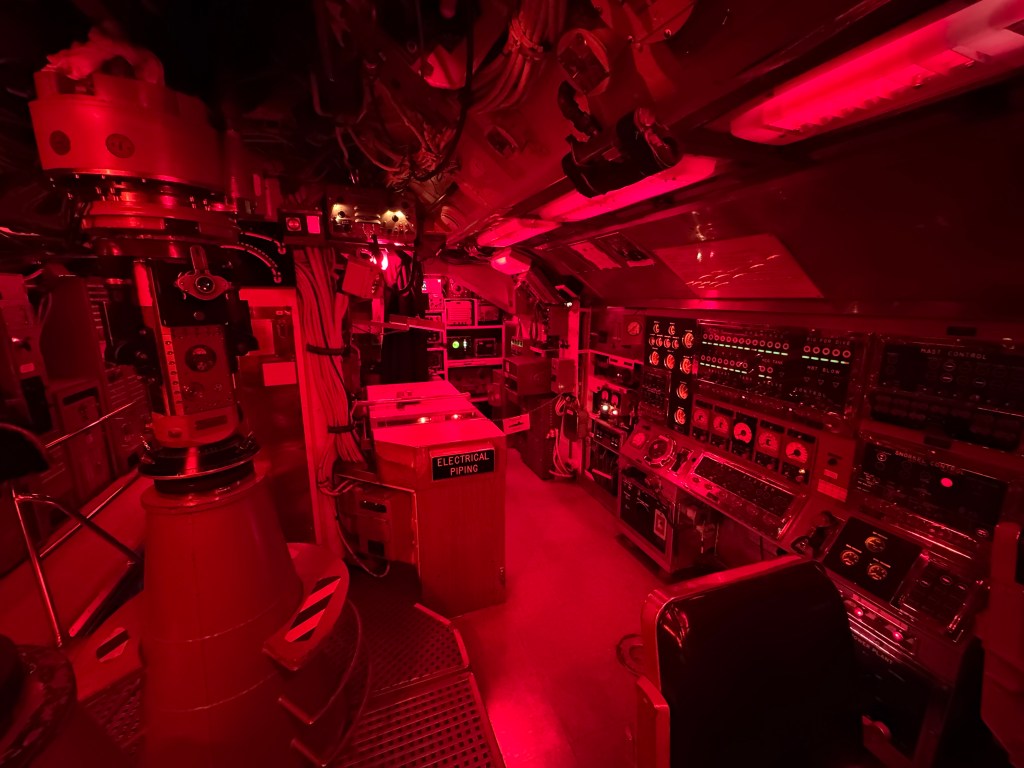
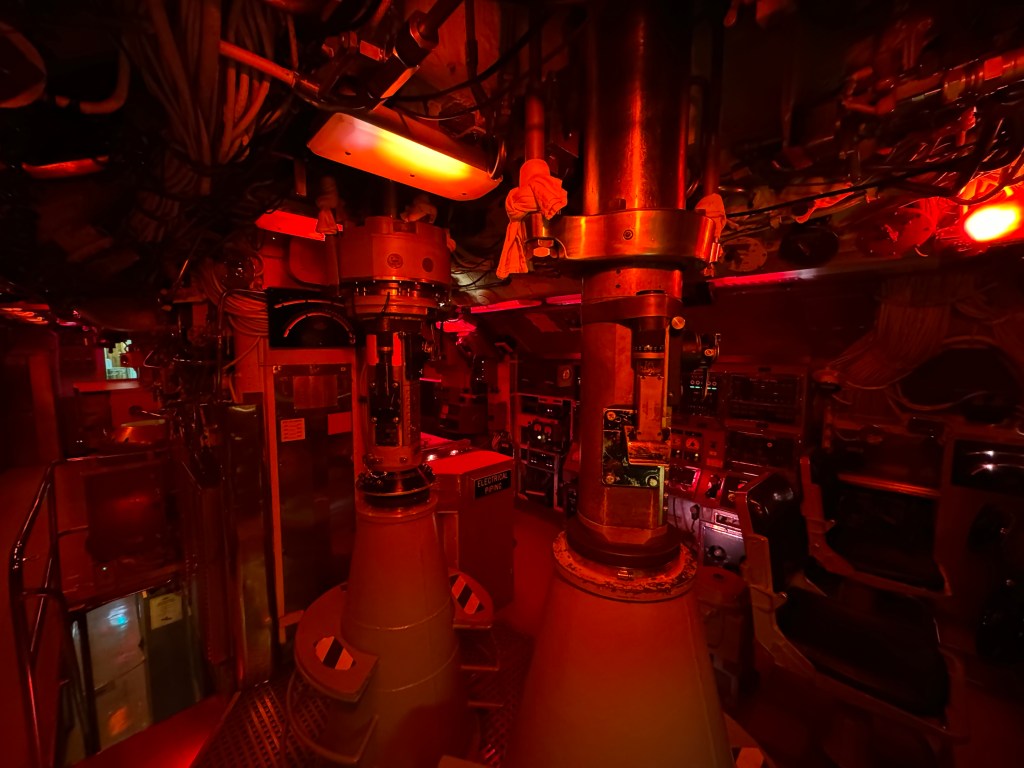
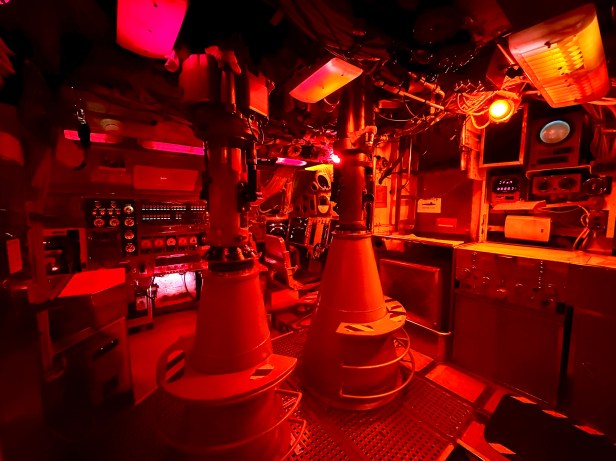
The red lighting (known as “rigged for red”) serves a few purposes. Firstly, it tells the crew that it is nighttime. Windows and sunshine are non-existent on a submarine, so the natural day and night cycle has no meaning. Secondly, if the sub is at periscope depth with the periscopes raised, then red light will not compromise your night vision as much as white light. Thirdly, white light can travel up the periscopes and be seen for miles at sea, especially in the dark. Red light is harder to see at night due to its longer wavelength, and the rods in your eyes are much less sensitive to red light. If the submarine is operating in a highly sensitive patrol area, then the lights in the control room can all be blacked out.
Sonar Room
At the bottom of the ladder from the control room is the sonar room. Tours normally just pass by it coming down the ladder, since you would be hard-pressed to fit sixteen people in this room, and we definitely do not want people touching the panels and equipment in there. Indeed, some of the equipment is still energized and operational.
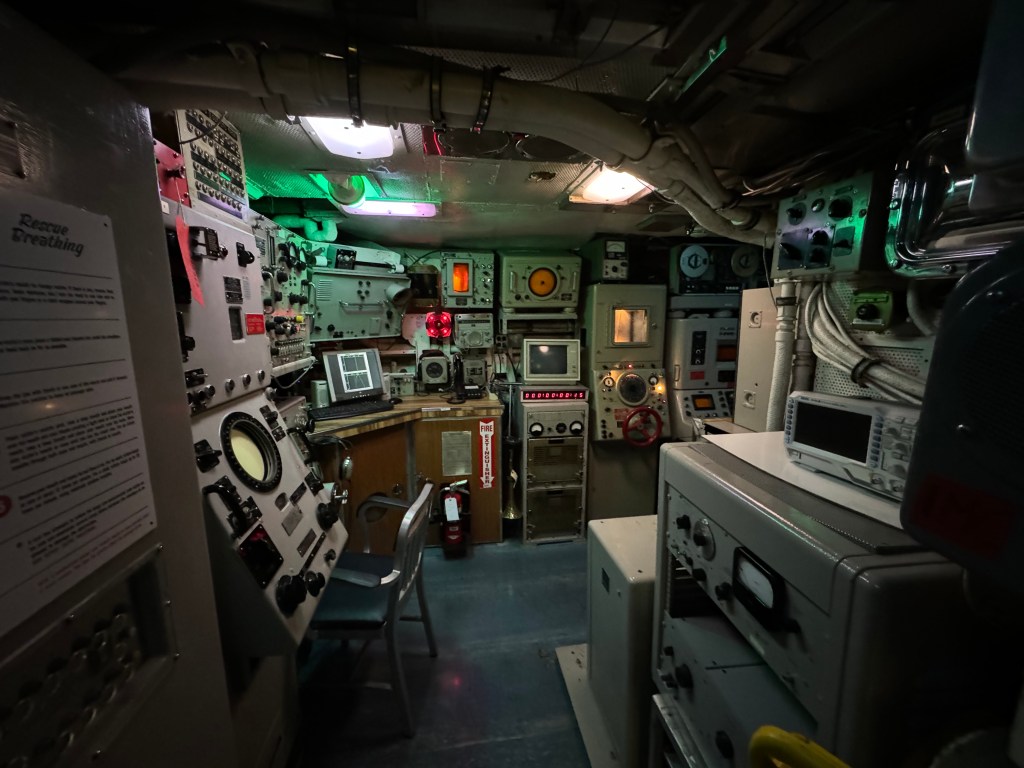
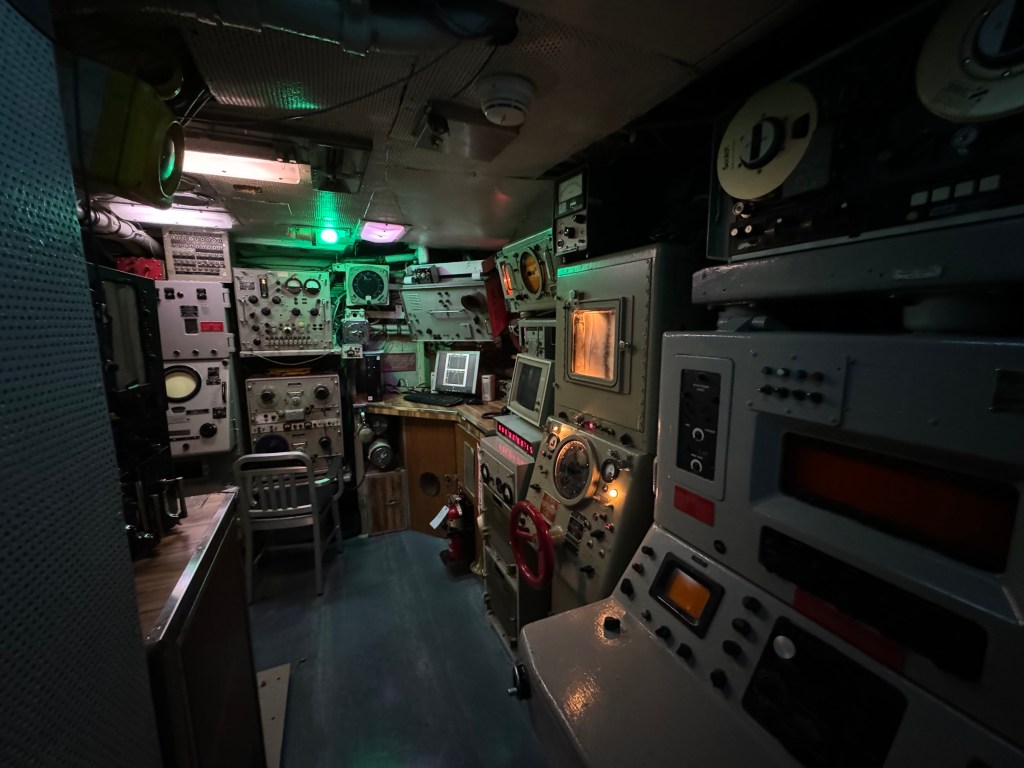
The current equipment contained in this room is as follows:
- AN/BQR-2B – passive sonar
- AN/SQS-49 (BQS-4) – active/passive sonar
- BQG-2B – sonar receiver
- BQA-8B – sonar computer (measuring own ship’s noise, cavitation, and figures of merit)
- RD-337/UNQ-7E – sound recorder
- RQ-55209 – cavitation indicator
- IP-334/BQR-2B – azimuth indicator set for BQR-2B sonar set
The sonar arrays are in the bow of the submarine, with the SQS-49 array located above the torpedo tubes and the BQR-2 array below the tubes.33 The arrays are covered in sound-transparent glass-reinforced plastic. Both the BQR-2 and BQS-4 sonars are mounted on other submarine classes, as well. Such as the earlier Tang-class.34
BQR-2 Passive Sonar
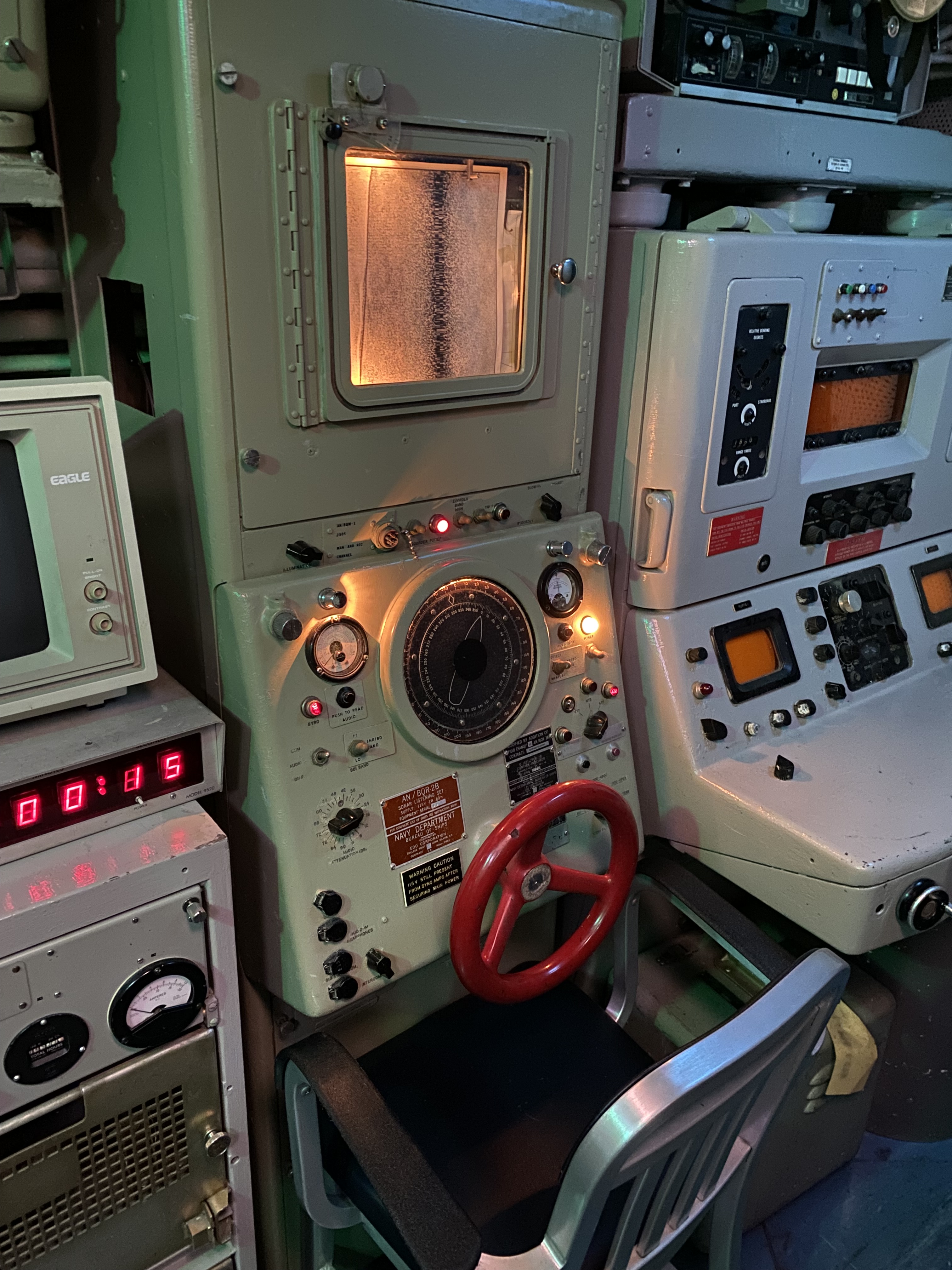
The BQR-2 is the passive sonar listening array for medium-range detection and fire control tracking. Essentially, it is an American copy of the GHG sonar taken from captured German Type XXI U-boats; the most advanced passive sonar of its time for post-WWII submarines (circa 1956).35 It can operate in either searchlight or scanning mode and includes forty-eight 3-foot vertical elements in a 6-foot diameter circle and a 5-foot high dome. It has an 18-degree beam, operating between 500 cycles and 15 kHz. While the German GHG was used like a searchlight (i.e. with the beam turned in a certain direction to listen), the U.S. BQR-2 added a commutator operating in the 5 – 9 kHz range, which either scanned continuously at 4 RPMs or was tracked by the Bearing Direction Indicator (BDI). The BQR-2B version added a second commutator operating in the 700 Hz to 1.4 kHz range that fed a Bearing-Time Recorder (BTR). A piece of paper rolls down past a stylus that moves horizontally, with each pass of the stylus being one full commutator scan. Whenever the received signal reached a certain level, the stylus placed a mark on the paper. Over time, the BTR could be used to estimate a target’s motion and position. The BTR beam could be driven at 1 or 10 RPMs, with the higher one being used for a stronger target signal.36 The BQR-2B has a sound-bearing recorder for 1 – 4 kHz, but it can aurally detect noise at 0.3 – 15 kHz. Automatic target following had an accuracy of 0.25 degrees against a noisy submarine at 12,000 yards. The typical performance for this set is as follows:37
| Noise of submarine | Detection distance above thermocline | Detection distance below thermocline |
|---|---|---|
| (Own sub) Quiet (Target) Snorkeling/cavitating | 110,000 yards | 8,000 yards |
| (Own sub) 13 knots (Target) Quiet/shallow | 13,000 yards | 4,000 yards |
| (Own sub) Quiet (Target) Quiet/shallow | 10,000 yards | 2,500 yards |
That said, in May 1951, Captain W.B. Siglaff of SubDevGru 2 reported that the best range of a BQR-2 passive sonar was 20,000 to 30,000 yards. The worst range was 2,000 to 4,000 yards, and the average was 8,000 yards.38 The documentation on Blueback similarly credits the BQR-2B with a detection range of 40,000 yards in excellent sound conditions with a bearing accuracy of 0.1 degrees. It has a 50% probability of detecting a snorkeling submarine traveling at 10 knots at a range of 36,000 yards in a sea state of 2 with a thermal layer at 100 feet depth. Echo ranging in the 1 – 15 kHz range can be tracked. The passive sonar can be used as an input for fire control.
The desktop computer in here is a modern addition and would not have been there when the submarine was in service.39 The screen shows a fake digital waterfall display. Since this submarine was originally in operation before digital computers, Target Motion Analysis (TMA) was done via a Bearing Time Recorder (BTR) as seen above the BQR-2B sonar console. There is also an azimuth indicator and a BTR console up in the control room. A modern submarine’s digital waterfall display originated from this analog device.40
SQS-49 (BQS-4) Active Sonar
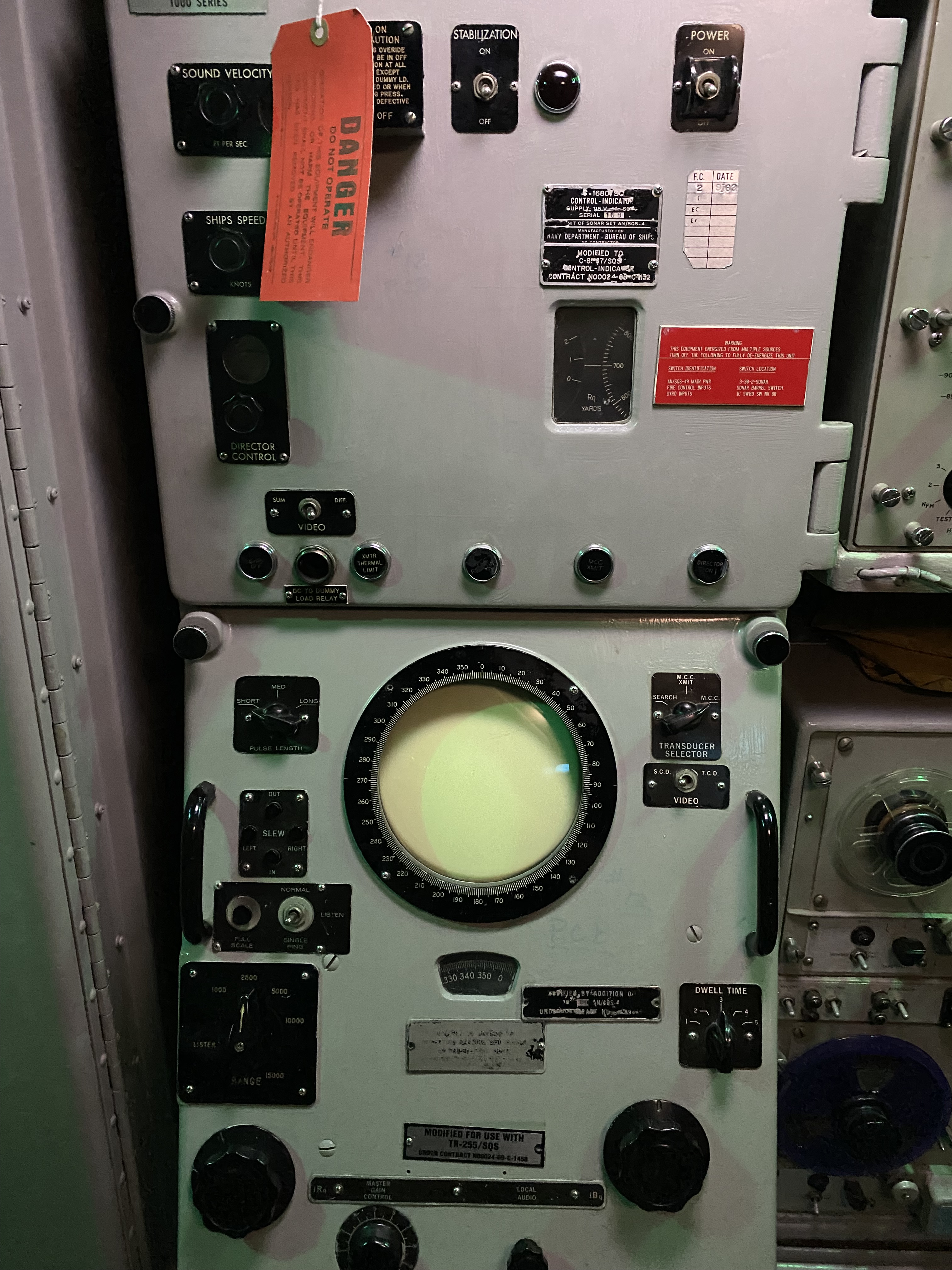
SQS-49 sonar is an SQS-4 mod 1 with MARK (Maintenance and Reliability Kit). The SQS-4 is the first postwar long-range sonar produced for both surface ships and submarines. Effectively, it is a lower-frequency version of a WWII QHB, the first operational U.S. scanning sonar, with a similar beam shape and three different pulse lengths: 6 ms (50 kW), 30 ms (30 kW), and 80 ms (10 kW) at the original frequency of 14 kHz. The Mod 1 decreases the frequency to 8 kHz. SQS-4 is considered accurate out to 5,000 yards on surface ship sets and can achieve even longer ranges on submarine sets. It can be operated in a passive mode and incorporates functions of both a search and attack sonar, such as both a ship-centered (PPI) and target-centered display.41 On a noisy, transiting submarine, SQS-4 has a range of around 6,000 yards.42
Documentation on the sub notes that this active ranging sonar also has the capability of passive listening. It has a range of 15,000 yards in active mode with a range accuracy of 2% of scale and bearing accuracy of 1 degree (3 degrees in passive mode). While this set is normally used in passive mode, if an ASW vessel has contact, then a maximum intensity signal can be emitted to saturate the vessel’s scope and present a false target. It has a peak power output of 50 kW.
Many BQR-2B sets are often combined with BQS-4 active sonar sets since the passive array can be used as a receiver for an active set. The BQS-4 features seven transducers stacked on a stave inside the BQR-2 array, pinging at 7 kHz.43
BQG-2B Sonar Receiver
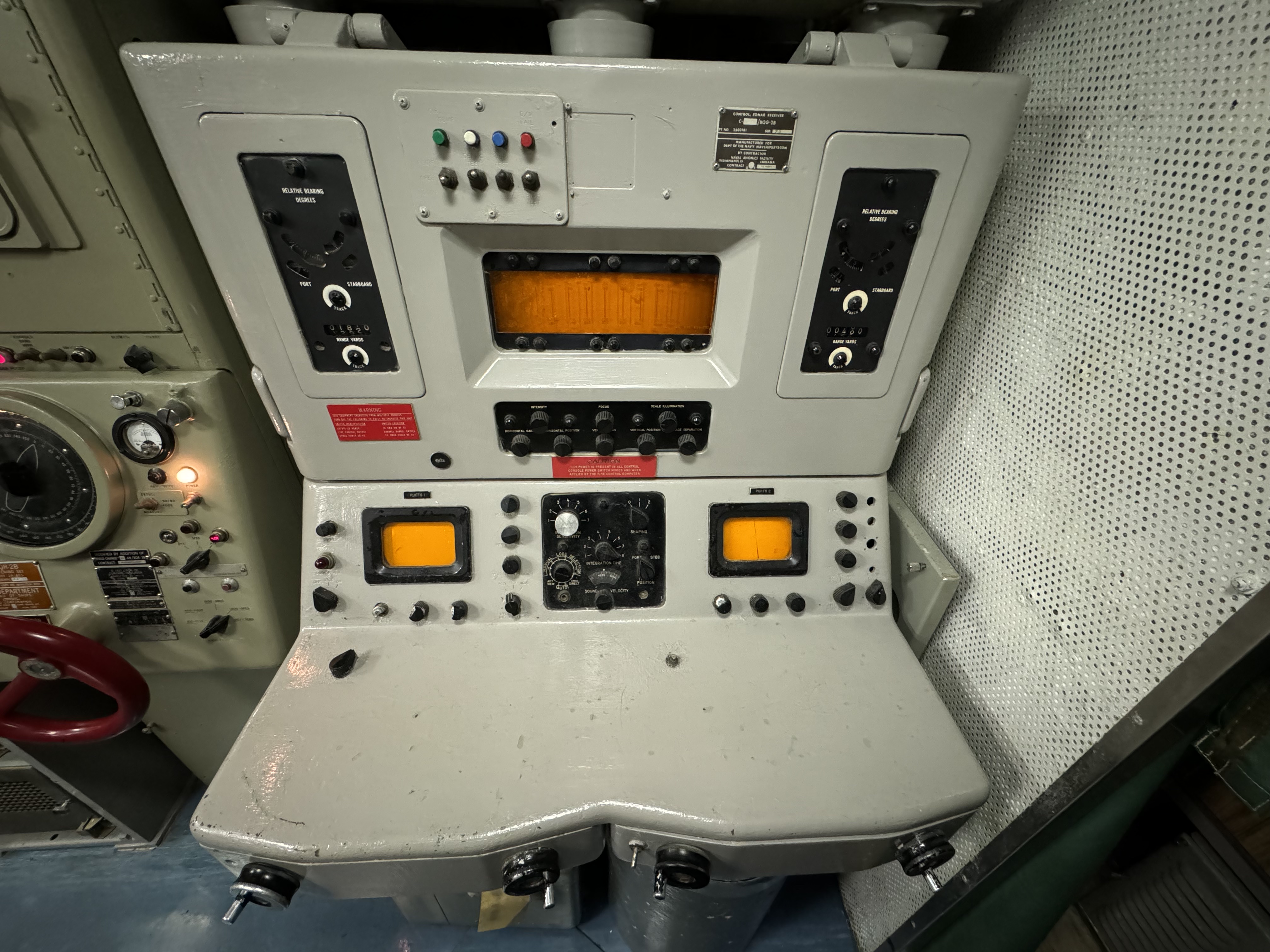
Originally, the Passive Underwater Fire Control Feasibility Study (PUFFS), this set is for determining the passive ranging and bearings of a target. Norman Friedman writes that the BQG-1, -2, and -4 sets obtained information from a set of three hydrophones. The original idea was that three equally spaced hydrophones on a 250-foot base, operating at 0.2 – 8 kHz, would be able to obtain ranges within 2 percent against a snorkeling submarine at 10,000 – 15,000 yards. They would measure the curvature of the wavefront of the target signal, compare the time of arrival at the three detectors, and then correlate the information. Feasibility studies of this began in March 1953 and progressed to a working model aboard USS Blenny (SS/AGSS-324) in November 1960.44 Other publications suggest that the Barbel-class submarines never had the PUFFS system installed, or at least the hydrophones, since they would have created too much hydrodynamic drag.45
Documentation on the boat suggests that this was originally a BQG-2A receiver with passive ranging and bearing accurate to within 20,000 yards (+/- 25 yards range and +/- 0.1 degrees of bearing) and bearings accurate to 40,000 yards. However, it was ineffective against echo ranging in frequencies below 5.6 kHz. The set could track two targets simultaneously (port or starboard) and input information to fire control.
Silent Running
Documentation on the boat for operations notes that three conditions of silent running are prescribed by the ship’s organization manual.
- Patrol Quiet: Equipment is secured to the maximum extent possible with normal living conditions. This would be when the submarine is operating in its patrol area. The AC load is dropped so it can be maintained by one 75 KVA generator set.
- Battle Quiet: Maximum securing of equipment and only personnel on watch are up and about. Self-noise is reduced so that a Mk. 37 torpedo’s gyro can be heard to turn up over the UQC Underwater Communications Set.
- Sonar Quiet: Extreme quieting conditions are maintained for the purpose of specialized sonar recording. Only equipment essential to safely operate the ship is used under this condition.
Small Arms Locker
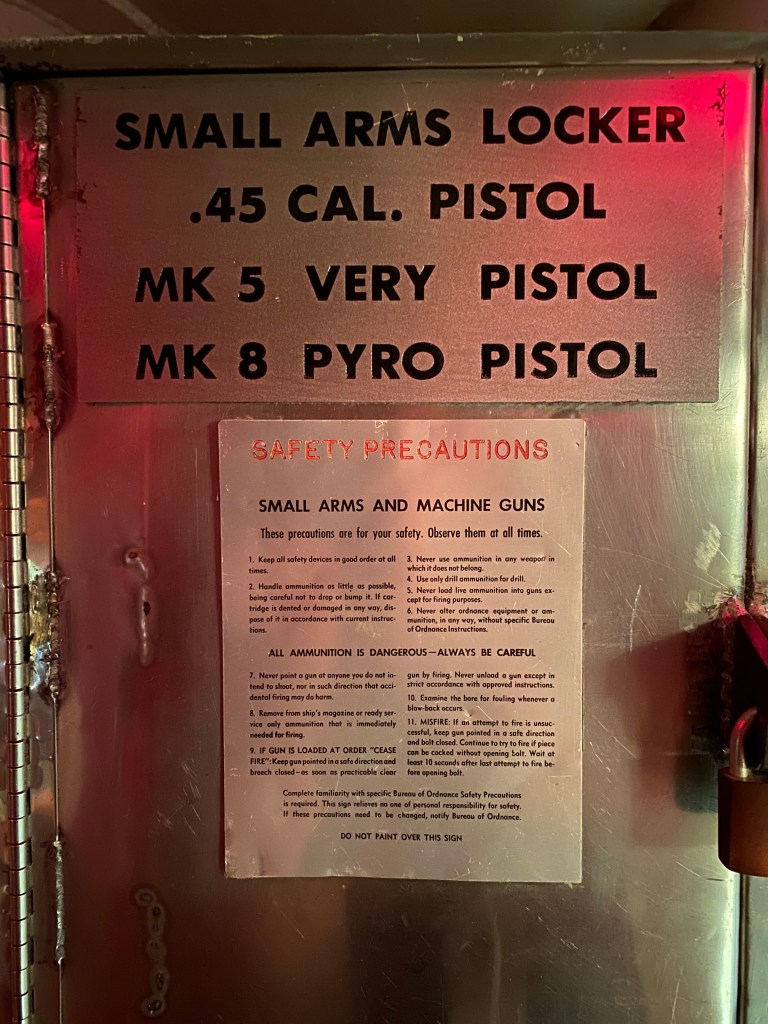

Forward of the sonar room are two metal cabinets which are the small arms lockers. Small arms are handheld weapons like pistols, rifles, shotguns, etc.
In the top small arms locker of Blueback would be pistols such as M1911s, as well as pyro and very pistols (AKA flare guns). The bottom locker is larger and would hold M14 rifles and 12 gauge shotguns.
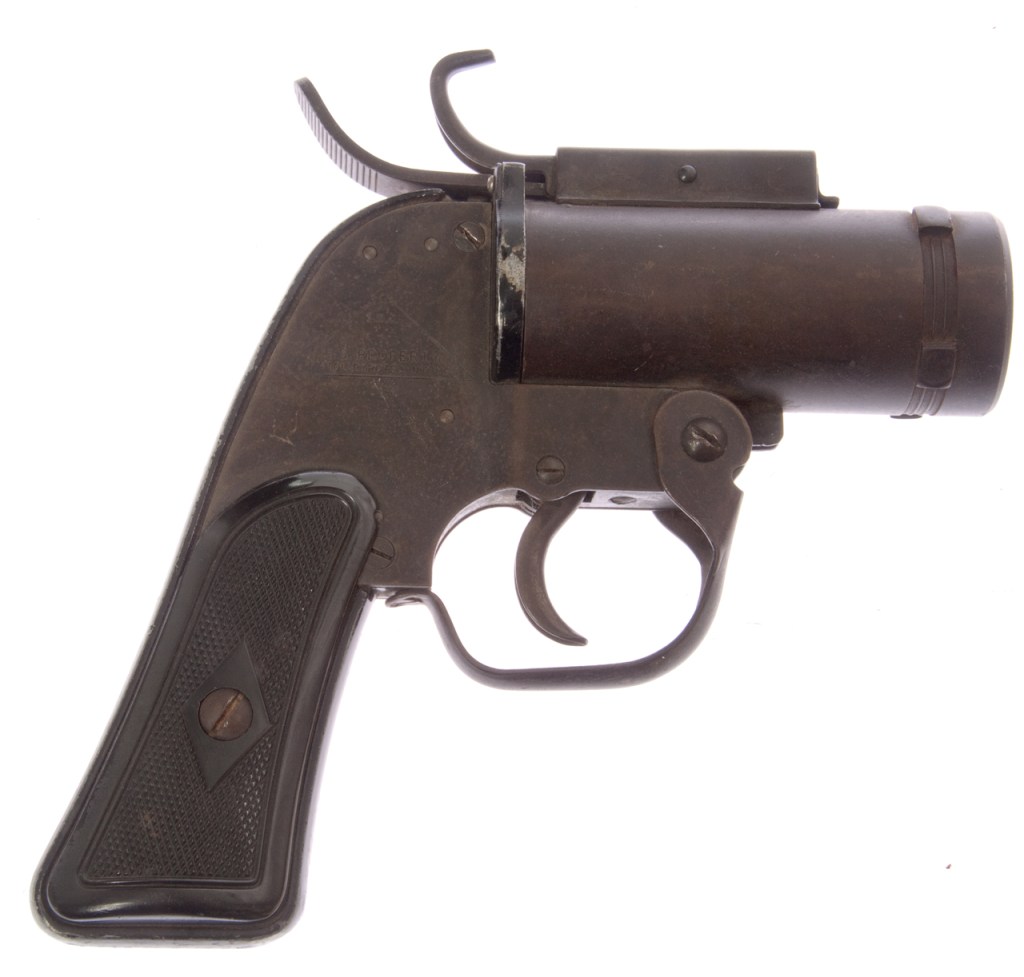
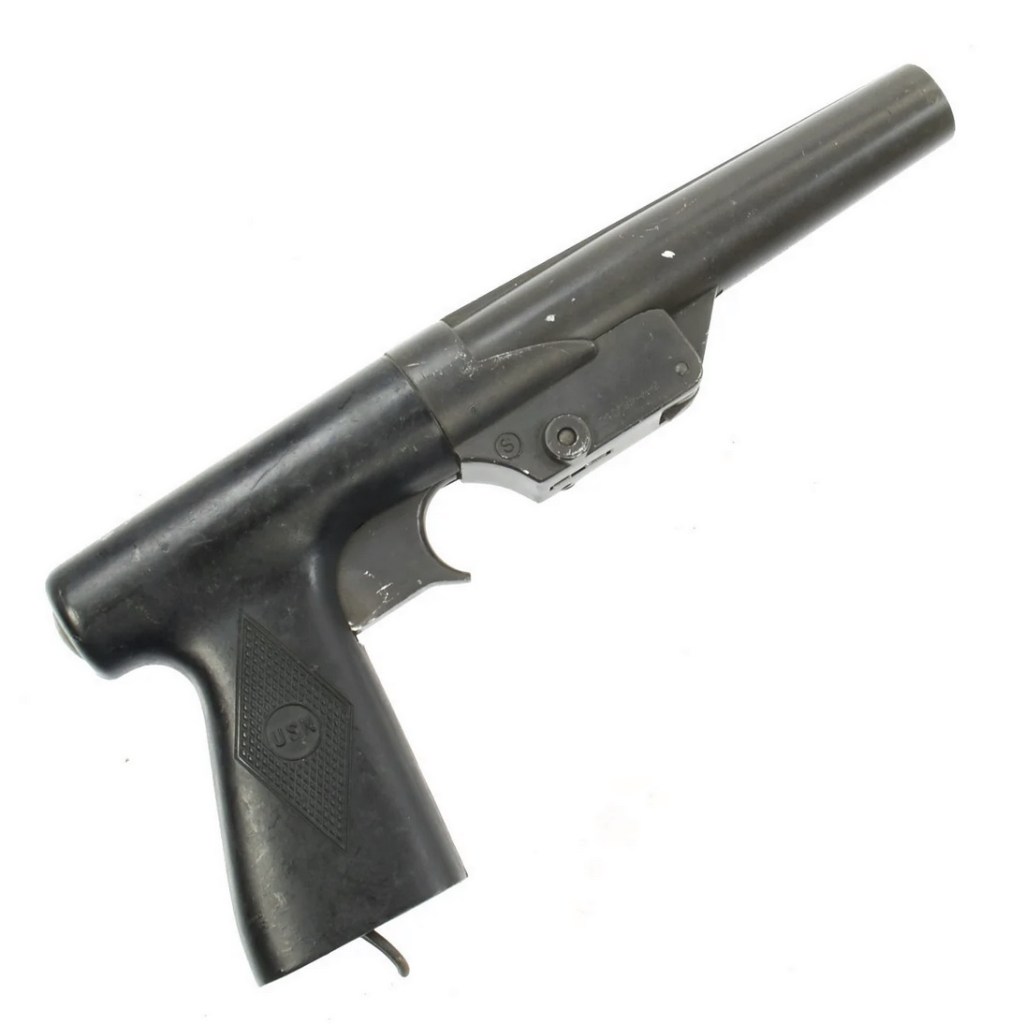
NAVORD OD 10718, originally published in June 1956 and declassified in August 2025, shows the original ordnance loadout for a Barbel-class submarine. When commissioned in 1959, the small arms lockers would have included 8x Colt M1911A1 .45 caliber pistols, 6x Thompson .45 caliber submachine guns, 3x M1 30.06 M1 Garand rifles, 2x Mk. 5 Very pistols, and 2x Mk. 8 Pyrotechnic pistols. The upper locker has 14 pegs for pistols, suggesting that when Blueback was armed with the nuclear-tipped Mark 45 torpedo, the number of pistols would have been increased. There would have also been a line-throwing gun. As time went on, the small arms in these lockers no doubt changed to more modern weapons like M14 rifles and 12-gauge shotguns.
All naval vessels have small arms to defend the ship, and submarines are no exception. However, unlike the movies, you are unlikely to be repelling boarders, and if you get into a gunfight on a submarine, then something has gone very wrong. Additionally, the base skillset of sailors is seamanship, not infantry tactics. Sailors are not trained to run around in jungles or up and down mountains blasting away with rifles, machine guns, and rocket launchers. That is what we pay the infantry (Army 11Bs and 0311 Marines) for.
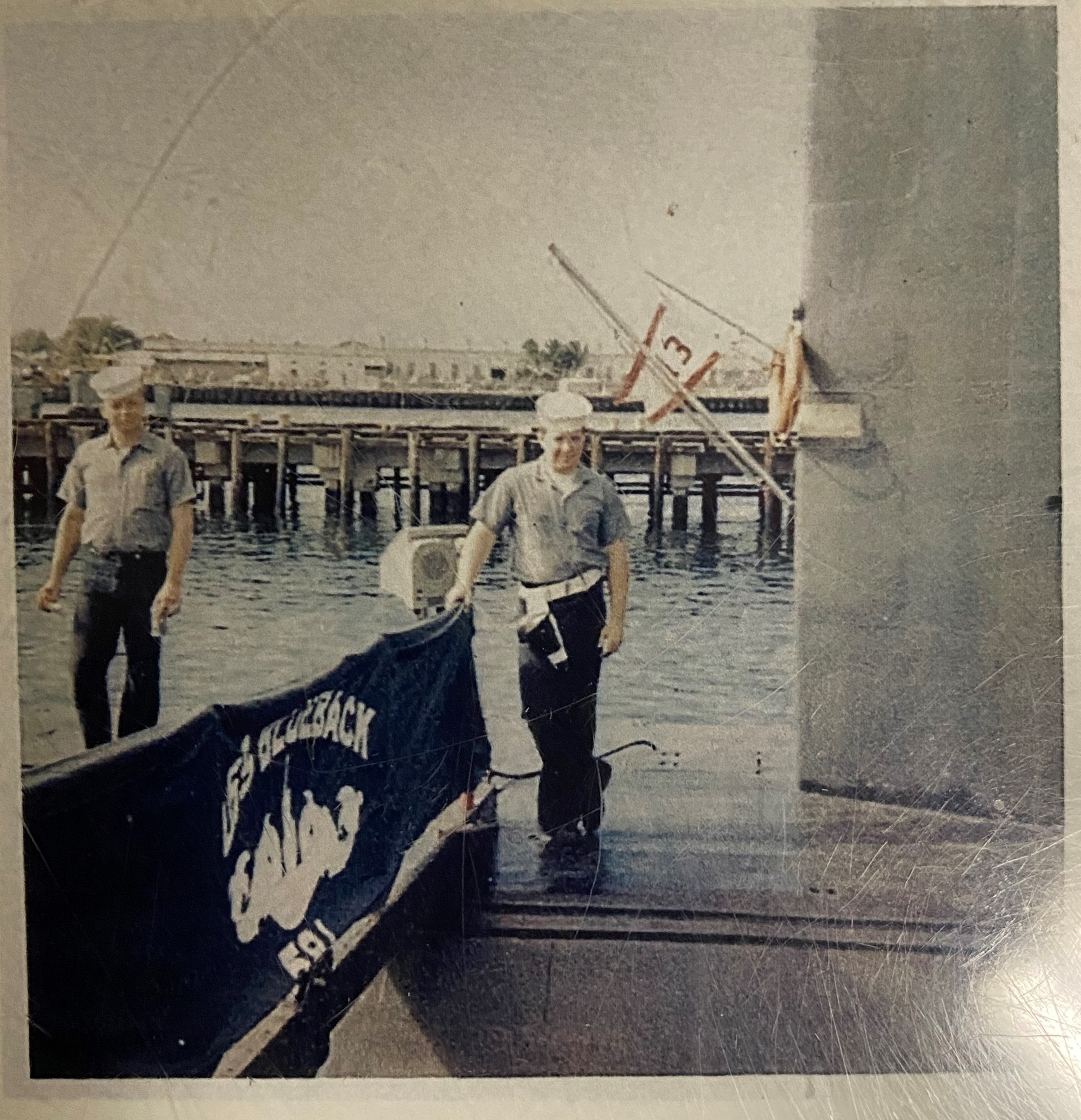
Rather, the small arms are used when the submarine is in port. A sentry (such as the Officer of the Deck) will be stationed on the pier or the quarterdeck with a weapon to provide security and prevent unauthorized people from getting on the boat. People do not walk around a naval vessel (or any military installation) carrying weapons at all times. There is simply no need for that. The people who would be armed are MPs or MAs (Military Police/Master at Arms). The small arms would always be in a secure area, and if there is ever a need for them, then there would be time to unlock them and issue the weapons out. Certain secure areas of a vessel, such as the engineering spaces or the radio shack, would likely have someone with a loaded weapon present to deter intruders. Do not try to enter these areas without authorization, or you will be greeted with a loaded pistol pointed in your face and told in no uncertain terms to leave.
There could also be small arms qualification where the submarine could be on a surface and the sailors would be topside on deck (or on the bridge on the sail), firing at targets to maintain their qualification in using pistols or rifles. A swim call would also necessitate someone standing on deck with a loaded weapon in case any sharks show up to the party.
Showers & Heads
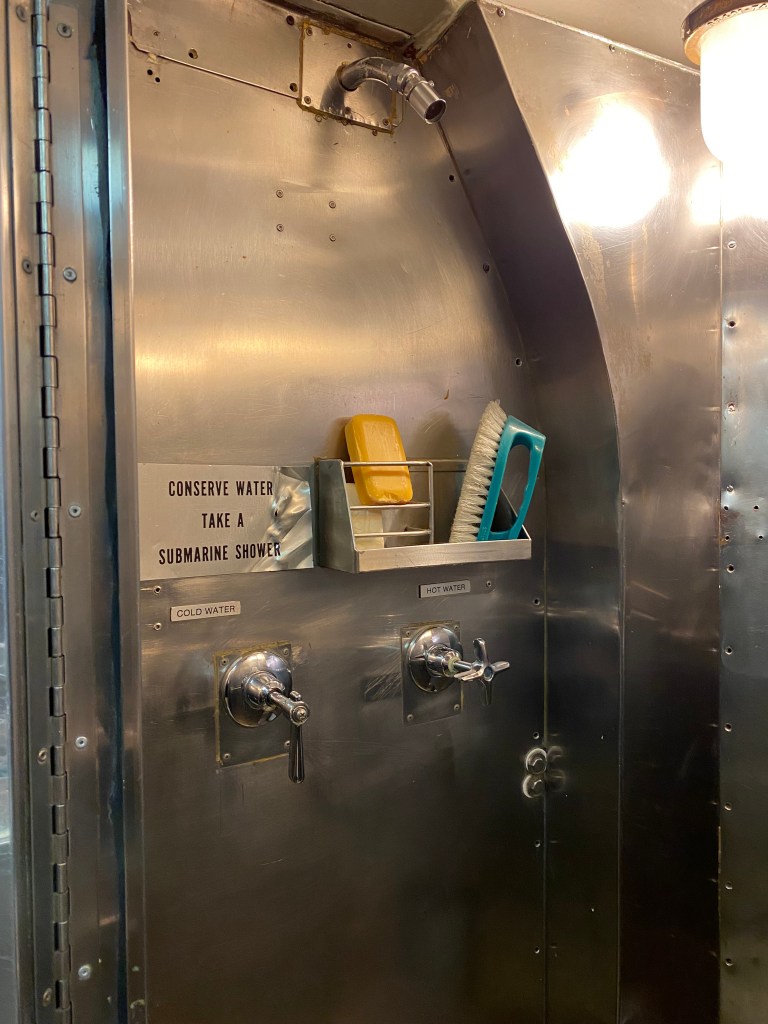

There is nothing particularly special about the showers and heads (toilets). There are two showers and four heads for the 77 enlisted crewmen.46 I have already written a short article on the procedure for using the head (as well as one for the showers). The showers are an interesting experience because a diesel-electric submarine would be perpetually rationing freshwater. Any shower you take would not be a long “Hollywood” shower, as sailors call it, because it wastes too much water. Rather, the experience is a one or two-minute-long “submarine” shower (if the sub is operating at high latitudes, then you can bet the water would be freezing). Here is how you take a submarine shower:
- Get in the shower.
- Turn the water on for 10 seconds and get wet. Turn the water off.
- Apply your shampoo and soap. Scrub.
- Turn the water back on for about 30 to 45 seconds and rinse off. Turn the water off.
- Get out and dry off.
If you are lucky, you will get a shower once a week on this submarine. More than likely, you will shower once every two to three weeks or even just once a month. According to Rick Neault, on one patrol, the crew went roughly 54 days (almost 8 weeks) before they got a shower. Rick (and Tony Capitano) also said that the water heaters worked, so at least the showers on these boats were hot/warm, but if the submarine was in port and receiving water from ashore, then they would be cold. Still, Rick said he could count the number of showers he took on these boats (Bonefish and Blueback) on both hands. Usually, showers were just once a month.
You can imagine the body odor of 85 men not showering much. But it gets better. Around 75% of the crew smoked on the submarine, plus there would be the smell of dirty clothes, diesel fuel, oil, lubricants, hydraulic fluid, food, and whatever was in the various tanks and bilges. Therefore, the odd smell on board the submarine is a combination of all those odors. It has permeated everything, and it cannot be gotten rid of. The submarine has been airing out since 1994, but imagine what she smelled like when the museum acquired her. Several of the tour guides are former diesel boat submariners, and note that Blueback smells very much like their submarine did. It is the classic odor of a diesel-electric submarine that spent 31 years in service. The only sailors on board who would be allowed to shower daily would be the cooks and the corpsman, for obvious health reasons. Yes, even the officers and the Captain would be limited in their showers. Thankfully, in modern nuclear-powered submarines, the water distillation plant is more efficient (described below), and showers are “usually” daily (although they would still need to take submarine showers to conserve water). Beards are also no longer allowed, and you would need to maintain a military regulation haircut. One sailor on a Los Angeles-class boat told me most of the crew would simply shave their heads before they left on patrol and just let their hair grow. The U.S. Navy also banned smoking on submarines in 2010. Before that, it was at the Captain’s discretion. The following year, the first female officers were allowed on submarines (female enlisted were allowed on subs starting in 2012). Although allowing women on subs and the smoking ban are not related events. A modern nuclear submarine also has a very distinct odor because it is permeated with monoethanolamine (AKA amine) from the CO2 scrubbers. Thus, there is a more fishy, ammonia-like smell in the air on nuclear boats.47 If you did a really good job and the captain gave you an “attaboy” then you might be allowed to take a Hollywood shower. It would not be much longer, but maybe you could take a 3 – 5 minute shower instead. Hooray!
Torpedo Room
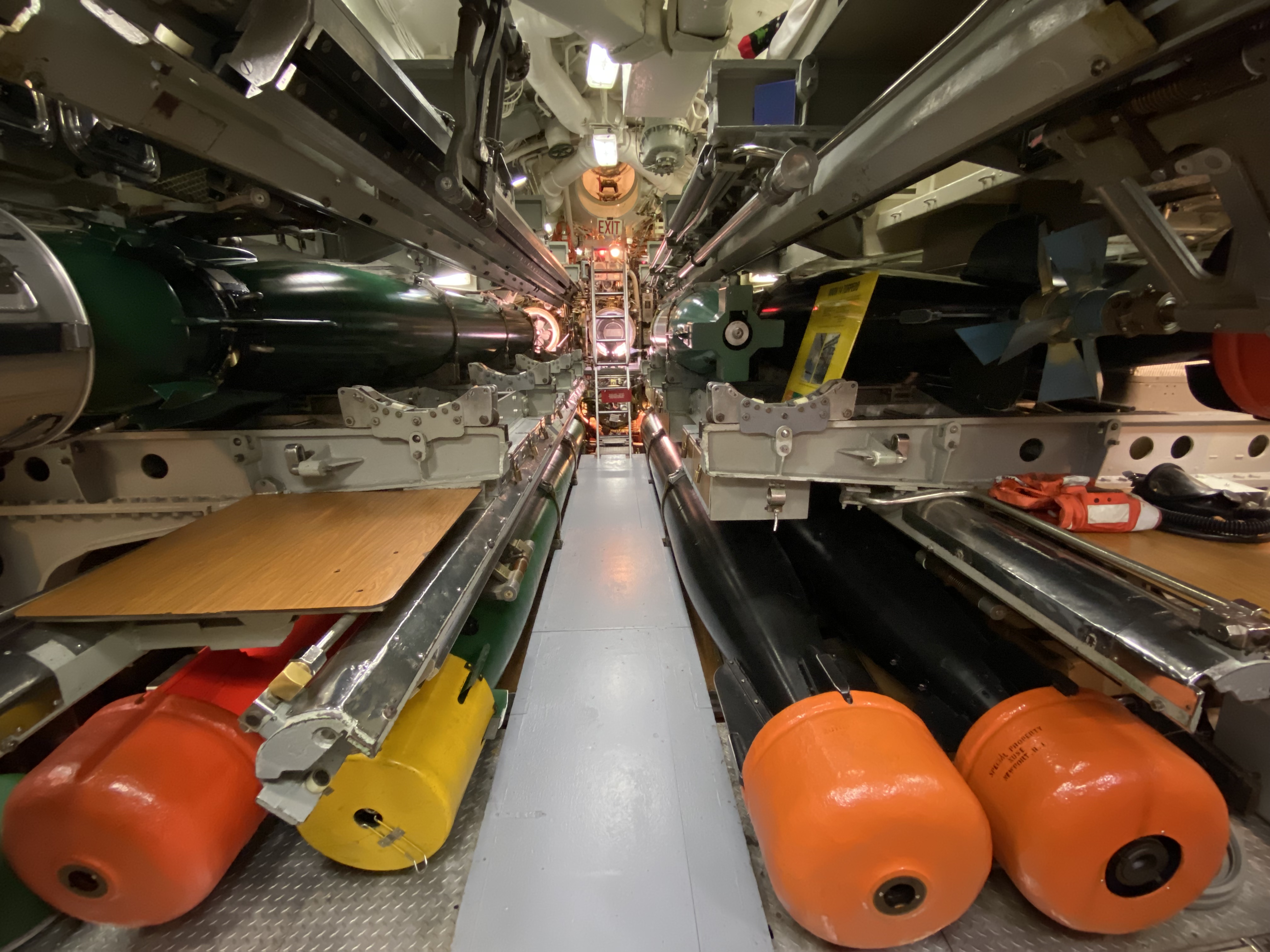
The torpedo room is the forward-most and smallest of the three watertight compartments of the submarine. However, it feels larger because the overhead is the top of the inner pressure hull. Blueback has six Mark 58 mod 1 and 2 torpedo tubes, all located forward, in a three-over-three configuration. The torpedo tubes are 21 inches in diameter and extend 21 feet forward to the bow of the sub.48 The Mark 58 tubes can fire torpedoes either electrically from a remote location or via the hand-firing key at the tube. Wire-guided, electrically set torpedoes can be used, with either electrical starting or mechanical starting provided. Firing swimout torpedoes without the use of the hydraulic ejection system is also possible.
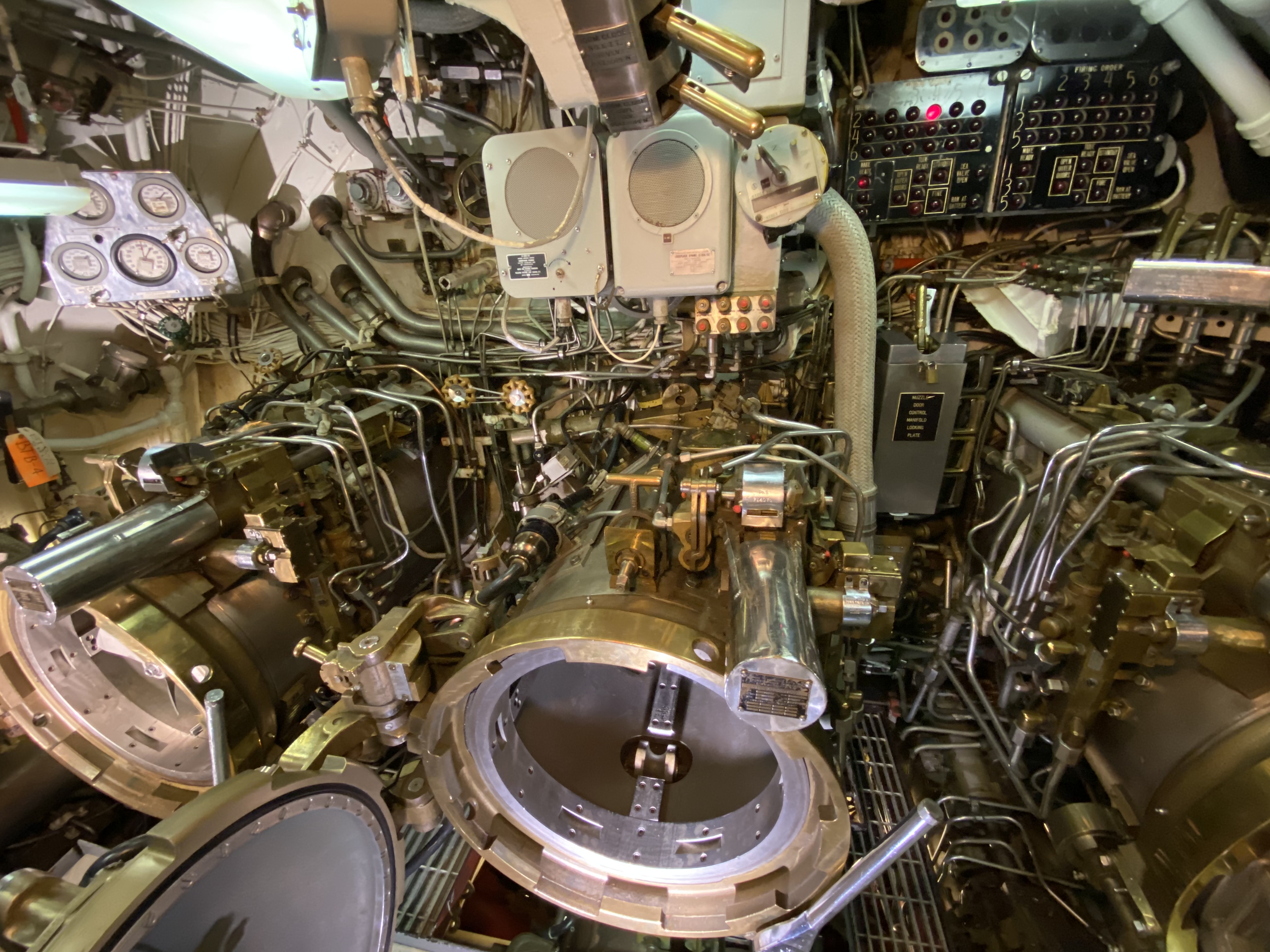
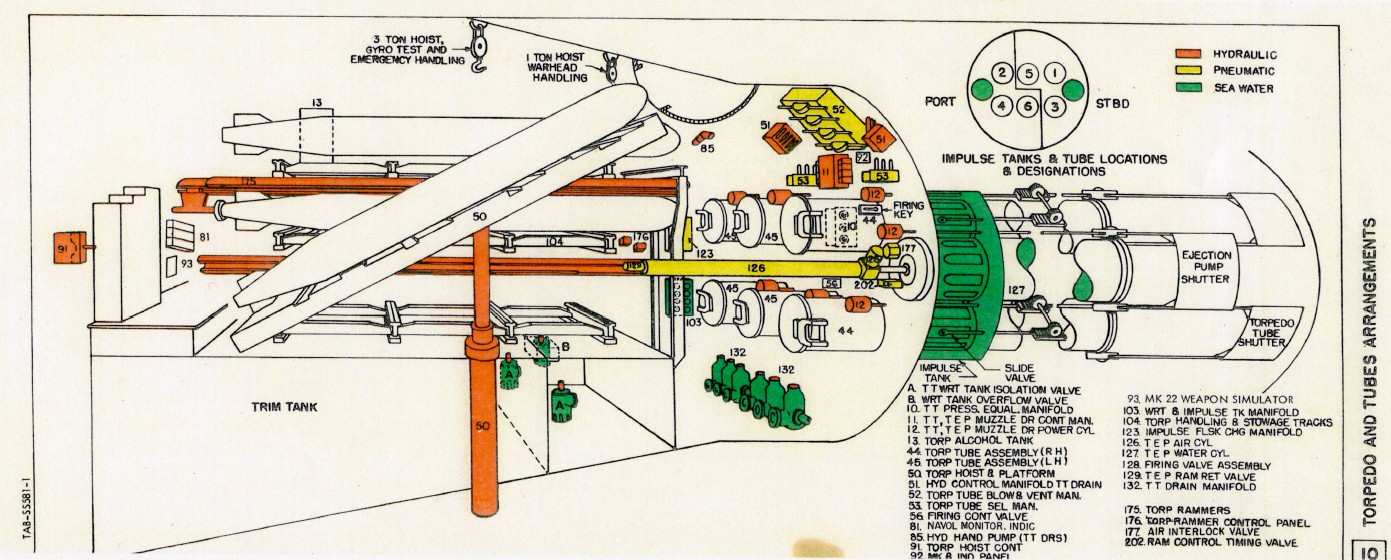
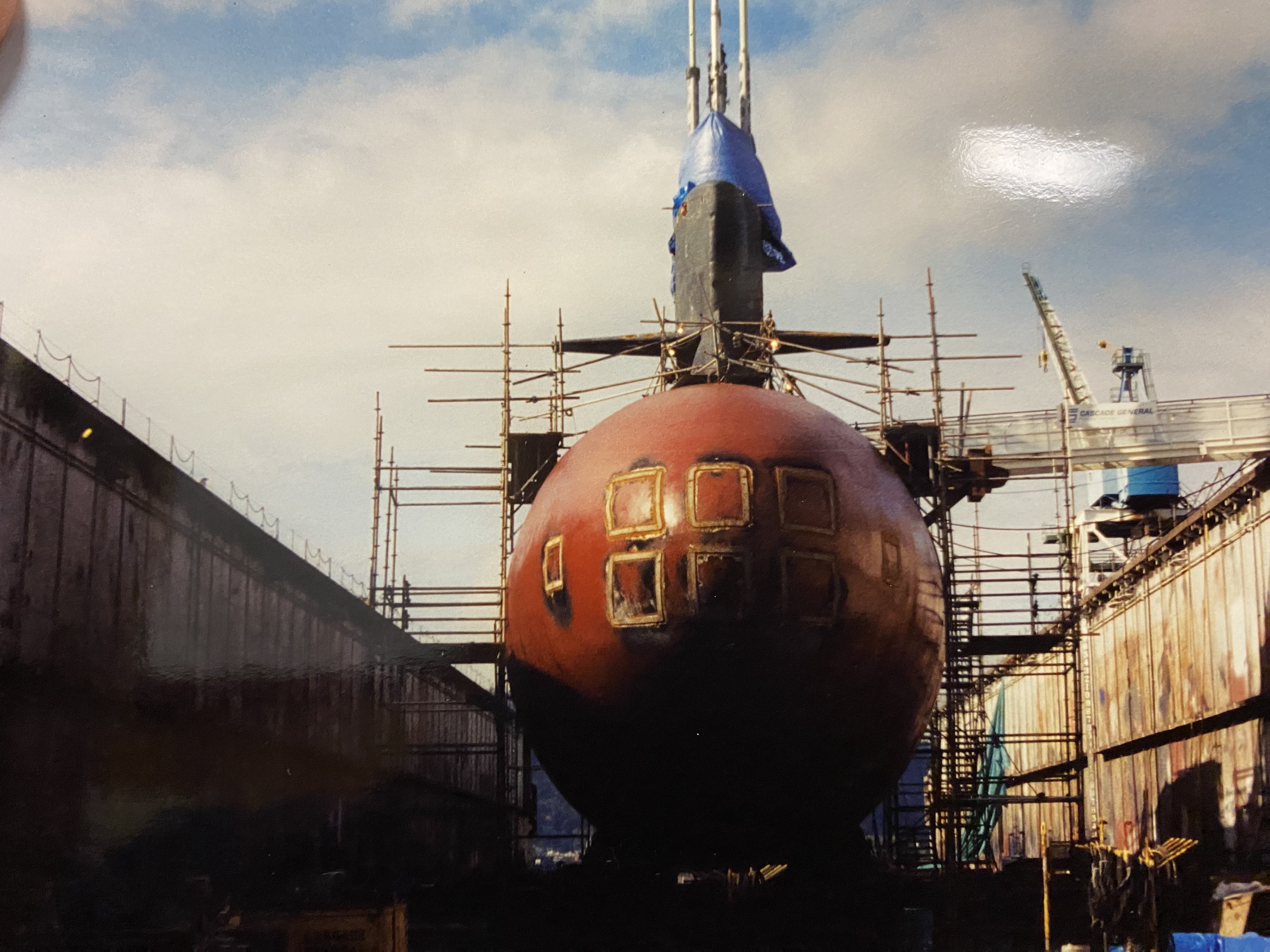
On a lot of tours I give, people are surprised by the size of the torpedoes; either because they have never seen a torpedo before, or they are used to seeing modern surface/aerial-launched torpedoes, which are considerably smaller. In contrast, these are heavyweight submarine torpedoes. Reportedly, these are all real torpedoes, but being a museum, they are simply empty shells with the fuel and explosives removed from them…except for one, but they did not tell me which one. (That is what I like to tell my tours.)
Blueback was never actually in combat. USS Torsk (SS-423) was the last U.S Navy submarine to fire torpedoes in combat during World War II, on 14 August 1945, when she sank some Japanese escort vessels in the Sea of Japan. It would be over 80 years, until 3 March 2026, when a U.S. submarine (USS Charlotte (SSN-766)) again fired torpedoes in combat and sank the Iranian frigate IRIS Dena in the Indian Ocean south of Sri Lanka.49
Blueback can carry a total of 22 torpedoes. Sixteen on the skids (i.e. storage racks) and six loaded in the tubes. Although I have been told she would normally carry no more than 18. There are currently 11 torpedoes in this room (one is loaded in a tube). The torpedoes in here are merely a representation of the types of weapons Blueback carried throughout her 31 years of service.
The torpedoes contained in this room are as follows:
Mark 14 Mod 5
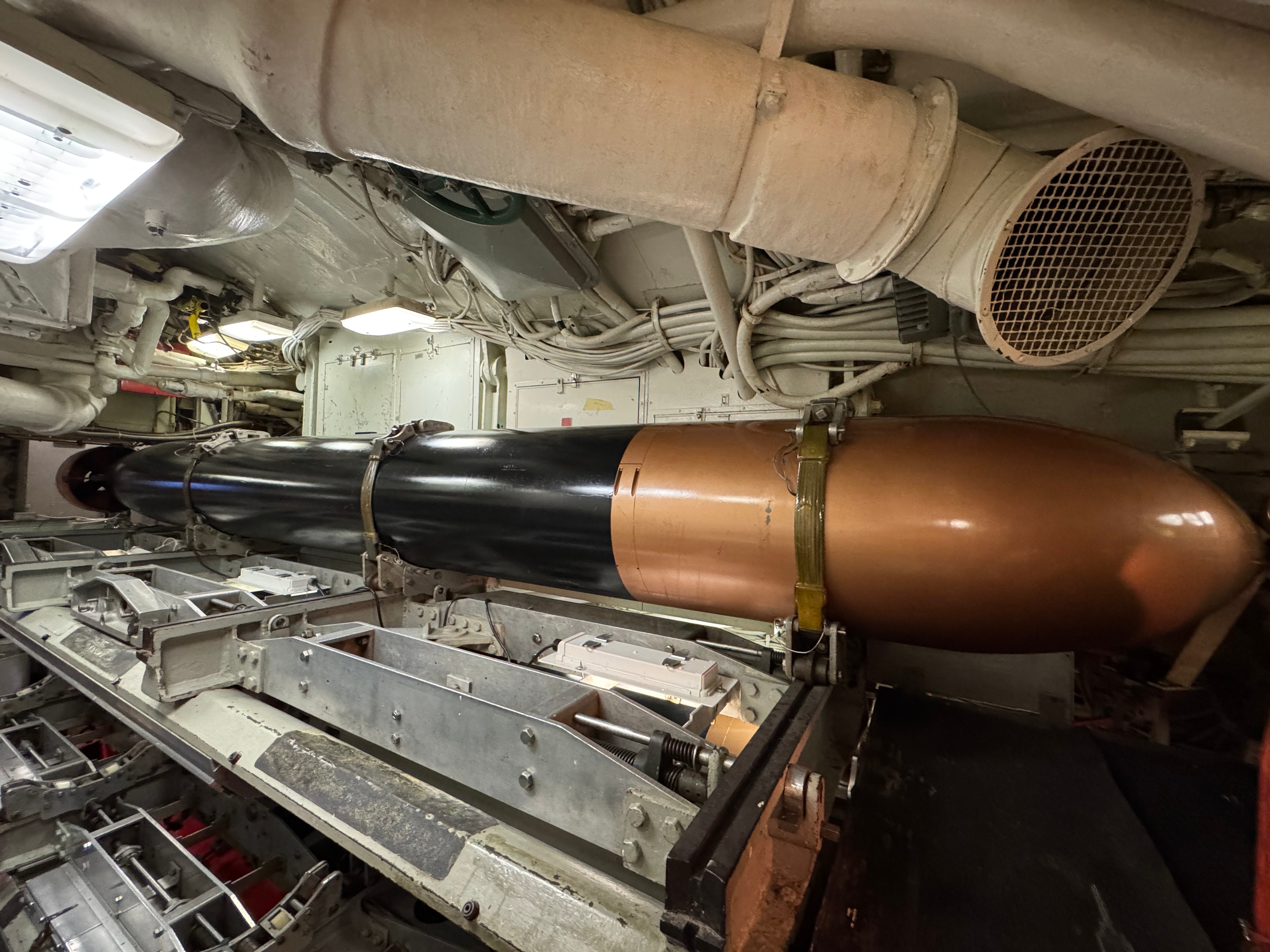
| Type | Anti-surface ship torpedo |
| In Service | 1931 – 1970s |
| Weight | Mod 3: 3,061 lbs (1,388 kg) |
| Warhead | Mod 3: 668 lbs (303 kg) Torpex |
| Range/speed | All Mods: 4,500 yds (4,100 m) / 46 kts Mod 3: 9,000 yds (8,200 m) / 30.5 kts |
| Powerplant | Wet-heater steam turbine |
| Guidance | Gyro |
The Mark 14 torpedo was the main anti-surface ship weapon for submarines and was infamously unreliable during combat in WWII. The problems with this weapon were legion since it was developed during the Great Depression, and the weapon underwent no substantial live fire testing (if any at all). The magnetic exploder of this weapon was also developed in secrecy, never went through a live fire test, and as a result, failed to work properly, often exploding prematurely or failing to explode. The backup contact exploder, when impacting the target at the ideal 90-degree angle, resulted in a dud with the exploder being crushed by the impact. The torpedo also tended to run about 10 feet too deep and would pass underneath the target. Additional criticisms were leveled at the prominent bubble wake the torpedo created and the fact that occasional circular runs were noted.50 The problems with this torpedo were not fully remedied until mid-1943, after which it became a (more) reliable weapon and continued to see use into the 1970s.51 These torpedoes have no homing feature on them. Their gyroscopic angle can be set, which allows the torpedo to make a turn toward their target after they are fired, but after that, they are completely reliant on a firing solution from the TDC in the control room to hit a target. Blueback has one of these on board.
Mark 16 Mod 8
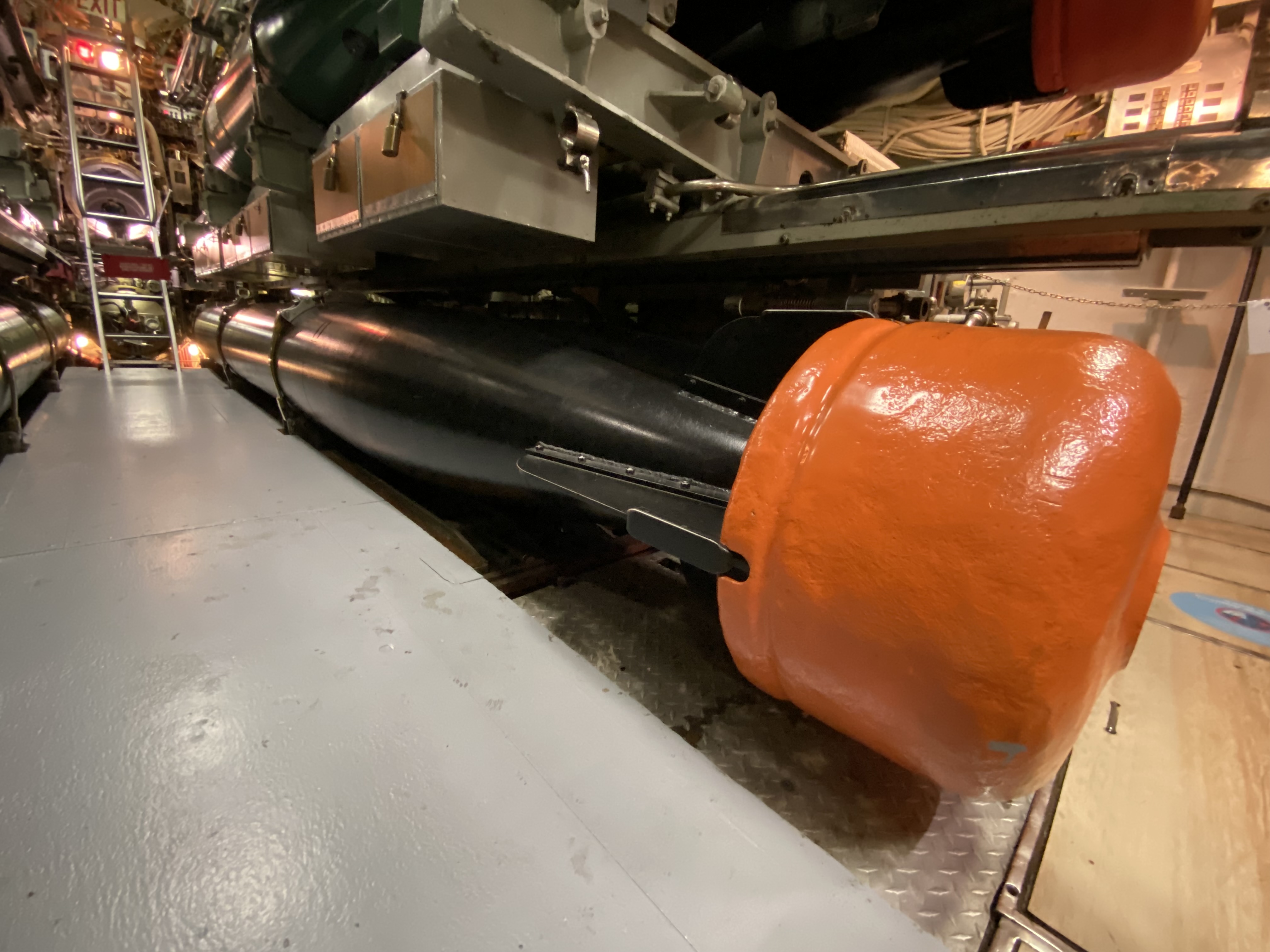
| Type | Anti-surface ship torpedo |
| In Service | 1945 – 1975 |
| Weight | 4,000 lbs (1,814 kg) |
| Warhead | 746 lbs (303 kg) HBX |
| Range/speed | 11,000 yds (10,058 m) / 46 kts |
| Powerplant | Turbine |
| Guidance | Gyro |
This was a high-performance, but expensive, torpedo powered by Navol (concentrated hydrogen peroxide). It was withdrawn from service in 1975.52 Like the Mark 14 torpedo, these were gyroscopically guided and had no homing capability.
Surprisingly, the vast majority of the black torpedoes in this room are actually Mark 16 torpedoes. Not the Mark 14 as I initially thought. I only discovered this after I located the label that was stamped on the torpedoes themselves. It does not help that both the Mark 14 and Mark 16 are black. There are five of these on board.
Mark 37 Mod 3
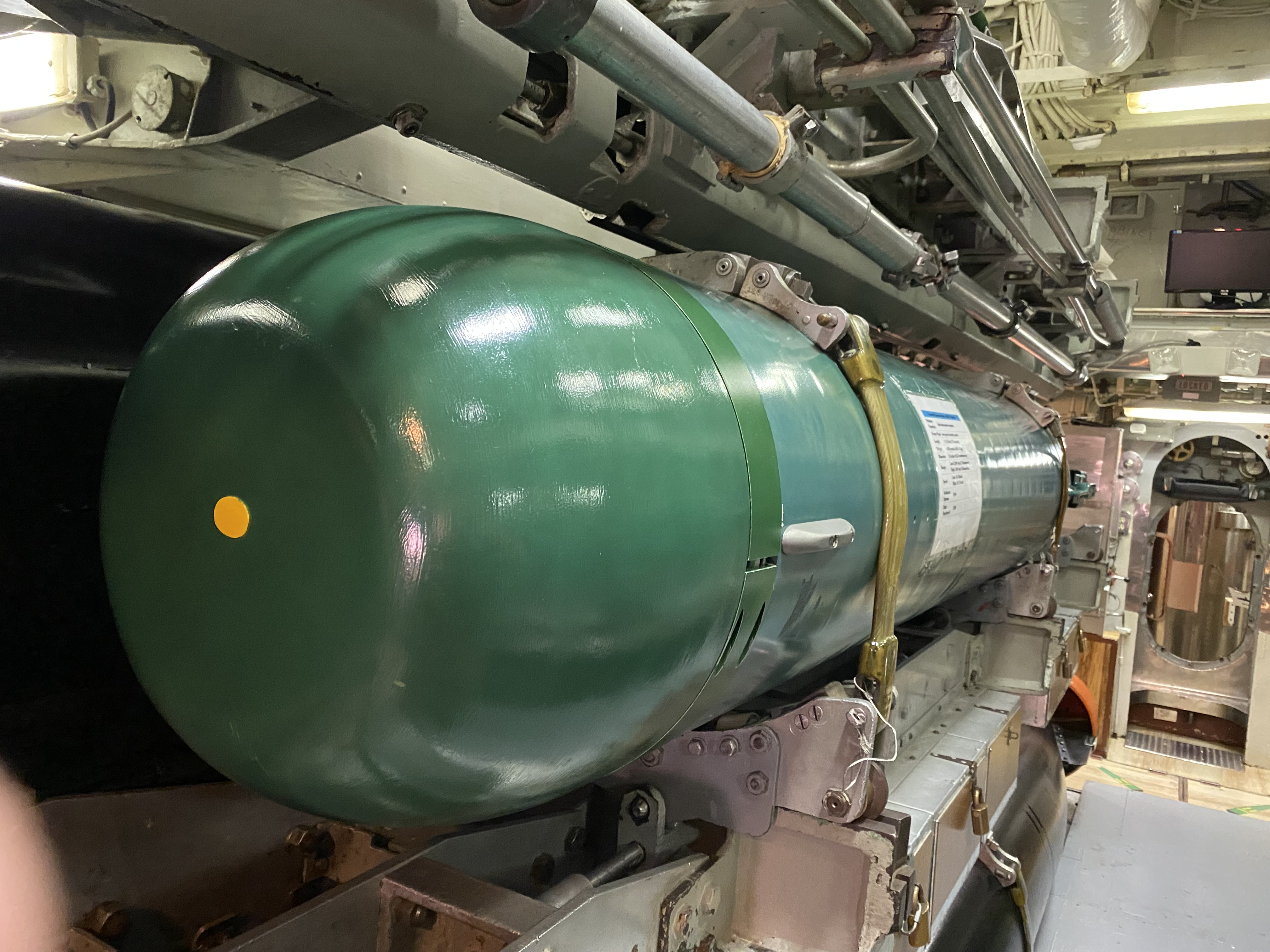
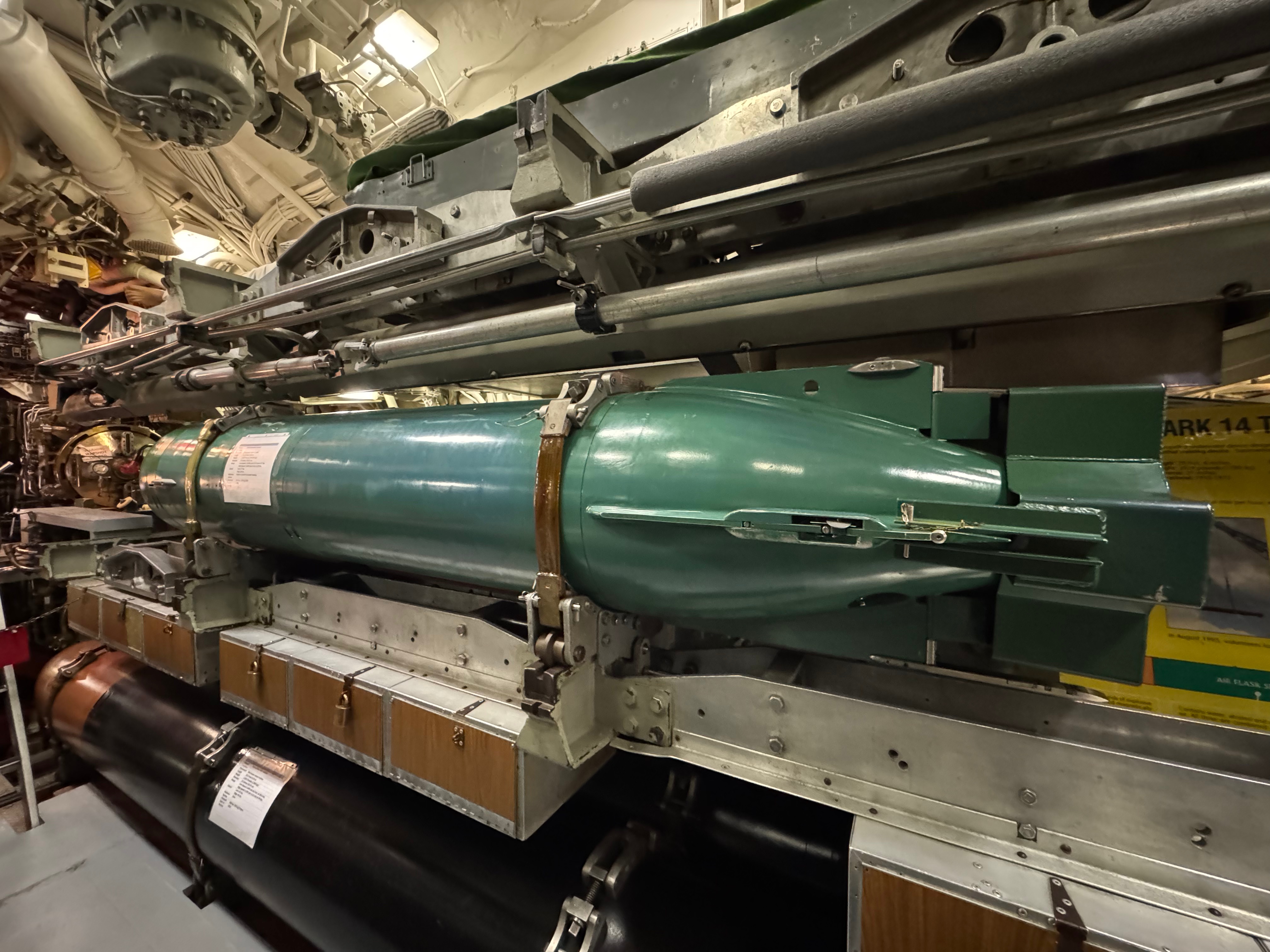
| Type | Anti-submarine torpedo |
| In Service | 1956 – 1990s (some versions) |
| Weight | Mods 0 & 3: 1,430 lbs (649 kg) |
| Warhead | 330 lbs (303 kg) HBX |
| Range/speed | 10,000 yds (9,140 m) / 26 kts 23,500 yds (21,490 m) / 17 kts |
| Powerplant | Electric Battery |
| Guidance | Acoustic homing |
Introduced in 1956, this was the primary submarine-launched anti-submarine torpedo used by the U.S. Navy until the 1990s, although it continued to see use with other navies into the 2000s. There are two different guidance systems for this torpedo, depending on the mod: either wire-guided or acoustic homing. This torpedo is the mod 3 variant, introduced around 1967, and is acoustic homing. This was generally considered to be a good anti-submarine weapon until submarines began achieving speeds greater than 20 knots and diving deeper than 1,000 feet.53 There is one of these on board.
Mark 45 Mod 2 ASTOR (Anti-Submarine TORpedo)
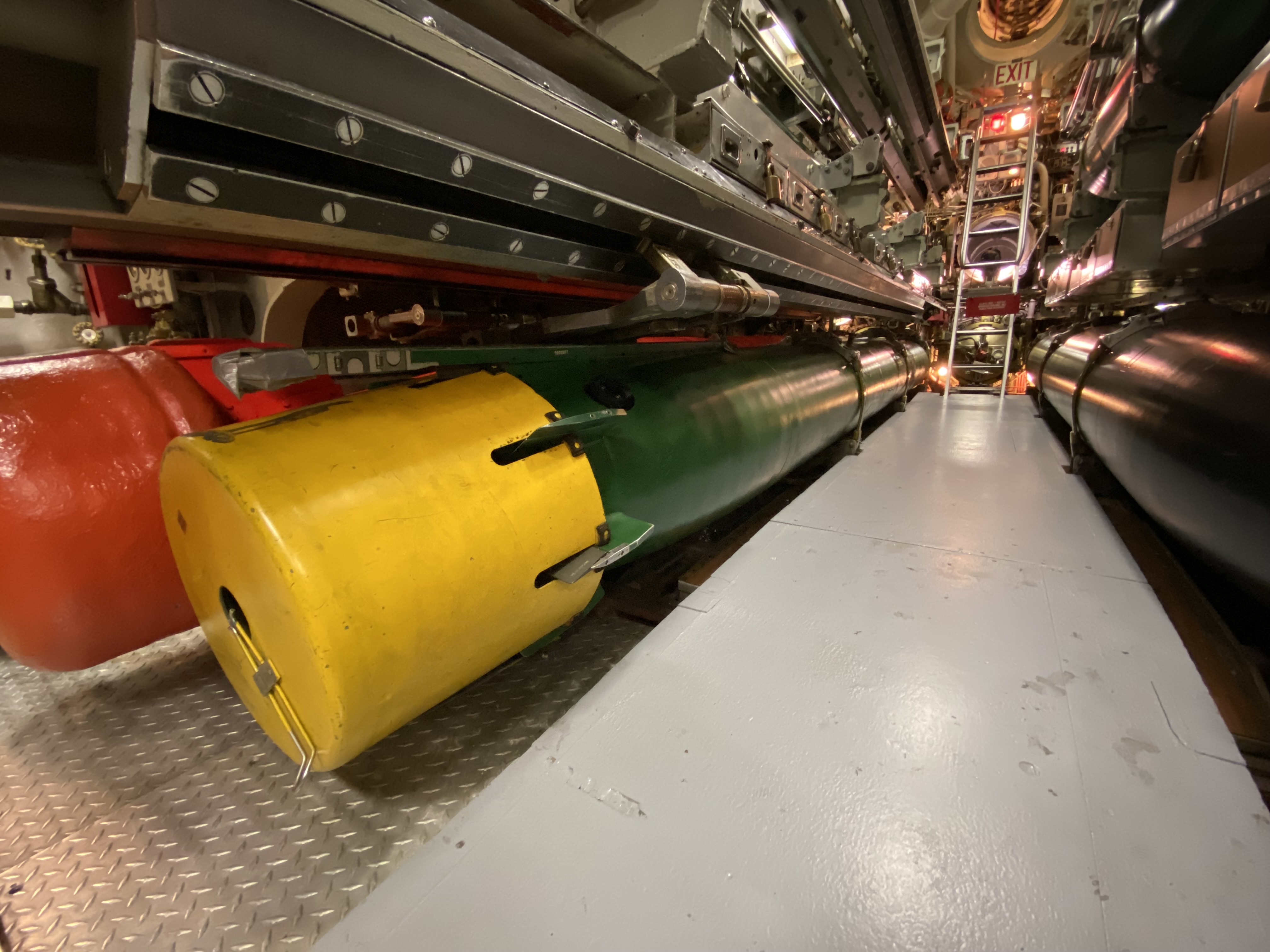
| Type | Anti-submarine torpedo |
| In Service | 1963 – 1976 |
| Weight | Mod 2: 2,213 lbs. (1,003 kg) |
| Warhead | Mod 0: 11 kt W34 nuclear warhead |
| Range/speed | 11,000 – 15,000 yds (10,000 – 13,650 m) / 40 kts |
| Powerplant | Seawater-activated Electric Battery |
| Guidance | Wire-guided, command-detonated |
The only nuclear-tipped torpedo the U.S. Navy ever fielded, this is a wire-guided, command-detonated torpedo with an 11kt W34 nuclear warhead. Designed to address the issue of deep-diving, high-speed submarines, it could only be detonated by a command from the firing submarine to maintain positive control of the nuclear weapon. Given the questionable utility of using tactical nuclear weapons against subs, it was removed from service upon the introduction of the Mark 48. The nuclear warheads were removed and replaced with conventional warheads and wake-homing guidance systems. Subsequently, they were reportedly sold to other countries as “Freedom Torpedoes.”54 There are two of these on board. One is loaded in a tube.
Mark 48 Mod 1
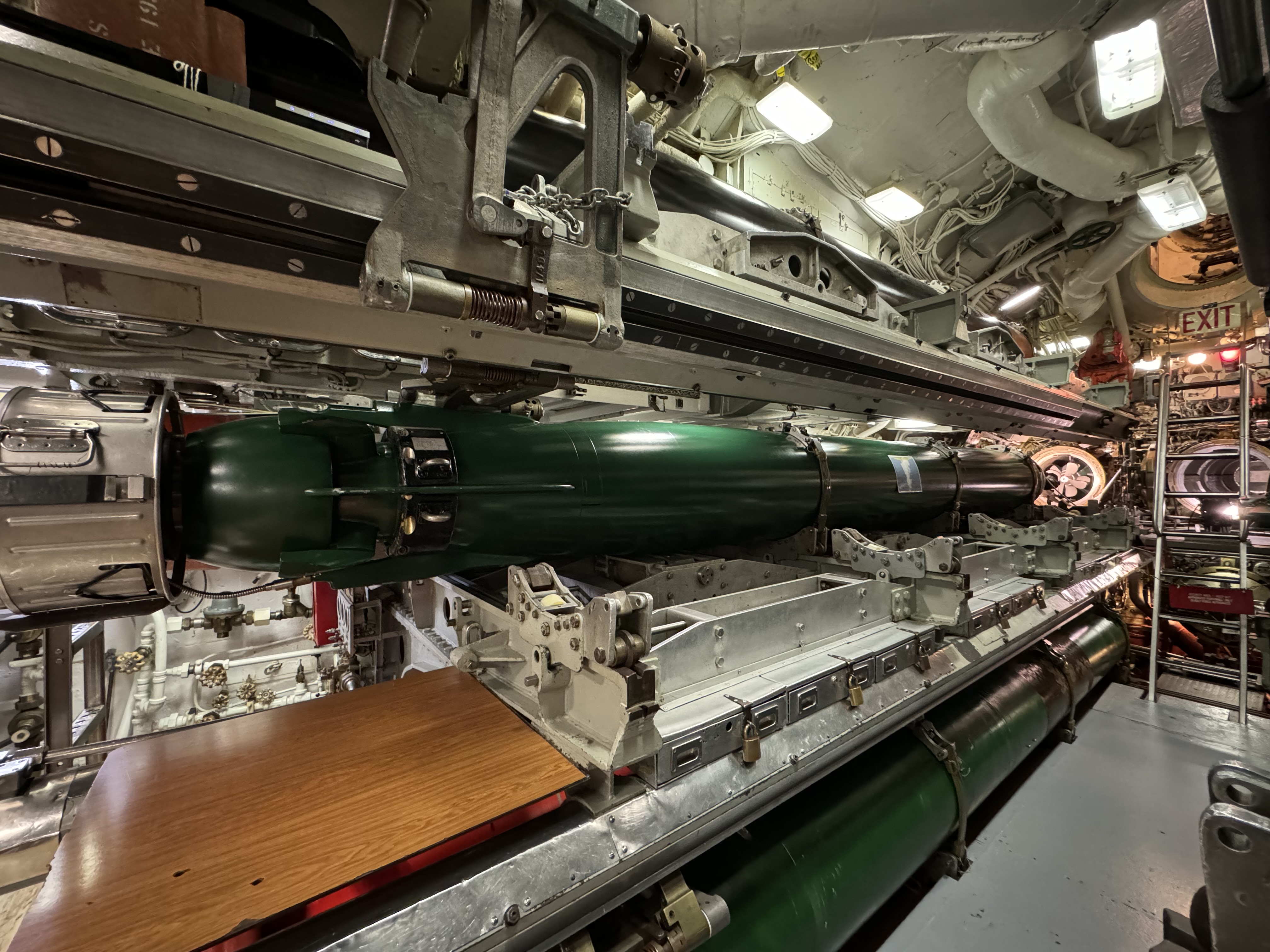
| Type | Anti-surface ship & anti-submarine torpedo |
| In Service | 1972 – present |
| Weight | Mod 1: 3,434 lbs. (1,558 kg) |
| Warhead | 650 lbs. of PBXN-103 (plus any unused fuel) |
| Range/speed | >10,000 yds. at 28+ kts. (official) >35,000 yds. at 55+ kts. (unofficial) |
| Powerplant | Otto II fuel monopropellant powering a Swashplate piston engine with an axial-flow pump jet propulsor |
| Guidance | Wire-guidance, passive & active acoustic homing. |
Additional information on this torpedo can be found in the article here.
In service in 1972, the Mod 1 version was developed by Clevite, Inc. (later Gould Electronics). It has a swashplate piston engine powered by Otto II monopropellant. The torpedo has mid-course wire-guidance. In the Torpedo Mounted Dispenser (TMD) (i.e. the wire can) are about 11 miles of wire that spools out when the weapon is fired. Additionally, another wire dispenser (not shown) would be mounted over the torpedo’s propulsor, containing another 10 miles of wire to allow for over 20 miles of wire. When fired, the TMD stays in the tube while the torpedo’s own wire dispenser travels with it. With the wire connected to the sub, it can be used to send updated attack profiles to the weapon. If the torpedo misses, it can circle around and reattack the target. If the wire is cut, the torpedo can operate autonomously and seek out its target. Upgraded versions use fiber optic cabling, and the torpedo and submarine can communicate with each other via the wire. The Mark 48 torpedo is still used by U.S. Navy submarines today as their heavyweight anti-surface and anti-submarine torpedo. There is one Mark 48 on board.
Mark 14/16 Dummy Torpedo Ejection Model
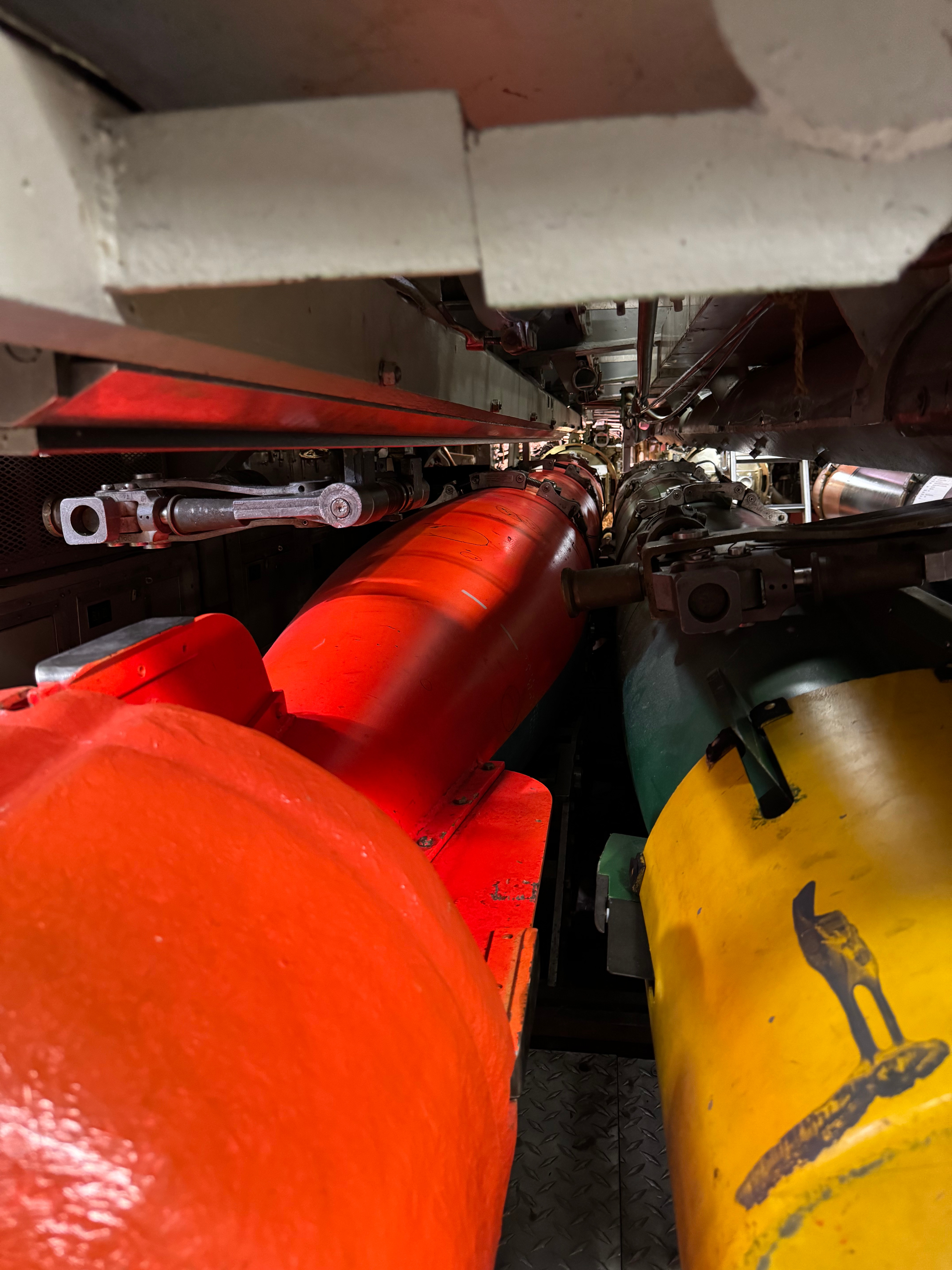
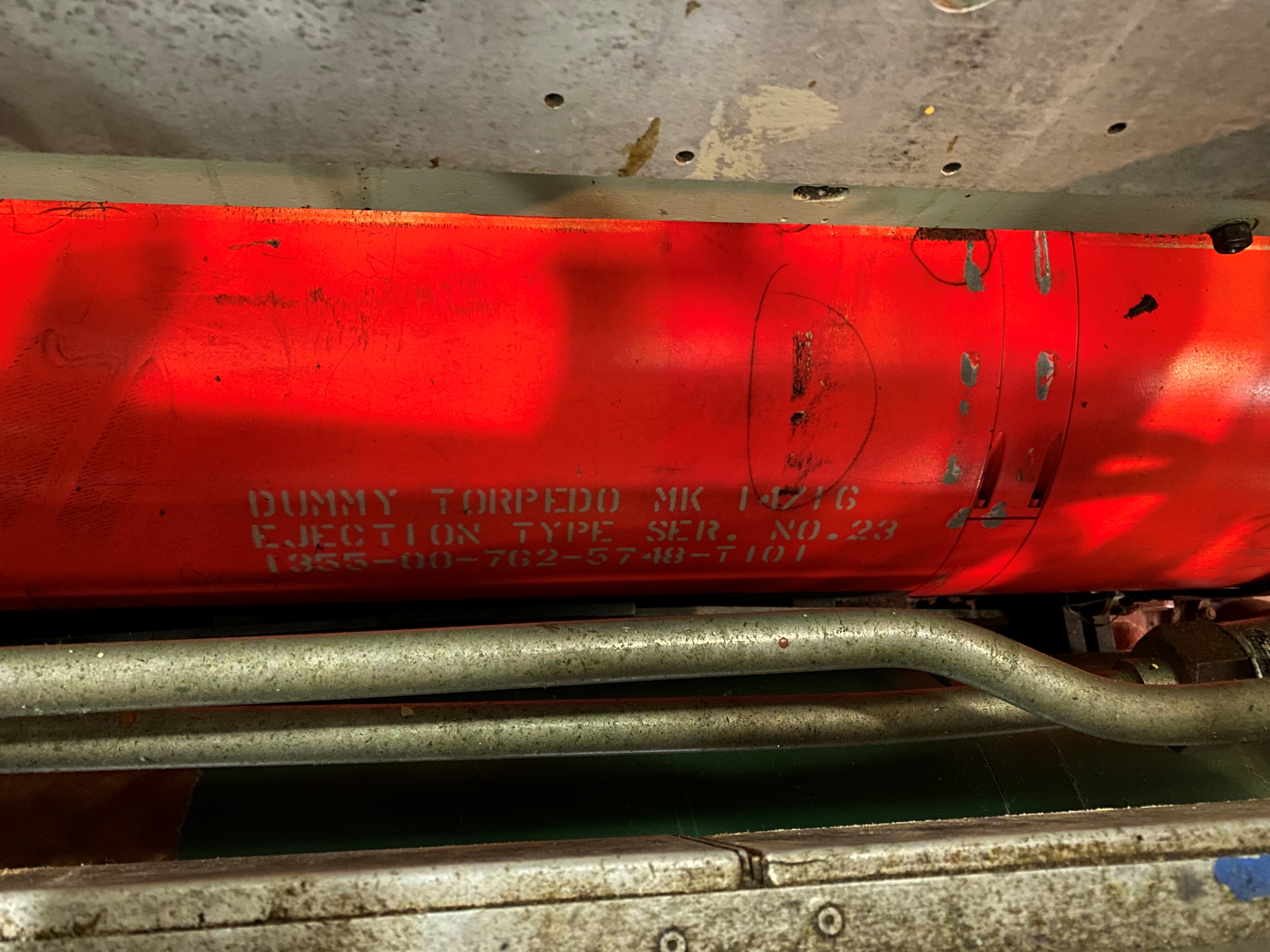
This is an inert torpedo used to test systems, such as the torpedo tubes. The benefit is that these torpedoes can be fired without wasting a live weapon. Some versions also function as a mock weapon during exercises and can impact a ship without causing any damage. Once fired, they float to the surface and can be recovered. There is one of these on board.
Based on the recollections of the two tour guides who served on the Barbel-class, Blueback likely carried Mark 14s, 16s, and Mark 37s during her first decade or two of service. However, by the late 1980s, she was only carrying Mark 48s. We have also confirmed that at one point, she did carry practice Mark 45s. Of course, the Mark 45s were only in U.S. service for 13 years. The joke, of course, with the Mark 45 torpedo is that it has a probability of kill of two: the submarine it was fired at, and the submarine that fired it.
Loading torpedoes onto the submarine
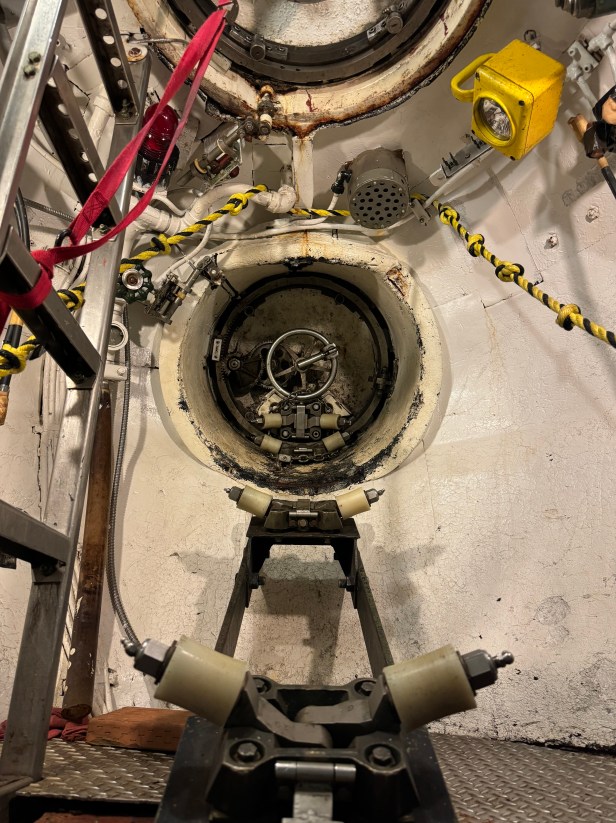
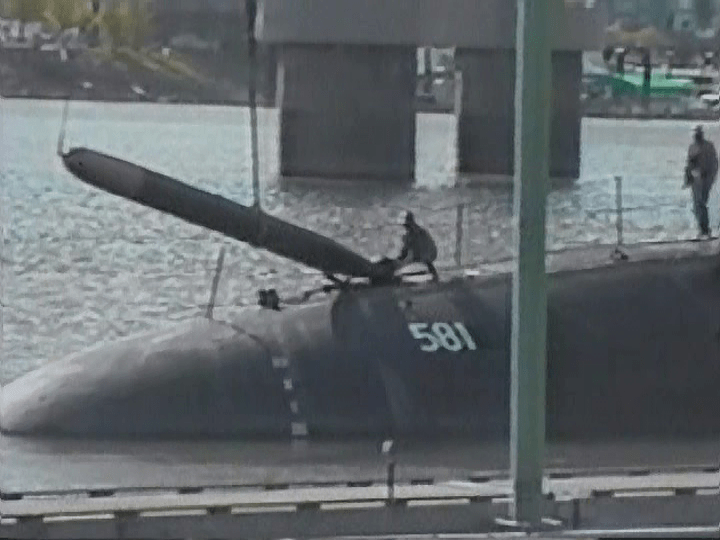

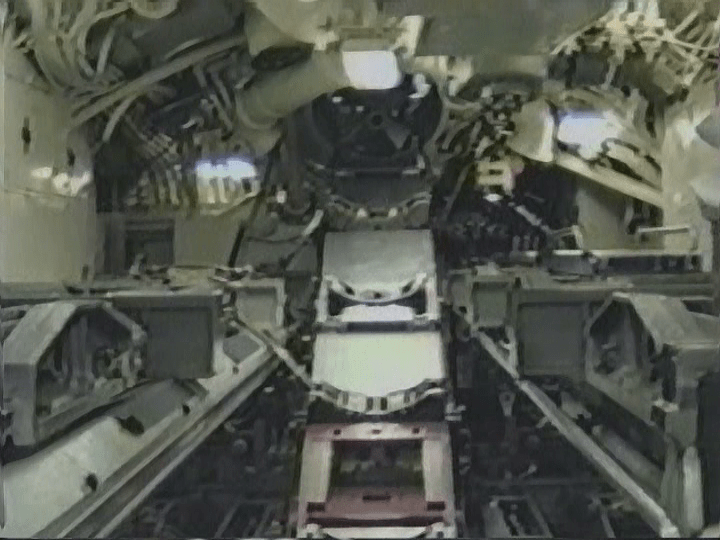

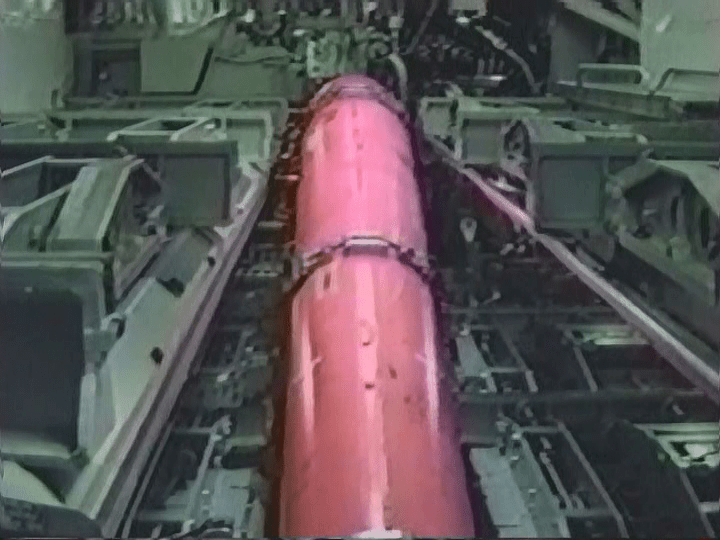


- Torpedoes are lowered by a crane.
- An angled hatch leads down into the torpedo room in the bow of the sub.
- Meanwhile, the torpedo lift is raised at an angle.
- The torpedo is lowered down onto the lift.
- The lift lowers to the torpedo so it is horizontal.
- The torpedo is pushed to the sides onto the skids to stow them.
- The torpedo is aligned with an open tube and rammed in.
- The rammer (on the right) pushes the torpedo all the way into the tube.
Some of the torpedoes weigh nearly 3,700 lbs. They are lowered by a crane and come down through the loading hatch/escape trunk above the ladder in this room. The grey floor is actually a hydraulic lift. It rises up at an angle, and the torpedo is lowered down to it and leveled out. The lift can move the torpedo up or down, and the weapon is moved onto the skids. The skids can move laterally to allow the torpedoes to be aligned with the center tubes. Additional research we have conducted indicates that approximately a dozen weapons can be loaded onto the submarine in as little as 45 minutes. The process on these boats was very efficient since the torpedoes only needed to be lowered down one hatch and came directly into the torpedo room.
According to former Blueback crewman Rick Neault, there were normally 5 – 10 men working in the torpedo room. More would be in here if needed, such as during general quarters. Others have told me that only about 2 men would be working in the torpedo room normally.
Firing torpedoes
To load a torpedo into a tube, a hydraulic rammer (known as a rabbit) is attached to the back of a torpedo (like on the Mark 16 on display). According to Rick Neault, at full speed, the rabbit can ram the torpedo into a 21’ long tube in about 10 seconds, but normally, they would be rammed more slowly. The rammer can also be used to unload a torpedo from a tube.

Once the torpedo is loaded, the inner breach door is sealed, and the tube is flooded with seawater from the WRT (Water Round Tube) tank, equalizing the pressure with the outside. At this point, the outer muzzle door can be opened. The ram of the ejection pump (an air cylinder and hydraulic piston) then forces a 3,000 lb slug of pressurized seawater from the impulse tank into the tube behind the torpedo and ejects the torpedo out of the tube at about 23 knots (27 mph). (Given that there are only two ejection cylinders, an interlock is present which allows only one torpedo tube door to be open per cylinder, so only two torpedoes can be fired at one time.) Once fired, the tube (now filled with water) is drained using 400 psi air, and the air from the now vacant tube will be vented back into the compartment. (Reportedly, this is a very loud noise.) A former sailor on USS Barbel told me that another torpedo could be loaded into the tube in roughly 10 minutes (give or take).
It is believed that newer versions of the Mark 48 torpedo can actually “swim” out of the tube, which is quieter than firing it out.
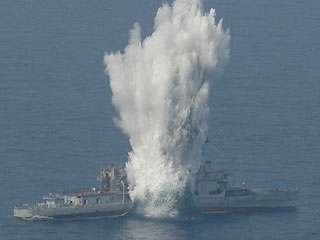
“Skid racks” and Navy SEALs
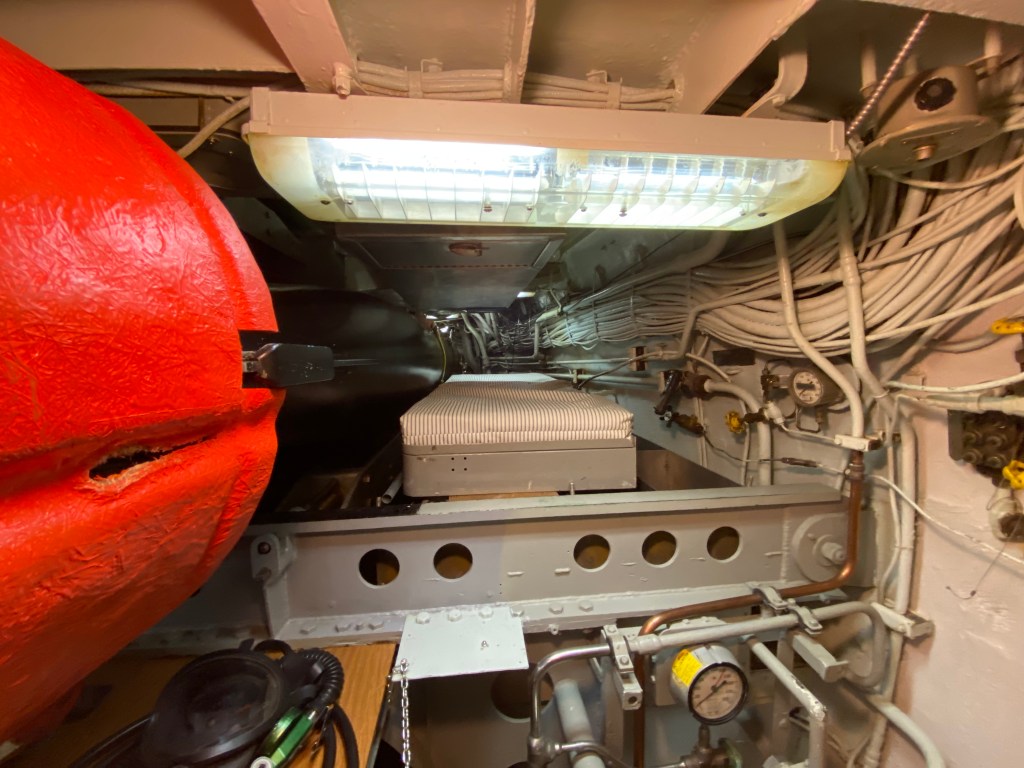
The torpedo room can also be used as overflow berthing. If this compartment is not fully loaded with torpedoes, then sleeping berths (AKA skid racks) can be set up in the empty spaces. For example, if you are a junior enlisted Torpedoman in the Navy, then you may be lucky enough to have your own rack in this area, also known as the “Bridal Suite.”55 It is one of the nicer places for enlisted men to sleep on the sub because there is more room to stretch out, it is well-air-conditioned, and the torpedoes do not snore. Rick Neault said there were usually six skid racks on the top skids, although he actually preferred the middle skid racks in the torpedo room on the port side (as opposed to the normal berthing spaces). Another former Blueback crewmember told us that top skids could not support the weight of Mark 48 torpedoes, so those were simply turned into skid racks.
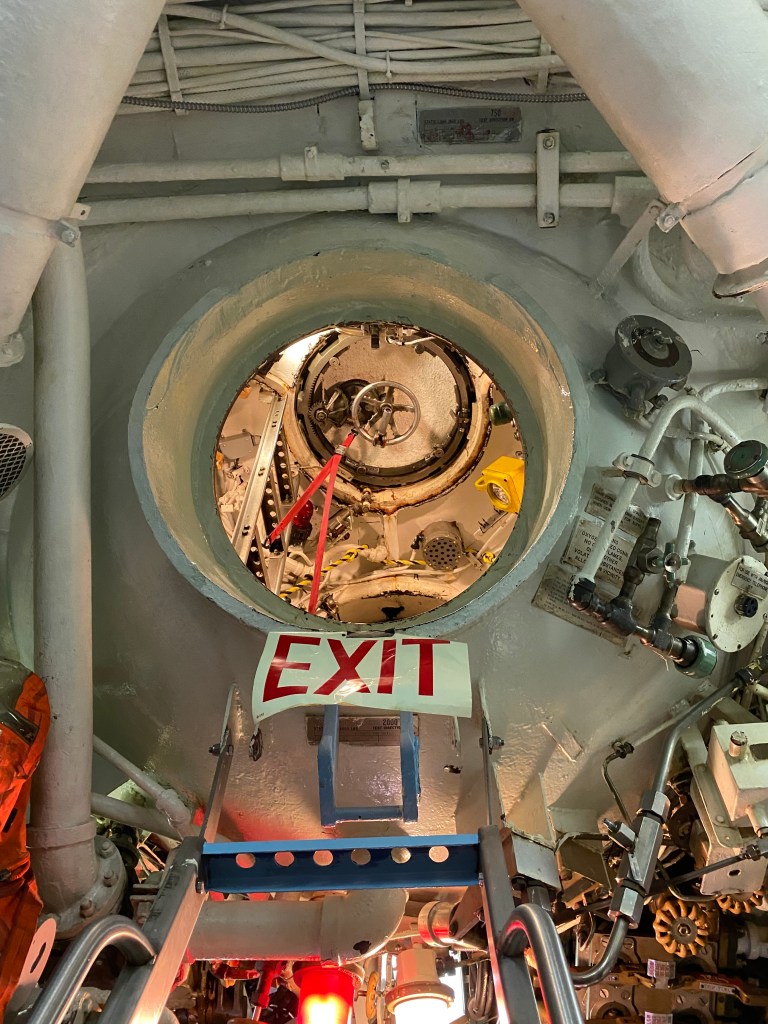
Usually, every submarine has at least a couple of crew members who are also trained Navy divers. They could work on or inspect the hull of the boat for damage, corrosion, or anything untoward (like planted explosives). There may also be other guests on the submarine, such as Navy SEALs. (Other special ops guys can be accommodated. For example, Blueback did an exercise in 1979 with Army Special Forces.) Blueback can deploy SEALs into the field from a depth of about 60 feet below the surface. They will get their SCUBA gear on and climb the ladder into the escape trunk (about 1 or 2 men at a time). When they seal the inner hatch, flood the chamber, and equalize the pressure, they can open the outer hatch and swim out. Everything they do beyond that is classified, and two or three days later, the sub can come back and pick them up. We do not shoot the SEALs out of the torpedo tubes (no matter how much they may have wanted to try). That is not the recommended way to exit the boat. Only torpedoes or bratty, misbehaving children get shot out of the tubes.56
Steinke Hoods, EABs, & OBAs – Safety Equipment
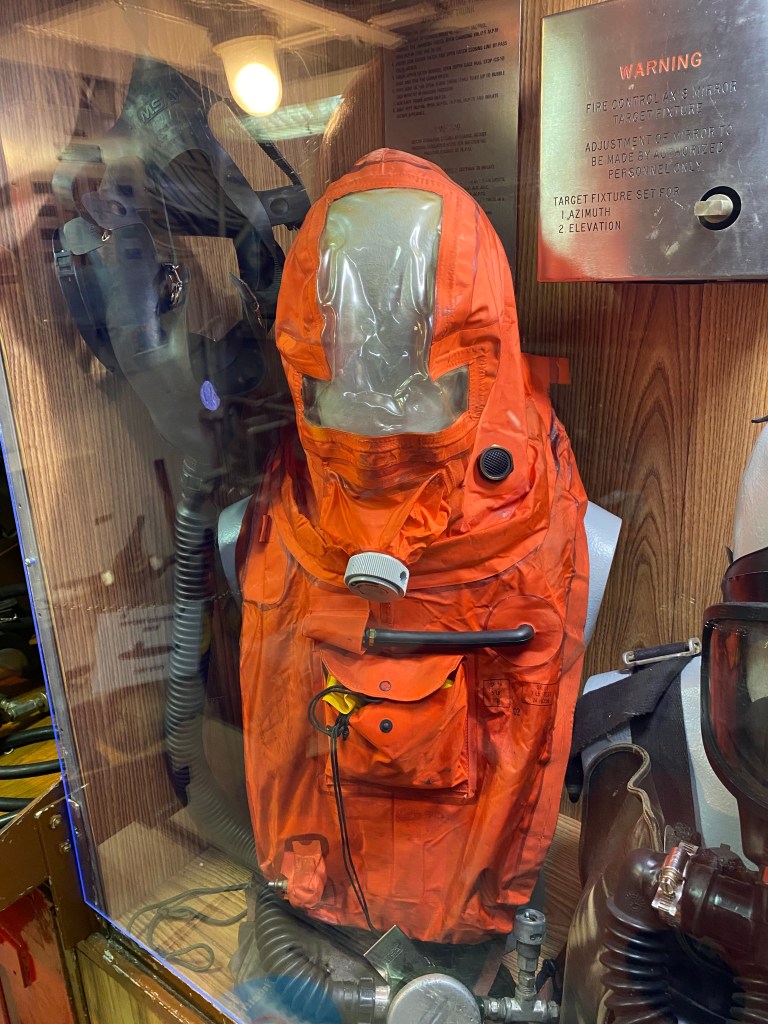
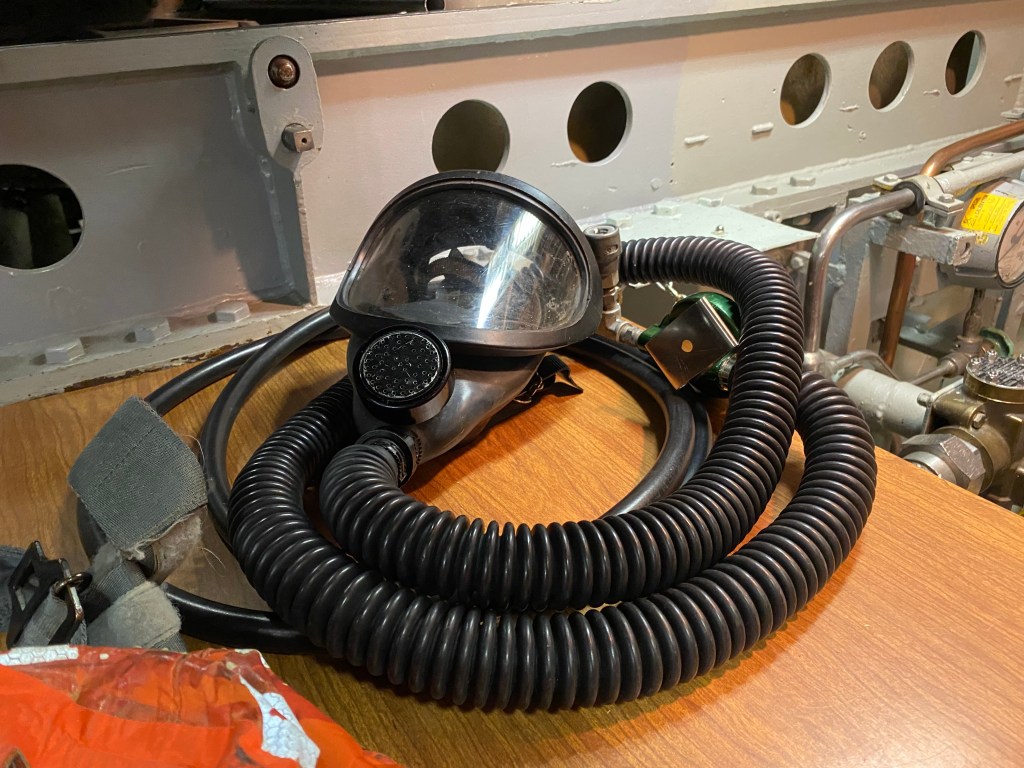
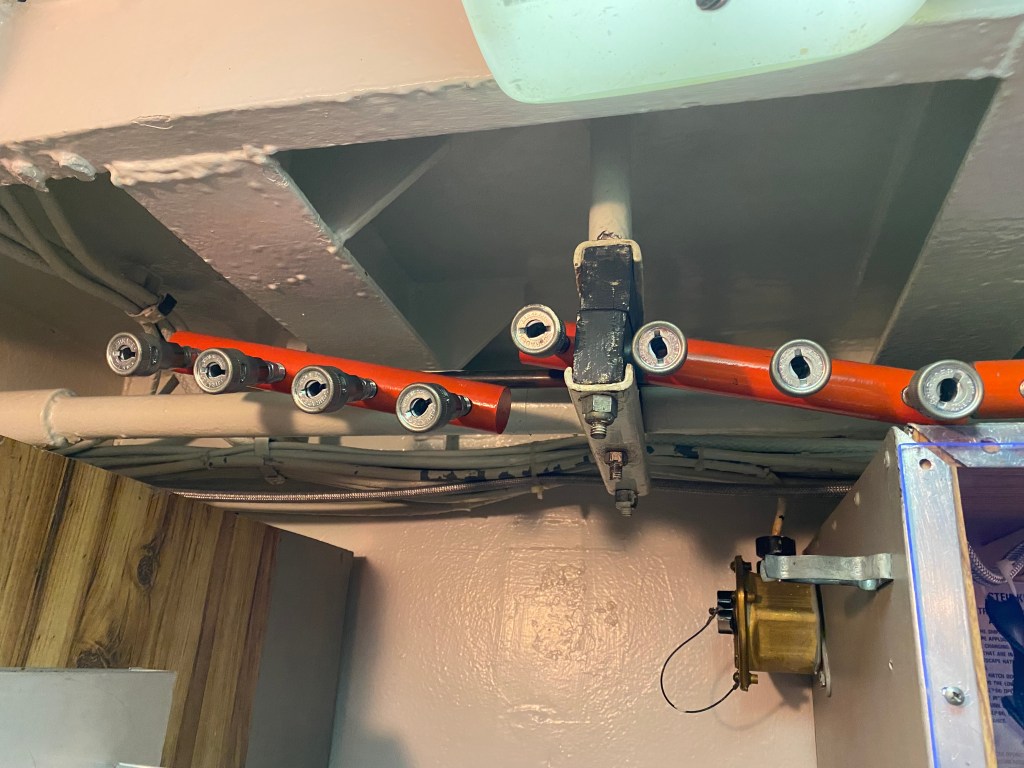
The various masks you see in the rear of this compartment are safety equipment. The orange hoods are called Steinke hoods. Named after Lieutenant Harris Steinke, who invented them, this is basically a life preserver if you need to escape a submarine that is trapped underwater. You put that on and climb into the escape trunk. After escaping the boat, you will float to the surface wearing it and saying “Ho, ho, ho!” all the way up. Holding your breath is not recommended since you would suffer barotrauma (i.e. Your lungs would explode. That is Boyle’s Law in action). However, this escape procedure only works if the submarine sank in about 300 feet of water or less. Any deeper and all bets are off.57 If the submarine sank in deeper water, assuming it was not crushed by the water pressure, then you would need some form of Deep Submergence Rescue Vehicle (DSRV) to get down to the sub and rescue the crew.
The black mask with a long hose is called an Emergency Air Breather (EAB) mask. In each room or compartment are red emergency oxygen manifolds. In the event of a fire or toxic atmosphere, you would get an EAB on and plug it into the manifold. Since a submarine can fill with smoke and rapidly reduce all visibility to zero, you would need to memorize where all these manifolds are throughout the sub. On the deck beneath all of these manifolds is a small piece of non-skid that can be felt with your foot or hand, so you know that it is above that spot if there is reduced visibility on the boat. There is also a regulator with another connector on the hose of each EAB, so sailors can daisy chain themselves together with one plugged into the manifold and another plugged into the sailor’s EAB connector. Blueback did not originally have an EAB system. It was retrofitted onto the boat in the 1970s. That is why there are so few manifolds around the sub.
Submarine crews sometimes do an activity called EAB/Damage Control Olympics. This may consist of teams or be done by departments, but the basic premise is that crewmembers assemble at one end of the sub, are blindfolded, and don EAB masks. Their task is to then make their way to the other end of the sub, identifying all of the oxygen manifolds by touch. Other “events” in these Olympics could relate to other damage control procedures, such as rolling up fire hoses, locating all the fire extinguishers, or fixing an imaginary leak in a certain amount of time.

The other black mask is not SCUBA gear; it is an Oxygen Breathing Apparatus (OBA). Essentially, a closed-circuit rebreather. Unlike the EABs, this is a portable oxygen mask, so you can put this on and move around without having to plug it into the air manifolds. Inside the bag around your chest is a green canister filled with potassium superoxide that scrubs out carbon dioxide and creates oxygen as you breathe into it. At the base is a sodium chlorate candle that creates oxygen upon startup because the canister has to reach an appropriate temperature before it starts working. The reaction of the potassium superoxide with the moisture in your breath is exothermic, which means the canister in the bag will get very hot, and you will need thick gloves just to handle it after it has been used. The air bladders along the sides of the unit cool the air mixture before it enters the mask. This way, you are not breathing in a lung full of hot air. In any case, it beats choking on caustic smoke as the submarine burns around you. The OBA will give you about 1 hour of breathable oxygen. In the early 2000s, the Navy replaced these with the Self-Contained Breathing Apparatus (SCBA) that firefighters use. Those are heavier and bulkier than an OBA (because you are strapping an oxygen tank to your back), but they are cheaper and do not produce hazardous waste.
Even today, as tour guides, we need to know the location of all of the escape routes, fire extinguishers, and fire alarm pull stations. Fire is still very much a concern, even though Blueback is a museum ship.
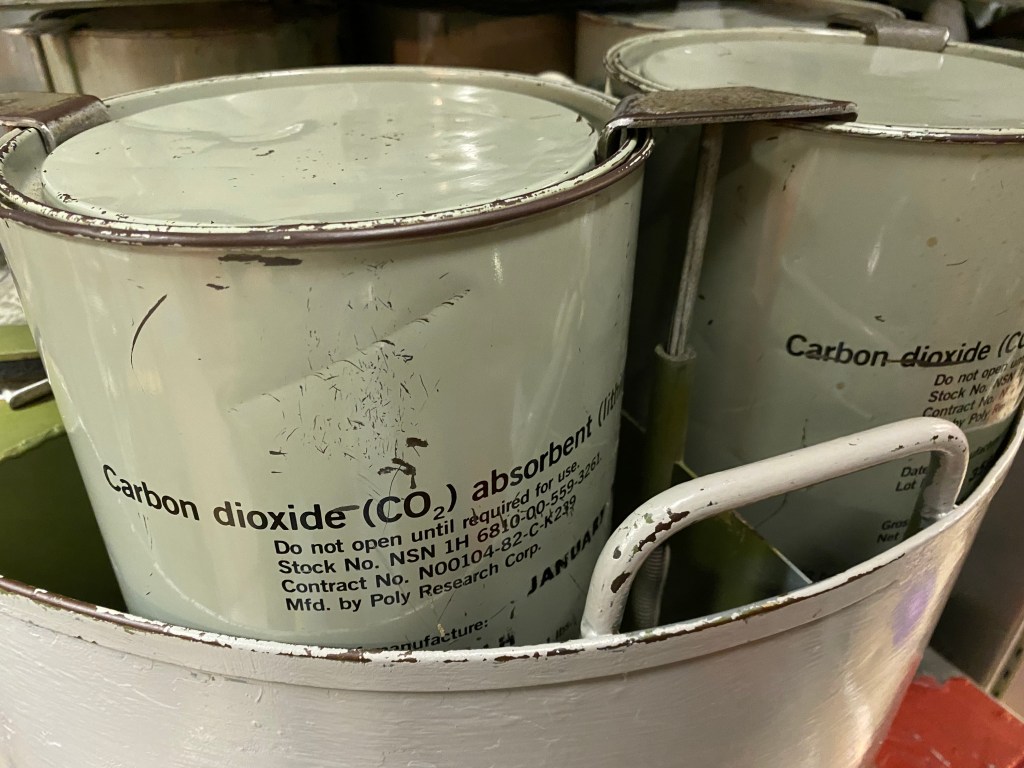
On the other side are cans of lithium hydroxide (LiOH). This is a CO2-absorbent powder. It actually goes into the hopper on this machine, and it will scrub the CO2 you are exhaling from the air. This will extend the breathable air inside the submarine for some time if it is trapped below the surface. According to the Ship Information Book, there would be enough LiOH for a 3-day emergency supply based on the usage rate of 0.12 lbs. per man per hour.
The generation of oxygen in an emergency can have disastrous results depending on the method used. In August 2000, the Russian submarine Kursk (K-141) suffered a torpedo explosion, which sank the submarine in 350 feet of water. However, some survivors were still alive in the aft compartments. To extend their breathable oxygen, they used cartridges of potassium superoxide, which had to be manually loaded into a chemical oxygen generator. The danger is that this chemical reacts violently when exposed to water. It is believed that the survivors were killed when one of the cartridges was accidentally dropped into the water of their partially flooded compartment. The resulting severe exothermic reaction caused a flash fire that killed several men and consumed the remaining oxygen in the room, causing the rest to suffocate.
According to the Ship Information Book, there are six flasks of 3,000 psi oxygen around the hull of the submarine, totaling about 126 cubic feet. That amounts to around 26,000 cubic feet at normal atmospheric pressure. So under normal conditions, 77 crewmembers would consume about 1,850 cubic feet of oxygen per day, meaning the supply would last approximately 13 days when submerged. Additionally, there are three flasks of emergency oxygen pressurized to 2,265 psi, providing about 6.5 cubic feet of gas. This can be bled into the submarine to further extend the breathable air. That said, this is only breathable air since the batteries would not last 13 days.
Blueback in The Hunt for Red October
Blueback does have a brief appearance in the 1990 film, The Hunt for Red October. It is at about timestamp 28:12. When Captain Ramius (Sean Connery; playing the most Shcottish shounding shubmarine shkippper in the whole Shoviet Navy) is giving his speech to his crew about their orders and starts talking about Havana, Cuba, there is a 4-second shot of three sailors. Those are Blueback sailors (since the boat was still in service at the time). They were paid $50 each, had their heads shaved, and were dressed in Soviet Navy uniforms. The scene was filmed in Blueback‘s torpedo room. Specifically, they are in the forward part of the compartment, and the torpedo tubes are directly behind them.58

Enlisted Berthing
Submarine Watchstanding System
In Blueback‘s time, U.S. submarines normally operated on an 18-hour day broken into three 6-hour-long watches.59 Yes, they literally cut 6 hours out of the day. Since you do not see the sun, the day/night cycle no longer exists and your circadian rhythms no longer matter. The watches would probably be organized as follows:
| Watch | Day 1 | Day 2 | Day 3 |
|---|---|---|---|
| Mid(night) Watch (2330 – 0530) | Team 1 | Team 2 | Team 3 |
| Morning Watch (0530 – 1130) | Team 2 | Team 3 | Team 1 |
| Afternoon Watch (1130 – 1730) | Team 3 | Team 1 | Team 2 |
| Evening Watch (1730 – 2330) | Team 1 | Team 2 | Team 3 |
The crew is divided into three teams, with each team standing a 6-hour watch, followed by 6 hours off-watch. Generally, those six hours off-watch are used for eating, entertainment, studying, cleaning, and doing maintenance around the boat. It is not all leisure time, since realistically, you might only have one or two hours of free time during that period. The remaining six hours of the 18-hour day are used for sleeping. Also note that once the boat is underway, there are no days off (unless there is some kind of special event planned). It is not like a 9 to 5 job where you work 40 hours a week and get Saturdays and Sundays off. This is the military, not your cushy civilian life ashore.
Unlike on surface ships, this system used on submarines means that one of the sections has two watches per 24-hour day, and there are no dog watches. Watch reliefs happened at the bottom of the hour at 2330, 0530, 1130, and 1730.
Chief Petty Officer’s Quarters (AKA Goat Locker)
Senior enlisted men would be lucky enough to have their own racks in this area, known as the Goat Locker. These guys have spent enough time in the Navy to have earned it.
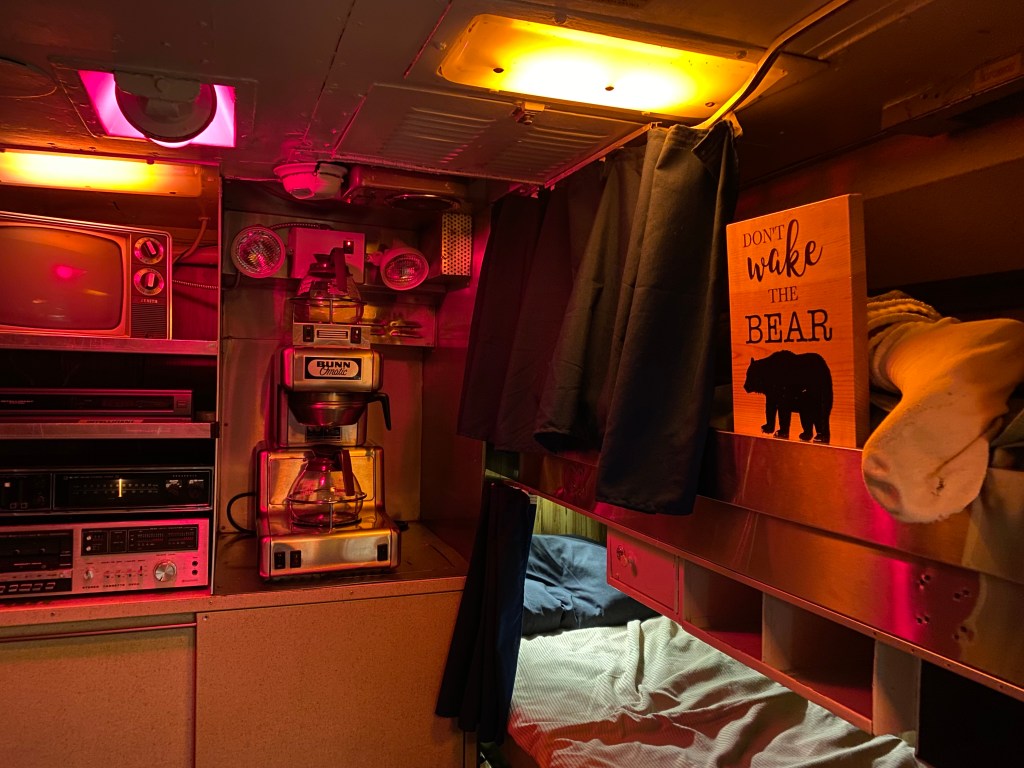
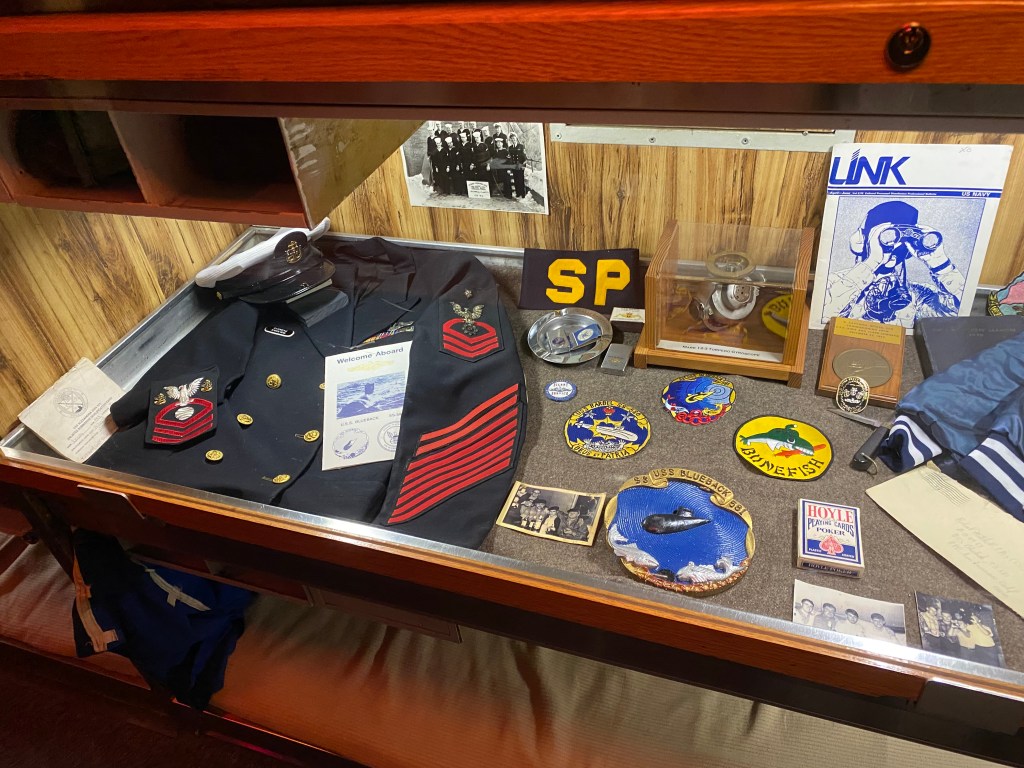
Sleeping on a submarine
Regardless, there are 66 racks on this submarine for 77 enlisted men. If you are new to the boat, you get to share a rack with someone. Not at the same time. Essentially, it works out to two racks for three men.
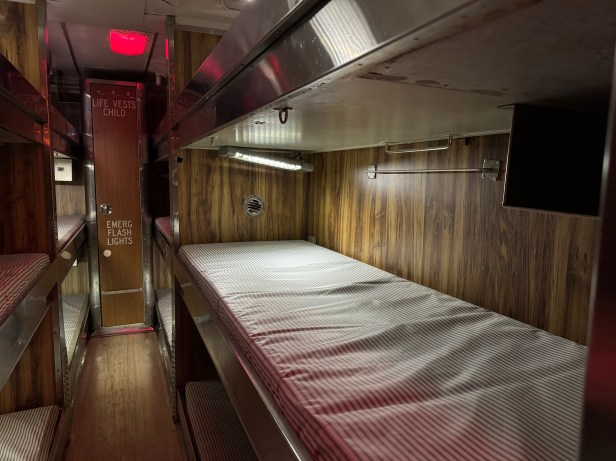
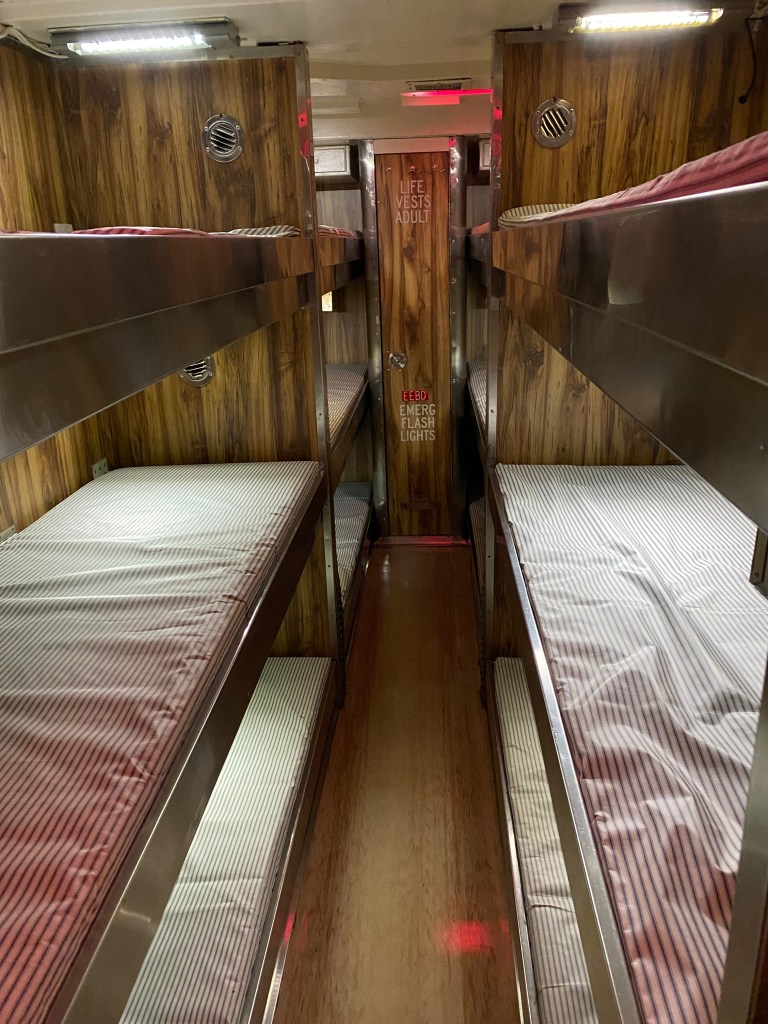
Based on the watch rotations, a third of the crew would be sleeping here at any given time. When the change of watch happens, a guy would come down here and wake up the guy who is sleeping in his rack. They would trade spaces, and the bedding is still warm from the body heat. That is called “hot racking.”60 In fact, if you need to be woken up by the person coming off the watch, then you are already late to relieve the watch. In case you are wondering, there is a correct orientation to sleep in the rack. Your head goes where the reading light is (which can be turned off, if needed). There would also be blue curtains on each rack that you could close for privacy.

Each rack is 6 feet 2 inches long and 2 feet wide, with 1.5 feet of clearance between each rack (as well as the top rack and the overhead). Essentially, each sailor has slightly less than 18.5 cubic feet of space to sleep in. The racks lift up to reveal a 4-inch deep storage space known as a “coffin locker.” That is all the space a sailor had to store his belongings…and he shares that space if he is hot-racking.
Generally speaking, the deployment schedule would see this boat leave its homeport once a year for a four to six-month period. In that time frame, there would be two patrols (each two to three months long) with one port call in between for reprovisioning. For the remaining time of the year, the crew will be ashore doing training, maintenance will be performed on the boat while in port, or the sub will be underway for shorter periods conducting additional training in the nearby area. Roughly every 2 years, the boat would go into drydock for general maintenance and overhaul on the hull.
As I like to tell kids, one patrol on this submarine is basically like spending your entire summer vacation trapped in a steel tube underwater with 85 of your (not-so-closest) friends. That means no sunlight, no fresh air, no internet, no social media, no smartphones/tablets/personal computers/video games (because they have probably been confiscated), and no streaming services or food deliveries for up to three months! This is because radio waves/WiFi/etc. do not penetrate beneath the water’s surface. Only Very Low Frequency (VLF) waves (3 – 30 kHz) can be received at shallow depths down to about 30 meters (~100 feet), and Extremely Low Frequency (ELF) waves (3 – 30 Hz) can be received at depths of hundreds of meters. The issue with ELF is that it has very low bandwidth. Only extremely short text messages (no audio or video) can be transmitted, and the transmitters are massive land-based antennas that require large amounts of power. Thus, communication with submarines is only one-way. Reportedly, in 2004, the U.S. Navy shut down its ELF transmitters and now uses VLF exclusively, explaining that the technology has improved to the point where ELF is now unnecessary. A modern submarine might be able to send and receive emails if they are shallow enough with the antennas extended (and as the tactical situation permits), but the emails are screened, and there would be an ombudsman (usually the Captain’s wife) who coordinates between the naval vessel and a family/spouse group of the sailors. In any case, you are not going to be sitting around on a submarine watching Netflix, streaming YouTube and Discord, or playing online video games.
Parents, are you ready to sign your kids up yet?

For every patrol, a sailor would get a couple of pairs of Navy coveralls, commonly called “poopie/poopy suits.” They are not used for that purpose, but sailors have a weird sense of humor, and after a few weeks, they start to smell like that anyway. These are your everyday working uniforms, distinct from your dress uniforms. You would wear these garments for weeks on end for the entire patrol. You would wear them forwards, backward, inside out, etc. When you take it off, it practically stands up on its own. Since there is no washing machine or dryer on Blueback, the sailors would put their dirtiest set of clothes in an olive green laundry bag. When they get back to port, they would then take that bag with dirty laundry and either wash it, throw it away, bury it, or burn it.
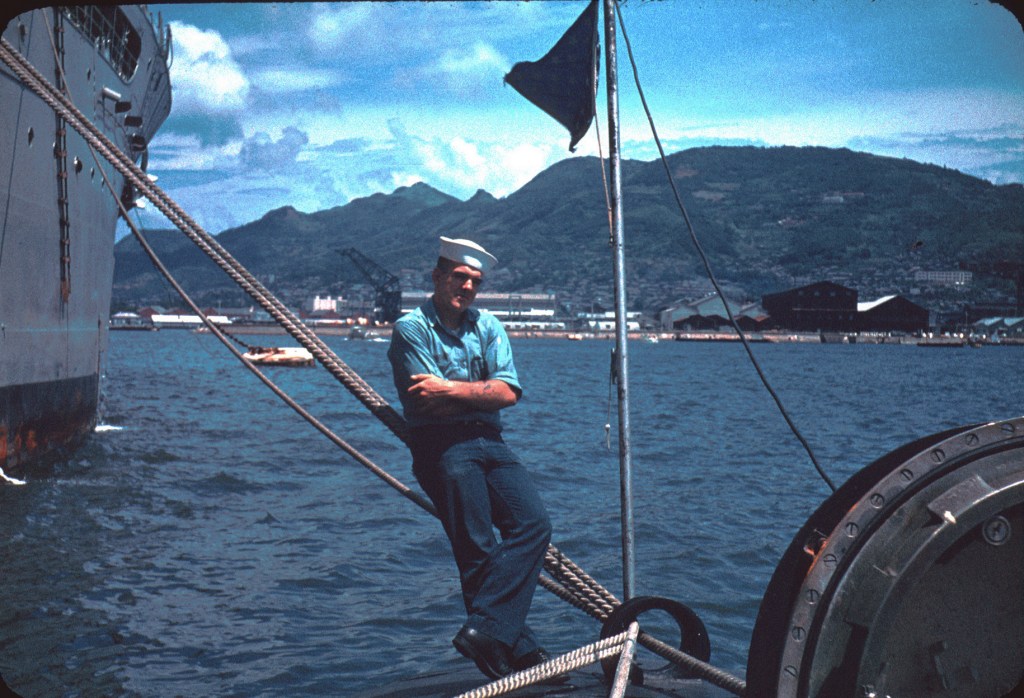
The two tour guides, Rick Neault and Tony Capitano, who served on the Barbel-class boats said they never wore poopie suits on these boats, but rather, dungarees (bell bottom jeans and light blue chambray shirts). Tony said he only wore poopie suits when he was aboard a ballistic missile submarine (USS Francis Scott Key). Reportedly, the whole tradition of wearing poopie suits (as a submariner uniform) started on boomers. However, it is also worth mentioning that uniforms in the Navy have changed since they were in. Although the Navy officially calls them “flame-retardant coveralls,” sub sailors still call them poopie suits and they are common on all submarines.
The other uniforms you see are the dress uniforms, which are not worn every day. They would be worn when sailors are reporting aboard or when the boat is coming back into port.
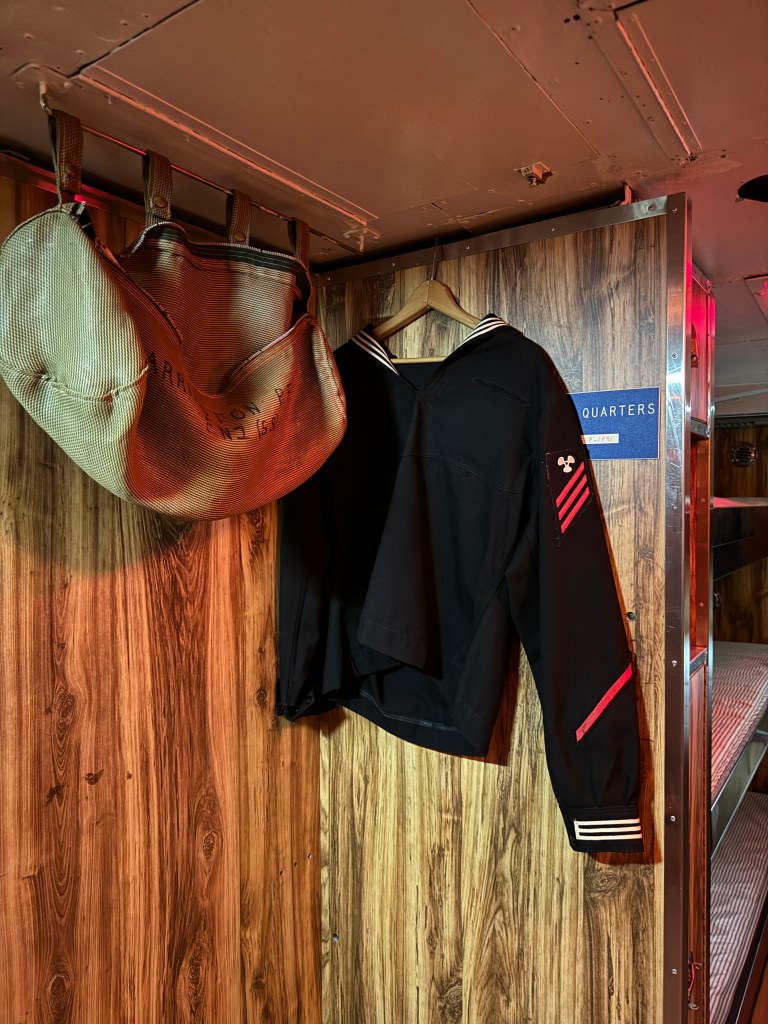
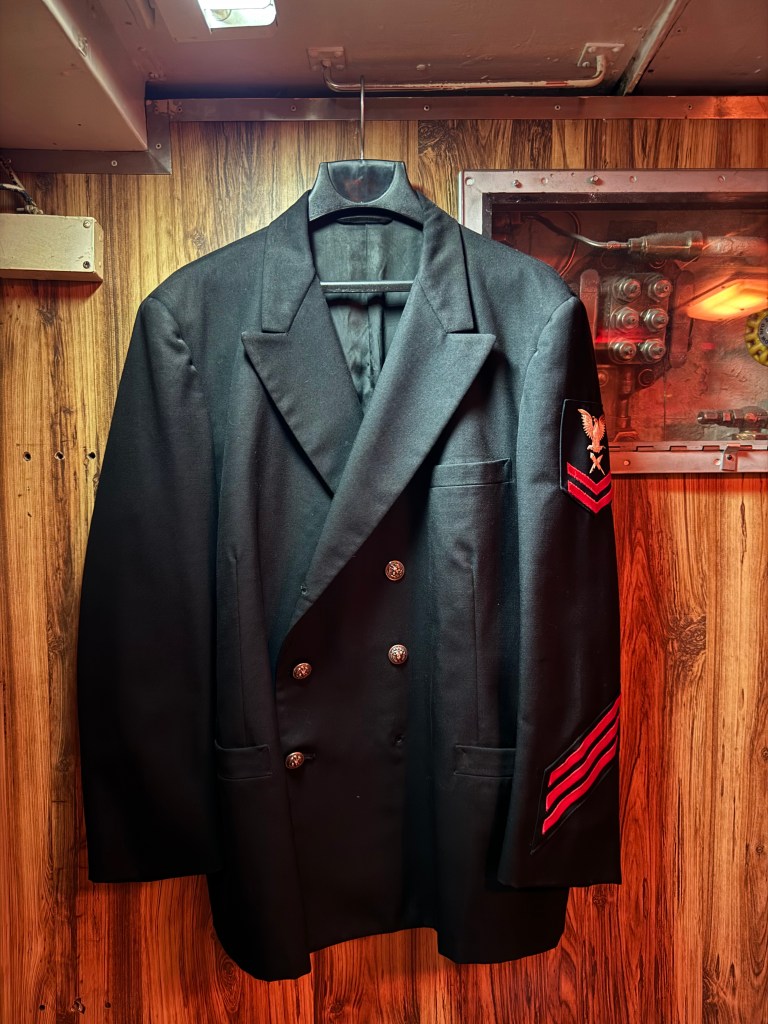
Regarding the temperature on board, the older WWII fleet boats had A/C, which was no doubt a luxury compared to other countries’ submarines. In reality, the temperature on fleet boats hovered around 95 degrees Fahrenheit and would climb into the triple digits if they shut it down. It was more of a glorified dehumidifier, not so much for your comfort as to keep condensation from dripping into the electrical components and starting a fire. In contrast, Rick Neault and Tony Capitano told me that the A/C and heating system on the Barbel-class submarines actually worked around 80% of the time and kept the submarine pretty comfortable (similar to what it feels like currently). Neault told me that they would often wear jackets in berthing, control, and even in maneuvering to stay warm. The torpedo room has no heating, so it was usually a very consistent temperature. So if there is one thing that worked really well on these subs, it was the air conditioning. Of course, when the A/C broke down (or was shut down), then it really sucked.
The overheads (i.e. ceilings) on Blueback are roughly 6 feet 4 inches high (depending on where you are). A common question I get asked is whether there is a height restriction on submarines. I have been told two different things regarding that (the ever-present frustration with doing research). Some tell me that the current height restriction is somewhere between 6 feet 8 inches and 6 feet 10 inches, but others say there is no restriction. Furthermore, Google does not help because I have not found any official U.S. Navy regulation either. Oddly enough, there is a minimum height to be on submarines, which is 4 feet 11 inches. There certainly was no height restriction when Blueback was in service, and reportedly, the tallest sailor on Blueback was an Electrician’s Mate at 6 feet 8 inches tall. There was also an Executive Officer who was 6 feet 6 inches tall, and there was a guy temporarily assigned to the boat who was 6 feet 11 inches tall. They just curled up their legs when sleeping, walked around hunched over all the time, and probably got a terrible crick in their necks.
Whatever the case regarding height restrictions is, they are not making submarines any roomier inside. So if there is any “restriction,” it is more of a girth restriction. You need to fit through the hatches and demonstrate that you can move around a submarine quickly in an emergency.
Put (bluntly) another way:
If you are too tall to stand up straight inside the submarine, well, that is your problem. Duck lower! On the other hand, if you are too big to move around the sub quickly or fit through a 25-inch diameter hatch to enter or exit the submarine, that is everybody’s problem.
Battery Compartments
Blueback has two batteries, composed of the fore and aft battery compartments/wells. These compartments take up about 1/3rd of the lowermost level of the submarine. The forward battery well extends roughly from below the sonar room back to about 2/3rds of the enlisted berthing area. The after-battery well extends from the forward battery well back to the engine room, just past the freezers/refrigerators.
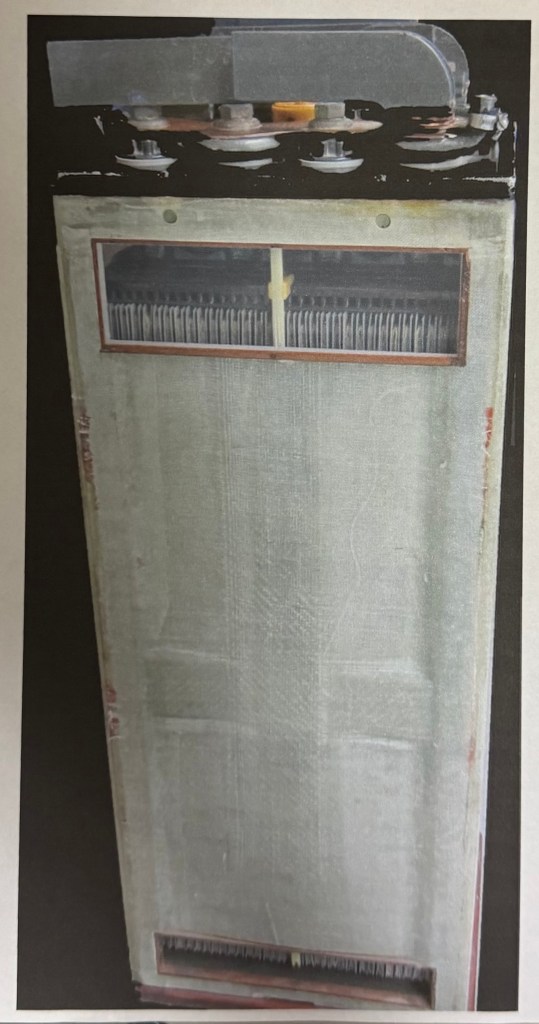
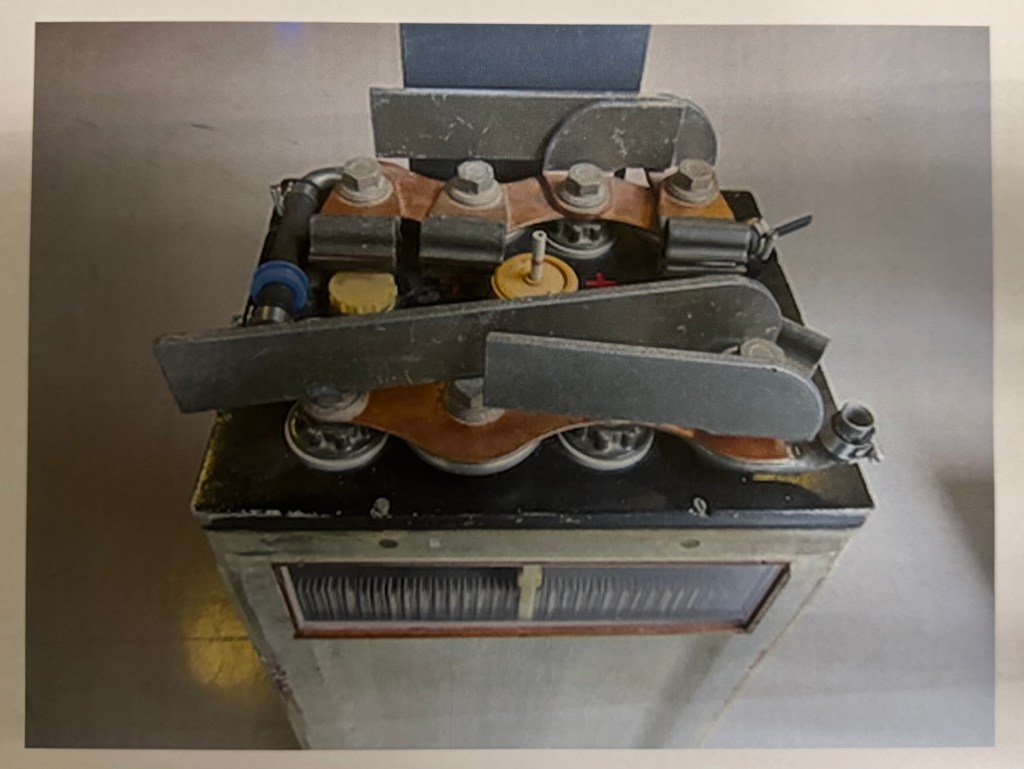

Each battery compartment contains 252 individual battery cells for a total of 504 cells. Each cell is about 1-foot square, 4 feet tall, weighs about 1,200 lbs., and generates about 1.98 volts. That is a total of 604,800 lbs. of batteries, about 1,000 volts, and 5,400 amps. The cells in each battery compartment are wired up in series to produce around 500 – 550 volts DC. The two battery compartments can be operated either in series or parallel.


Access to the battery compartments is via the deck hatches in the airlock just aft of the crew’s berthing before entering the crew’s mess. One of the hatches on Blueback is opened so visitors can see down into the aft battery compartment. Currently, our Chief Electrician’s Mate (i.e. the Energizer Bunny) is working down there to maintain the batteries.
Crew’s Mess

The crew’s mess (AKA mess deck) functions as the dining area and social hub of the submarine. It is similar to the wardroom but for the enlisted crew. It is composed of the mess tables, the scullery, and the galley. The lights are always on, and there is usually something happening in here. Normally, it can seat 20 people at one time, and there were originally four tables (two 6-person tables inboard and two 4-person tables outboard), but one 6-person table was removed, and the exit ladder was installed when the sub became a museum ship.
The Scullery
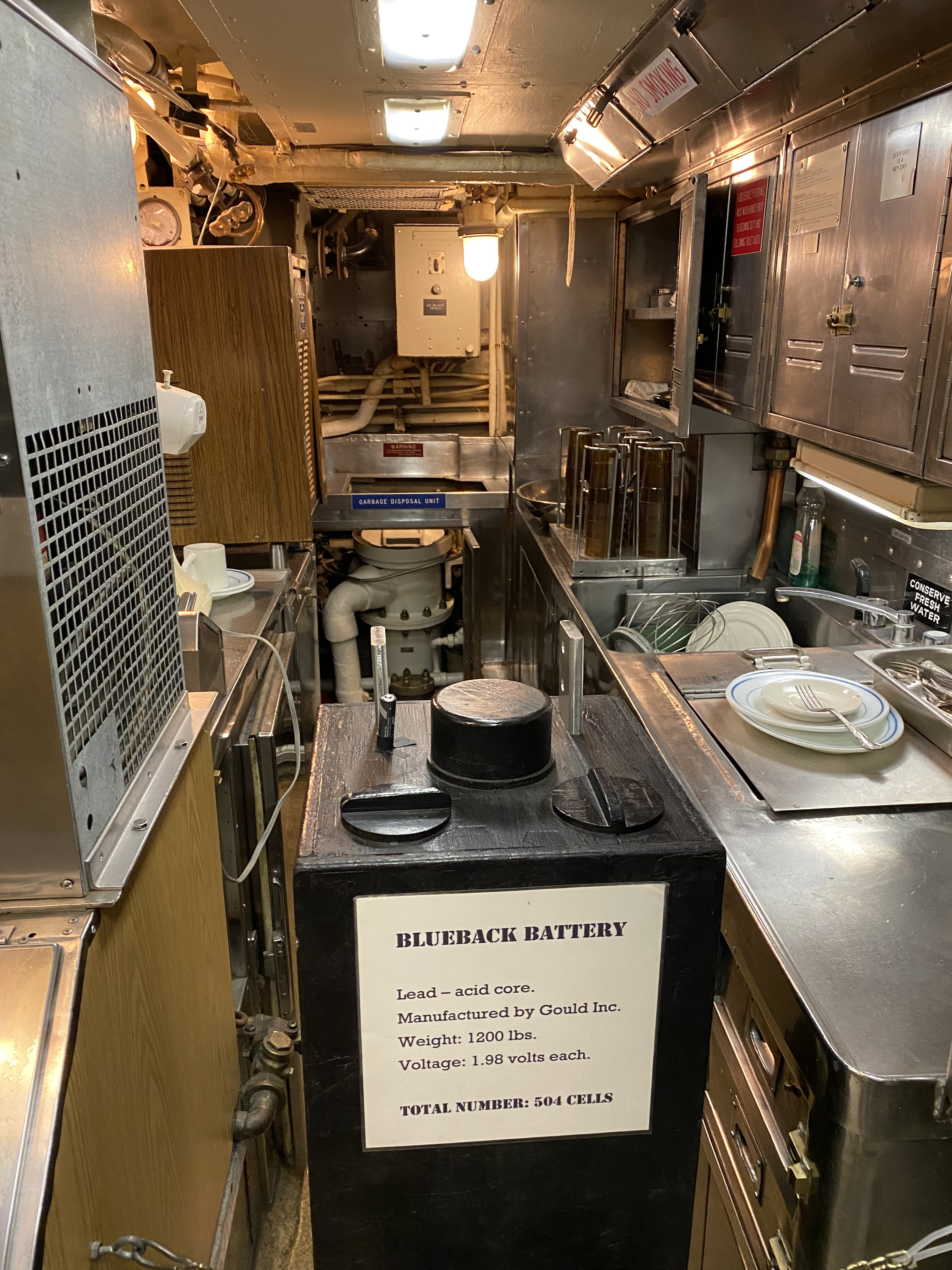
The scullery across from the galley is where all the dishes are washed. There is no dishwasher on board, so that job goes to the new guys. If you’re an enlisted sailor below E-4 and new to the Navy, then your first job on any vessel (submarine, surface ship, or otherwise) is to spend about 90 days in this room doing what is known as “mess cranking/cranking,” and you are what is known as a “crank.” This means that you will wash the dishes and scrub the pots and pans by hand. Additionally, you peel potatoes, chop up veggies, make salads, assist the cooks, fetch/stock food, refill the coffee pot, take out the garbage, serve people their meals, and keep the crew’s mess clean.61


For example, you will be washing dishes one moment, and then somebody sitting in the mess will yell, “Crank! Get me some more coffee!” So you run out and oblige. (No, they are not going to get up and get it themselves, especially if they are sitting in one of the outboard seats since they cannot climb over someone to get it. That is what you are for.) You then go back to washing dishes until a minute or two later someone yells, “Crank! More ice cream!” So you get them some more ice cream and go back to washing dishes.
It is not a fun job, and it takes time away from your other duties, such as working on your qualifications for your dolphins or your rating (job), but you just got on the boat, and you do not know anything about it. So you are stuck doing the new guy jobs and making yourself useful for the time being. However, this gives the rest of the crew a chance to get to know you and what your temperament is. They need to make sure you have the right attitude and work ethic that they demand to be on submarines, and are not someone who is going to half-ass their work. Otherwise, they might “unvolunteer” you from submarines.
Trash disposal
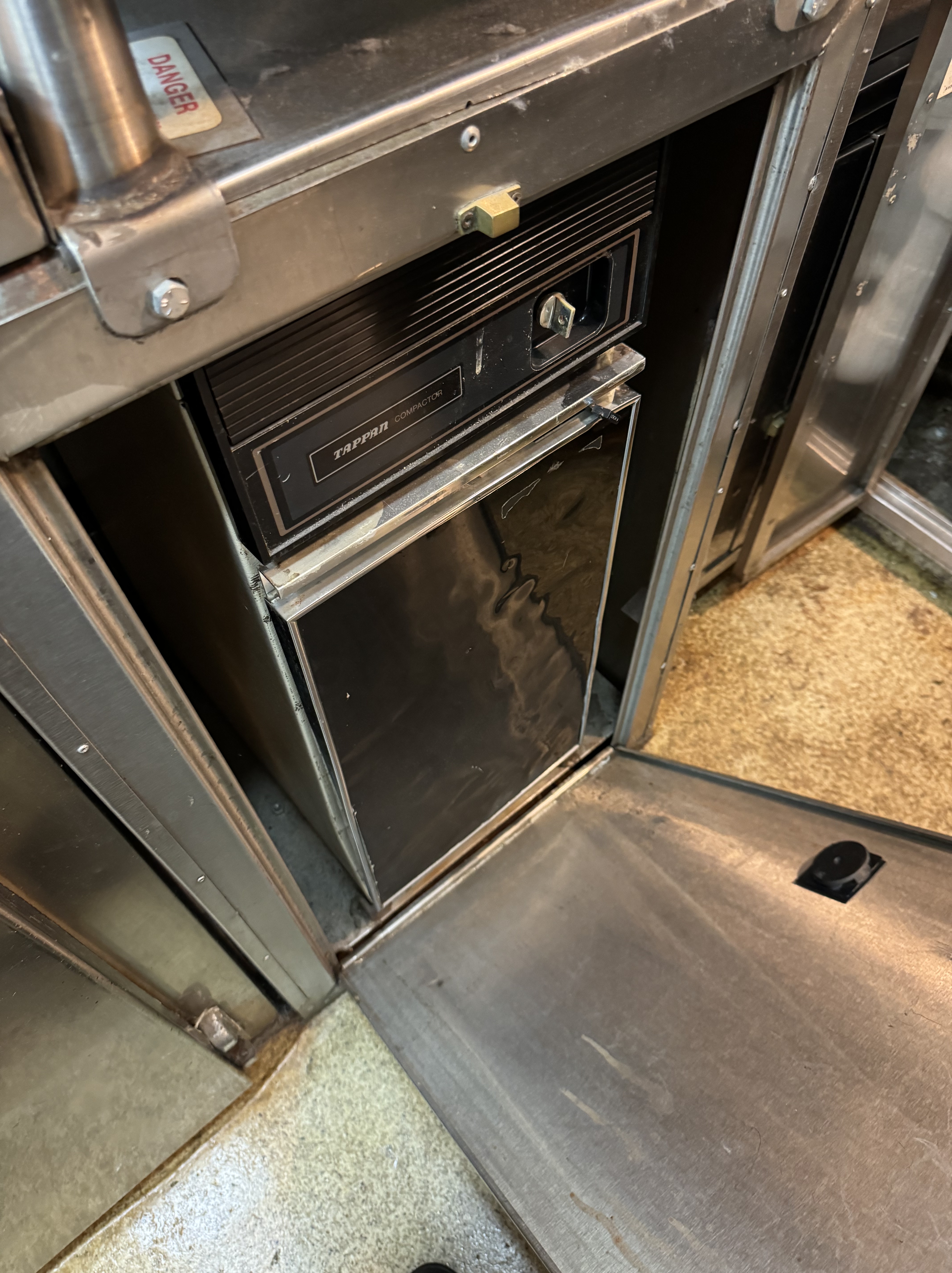
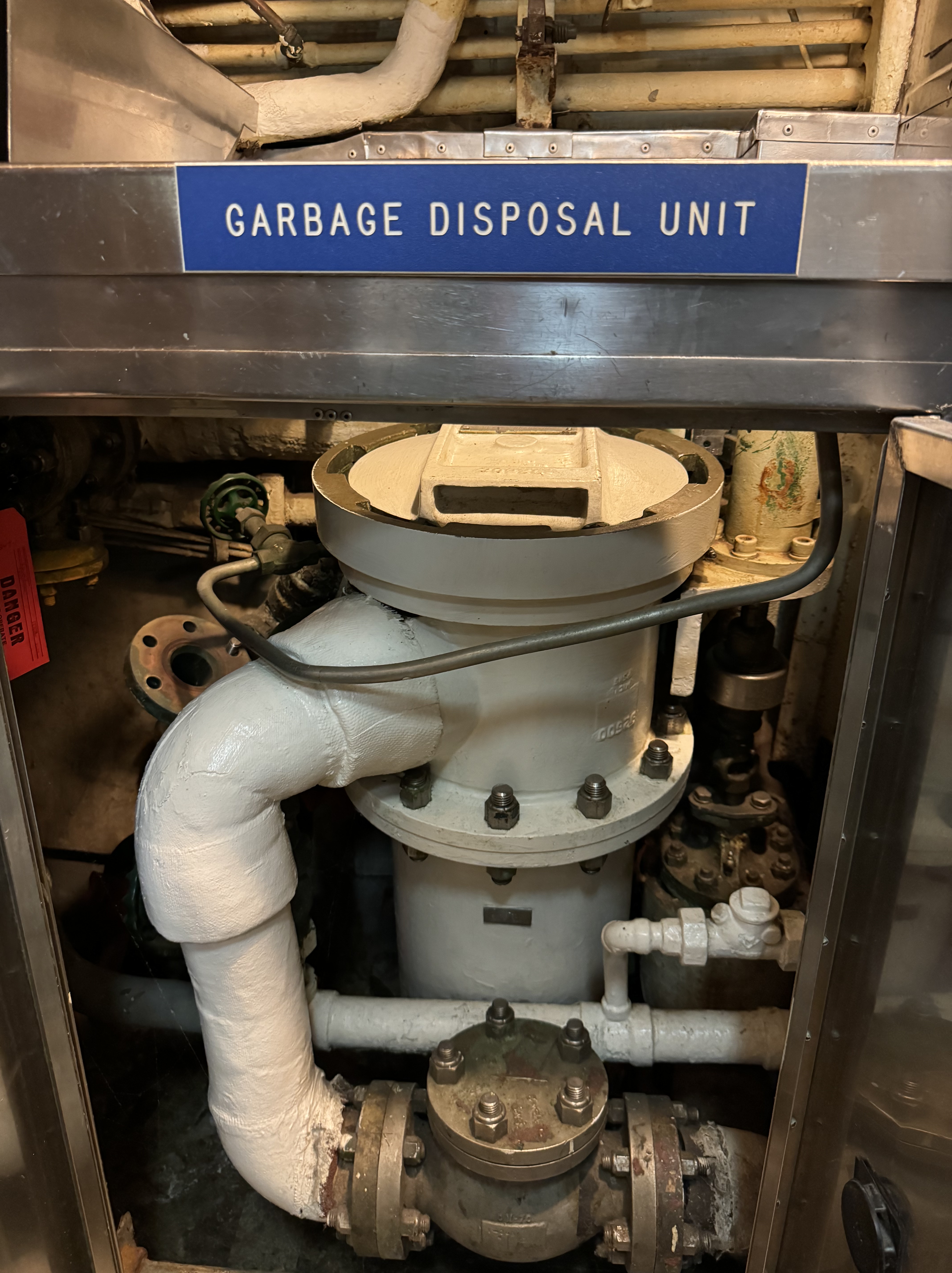
There is no way for the submarine to haul the trash out to the curb for pickup, although a trash compactor does exist on the boat. Non-biodegradable waste (such as cans and glass) gets smashed down until the submarine gets back to port. In Blueback‘s day, both biodegradable and non-biodegradable waste were discharged into the ocean. However, changing environmental laws in the 1970s meant that only biodegradable (and pulped/treated) waste could be discharged beyond certain distances from land. Food waste went into perforated cans, which originally came flat and needed to be folded into the appropriate shape. These cans, full of trash, are then weighed to make sure they weigh about 50 lbs. If not, then circular iron weights will be added to make sure they do. This is loaded into the Trash Disposal Unit (TDU), which is basically a small vertical torpedo tube. The tube is flooded and pressurized, and the trash can is ejected out of the bottom of the submarine.
A malfunctioning trash disposal unit is what caused the battery fire aboard the USS Bonefish on 24 April 1988. Reportedly, the same flaw was discovered in Blueback‘s unit, but luckily, it never caused a fire on her.
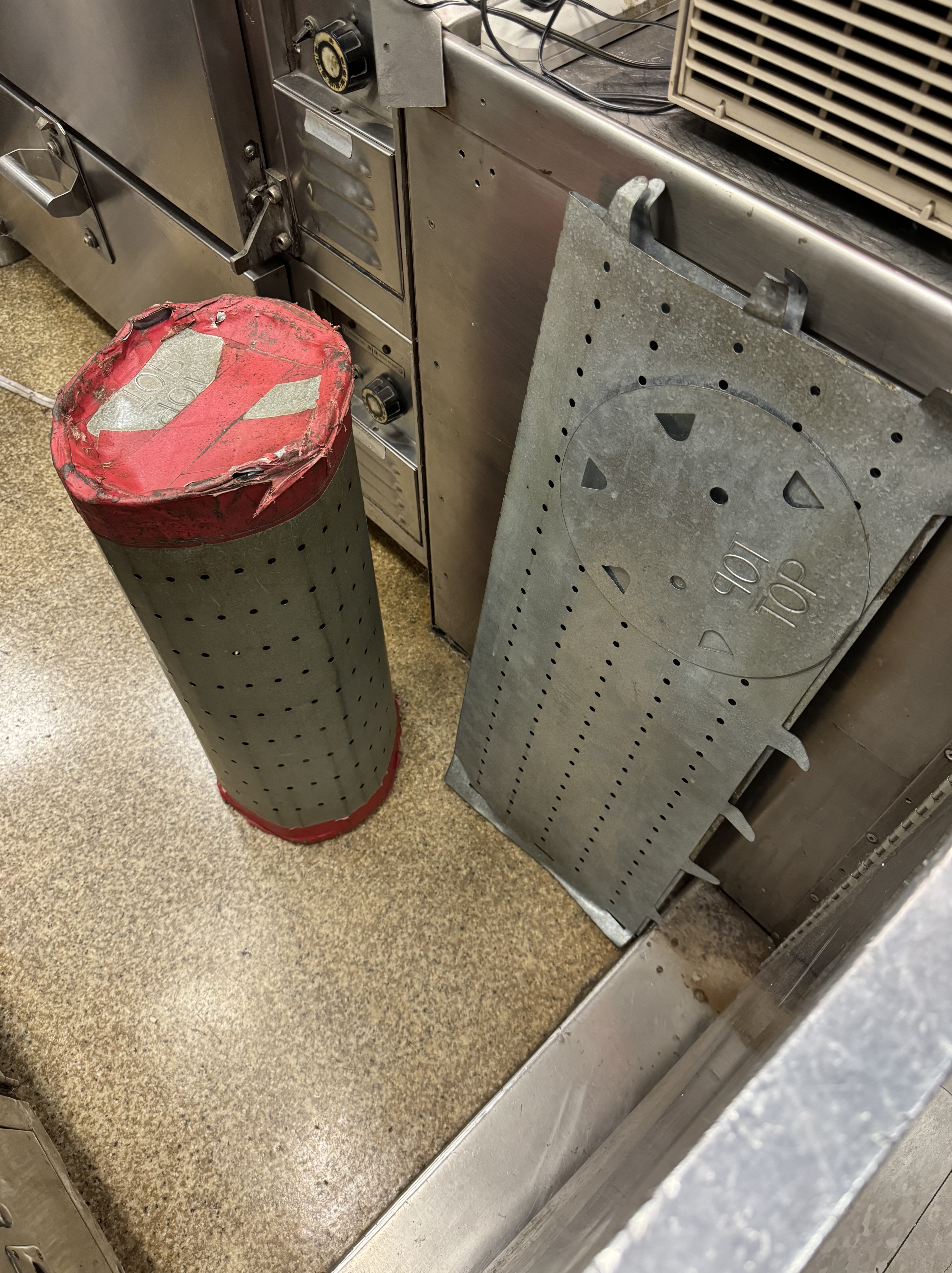
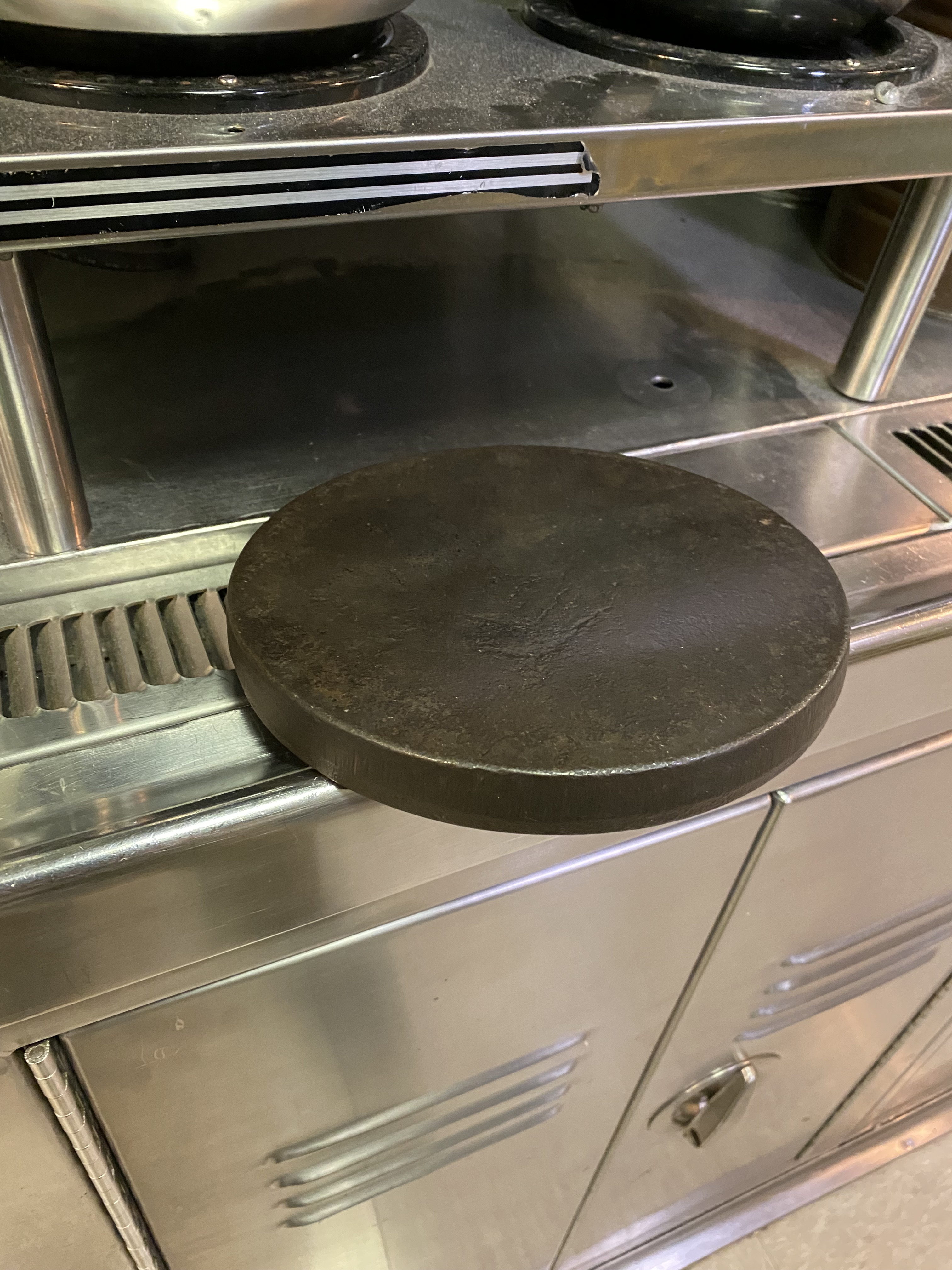
We do not care what happens to the can, as long as it does not float to the surface. If it floats to the surface, then we leave a trail and give away the position of the sub. Hence, the holes in the can allow it to flood. The can is made of non-galvanized tin, so it will rust away in seawater and leave only the weight at the bottom. The fish eat the rest. Some submarines operating in highly sensitive areas will not discharge any trash for most of the patrol and simply stow it until they get to an area where it can be ejected.
If you have seen the 1958 film Run Silent, Run Deep, there is a subplot in that film where the submarine, operating in the Pacific during World War II, does not properly weigh down its trash when it gives it the float check. An Imperial Japanese Navy submarine is picking it up and gaining intelligence from it. Hence, you want to make sure the garbage will sink.
Meal times
Meal times are one hour long. Breakfast (0500 – 0600), lunch (1100 – 1200), dinner (1700 – 1800), and midnight rations (AKA Midrats) (2300 – 0000). Midrats are basically lighter meals, like leftovers, soup, or sandwiches. Given the seating restriction, the aforementioned watch system, and the meal durations, the enlisted crew has to eat in shifts. The ongoing watch section has the first 20 minutes of the hour to eat before going on watch. Then the non-watchstanders would have the next 20 minutes to eat, and finally, the now-relieved watch would have the last 20 minutes of the hour to eat.62 However, Rick Neault told me that the amount of time you had to eat depended on whether or not you were qualified and a senior enlisted man. If you were a non-qual, then you would basically scarf down your food and move out to make space for someone else to eat. If you were a Chief Petty Officer, then you could take your meal back to the Goat Locker and enjoy it there or sit in the crew’s mess and take more time to eat.
These time constraints are largely theoretical. A study conducted showed that realistically, the average eating time for a sailor to consume his meals on non-nuclear submarines was 36 minutes for breakfast (22 to 40 minutes), 36 minutes for lunch (29 to 43 minutes), and 41 minutes for dinner (30 minutes to >1 hour). As can be seen, there was quite a bit of variation between boats.63 By these times, the galley and crew’s mess would roughly follow this schedule:
| Nightly baking | 2230 – 0430 |
| Breakfast prep | 0500 – 0600 |
| Breakfast served | 0600 – 0800 |
| Breakfast clean up | 0800 – 0900 |
| Lunch prep | 1030 – 1130 |
| Lunch served | 1115 – 1400 |
| Lunch clean up | 1400 – 1500 |
| Dinner prep | 1530 – 1730 |
| Dinner served | 1730 – 1945 |
| Dinner clean up | 1945 – 2100 |
As per the schedule above, the mess would not be used until about one hour before meal times when prep has begun. When not being used for meals, even amongst the clatter of washing dishes and cleaning the galley, the mess would be the space for training and recreation during the following time windows: 2045 – 0500, 0900 – 1030, and 1500 – 1630.64 (See below for more on recreation.)
The schedule would be more relaxed when the submarine was in port. Breakfast would be from 0600 to 0755, just before colors. Lunch would be from 1100 to 1300, and dinner would be from 1600 to 1800. Since liberty would begin around 1600, not many crew would stick around for the evening meal. Weekends in port were also more relaxed. Sundays would only feature two meals, one of which was brunch served from about 1000 to 1200, and then the evening meal in the late afternoon. Again, since only the duty section would be aboard, a special meal of lobster or some other expensive item would be served for dinner on Sundays. However, the menu could change to have less-than-popular items served at that time. During holidays in port, seasonal meals with all the trimmings would be prepared and guests would be invited to dine aboard.65
The Galley
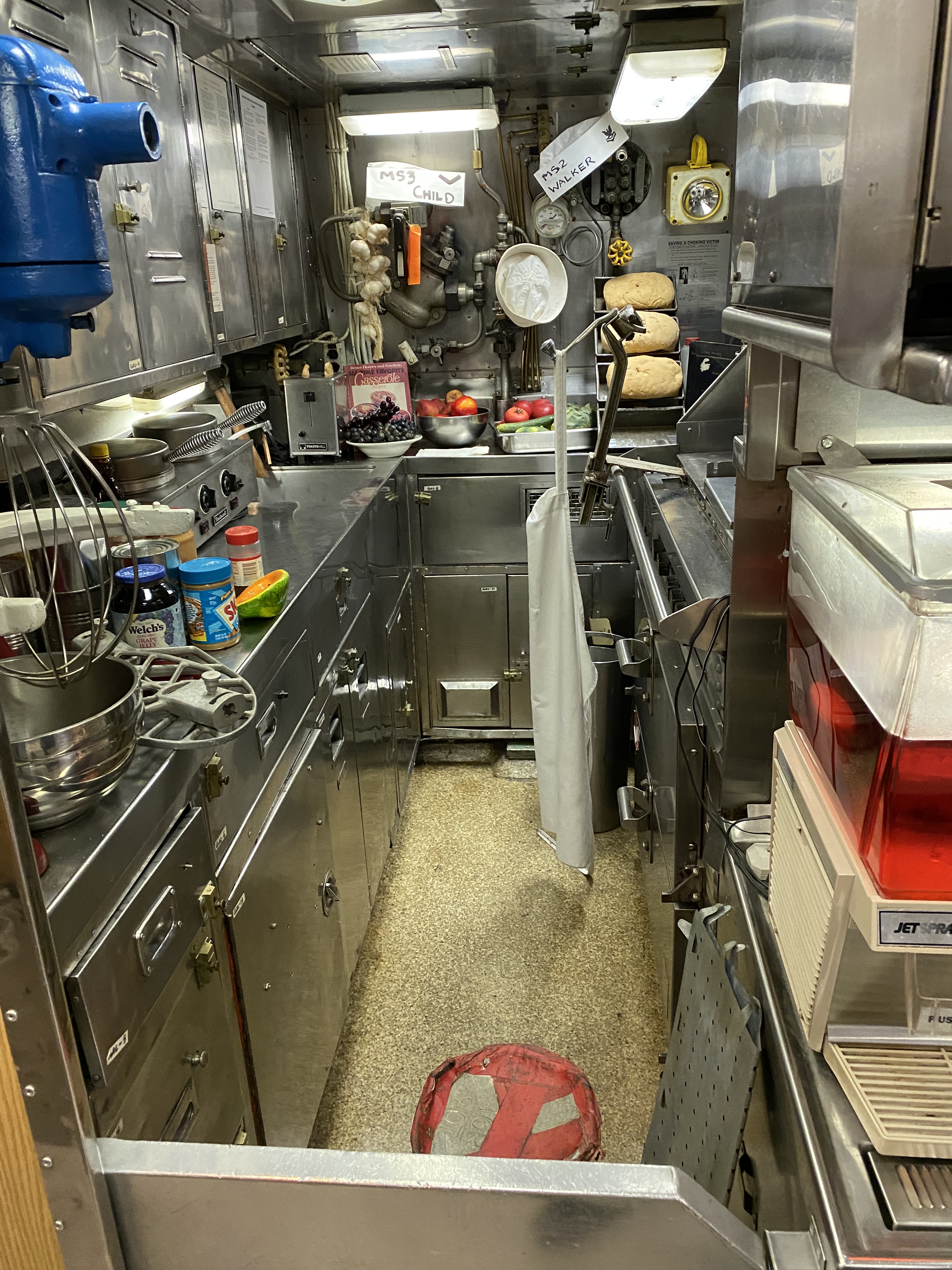

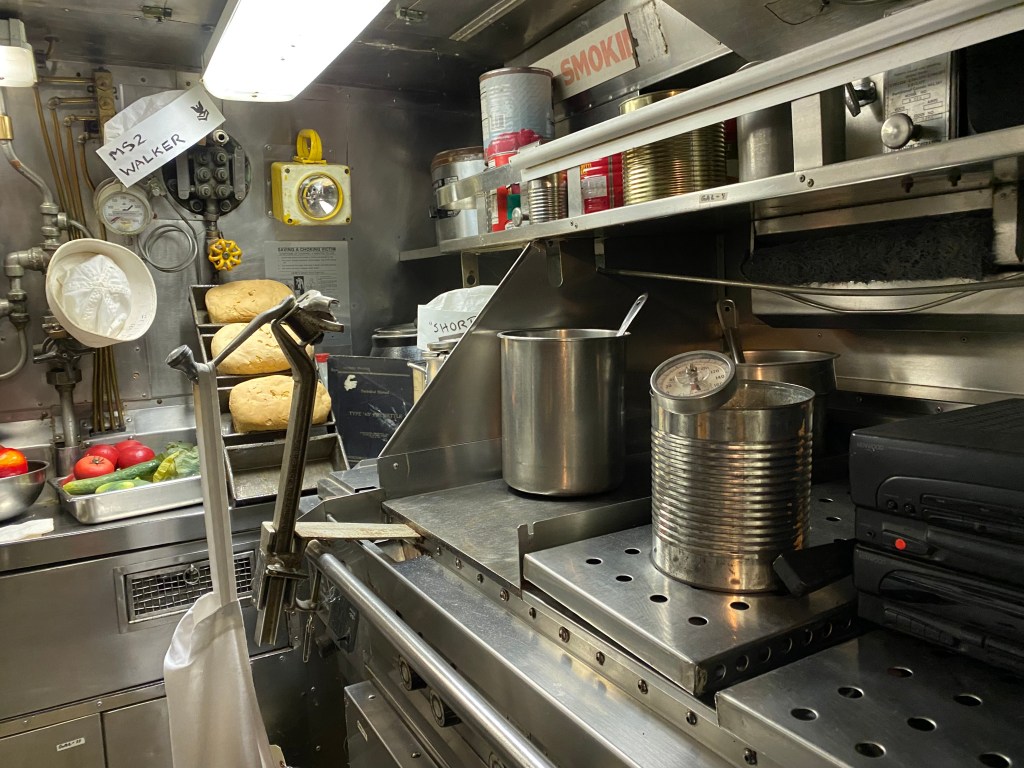
The galley is the kitchen for the entire submarine. In the galley are one sink, one electric range, one 12 lb. capacity deep fryer beside the range, one 12 qt. capacity food mixer, one portable toaster, two ovens, and two waffle irons. It is consistently one of the busiest areas on the boat and operates virtually 24 hours a day.
There would normally be 3 to 4 cooks on board, rotating through the galley, making four meals a day for all 85 men. In earlier times, much of the cook’s training was more on-the-job and less formalized, but today, submarine cooks initially go through approximately 5 weeks of Navy Culinary Specialist (CS) “A-school,” and selected ones are sent for another couple of months at the Culinary Institute of America (CIA).66 By that time, they are pretty much chefs.67 Once they leave the Navy, submarine cooks often go on to work in high-end hotels and restaurants, and usually one of the cooks at the White House served on a submarine.
Menus and Recipes
In 1938, the first edition of The Cook Book of the United States Navy was published, which replaced their original from 1920. It has been revised multiple time,s and you can find versions of this book online. The book itself contains sections devoted to nutrition, menu planning, and of course, recipes. In the late 1940s, this book was replaced with Standard Navy Recipe Cards, and in the 1990s, the menus became computerized. It is debatable as to how closely the cooks followed the recipes and how often they got “creative,” but according to one survey:
- Submarine cooks followed the Standard Navy Recipes with very little deviation 71% of the time.
- Submarine bakers followed the Standard Navy Recipes for baked goods 93% of the time.
- Submarine cooks cooked from memory of personal recipes only about 19% of the time.68
Even then, the recipe cards were considered to be a starting point. One cook, Warren Rucker, aboard USS Grampus (SS-523) in the 1950s, recalled:
The older cooks thought the cards were a joke, but I (twenty years old) was required to use them from time to time. One meal I prepared using the cards brought a threat from our executive officer that he’d throw me overboard along with the next meal I prepared using the cards.69
Navy recipes and cookbooks are designed so meals can be prepared in about one and a half hours.70 Still, food preparation is always a challenge, given the cramped working conditions. The most common issue is just sheer exhaustion. There is never enough space, never enough time, and never enough cooks. It gets even more challenging if a diesel-electric boat like Blueback is on or near the surface (such as when snorkeling). In those conditions, the constant pitching and rolling of the submarine means food preparation can get dangerous, especially if the hot oil and grease start sloshing around. Even then, cakes can come out lopsided, and any loose objects start sliding around. If the submarine is making its way through particularly heavy seas on the surface, then simple meals like sandwiches, hot dogs, beans, chili, and cold cuts may be served for those whose stomachs can still eat while seasick. Modern nuclear submarines are only on the surface when going out or coming back into port, so seasickness is less of an issue, as is food preparation.71
The best food in the U.S. military can reportedly be found aboard submarines. The reason is to make up for their living conditions. We have President Theodore Roosevelt to thank for this. In August 1905, he became the first U.S. President to go aboard a submarine when he went aboard USS Plunger (SS-2). After seeing the conditions those men were living in, he signed several executive orders saying that every submariner would be a volunteer, we would pay them more, and give them better food.
According to the U.S. Navy submariners I have talked to, the accuracy of that statement about good food is generally on point, but I have heard both good and bad (but mostly good) things about submarine food. One former submarine sailor told me that it really depends on the skill of the cooks. His boat had good cooks, and he rated the food around an 8 or 9 out of 10, saying that the meals on his boat were really hearty. God help the cook if the food is bad because there is no place to hide on a submarine! However, having never personally tasted any food that actually came out of a submarine galley, I cannot speak with any authority regarding the quality of it. In my experience, the food I have had out of galleys is occasionally hit or miss. Sometimes it is great, and sometimes it is not-so-great. Most of the time, it is just average, and I would not rate it 5 stars, but it certainly beats fast food any day of the week. In reality, the quality of the food aboard ships, submarines, or ashore depends on many factors, not just the skill of the cooks. For one thing, how discriminating your personal tastes are is probably a major factor. If you grew up with lots of gourmet, Michelin-starred food, then you probably would not find a submarine meal to be the most epicurean thing you have ever tasted. Secondly, what your favorite foods are no doubt influences how well you enjoy the menu. Thirdly, when you are tired and hungry, just about anything tastes good. You do not have a ton of time to sit around and critique the meal, so eating becomes something of an automatic response. You shovel food into your mouth and get on with your day. Lastly is the time spent underway. The absence of any fresh ingredients after the first week or two at sea would probably have some bearing on the quality, since any ingredients after that would come frozen, dehydrated, powdered, or out of a can. At that point, you would be hard-pressed to refer to the food as “fresh,” and there is only so much you can do with canned, dried, or frozen ingredients.
On the bad end, I have heard some apocryphal stories of submarines pulling into port after long patrols where all the crews had eaten for the past week were saltine crackers and ketchup or powdered mashed potatoes, food coloring, and butterscotch topping. Other submarine veterans have equated the food to something like what you would eat at a Denny‘s restaurant. They have also told me that once you get down to the canned and dehydrated food, the quality of the meals noticeably drops, sometimes to the point where the taste of the food is not much better than what would come out of your average cafeteria.72
The food is both high-brow and low-brow. They eat food such as hamburgers, hot dogs, pizza, fried chicken, pancakes, waffles, French toast, steak, and lobster. That is just a small sample, but there would be a variety of beef, chicken, and pasta dishes served. The midnight cook is also the baker. He will be making fresh bread every night. Additionally, he could make donuts, cookies, cinnamon rolls, sticky buns, pastries, pies, or even your birthday cake…if you are really nice to him. Like many surface ships, some submarines do have certain meals on certain days. For example, burgers on Sundays, tacos on Tuesdays, Surf and Turf on Fridays, and pizza on Saturdays. I think most of the reputation of submarine food comes from the fact that much of the food is made from scratch. That means the above-listed bread, pizza dough, donuts, pastries, cakes, hamburger patties, whipped cream, etc., are not premade or prepackaged substitutes. Furthermore, unlike the rest of the Navy, submarines are allowed to have deep-fat fryers for things like fried chicken, French fries, and so on. All despite the extreme fire hazard they create. That said, there are certainly instances of botched meals. One Blueback volunteer tour guide related a story of a cook making pancakes with salt instead of sugar. That was not a particularly popular breakfast that day. Another who served on a Permit-class boat told me about one breakfast that included rehydrated cottage cheese, which the crew promptly spat out upon taking the first bite. Yeah, that sounds disgusting.
Here is one menu from Blueback for the week of 26 October 1970:73
| Day | Breakfast | Lunch | Dinner |
|---|---|---|---|
| Monday | Standard breakfast Chilled fruit juice Chilled fruit Fresh Milk Bread, butter, jam, jelly Assorted breakfast pastries Fresh eggs to order Home fried potatoes Add: Golden hot cakes Grilled bacon slices Hot maple syrup | Baked meatloaf Creamy mashed potatoes Tomato gravy Buttered broccoli Hot dinner rolls Fresh garden salad Assorted dressings Coffee, tea, milk Assorted cake and ice cream | Virginia baked ham Candied sweet potatoes Pineapple raisin sauce Club spinach Ice cream sundaes |
| Tuesday | Standard breakfast Add: Grilled pork sausage Hot french toast Hot maple syrup | Prime roast of beef Mashed potatoes Natural beef gravy Buttered green beans Pound cake and ice cream | Roast mat turkey American potatoes Giblet gravy Chilled cranberry sauce Buttered green peas Jelly roll and ice cream |
| Wednesday | Standard breakfast Add: Grilled ham slices Hot oatmeal | Spanish style steak O’Brien potatoes Natural sauce Buttered Brussel sprouts Banana splits | New England boiled dinner Simmered corned beef Fresh boiled cabbage Fresh boiled carrots Fresh boiled potatoes Hot mustard sauce Assorted pie and ice cream |
| Thursday | Standard breakfast Add: Creamed chipped beef Hot biscuits | Pineapple baked chicken Mashed potatoes Chicken gravy Chilled cranberry sauce Buttered green beans Assorted fruit pie | Chili con carne Steamed rice Steamed hot dogs Buttered asparagus Strawberry shortcake |
| Friday | Standard breakfast Add: Scottish woodcock Grilled bacon slices | Deep fried scallops Chicken a la king Steamed rice Buttered carrots Ice cake and ice cream | Grilled hamburgers Grilled cheeseburgers French fried potatoes Lettuce leaves Sliced onions Sliced Tomatoes Baked Navy beans Hamburger buns Ice cream sundaes |
| Saturday | Standard breakfast Add: Grilled ham slices Minced beef on toast | 0900 – 1030 Brunch 1500 – 1600 Dinner | Grilled beef liver Steamed hot dogs Buttered fried onions Grilled bacon bits Buttered whole corn Ice cream sundaes |
| Sunday | Standard breakfast Add: Hot buttered grits Grilled pork sausage | 0900 – 1030 Brunch 1500 – 1600 Dinner | Grilled cheese sandwiches Grilled ham and cheese sandwiches Bacon, lettuce, tomato sandwiches French fried potatoes Ice cream sundaes |
Note that this menu is oriented toward American cuisine. But then again, it is from 1970. Beef, chicken, and pasta entrees remain staples of military food, but there have been efforts in the last several decades to diversify the menu. That said, most of the menu diversity would come in the form of dishes that are palatable to most Americans. Something tells me that Japanese sashimi (raw fish) is unlikely to be on the lunch menu. If any Asian food is being served, it will be something akin to yakisoba or teriyaki chicken.
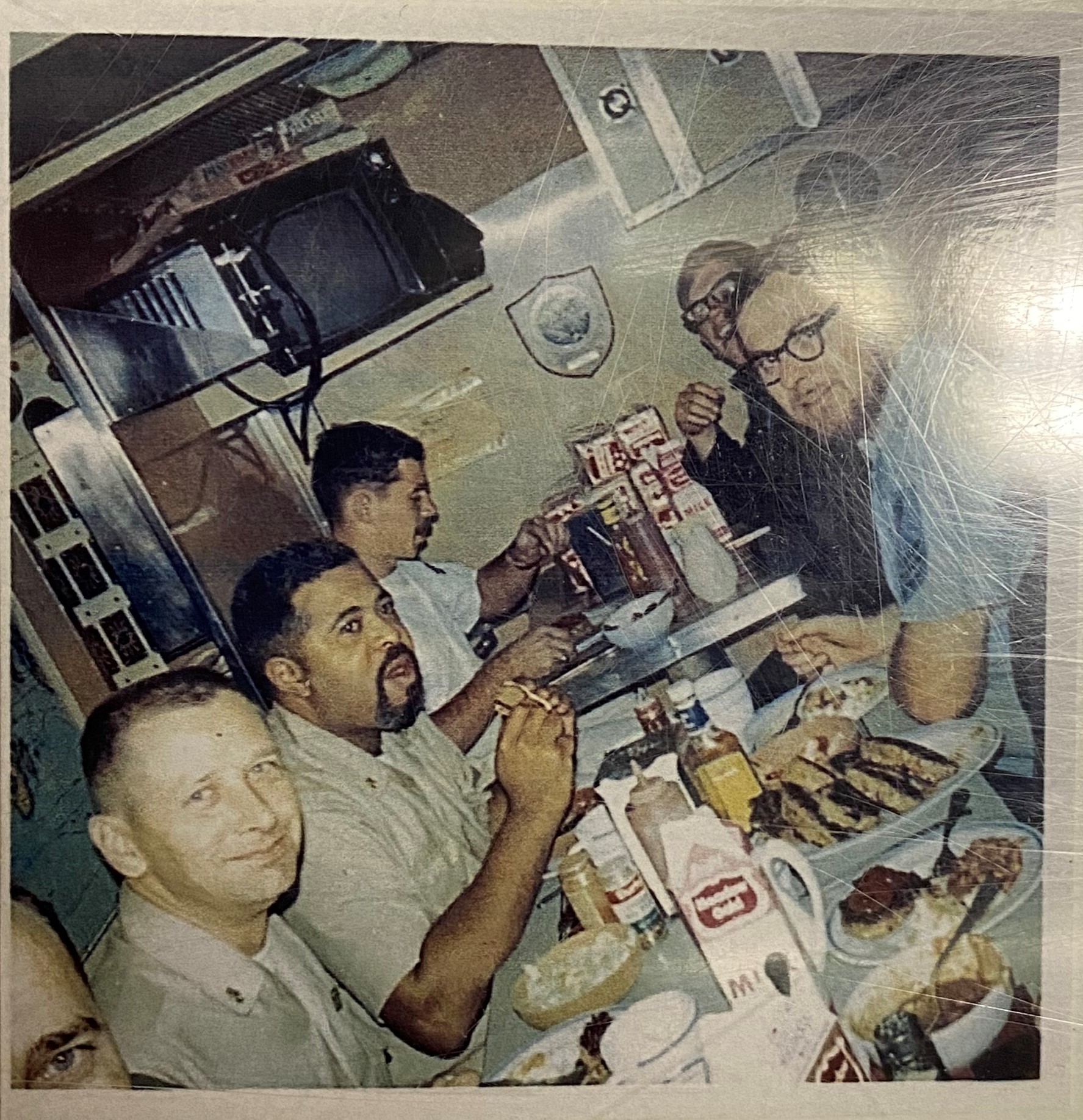
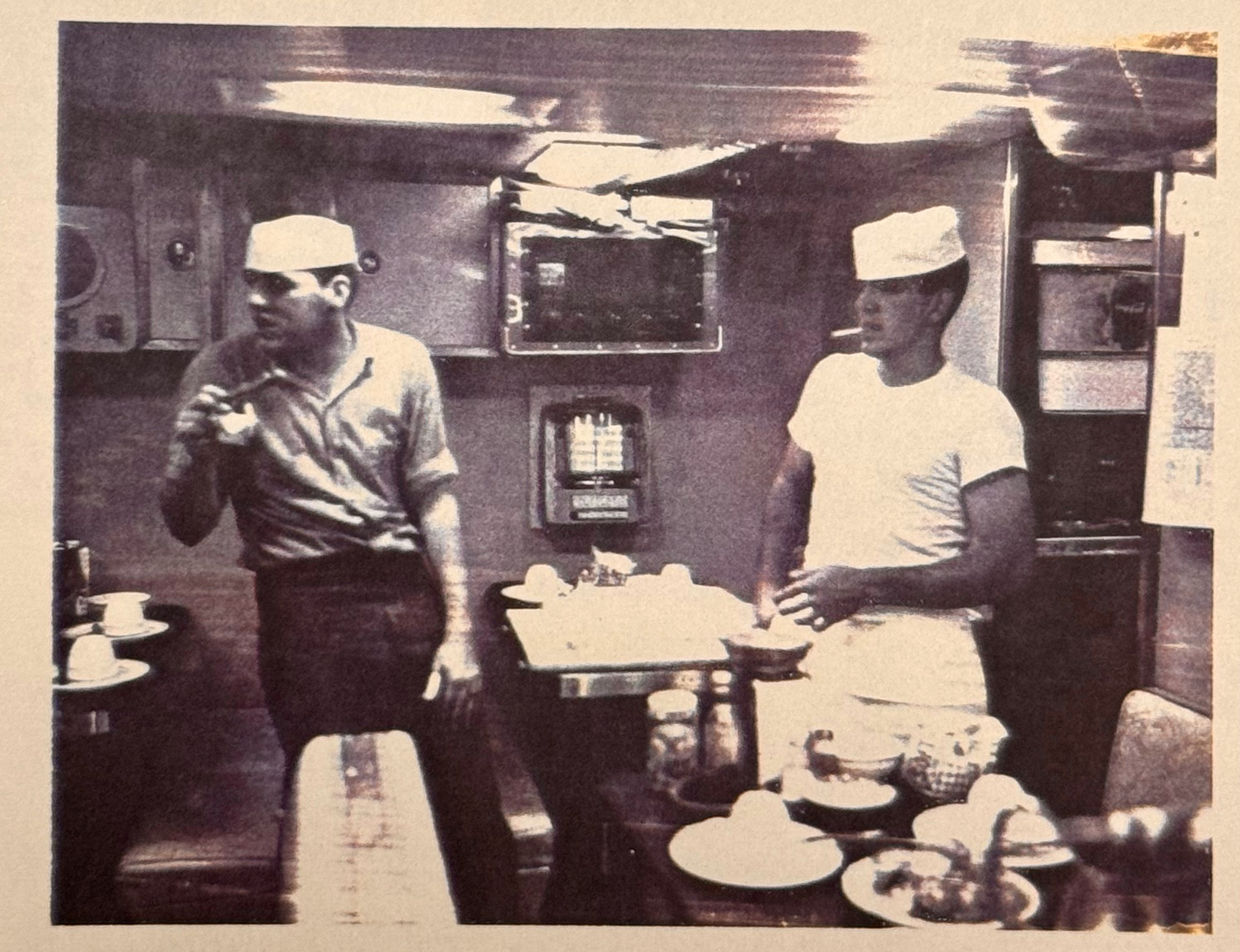
Speaking of Asian cuisine, there is a story of a cook, named Greenwood, who was infamous for his inability to make Chinese food. Sometime in 1956, aboard USS Razorback (SS-394), a postwar Guppy conversion submarine, as the officers sat down in the wardroom for lunch, the menu was listed off, which included tossed salad, apple pie a la mode, and last but not least, chicken chow mein. This infamous dish was Greenwood’s Chinese Special, and the mere mention of it elicited groans from the officers. As per custom on this submarine, the officers were not supposed to criticize the food, yet the commissary officer, a green LTJG Gilhooly, having never suffered through this questionable food, was excited about the entree. Once the Captain tasted the food, his face remaining stoic, Gilhooly meekly asked, “Good, isn’t it?” To which the Captain replied, “This is the lumpiest, most foul excuse for oriental food ever to find its way into this wardroom. But…good.”74
According to the Submarine Research Center, another thing to note about the menu is that the standard breakfast usually includes eggs, toast, butter, and some kind of potato. Bacon and sausage also appear, but hot cereal, such as oatmeal, is not common because it is generally too much of a hassle to prepare (at least back in the day). Cold cereals are more common. Another Navy staple, served 2 – 3 times a week, is creamed minced beef on toast, AKA Shit on a Shingle (SOS). The chilled fruit juice could have different meanings depending on the era. It could just be leftover juice from the fruit and likely came out of a can. Chilled or not, it was not very popular with sailors. Eventually, frozen fruit juice from concentrate became available, which is what we are used to today.75
Holidays would also see submarines serving special meals.
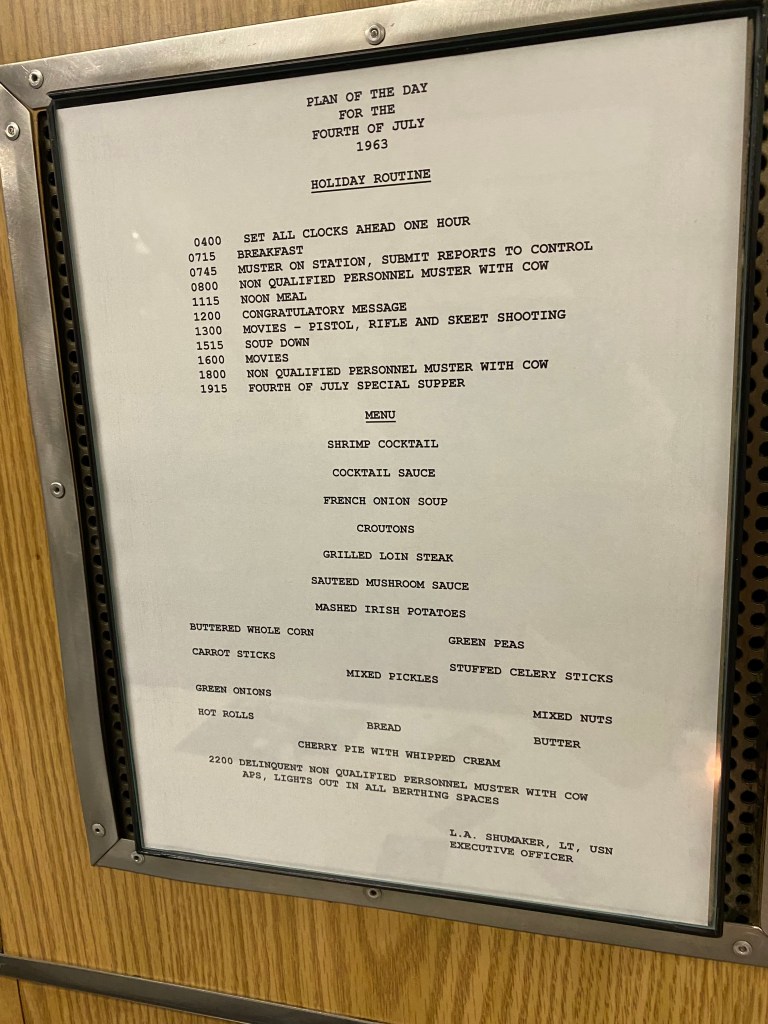
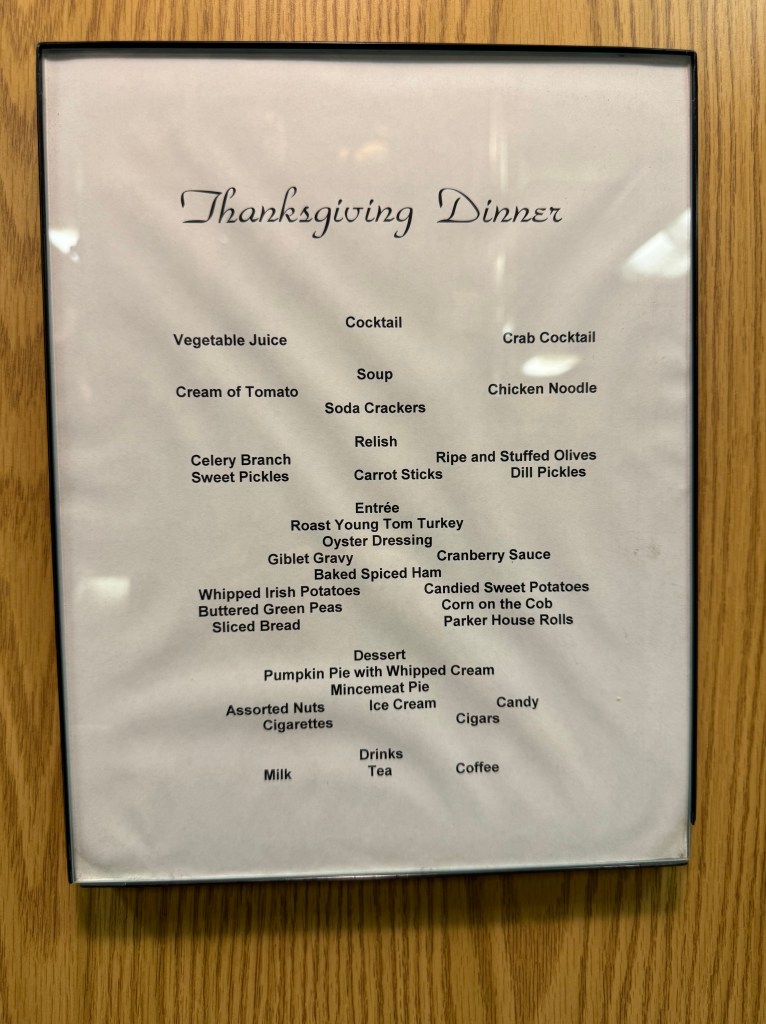
Whole chickens or turkeys were normally served in port, but when taken aboard, they were frozen and took up a lot of space in the freezer. Even then, the amount of meat they provided was also not very efficient in terms of nutrients per measured weight. Given the small ovens on submarines (like a WWII fleet boat or Blueback), only two or three turkeys or eight chickens could be roasted at a time. Still, Thanksgiving and Christmas dinners were too American to ignore the traditional meals. The availability of frozen poultry in rolls or filets made storage more economical. Canned turkey and chicken were also available and were preferred as they kept longer.76
Serving
Modern nuclear-powered fast attack and ballistic missile subs have larger spaces for the galley and crew’s mess compared to Blueback. On ballistic missile boats, meals are served buffet-style. Sailors grab a plate and get their food from steam trays (hot items) and ice trays (chilled items).77 On an old attack sub like Blueback, a lot of food is served family-style. For example, breakfast would include big bowls of scrambled eggs, bacon, sausage, pancakes, waffles, etc., which would be placed on the tables for sailors to help themselves to. They could also get their eggs to order or get French toast. For other meals, platters of food with the entree (for example, steaks) would be passed around. A modern nuclear-powered fast attack sub uses a combination of these food service arrangements, and most have a pass-through where food is served from hot and cold trays, much like what you would see in a cafeteria.78
Food Storage
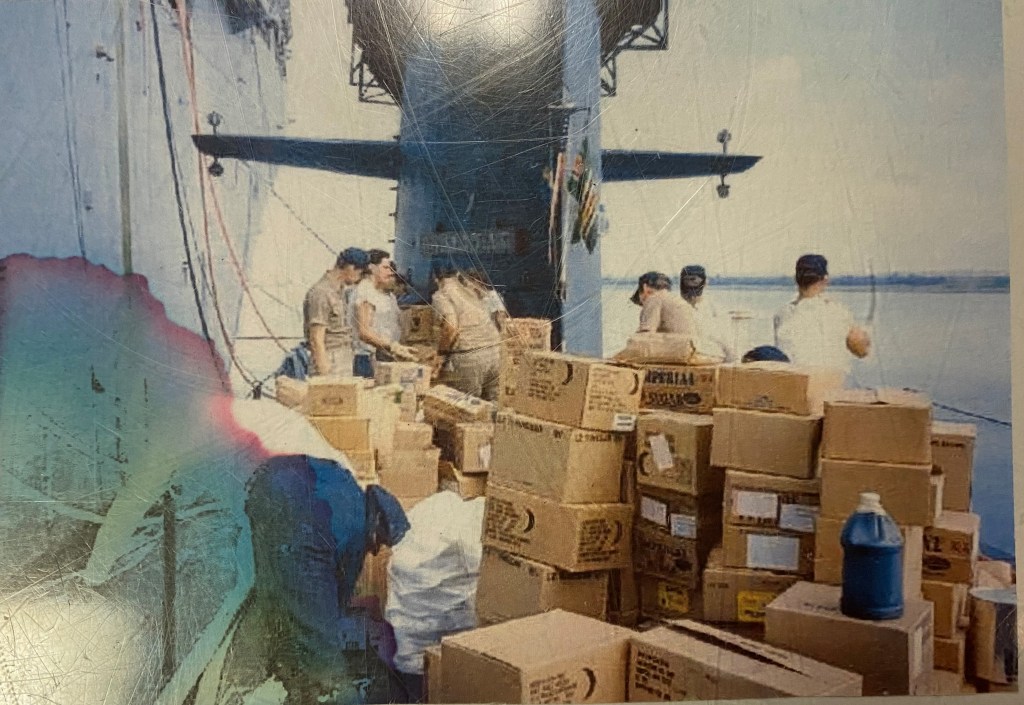
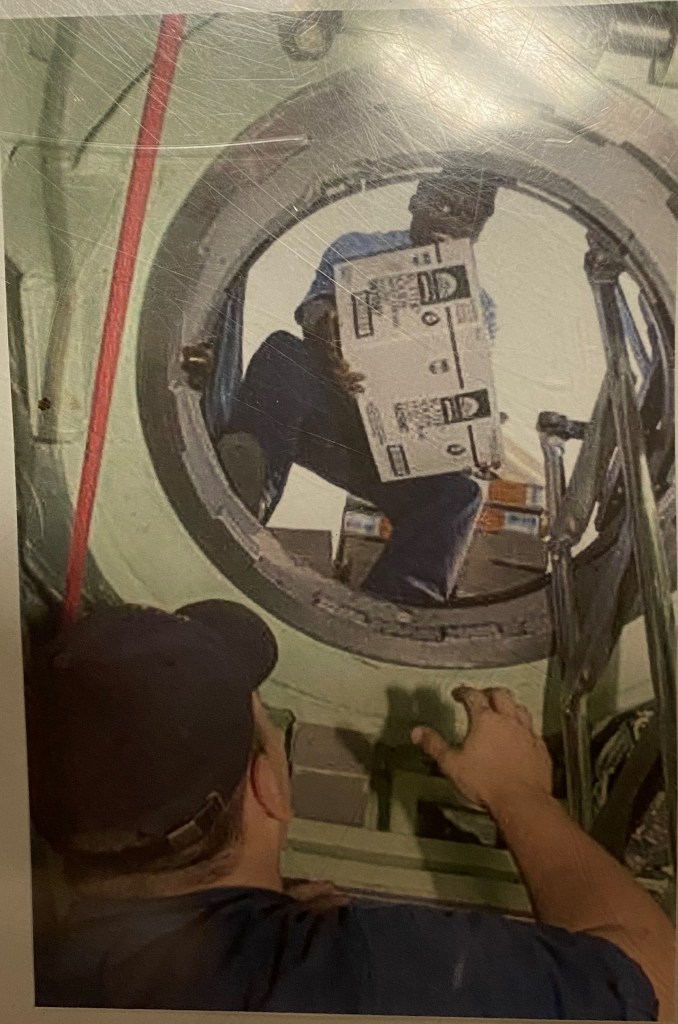
The problem is storage. Regulations state that submarines carry food for 60 days, plus another 30 days should the patrol be extended. So basically, food for 90 days at sea.79 In total, when it comes to Blueback and her 85-man crew, that is about 30,600 individual meals to be prepared. We have never been able to calculate exactly how much food this would be, but tour guides commonly say either 14 tons or the rather small 14,000 lbs. of food.80 The Ship Information Book notes that this submarine would carry 16.27 tons of provisions and other stores when fully loaded and ready for sea.81 If that book is accurate, then she may very well have roughly 14+ tons of food on board. (Having recently spoken with a former officer from Blueback who served on her in the early 1960s, he estimates roughly 15 tons of food was brought on board, confirming the larger of the quoted numbers and the Ship Information Book.)
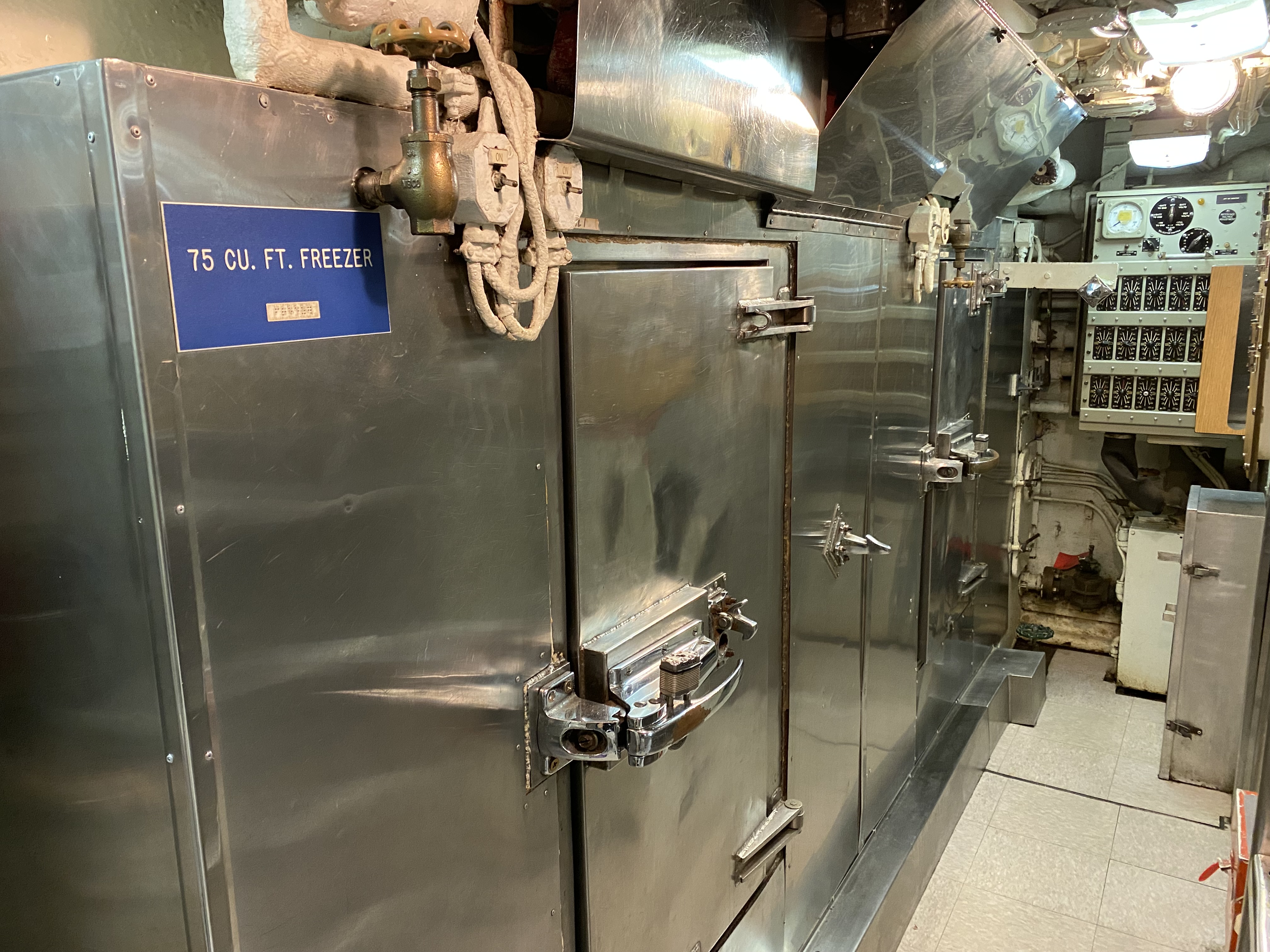
In any case, space is always at a premium aboard an attack submarine. To store the food, every available space will be used (except maybe the heads). There are two 75 cubic foot freezers/refrigerators for frozen goods.82 There are also several dry stores. One is through the door next to the milk machine. It leads into a room that goes outboard and aft. There is another further aft in the airlock leading to the engine room, and the other one is below the hatch in the deck just aft of the torpedo room in the forward part of the boat.
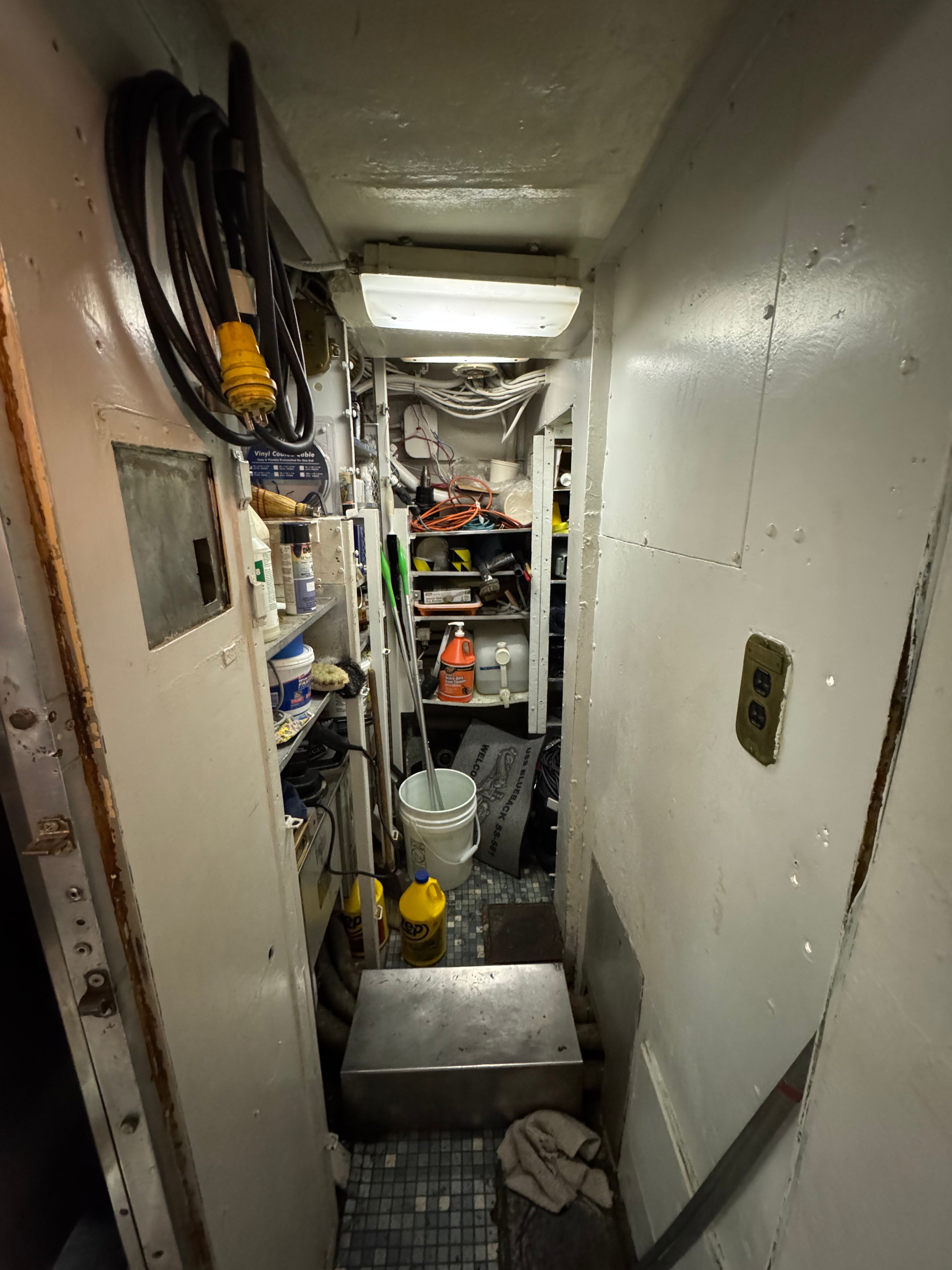
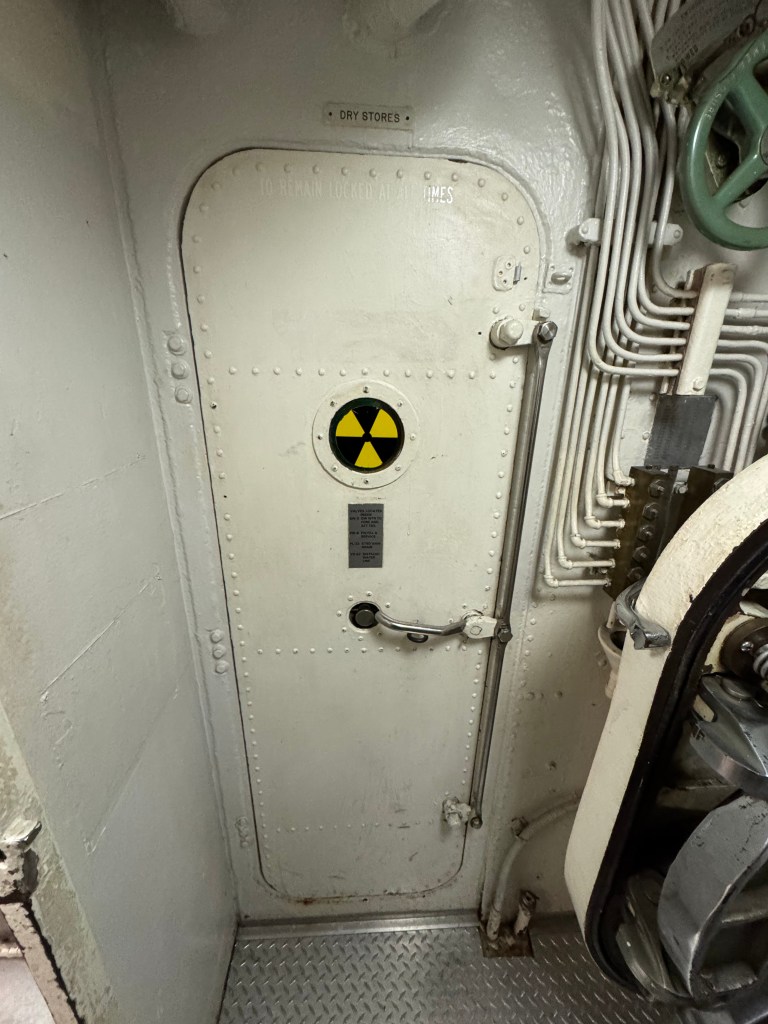

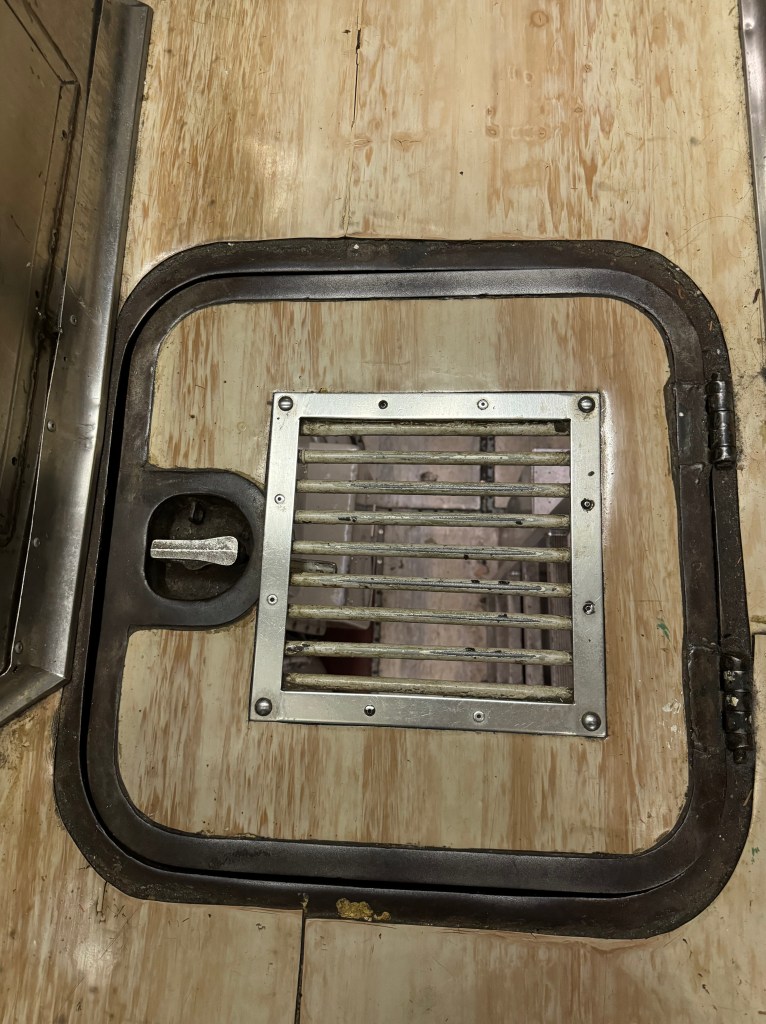
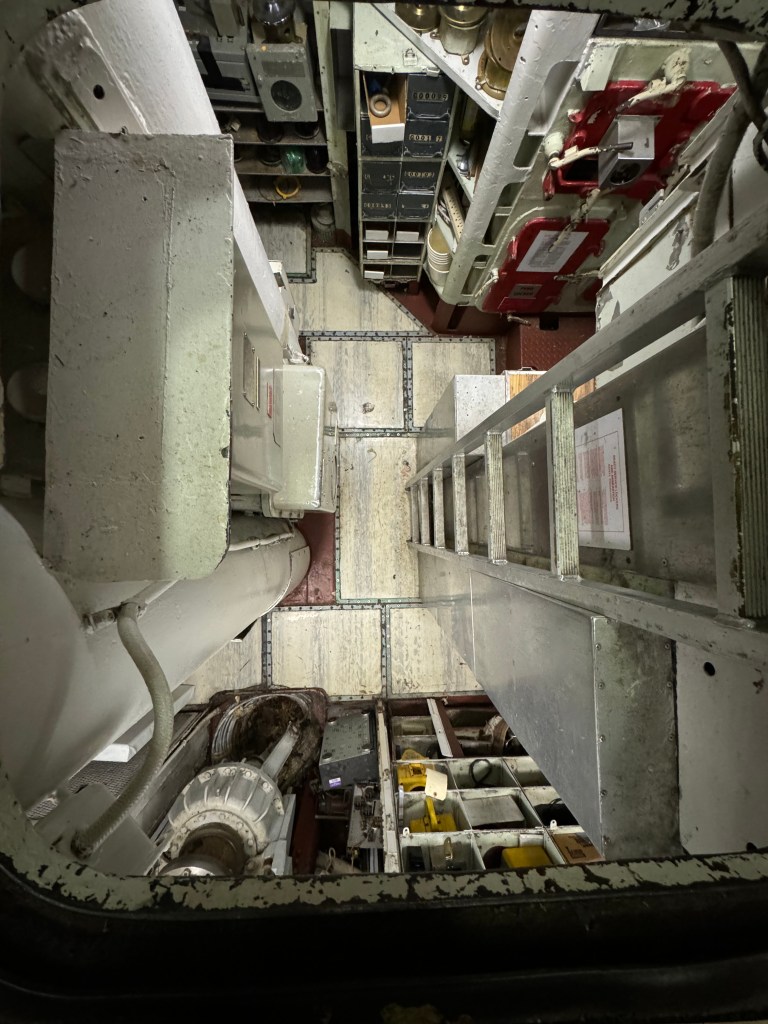
Things that need cooler temperatures, such as fresh produce, eggs, potatoes, or cheese, go in the torpedo room itself. (Even inside the torpedo tubes, if they are empty!)83 It is cold in that compartment because there are high explosives (it would actually be about 10 or 15 degrees cooler when the submarine is submerged), so it makes a good impromptu refrigerator. We are also going to fill up the showers with fresh food for about the first month underway. Nobody is really using them anyway. So if you are going to take your wonderful 2-minute ice-cold shower, then you need to get permission, clear the food out, take your shower, wipe the shower stall dry when you are done, and put the food back in…in the exact order that you found it! Would you really bother to do that for a measly 2-minute-long shower? Probably not. This is yet another reason why the showers would not get used much. Things that can withstand high heat, such as rice, beans, coffee, flour, sugar, or dry pasta, are stored in the engine room.
After that, it gets really creative.
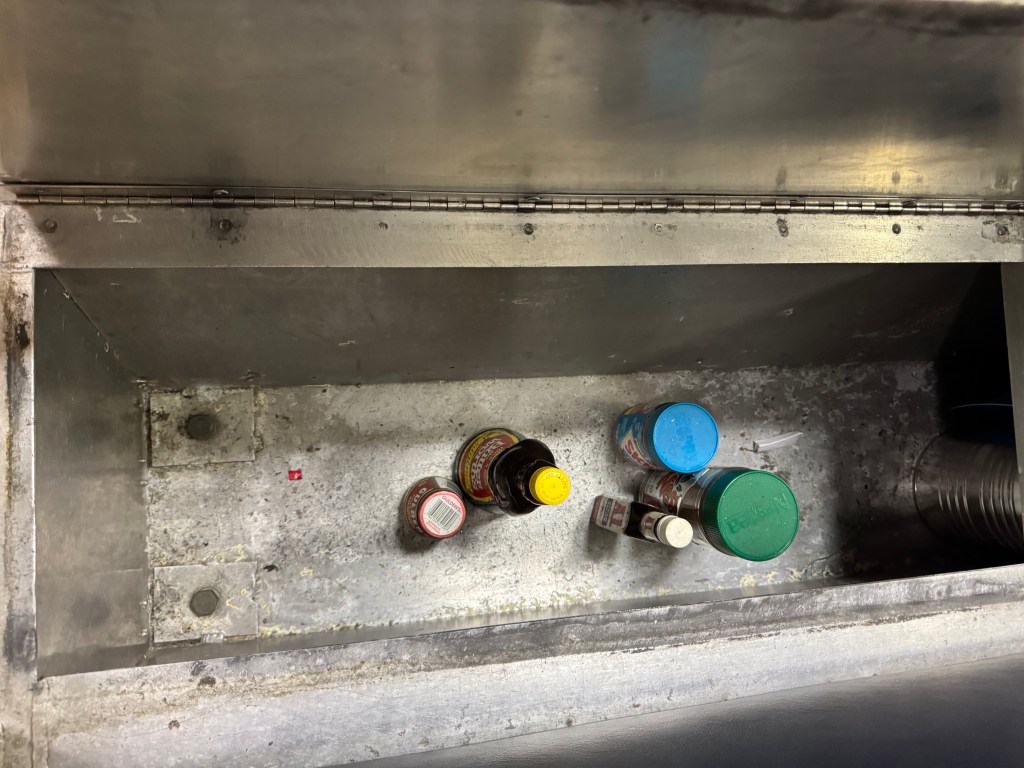
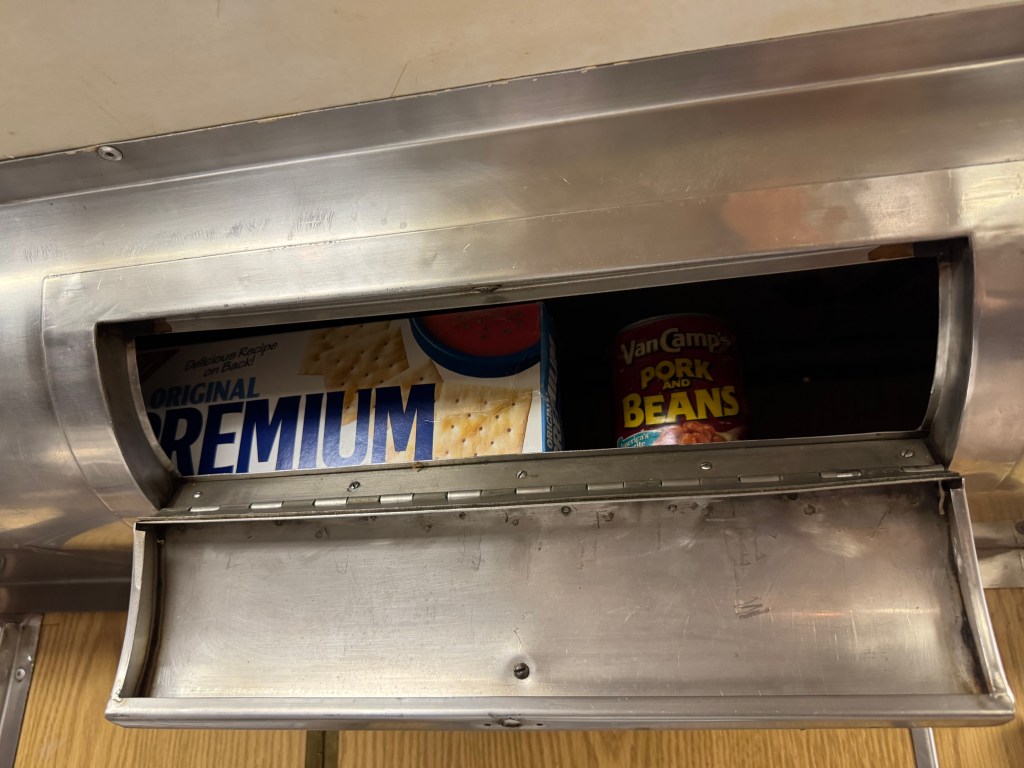
The benches in the crew’s mess, as well as in the wardroom, are hollow; we will put food in them (if there are no EAB masks stored in there already). The hollow trays on the tops of the bench backs would normally hold condiments. We will stack food underneath the tables and put food up inside the vents. Regardless of whether you are taller or shorter than 6’2″, you have also created a storage space…in your rack. You will share your bed with some food!
Storage spaces are actually different depending on the type of submarine. Older WWII-era diesel-electric Fleet Boats got even more creative with their food storage. The bilges and the deck become places of informal storage. Food would be shoved into every available horizontal space. The radiomen would sit on top of No. 10 cans for a while as chairs. Ideally, the food would be stowed so that you would eat your way to more comfortable spaces early on in the patrol.84 On modern nuclear-powered submarines, the situation changes somewhat. For larger ballistic missile boats, there is more adequate space for food storage. The escape trunks are removed to create large openings in the pressure hull (about 12 feet in diameter). The food, which has previously been sorted by a computerized menu planning system and loaded into large aluminum container modules measuring six feet by six feet by five feet (similar to aircraft cargo containers), is lowered down into the boat and power-dollied into built-in internal storage spaces. The containers, and the food inside them, are loaded in such a way that the food is accessible sequentially, meal by meal. Even then, we talked to a Culinary Specialist who was aboard an Ohio-class ballistic missile boat, and he told us that after the container modules with food were loaded onto the boat, the remaining food would be stored everywhere else, including on the decks and in every nook and cranny. (i.e. they would start lining the deck with cans.) Nuclear-powered fast-attack submarines do not have the luxury of such storage spaces, and the food is still loaded and stowed much as it was on old diesel boats. A human chain is formed, and food is passed by hand into the submarine through the vertical hatches.85 According to one calculation, a modern ballistic missile boat will consume the following amount of food on a typical patrol: 4,000 lbs. of beef; 3,000 lbs. of sugar; 1,200 lbs. of coffee; 120 lbs. of tea; 2,000 lbs. of chicken; 1,400 lbs. of pork loin; 1,000 lbs. of ham; 800 lbs. of butter; 3,400 lbs. of flour; and 11,520 eggs.86
Another publication notes that an Ohio-class ballistic missile submarine will carry enough food for 90 days on patrol, even though they typically return within 75 days. Since they do not enter foreign ports like attack boats, ballistic missile boats cannot replenish food while on patrol. Therefore, they will plan for 5 meals a day for 75 days for 160 men. This equates to about 75,000 lbs. of food in total, with about 14,000 lbs. left over when they return, since they are required to not run out. By one measurement, the supply officer orders $250,000 worth of food, of which $125,000 – $150,000 of it is dry goods. A dietician will evaluate the menus for appropriate texture, color, and nutrition.87
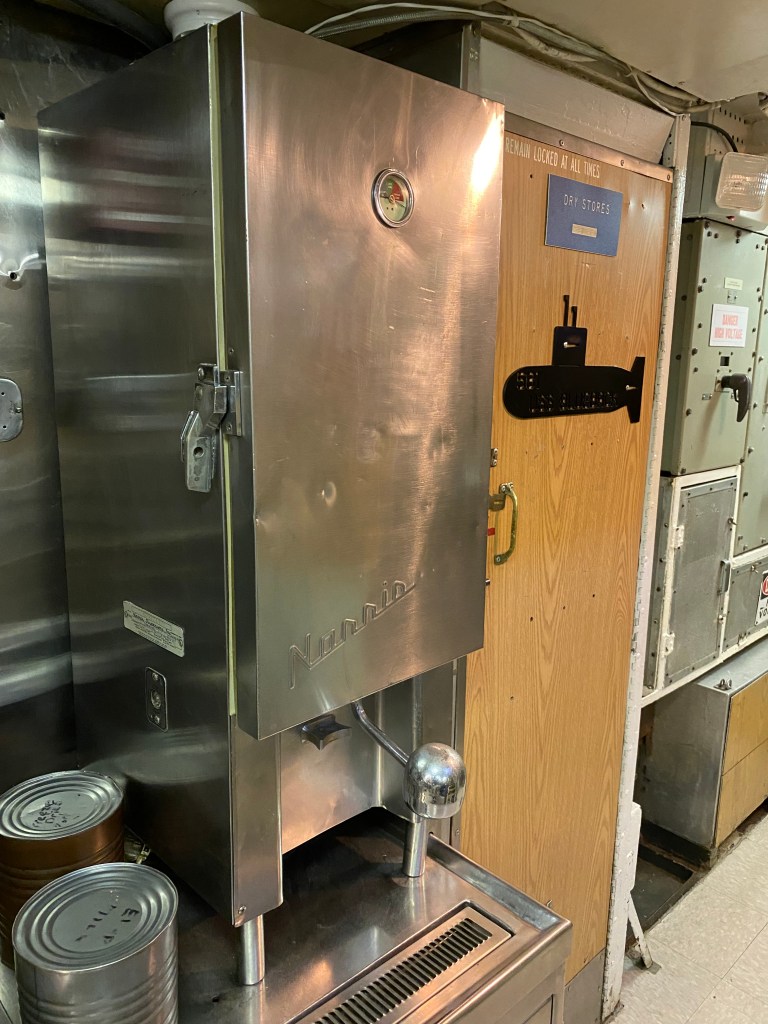
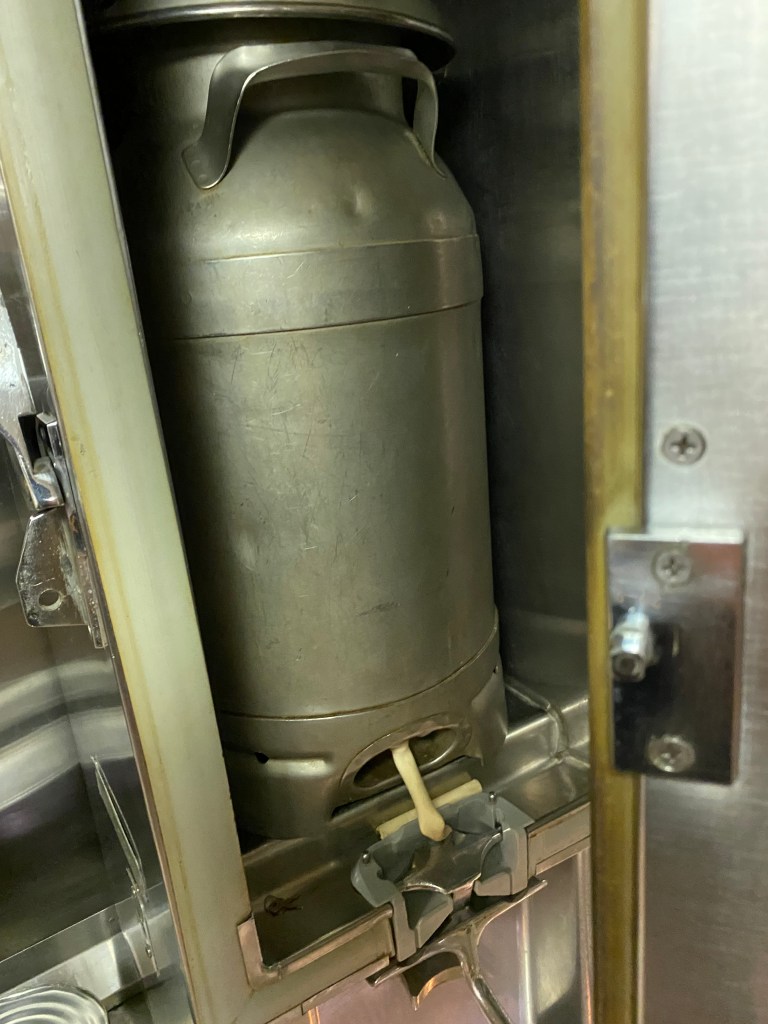

Anything fresh, like produce or milk, will be eaten up within the first several weeks at sea. After that, the ingredients will come frozen, dried, powdered, evaporated, or out of a No. 10 can. We will take aboard hundreds of these cans before we leave port, and there are all kinds of food in them, but there is only one place left on this submarine to store them. On the deck. We will line the entire floor of this boat, every room, from torpedo room to engine room, port to starboard, with a solid layer of cans. We then lay rubber mats over the top of them so they do not jostle around, and change the height of the rooms. You have now become 7” taller. If the boat is out on a long patrol of 2 or 3 months, then the cans would be double-stacked. Some areas would even have the cans triple or quadruple-stacked. Do you recall that the tallest sailor to serve on Blueback was 6’8″? That was without the aid of the cans! He had lots of fun! Do not worry, you will memorize where all the obstacles on the overhead are, and if you forget, the submarine will remind you when your head impacts it. So you will walk around hunched over until you literally eat your way down to the deck. But by the time that happens, you know that you are close to pulling into port. So it is like a calendar, as well. The supply officer and cooks carefully meal plan the entire patrol out, and they know what to bring aboard, how much of it, and where to store it so they can access it in the order that they will need it. Essentially, all of the food is loaded onto the submarine in reverse order, with the last day’s food loaded first. All this is to say nothing of the extensive record-keeping required of the supply officer and mess cooks, a lot of which necessitated headache-inducing paperwork and forms to fill out.
People have asked if the crew would ever fish off the deck of the boat when it is on the surface. Technically, they could, but a submarine, such as Blueback, with a teardrop-shaped hull, is not a good (much less stable) fishing platform, so it likely did not occur very often. Furthermore, I hope you have spare time and want to catch enough fish for 85 guys to eat. One early ballistic missile boat actually had the crew construct crab traps and lay them on the bottom of the Northern Pacific. When they retrieved them, the crew enjoyed fresh crab legs. On nuclear-powered submarines that stay under for the duration of their patrols, it pretty much never happens.88 There are some exceptions, of course. A former LA-boat sailor told me that if the sub is operating in friendly waters, such as during training, then they could have some recreational time up on deck when the sub surfaces. For example, he said that when they were training in the Caribbean, the boat surfaced and the crew had some free time to fish off the deck and have a swim call. They also played “King of the Dome” (i.e. king of the hill) where they used the sonar dome as the “hill.”

Now if you ask the officers (or the Navy), they will probably tell you that the most important machines on this submarine are the torpedoes, periscopes, sonars, fire control computers, or the engines. However, to the average enlisted man, the three most important machines on this submarine are in the crew’s mess. One keeps you awake, one keeps you healthy, and one keeps you happy.
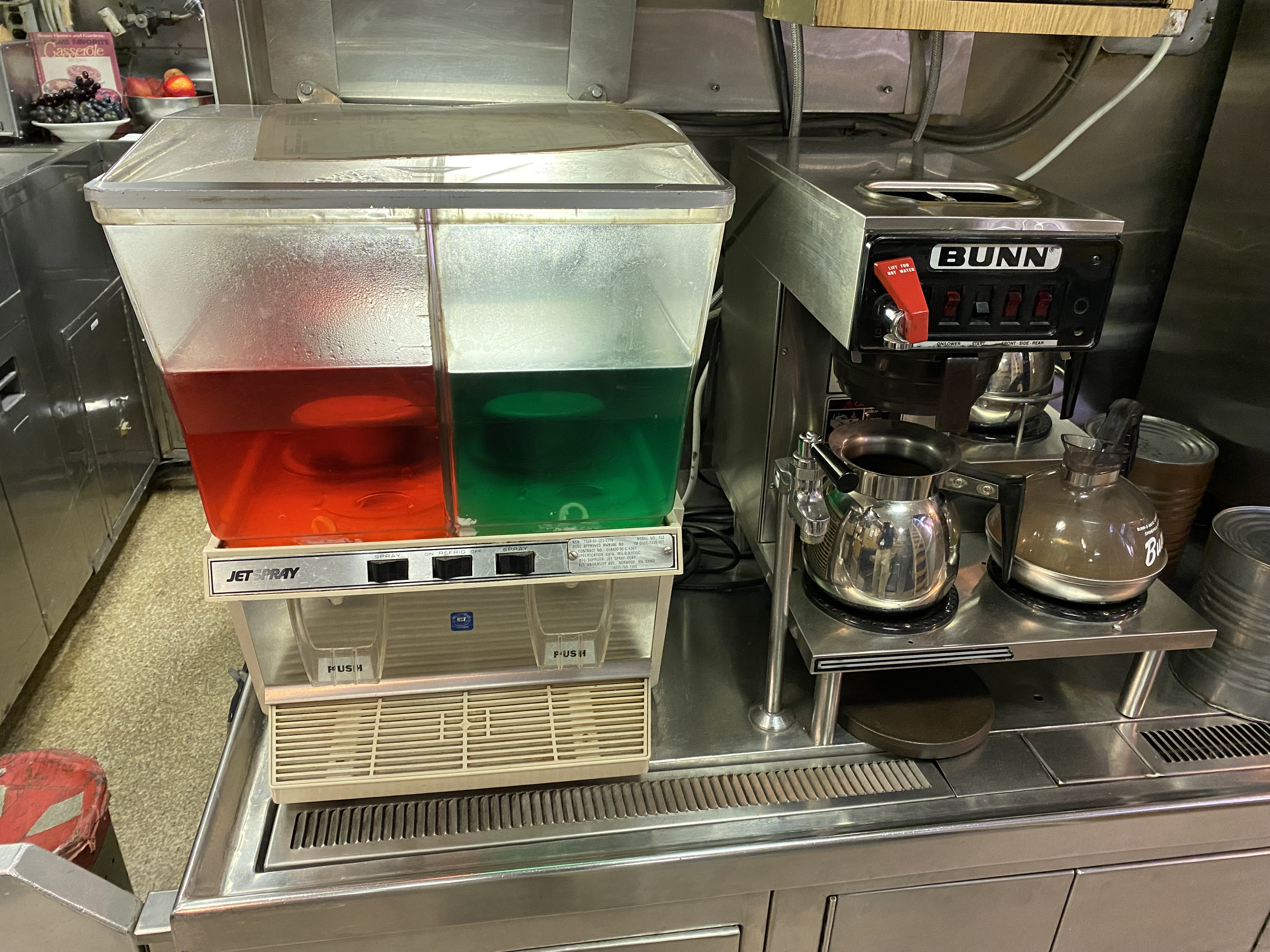
First is the coffee machine. 24 hours a day, the military runs on coffee. DO NOT leave home without it! The BUNN coffee maker currently displayed is not original to Blueback. According to the Ship Information Book, there would have been a big 4-gallon urn constantly brewing coffee. The second is the “bug juice” machine. No, it is not made from actual bugs. “Bug juice” is essentially Navy, industrial-strength Kool-Aid or Gatorade. It is really just a mixture of water, food coloring, vitamin C, vitamin D, many other minerals, and a whole lot of sugar. It comes in 5 colors (red, orange, yellow, green, and purple), but they have zero bearing on the flavor. It only tastes sweet. You still want to drink this every so often so you do not get a vitamin deficiency, such as scurvy and other diseases. The third, and arguably most important, machine on this submarine is the soft serve ice cream machine. U.S. Navy submarines have soft serve on them 24/7. You can have as much as you want, anytime you want, and no adults are guarding it. You can have any flavor of ice cream you want, but the sailors say they all strangely look and taste like vanilla, so use your imagination.89 If the soft serve machine or the coffee machine breaks down while at sea, then 10 guys on the boat just decided that they have become mechanics and they are going to try and fix them. If nobody can fix them, then there is going to be a mutiny on a submarine. In fact, the coffee and ice cream machines are considered to be such vital pieces of equipment that, according to the testimony of one of our tour guides, who is a retired submarine captain, a submarine will not leave port if these machines are out of order.90
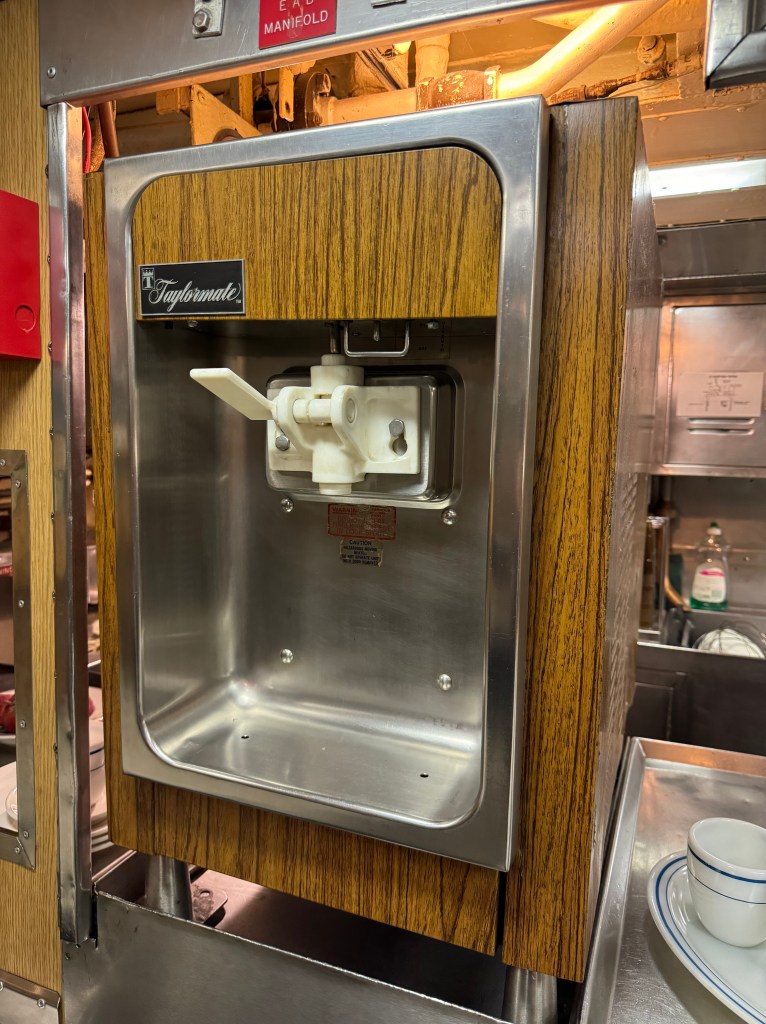
Anyway, the TLDR is that good food is essential on a submarine for keeping morale up. You do not want an unhappy submarine crew.
Entertainment
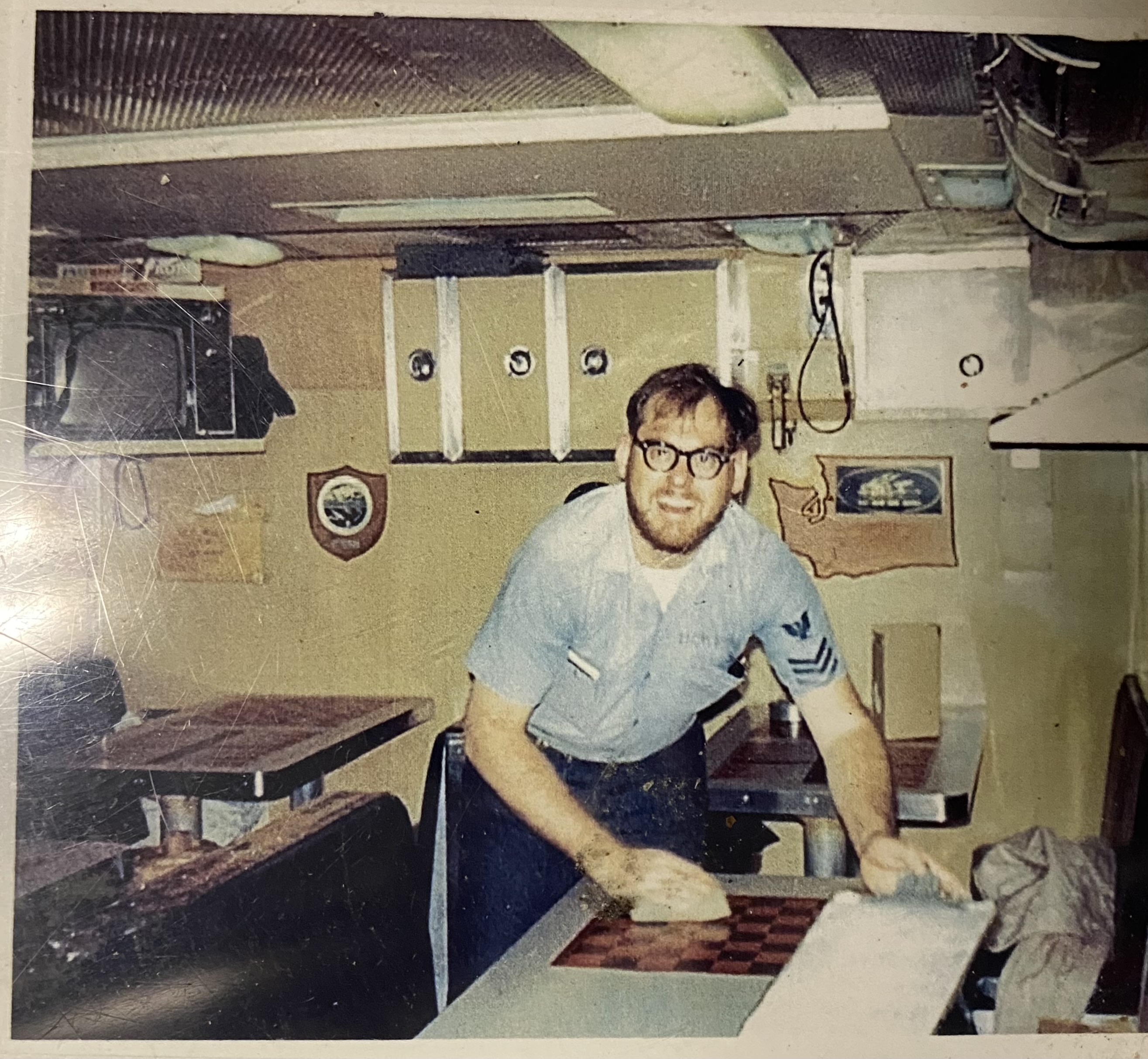
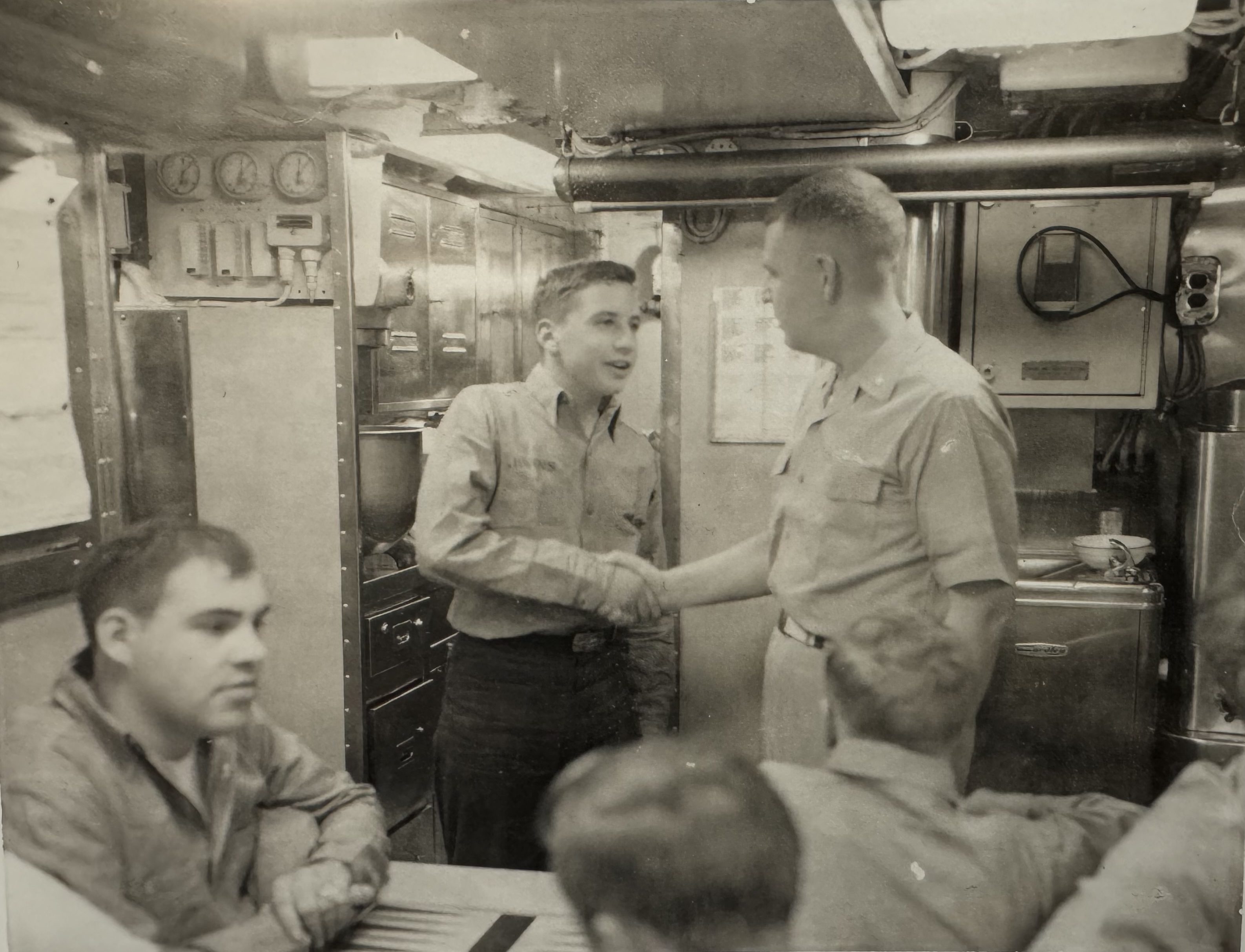
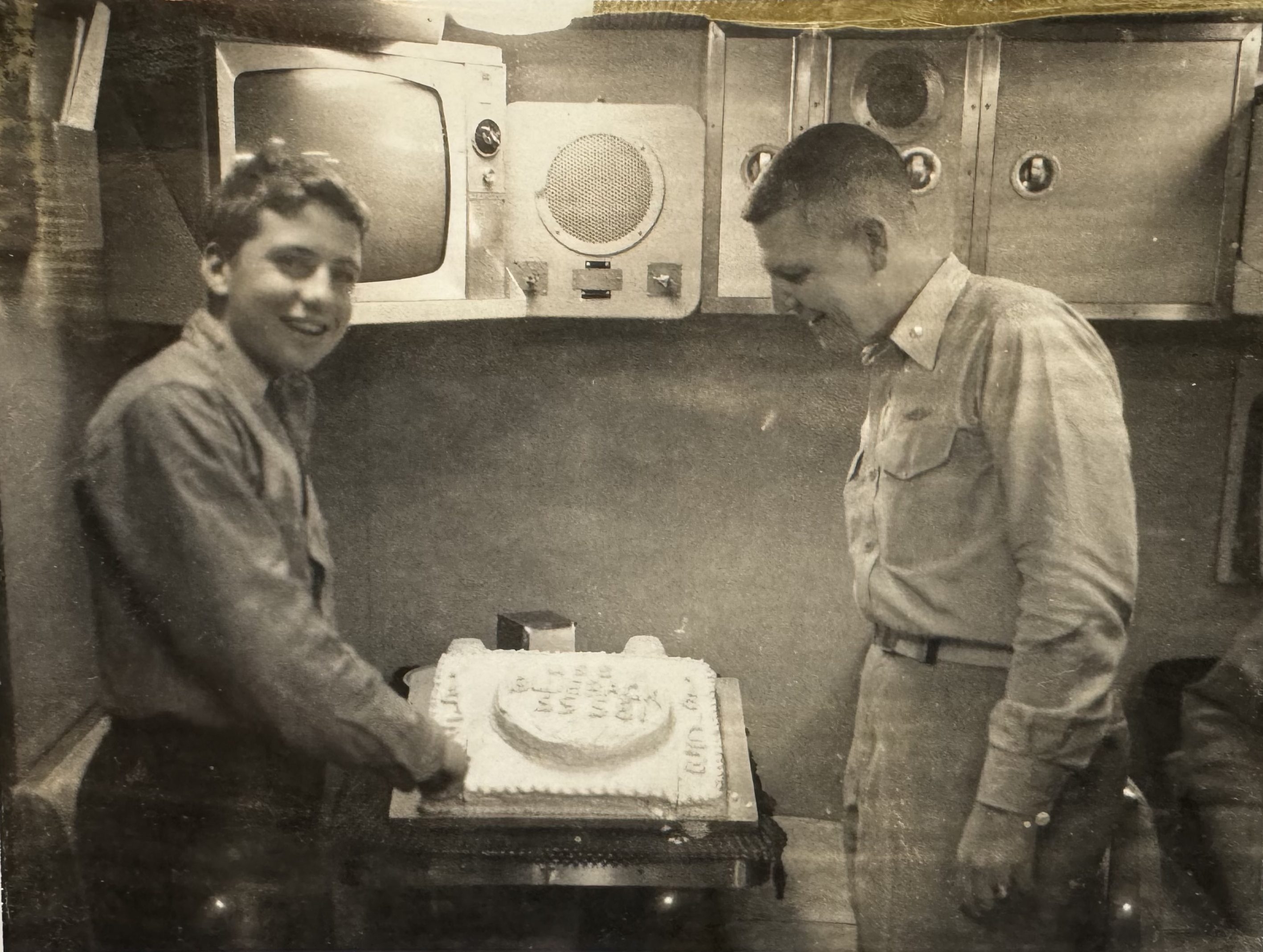
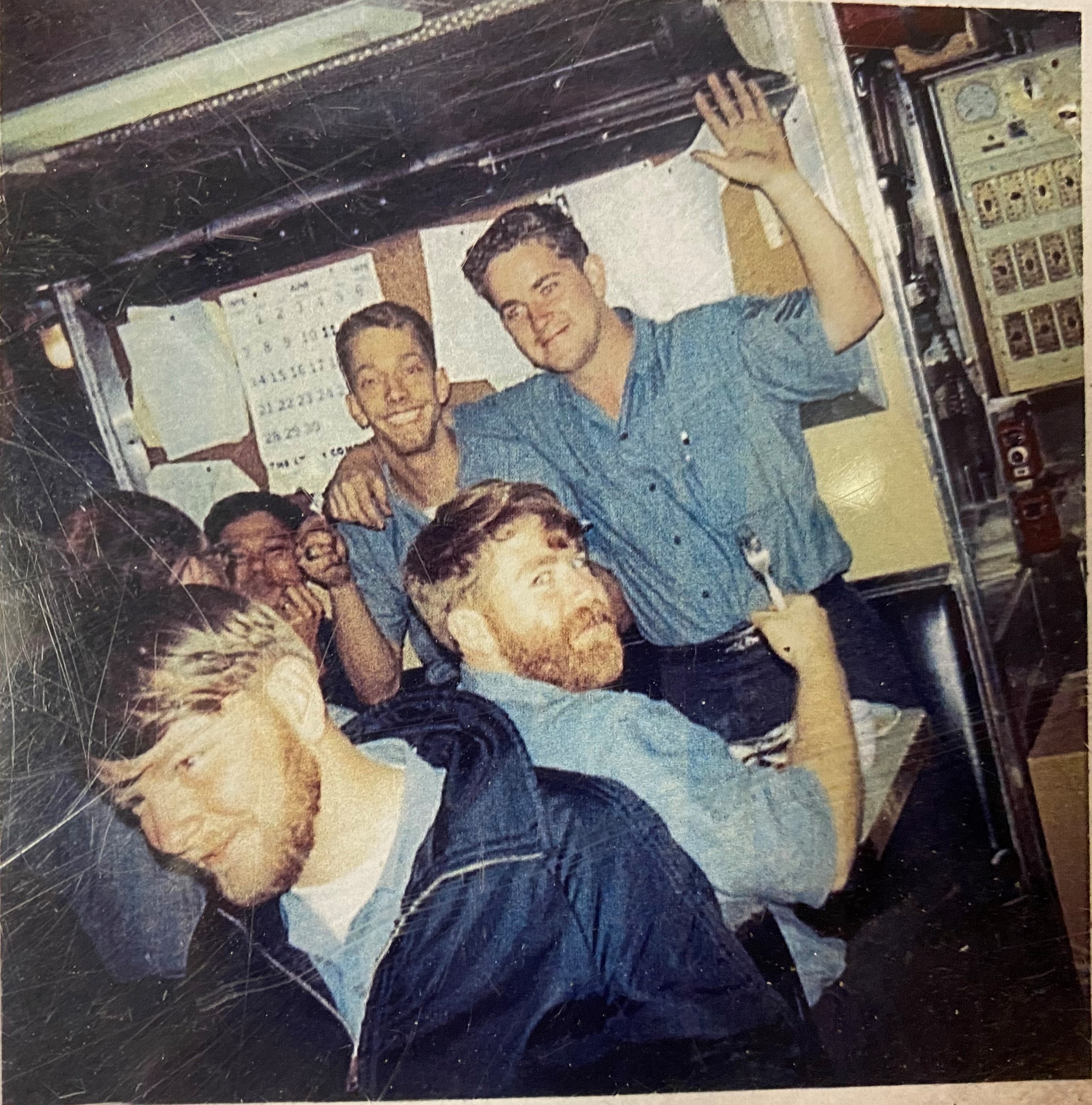
Aside from being a dining area, the mess is also the enlisted crew’s living room, so to speak. As one of the more open areas of the sub, meetings, training, studying, leisure time, and even religious services would be conducted in this room. The tabletops originally had chess and backgammon boards on them, but those were removed before handing the vessel over to the museum (for whatever reason). Hence, they now have pictures of Blueback sailors and diagrams on them. The crew would have running poker tournaments, games of cribbage, acey-deucey, checkers, and so on.
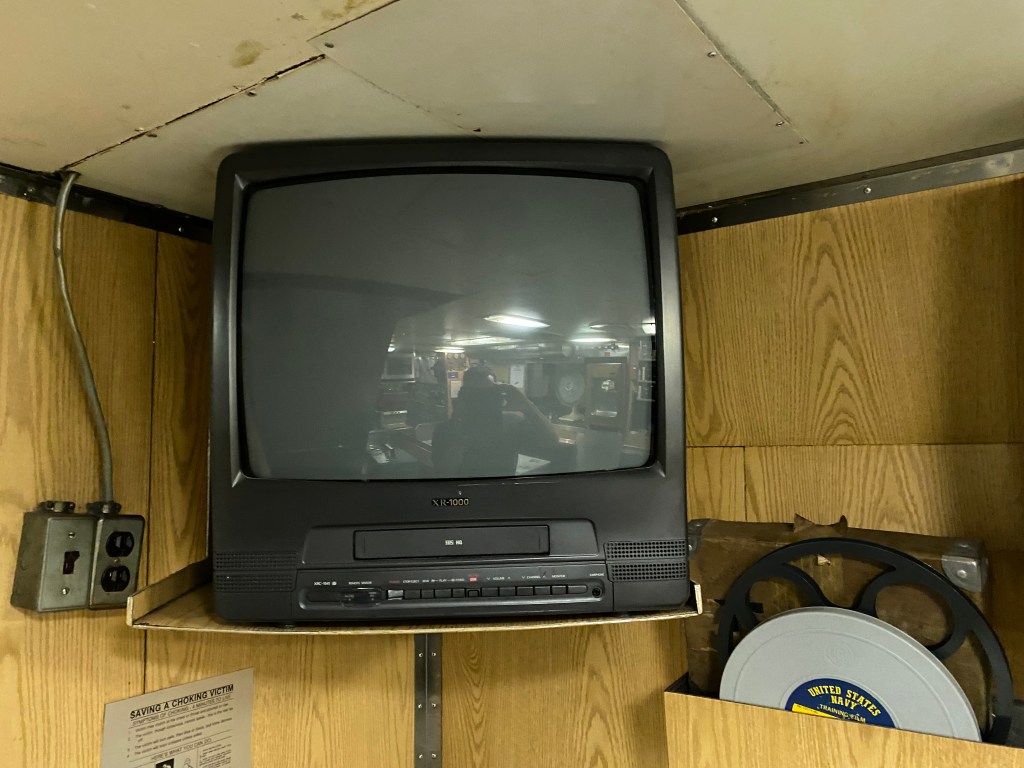
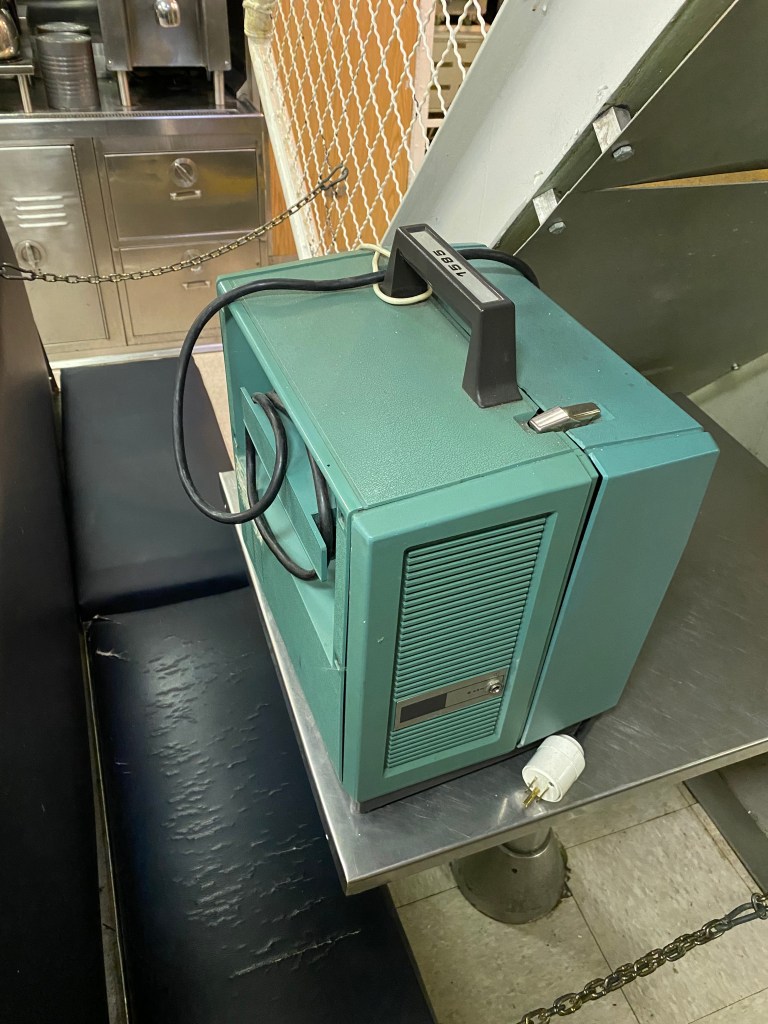

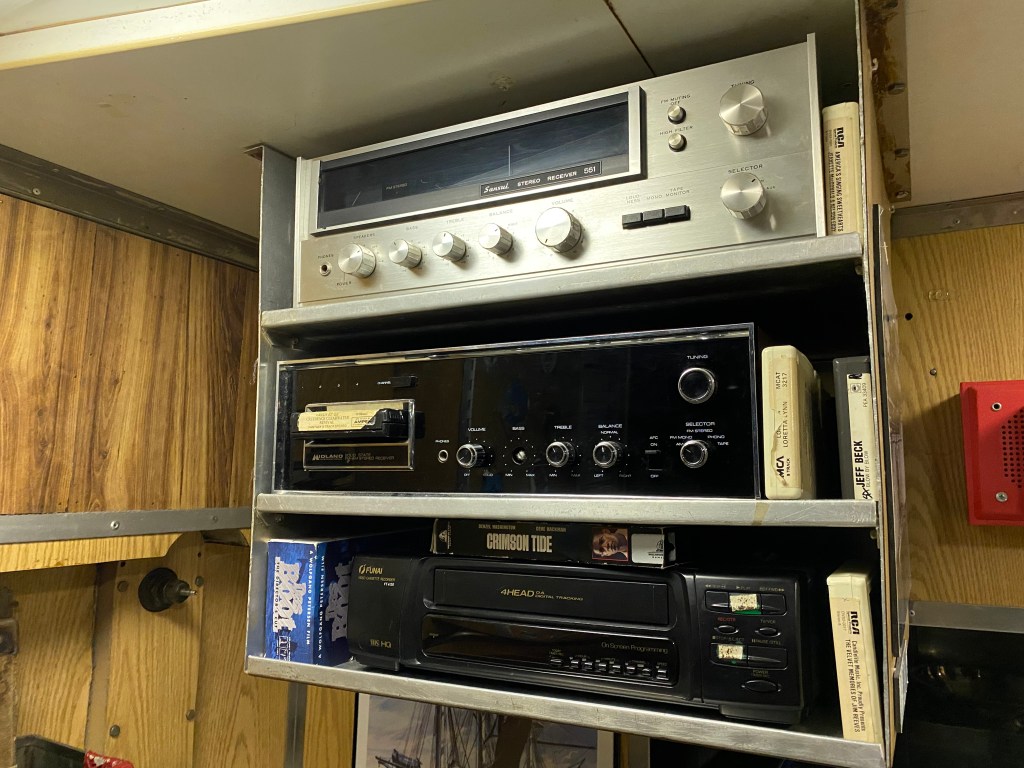
A few other things I will mention in the crew’s mess are relatively newer additions. The TV with a VCR and the microwave did not exist when this sub was first commissioned, and were not added until the 1980s. The original entertainment was the green box, which is a 16mm reel-to-reel film projector. Some of the reels are on the back bulkhead, and you can see the olive drab boxes they come in. The Navy has a deal with Hollywood to get new films on ships, often before they appear in theaters ashore. A movie screen (or, lacking that, a bedsheet) would be hung between the two hooks on the ceiling in front of the tables, and popcorn would be served. A good movie might get upwards of 30 – 40 men in this space, but that would not happen often. Furthermore, given the size of the film reels, you would only have space for about 10 films, so you get to watch the same 10 movies over…and over…and over. It would get to the point where you could turn the sound off and let the sailors say the lines themselves, assign a different character to each sailor, run the movie forward and backward, or just have the sailors make up their own dialogue (none of which will be repeated here). After 90 days at sea, you get pretty creative with your entertainment.
The introduction of VHS tapes allowed more films to be brought on board, and nowadays, DVDs and Blu-rays are common. Someone might also bring an external hard drive with movies on it to watch, as well.
Engineering
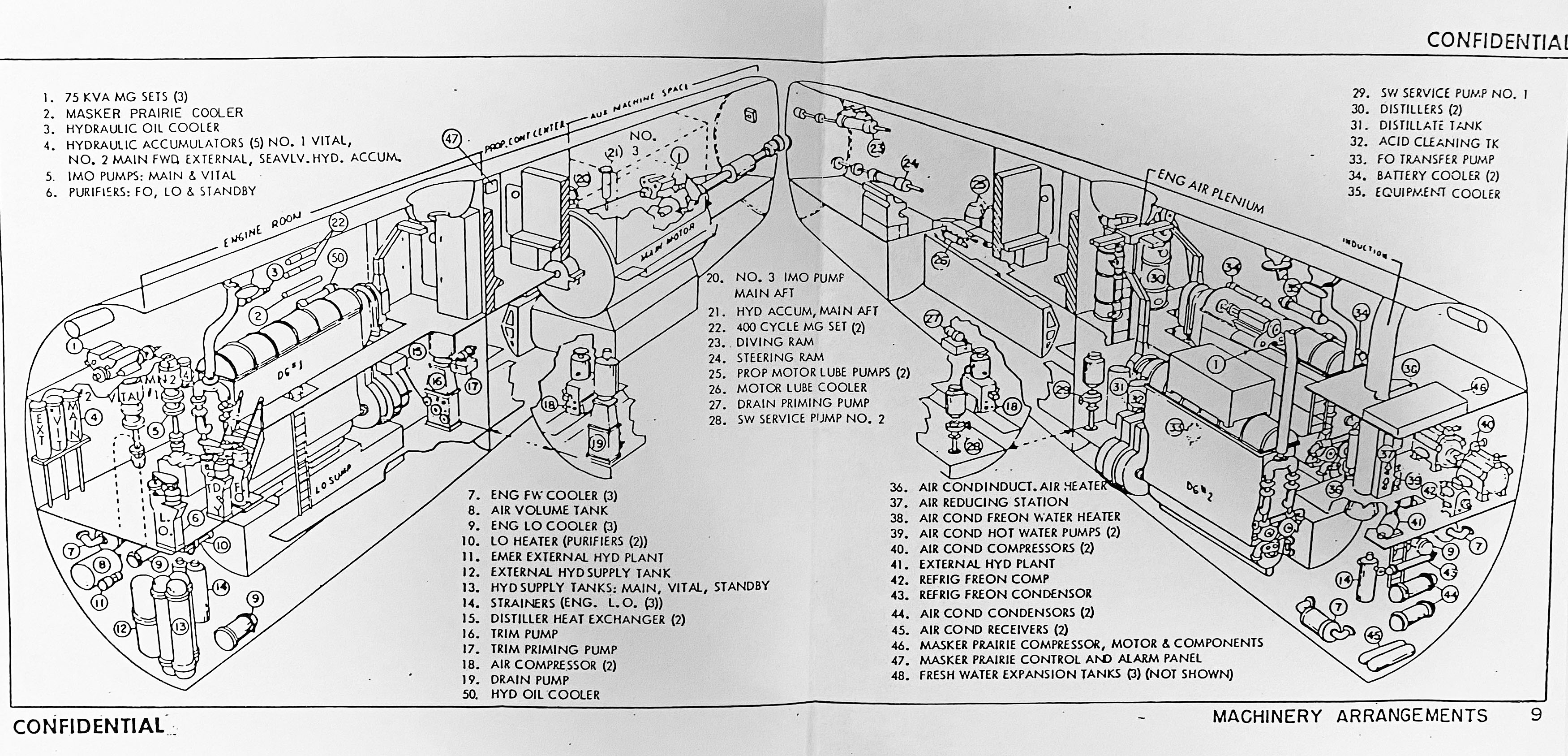
Before passing through the watertight door into the engine room, you pass through another airlock. When the engines are running, it sucks in air through the air induction valve at the top of the snorkel. This creates a change in air pressure. The button on the airlock door breaks the seal and equalizes the air pressure, allowing the door to be opened.
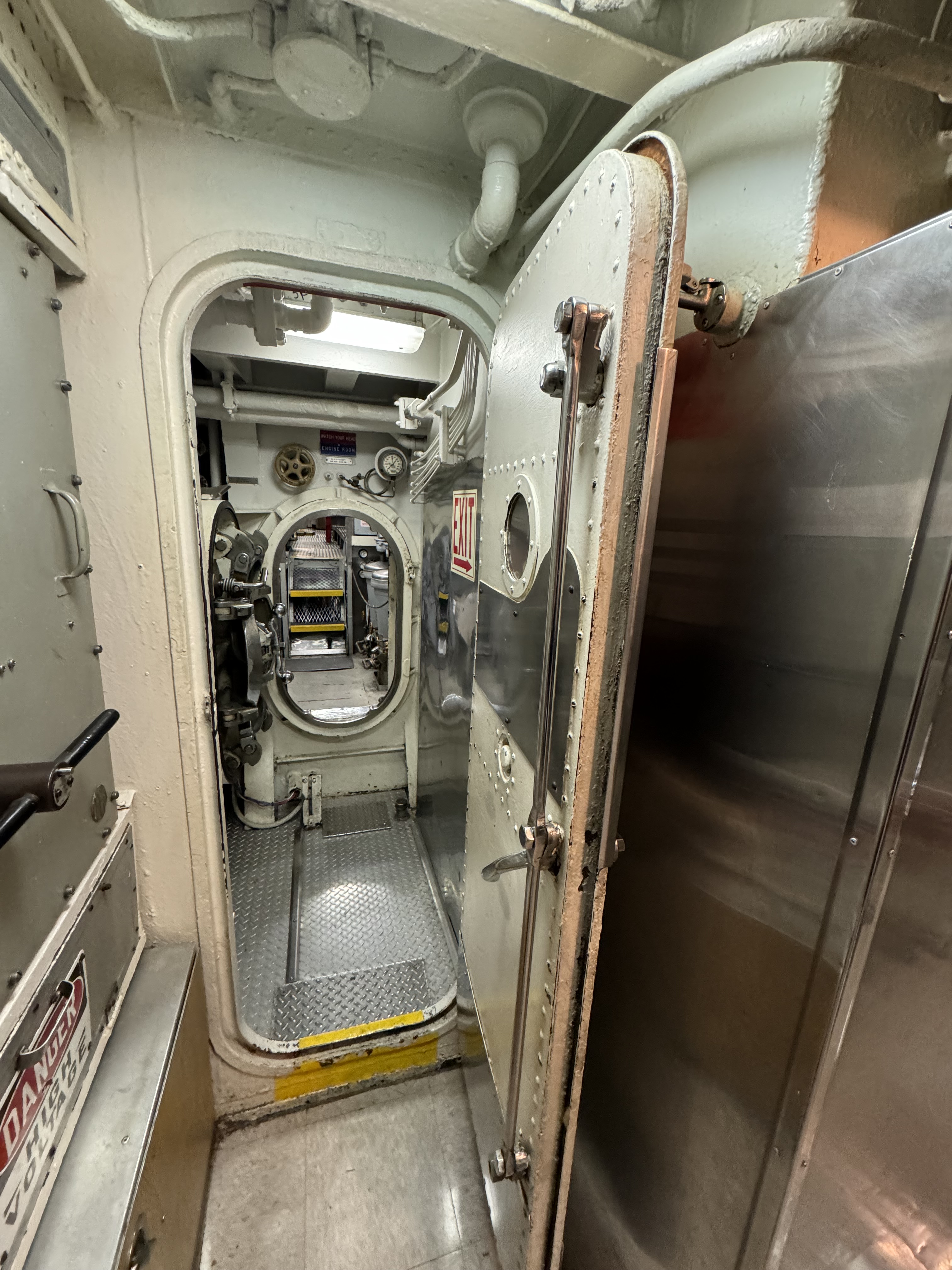
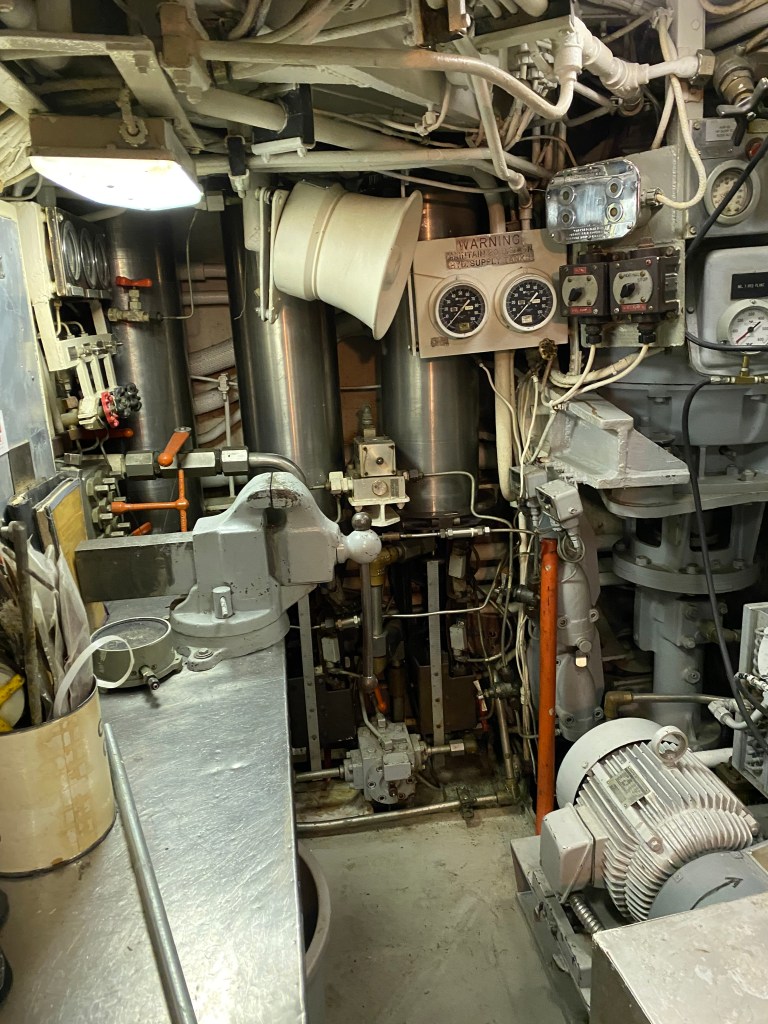
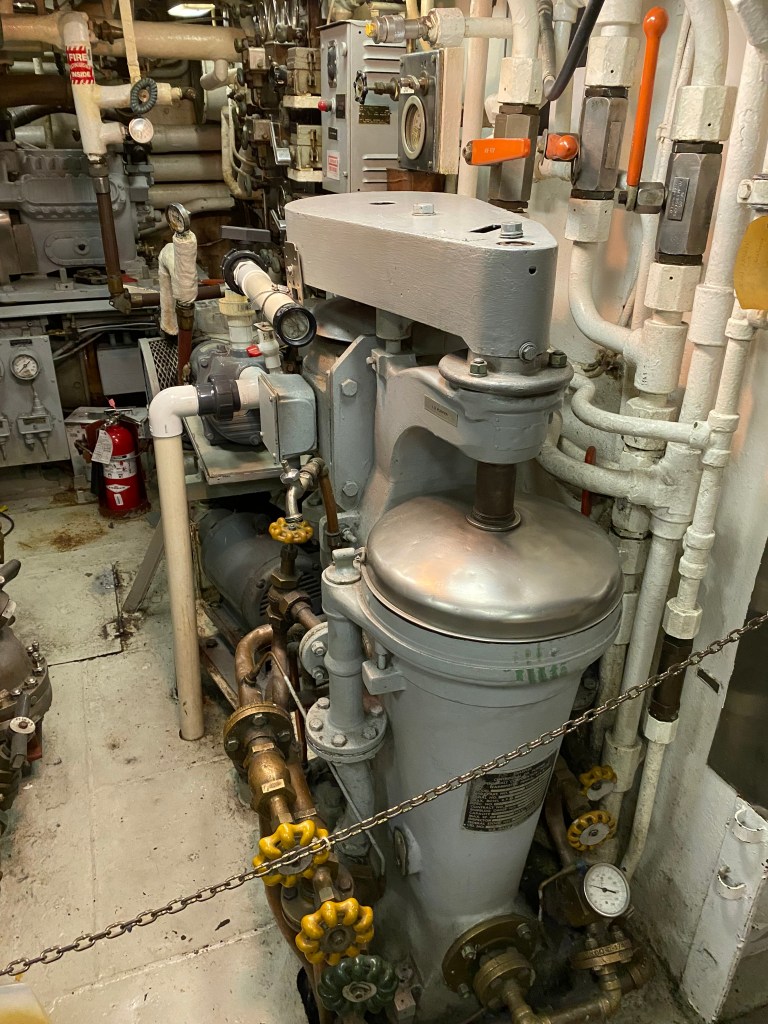
Directly on the other side of the watertight door aft of the crew’s mess are the machine shop and oil purifiers. There is not much to say about the machine shop. It is very small and has a limited number of tools to do basic repairs. Spare parts would be stored in lockers around the boat. Reportedly, there used to be a lathe in the machine shop, as well, but if any significant piece of equipment breaks on the sub, then they will need to pull back into port to repair or replace it. Outboard of the machine shop are the hydraulic accumulators (the big vertical steel tubes) for the main hydraulic system.
On the port side of the boat, across from the machine shop, are three purifiers for the submarine. These are strainers and centrifuges. One is for fuel oil, one is for engine lube oil, and one is on standby that can be used for either. The fuel oil centrifuge cleans the diesel fuel, which is stored in Normal Fuel Oil (NFO) tanks. Once clean, the fuel is pumped into Clean Fuel Oil (CFO) tanks and injected into the engines. Some fuel can also be stored in certain ballast tanks. Since the fuel is less dense than seawater, it will float on top when water is taken on board for ballast. Outboard the oil purifiers are two air compressors for the boat’s air conditioning system and one for the refrigeration system.
Engine Room
The engine room contains the three Fairbanks Morse 38D8 – 1/8 engines. These particular ones are 8-cylinder, 16 opposed-piston, two-stroke diesel engines that generate about 1,500 hp each. The three engines are actually separated on two levels. Engines No. 1 and No. 3 are on the upper level, and Engine No. 2 is on the lower level, which is accessible by hatches and vertical ladders in the deck plating. The engines are turned over with about 250 lbs. of air to start them.

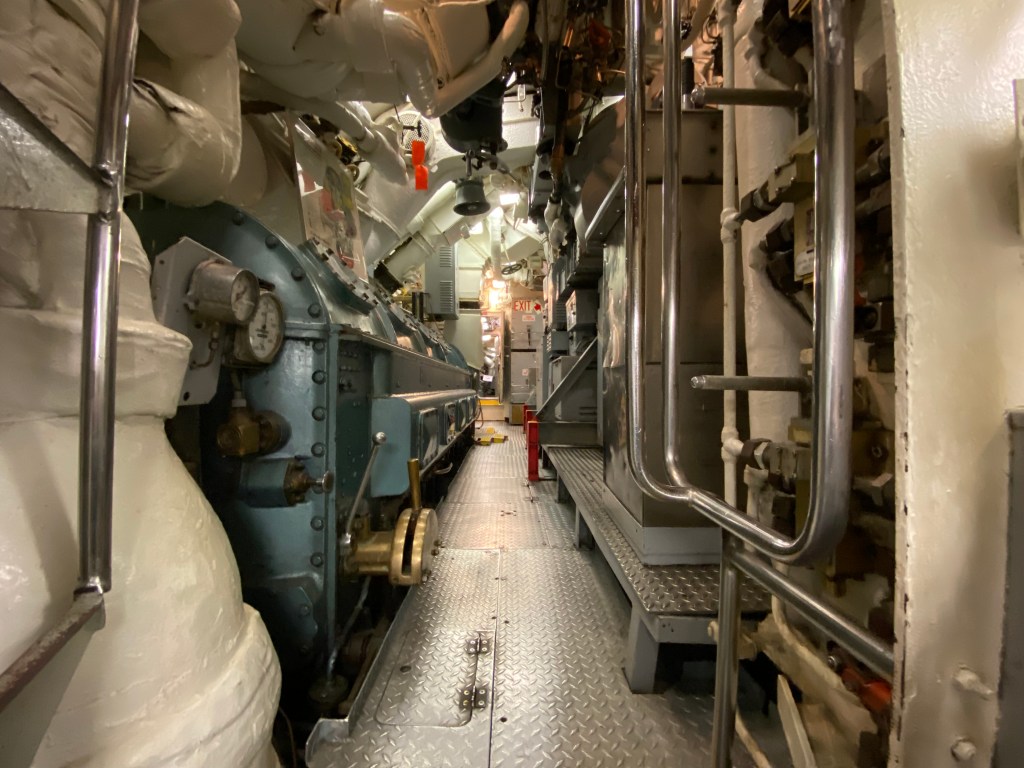
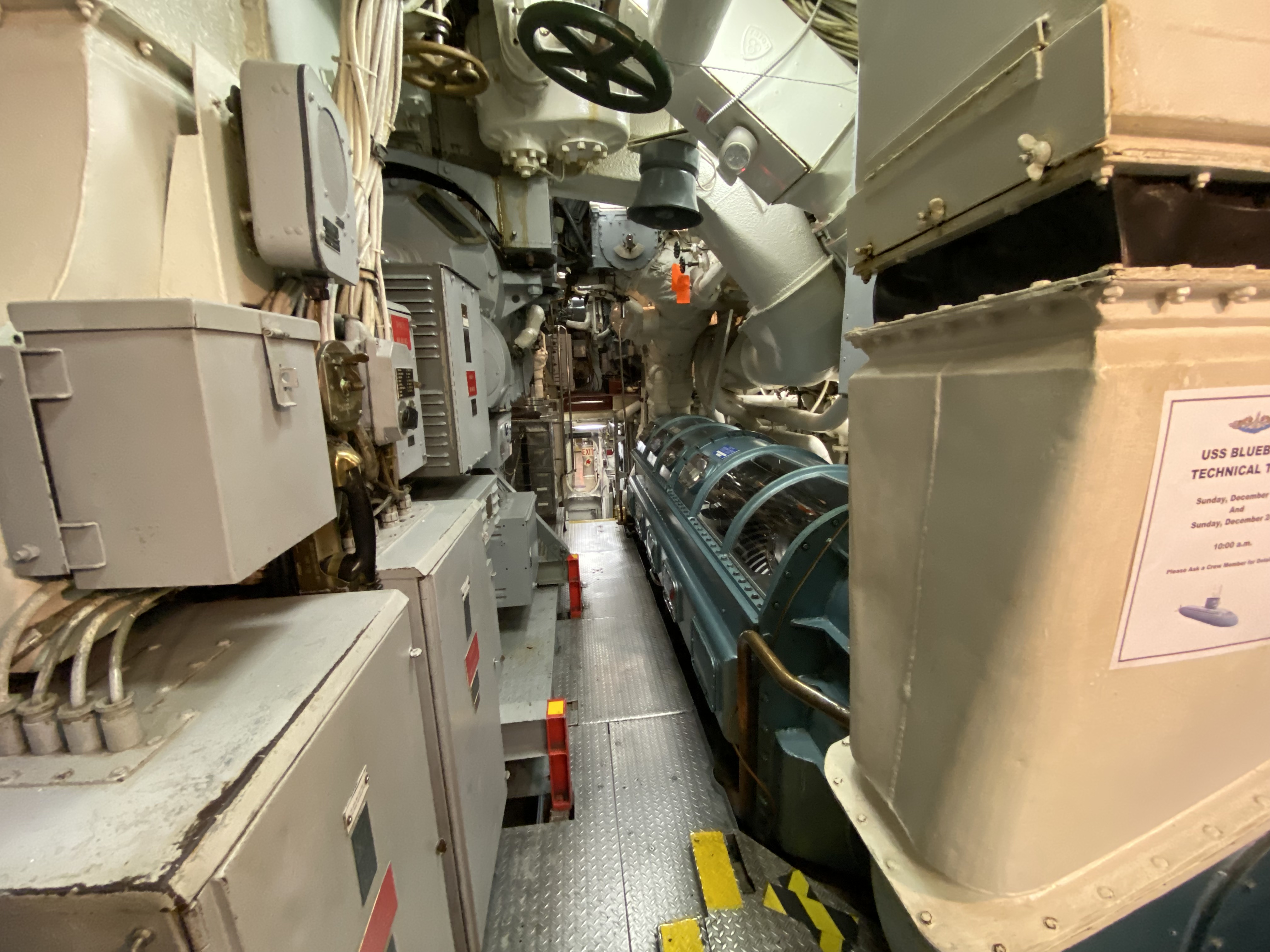
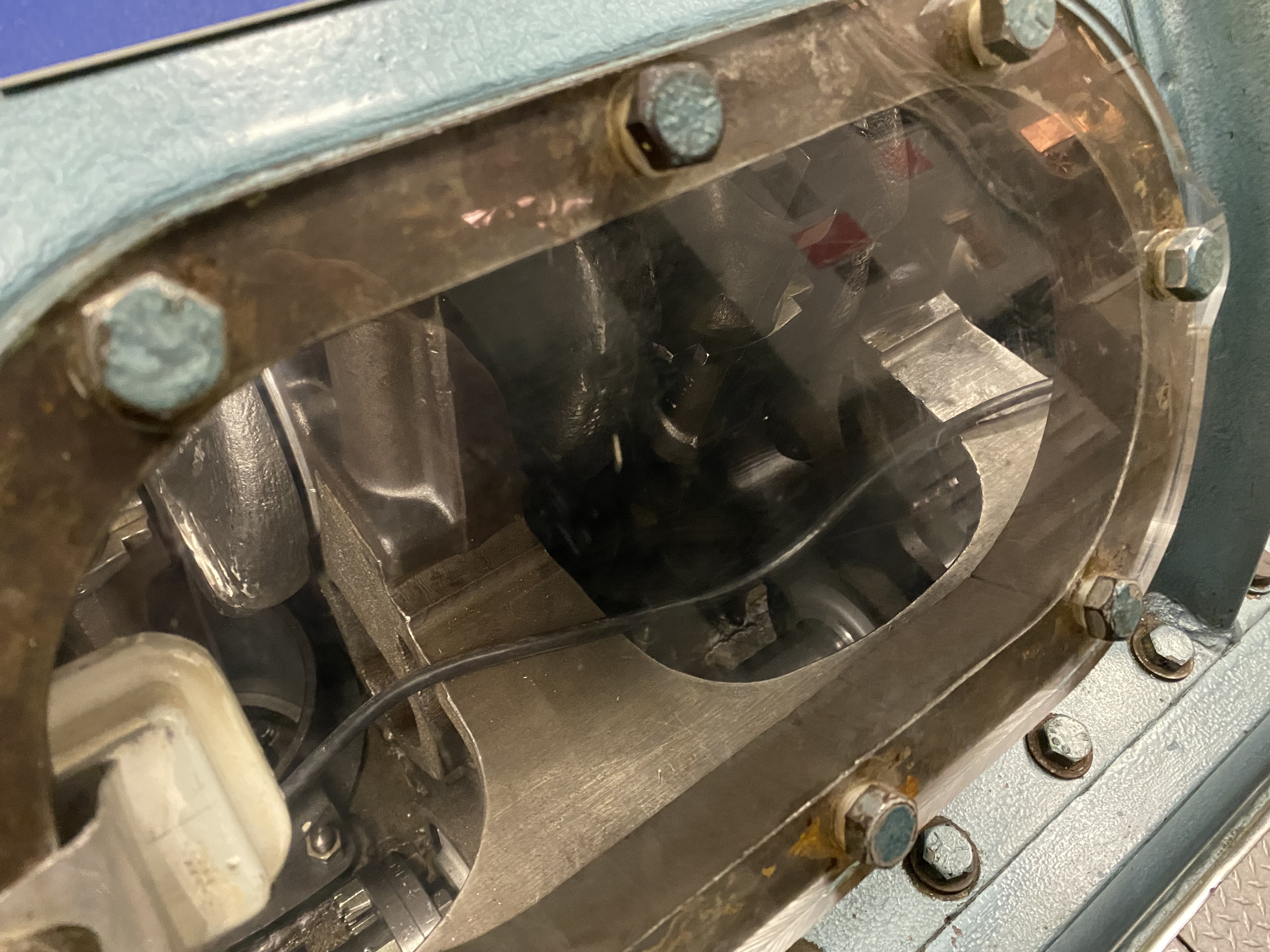
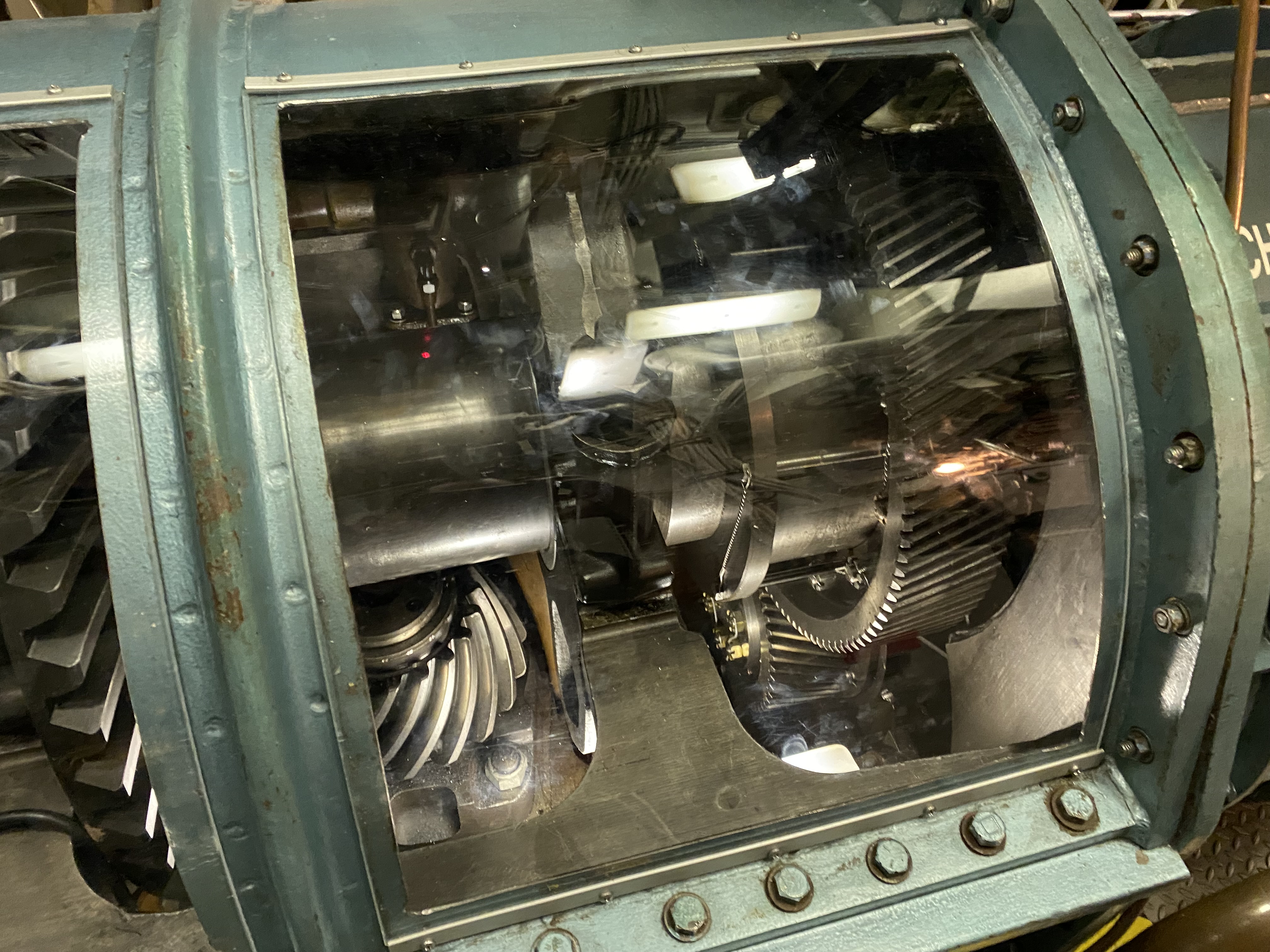
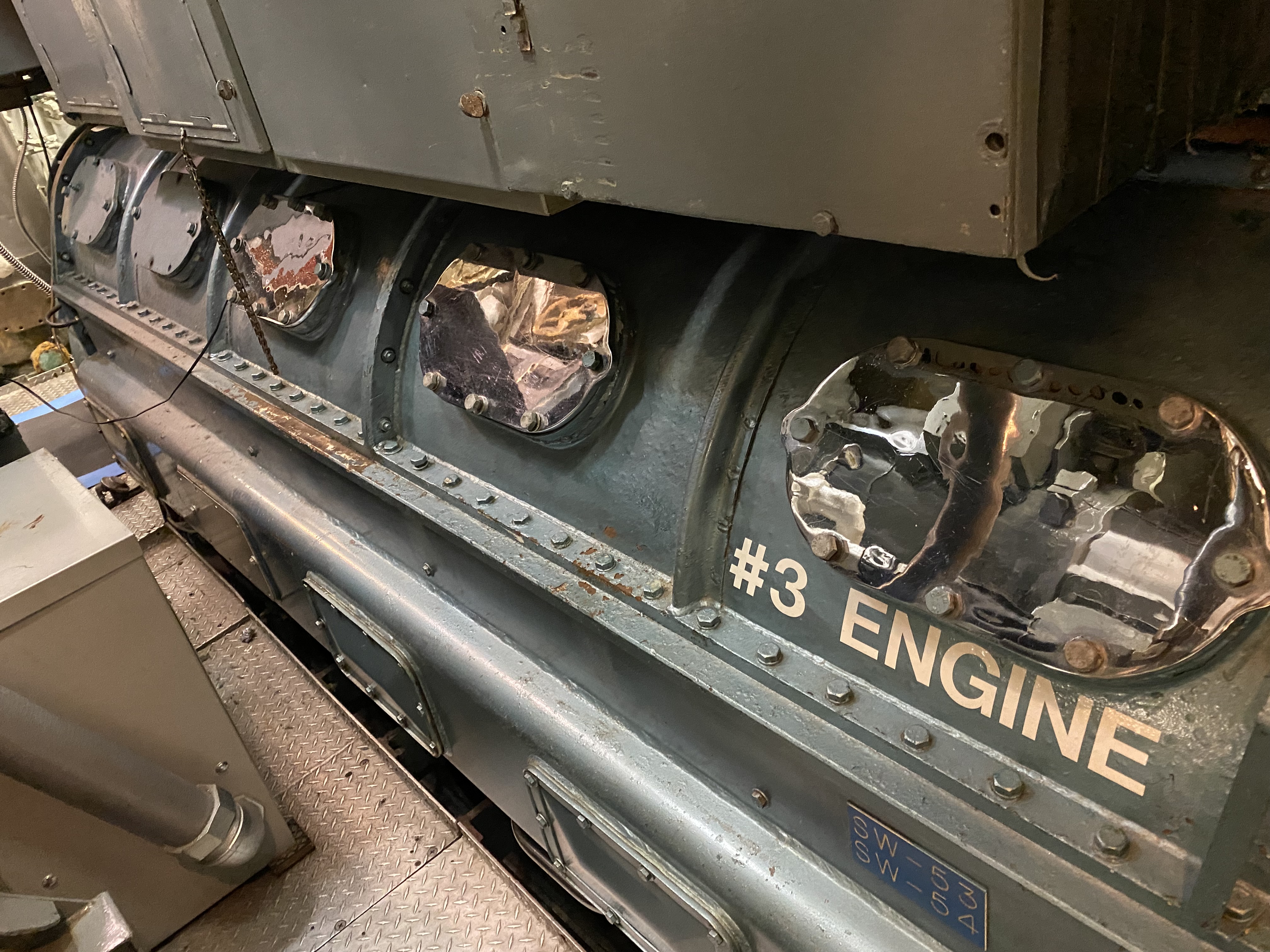
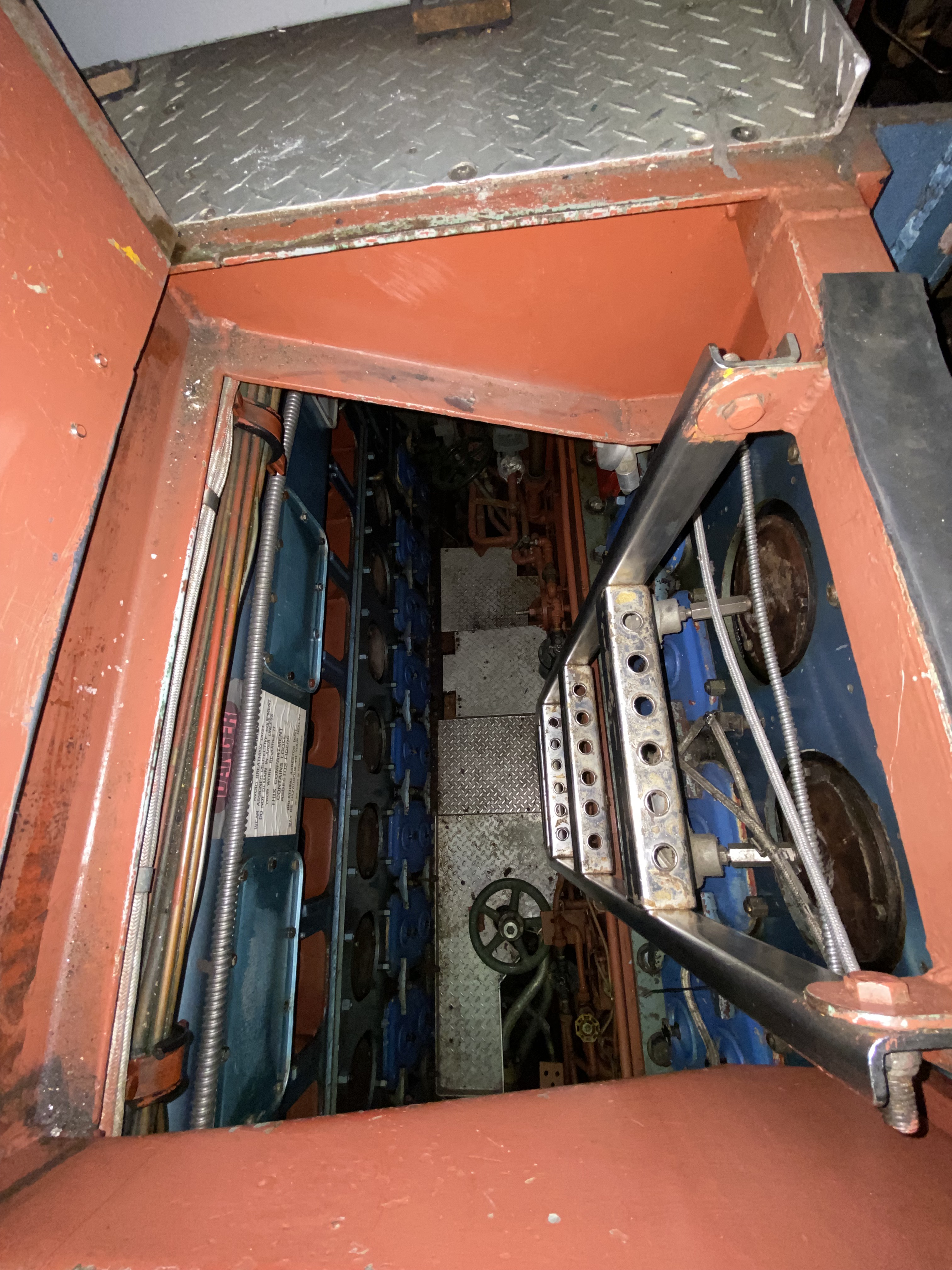
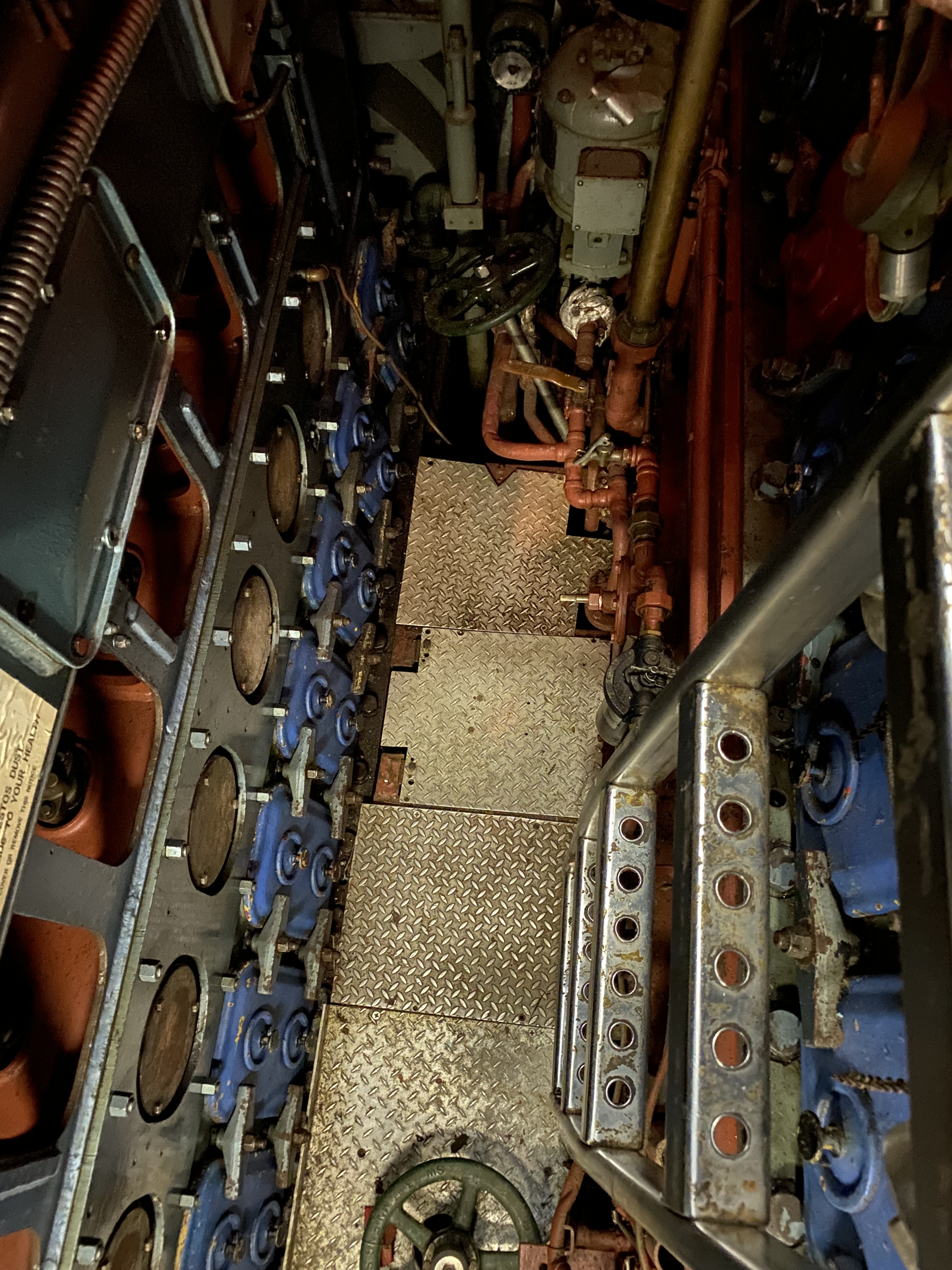
Directly above the No. 2 engine is one of three 75 KVA generator sets to produce 60-cycle power. Another is above on the engine room mezzanine, along with two 25 KVA generator sets and the air compressor for the Prairie Masker system. The third 75 KVA generator is back in shaft alley.
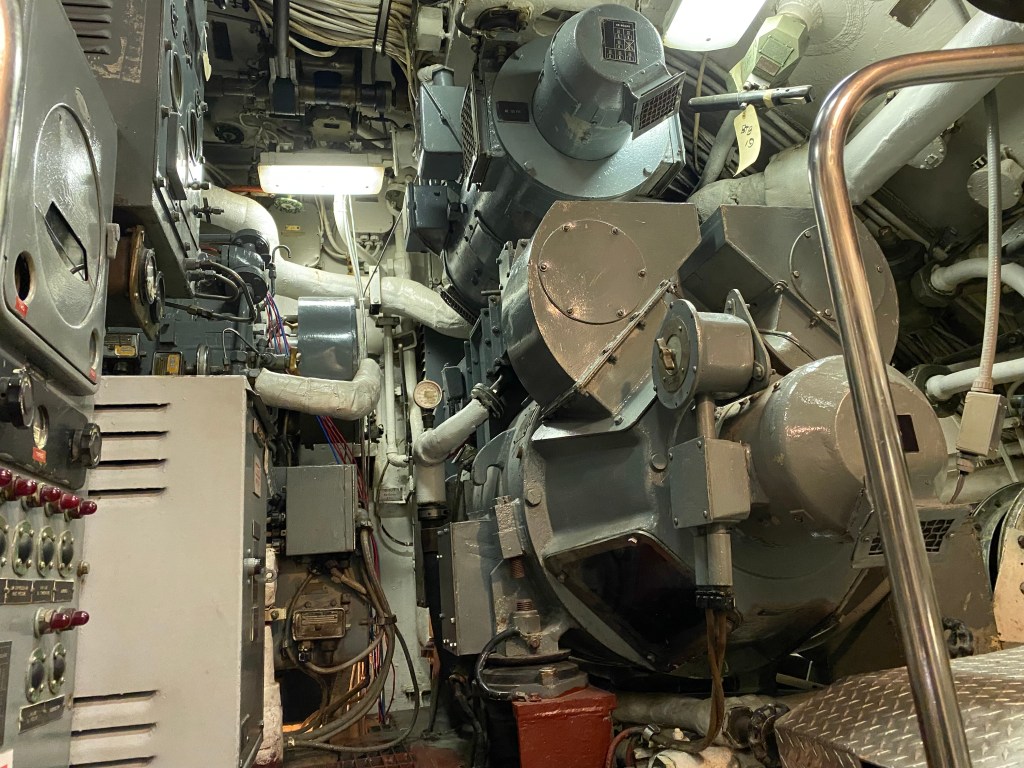
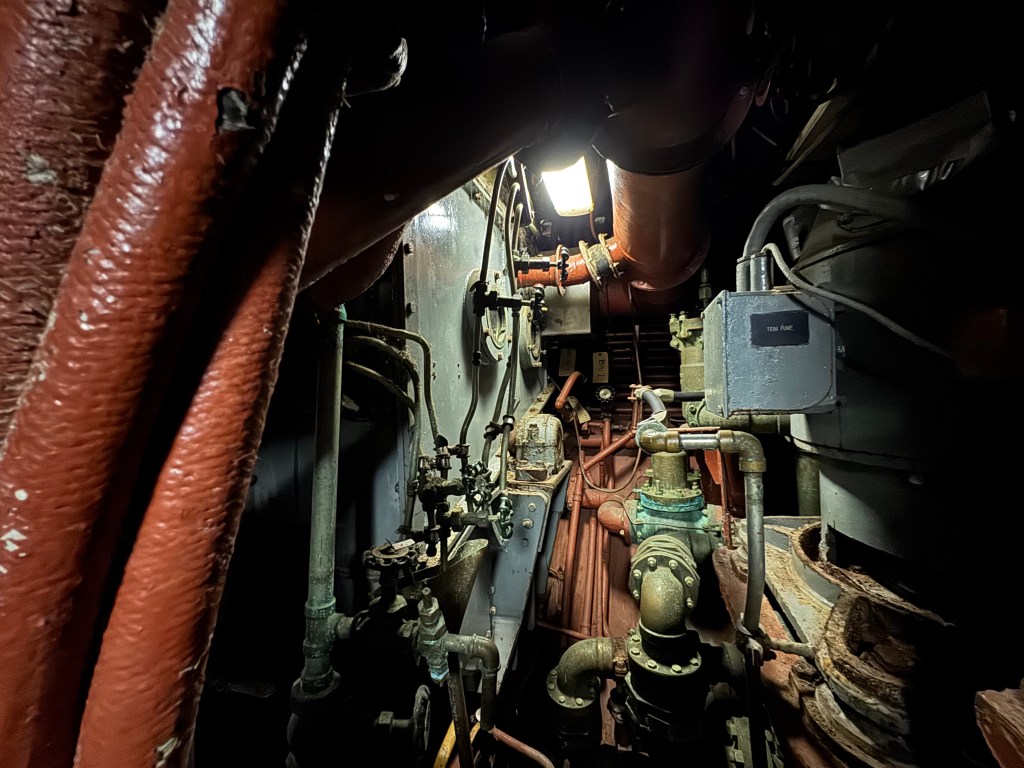
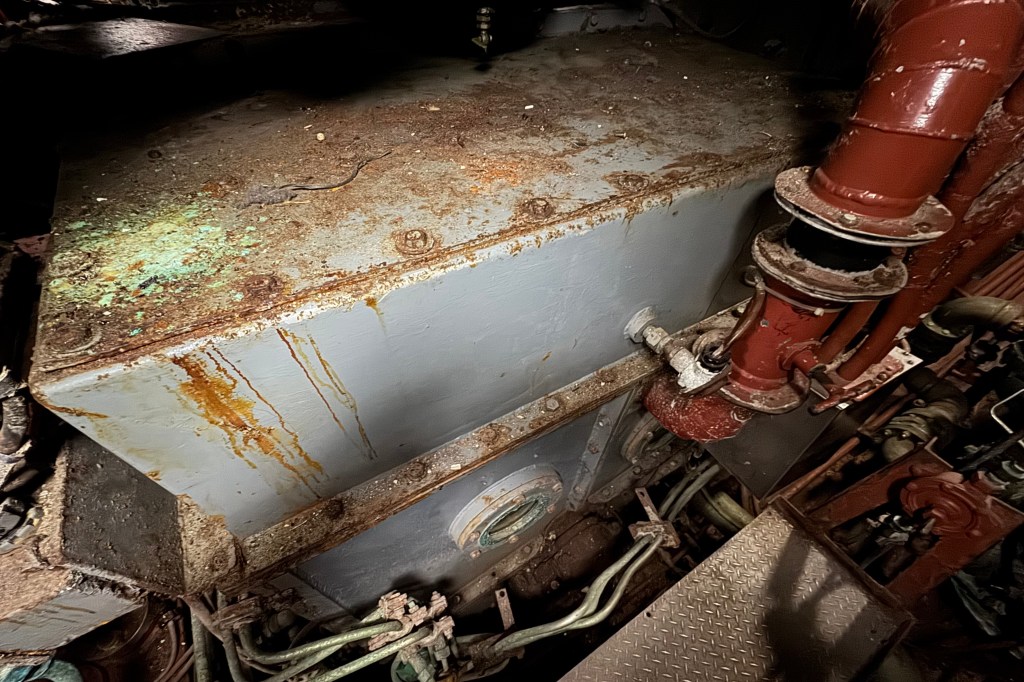
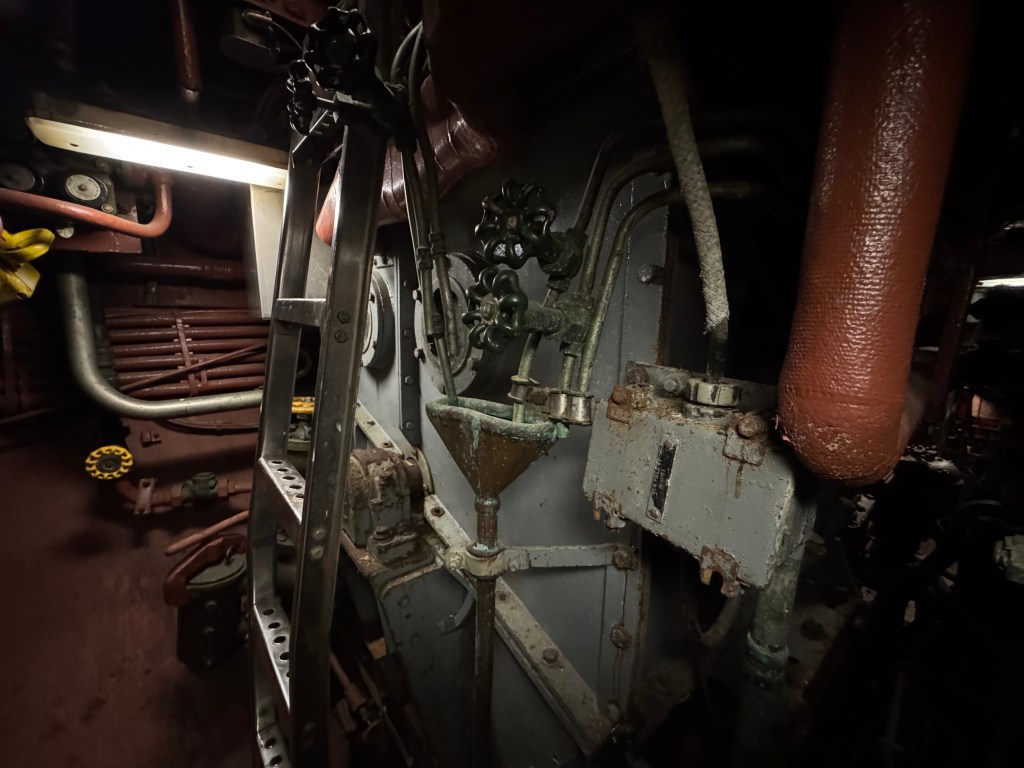
Snorkeling
Rick Neault (and other former crewmen) told me that, during normal operations, the submarine would ascend to snorkel depth every 2 – 3 days to recharge her batteries. If the batteries were fully drained, then it would take about 8 to 12 hours to charge them. Neault also related a story of how the submarine was operating off an “unnamed harbor” and gathering photographic intelligence with her periscopes. They would sneak in during the day and operate on battery power, then egress for the open ocean to charge batteries at night for about 8 hours. The following day, they would go back in submerged on battery power and take more photos. All three diesel engines could be run when snorkeling, but one of them would be shut down when the batteries were nearly charged just to conserve fuel.
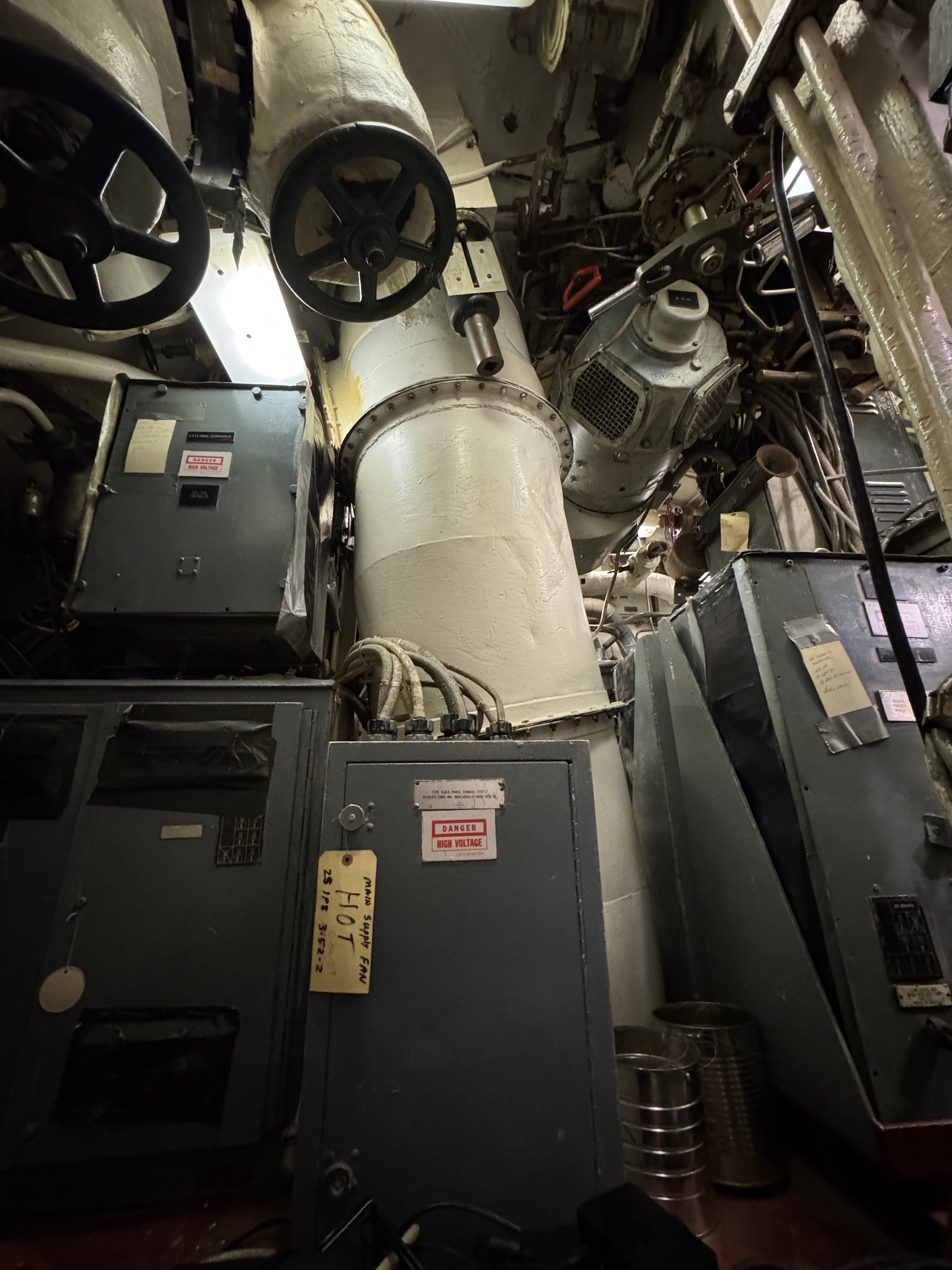
Snorkeling would only be done at night, when it would be harder to see the snorkel mast protruding from the water. Still, the quartermaster, handling navigation in the control room, would also need to know the time zone the submarine is in and the time of local sunset and sunrise. Woe betide the quartermaster who gets it wrong and has the submarine snorkel during daylight, thereby giving away its position.
There are several safety circuits present to protect the ship and crew when surfaced or snorkeling and running the diesel engines. These protect against the danger of hull vacuum and hull flooding via the snorkel air induction or exhaust. A hull vacuum can occur in the event that an outside air source is interrupted and the engines begin drawing air from inside the boat. Hull flooding through the snorkel induction or exhaust can occur since the air induction rides just above the surface of the water, and the exhaust is several feet beneath the surface.
If surfaced or snorkeling and the air pressure inside the boat drops to 12 psi, then the vacuum-cutout circuit trips, which stops the engines, unloads the generators, and shuts the main snorkel exhaust valve. A high scavenging air discharge pressure circuit is tripped when the scavenging air pressure reaches 12 psi. This stops the engines, unloads the generators, and shuts the main snorkel exhaust valve. Finally, when snorkeling, should engine RPMs fall below 420 – 450 RPMs (at which point the engine exhaust cannot keep the snorkel exhaust mast clear), then the low RPM cutout trips, which shut the snorkel exhaust valve. This, in turn, creates back pressure to trip another cutout to stop the engines and unload the generators.
Visitors to Blueback will note that the engine room is rather noisy. That sound is actually a recording. I have heard lawnmowers that are louder. In real life, if those engines were running, then they would purr at 137 dB, and the room would reach 120 – 130 degrees F. If you were to enter the engine room without hearing protection, you would have permanent hearing damage in 30 minutes. So you would have to wear double the hearing protection. That means rubber earplugs and “Mickey Mouse” earmuffs.
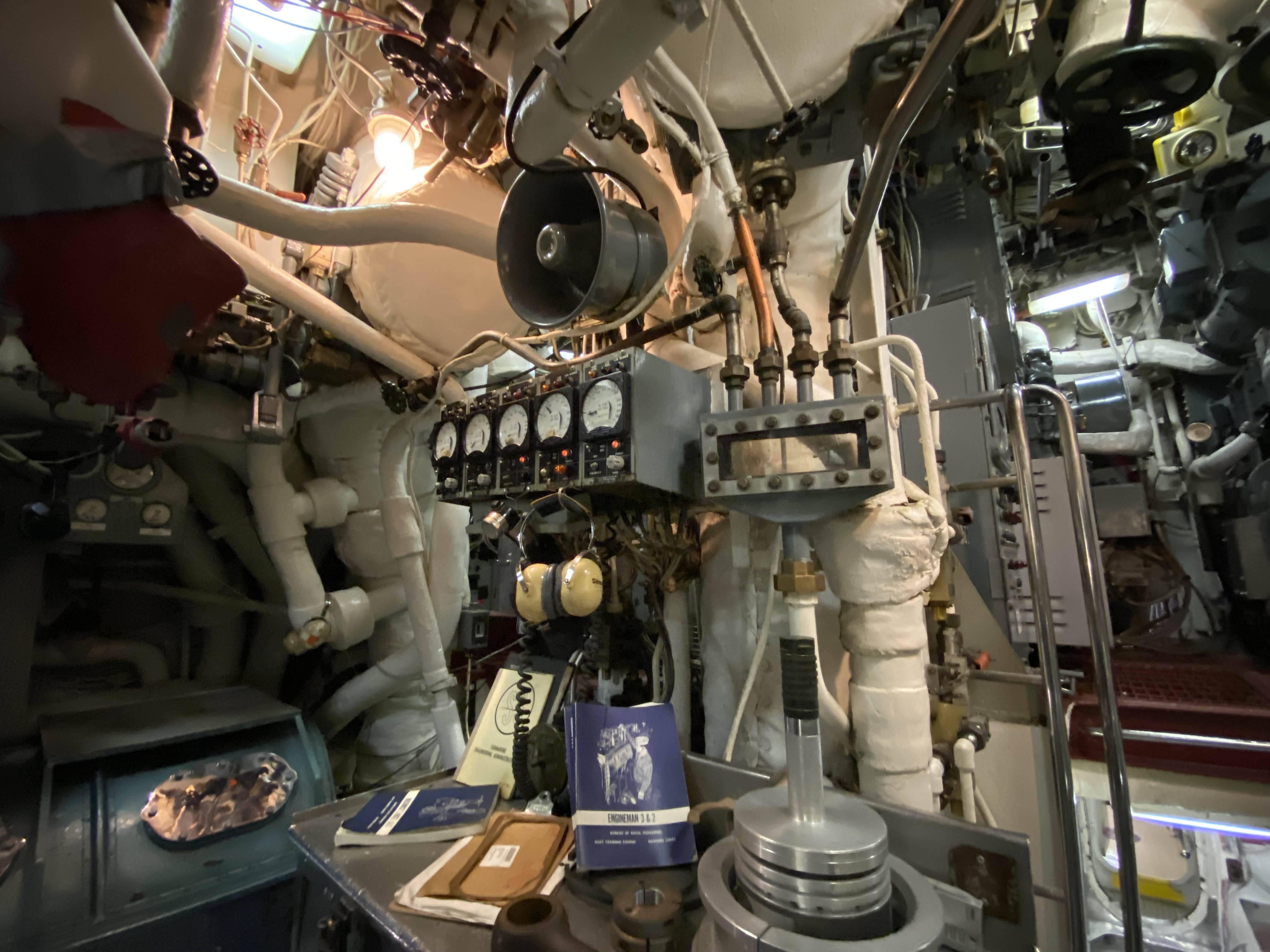
The metal piston in this room is merely a prop and not from the diesel engines themselves. For one thing, it is too small and lightweight to be a piston from the engines. It is from a 3,000 psi high-pressure air compressor (HiPAC). Since it is made of aluminum, it would not survive if put inside a diesel engine. However, we have put a 3D-printed version of a diesel engine piston and connecting rod on display. While we could have pulled one out of the engine, it would weigh about 170 lbs. It was easier just to print one up. These are the actual sizes of these objects.
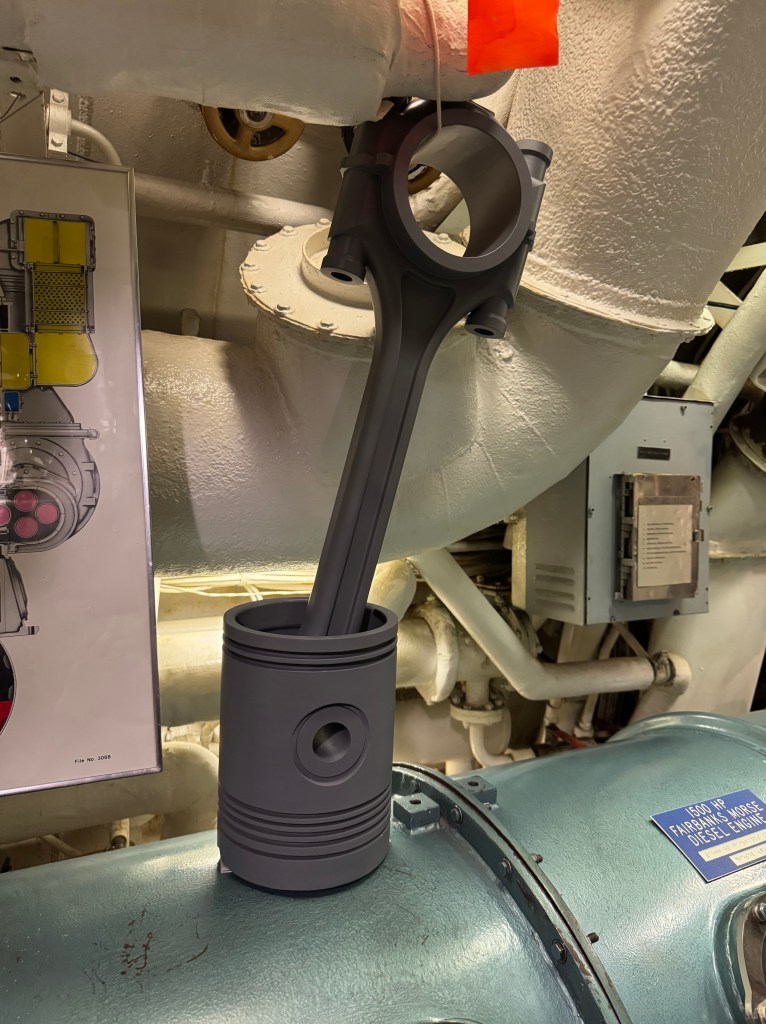

Part of the compressor for the evaporator stills is on the bottom left.
In the back of this room, next to the aft escape hatch ladder, are the two freshwater evaporator stills. These work by boiling seawater and collecting the condensation, which is freshwater because salt does not vaporize below the boiling point. Each of these stills is rated to produce 1,000 gallons of freshwater per day. So in theory, they can produce a total of 2,000 gallons per day. In practice, this was hardly ever achieved. The stills themselves just produce the freshwater, which is held in four freshwater storage tanks. For example, there would be battery tanks for the cleanest (most distilled) water and separate potable water tanks. Furthermore, as previously mentioned, this submarine would perpetually be on water rationing. The twice-distilled water would have to go to the 504 battery cells since the acid in them slowly evaporates every time they discharge and recharge. Furthermore, pumps would circulate water around the battery terminals to keep them cool. According to our former Barbel sailor, most of the freshwater is actually used for cooking and drinking. Whatever remains can then be used for cleaning. After that, there might be some freshwater left for showers, as described above.
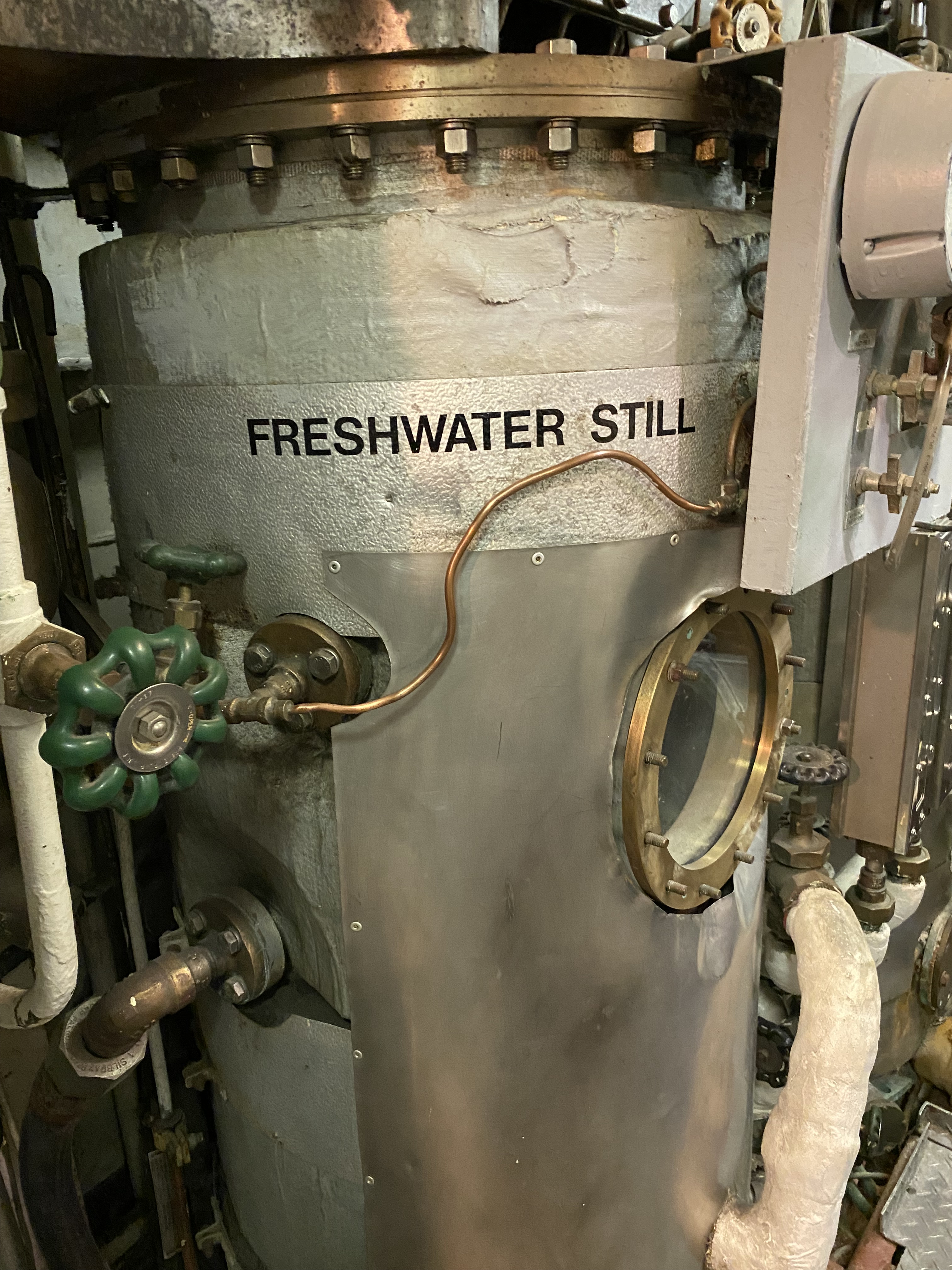
For comparison, the distillation plant on a Los Angeles-class attack sub is much larger and capable of producing some 10,000 gallons (38,000 liters) of freshwater a day. Most of this is used for cooking, cleaning, drinking, and personal hygiene. Only a small amount is used for power plant (cooling loops and steam generators).92 Modern nuclear-powered submarines use a process called Reverse Osmosis (RO), which pumps seawater through a semi-permeable membrane to filter out the salt and other impurities. This process is more energy-efficient than a distillation plant. While RO is more efficient at making freshwater, sailors generally still need to limit their shower time. One former sailor from an LA boat told me that his boat had evaporators for distilling and producing freshwater, but this was back in the early 2000s. He believes they now use RO.
Maneuvering Room
Abaft of the engine room is the maneuvering room, which controls all propulsion for the submarine. Essentially, this room is the “gas pedal” and “gear shift” for the boat and makes it go fast, slow, forward, or backward.
Below are the power characteristics of the engines, batteries, generators, and electric motor on Blueback:
| Diesel Engines | 3x Fairbanks-Morse 38D 8-1/2 | 2-cycle, 8 cylinder, opposed piston | (Surfaced) 1,500 BHP at 850 RPM, 6200 CFM air (Snorkeling) 1,335 BHP at 800 RPM, 5850 CFM air |
| Generators | 3x General Electric | Commutating & Compensating Winding | 750 – 850 RPM, 940 KW, 545 – 710 volts 1,500 amps |
| Power Control | 1x Westinghouse Electric | Single Control | 545 volts (continuous) 710 volts (max) |
| Battery | 2x (252 cells each, in series) Gould | TLX 53 Open tank vent, water-cooled, agitated electrolyte | Ventilation 5,800 CFM total Underway charge 3,500 CFM total Submerged nominal volts 500 volts 1/2 hr. rate – 6,100 Amp hrs. 1 hr. rate – 4,000 Amp hrs. |
| Electric Motor | 1x General Electric | Direct drive, double armature MCF (commutating & compensating winding) | 212 RPM 6,440 shp 880 volts 2,975 Amps each armature 5,950 Amps total |
The only thing the three diesel engines do is turn three generators that produce electricity, which (re)charges the batteries. The power then goes to the electric motor, which is behind the aft bulkhead. In other words, there is no direct mechanical linkage between the diesel engines and the propeller shaft. The entire submarine runs on electricity and is propelled by the electric propulsion motor.
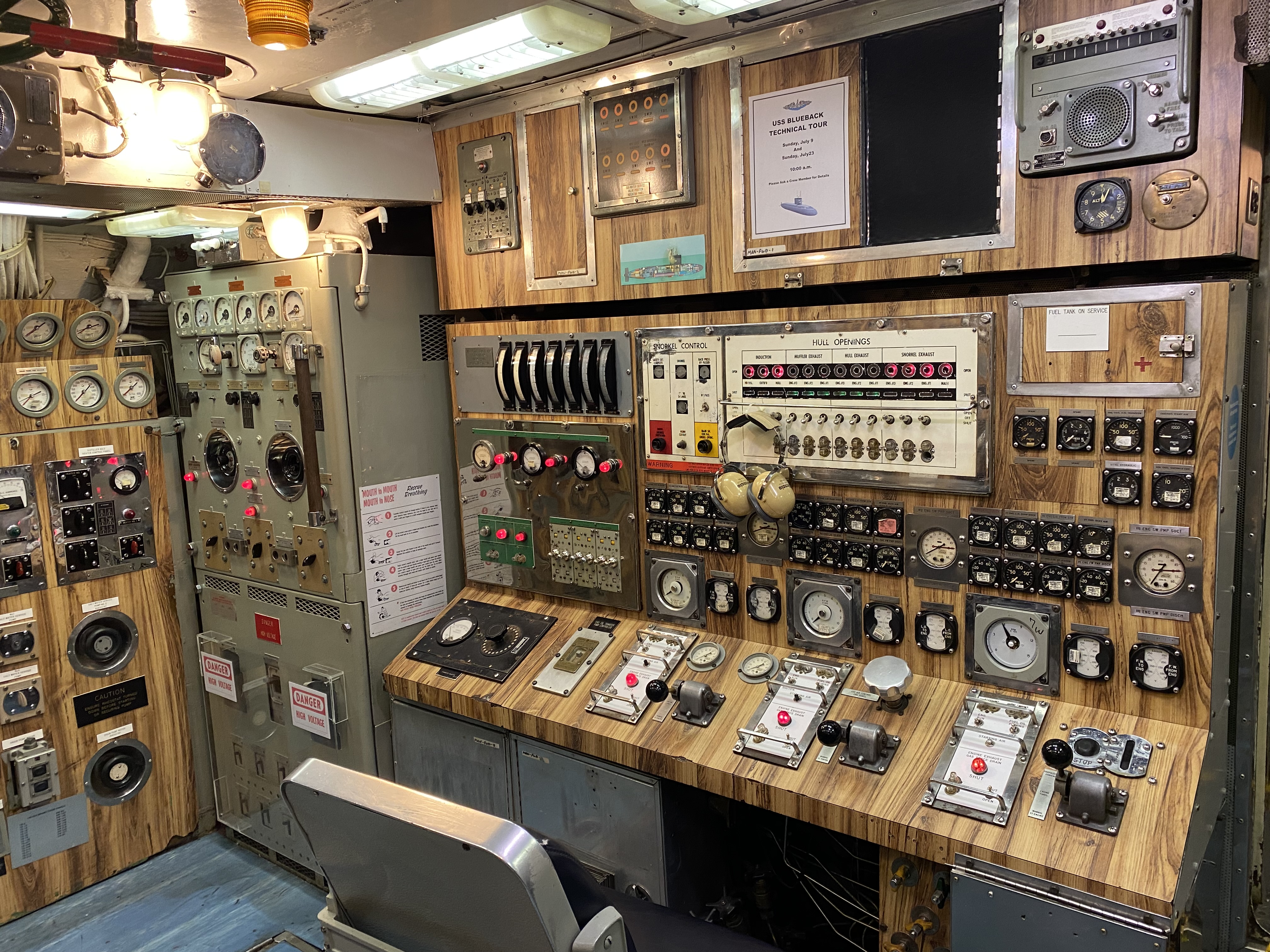
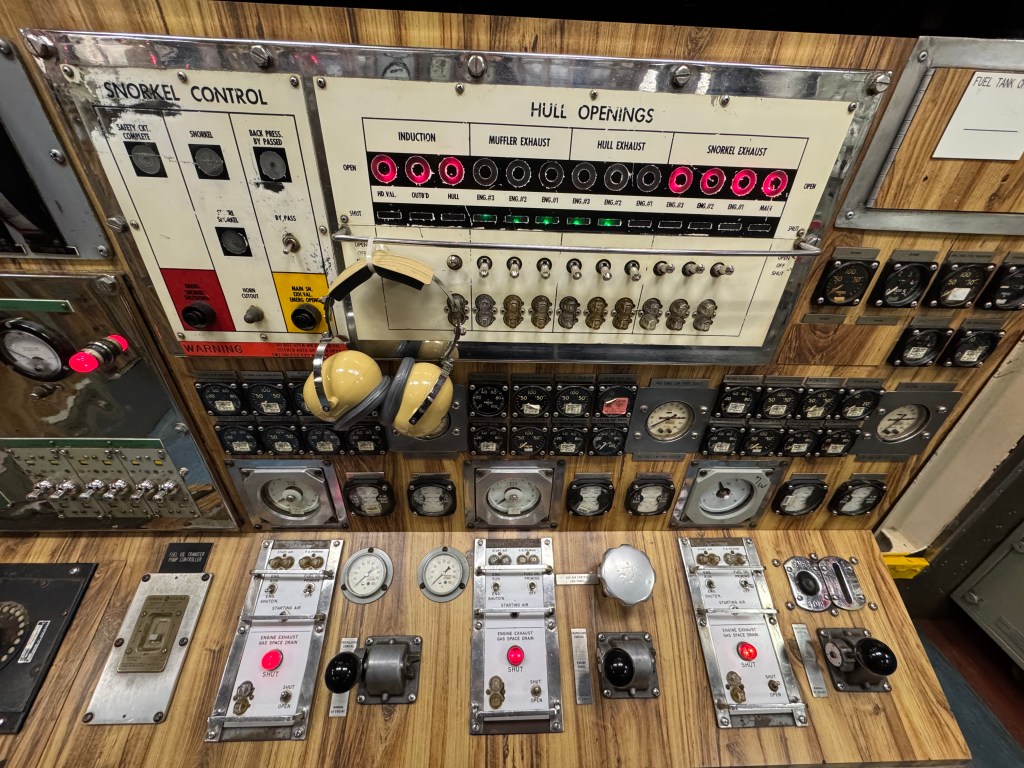
This arrangement also means that a diesel-electric submarine, like Blueback, can only use its diesel engines when it is on the surface or at snorkel depth. If the diesel engines were running when the submarine was submerged, instead of drawing air from the atmosphere, they would draw the air from inside the submarine and suffocate the crew with the diesel exhaust fumes. Blueback can carry 112,000 gallons of diesel fuel, which gives her a range of about 15,000 to 19,000 nautical miles before needing refueling. (Based on our examination of her deck logs, this submarine had a fuel economy of roughly 0.07 nautical miles/gallon or 13.5 gallons/nautical mile.) If she were running at her top speed of roughly 21 knots submerged, the batteries would last about 35 minutes. However, at a slower speed of 4 knots, the batteries can last 105 hours (4.38 days).
The diesel engines can be run in any configuration, but normally two would be run when surfaced, with the third being held in reserve. According to Rick Neault, all three engines can be run while at snorkel depth, but other former crewmen have told me only two would normally be run. One would be charging the batteries, and the other would provide power to the electric motor, so the submarine would be moving and not sitting still.
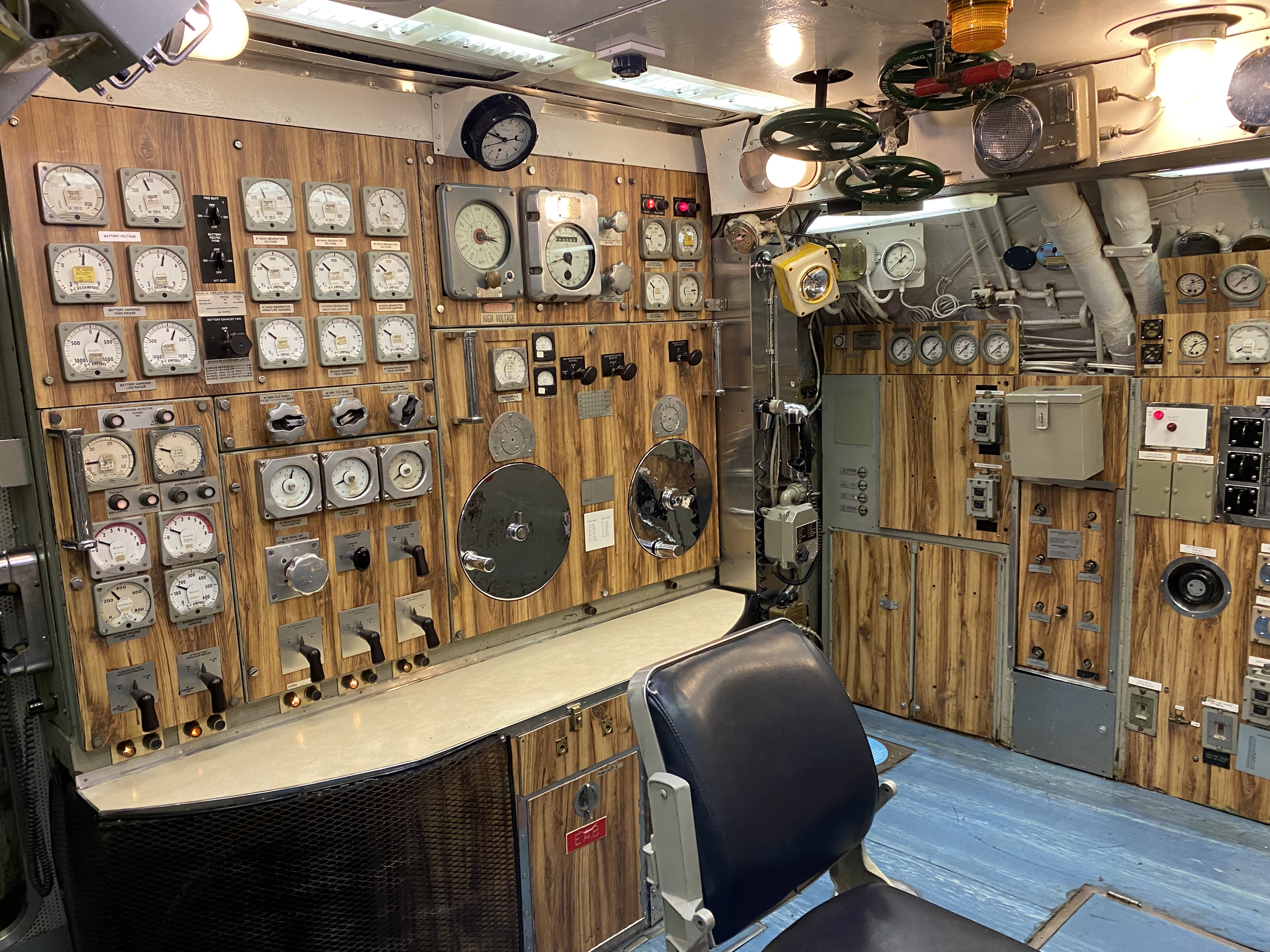
Normally, there would have been three men in the maneuvering room. These would be the engine console operator, the senior controller man, and the junior controller man. Their duties would be as follows:
- The Engine Console Operator (normally an Engineman) would man the engine control panel (the only remaining chair in the room). He has three identical sets of controls for the three engines. He would start the engines, get them up to the appropriate temperature, and shift control of the engines to the Junior Controller Man.
- The Junior Controller Man (a 3rd class Electrician’s Mate or above) would man the part of the propulsion control panel (with all the gauges measuring DC voltage) to control the batteries and generators. He would conduct battery charging while underway, and control the speed and load on the engines and generators.
- The Senior Controller Man (also the Engineering Watch Supervisor) (normally an Electrician’s Mate) would man the chrome wheels to control the speed and direction of the submarine. He also oversaw the junior controller man. As the Engineering Watch Supervisor, he would be in charge of the engineering watchstanders, as well as man the X1J handset and 7MC microphone in this room to communicate with the control room.
There would also be additional watchstanders in the engineering spaces of the submarine. These would generally be as follows:
- The Throttleman (normally an Engineman) would be in the engine room coordinating the men in there, as well as running the freshwater stills.
- The Oiler (normally an Engineman) would run the fuel and lube oil purifiers. As the lowest in the engineering hierarchy, he would do the dirty jobs.
- The Auxiliary Electrician (normally an Electrician’s Mate) would be a roving watchstander/coffee runner who would check gravities on the batteries and address any electrical issues around the boat. This was a preferred watch to stand since you got to roam around the boat. Anyone standing the 0000 – 0600 watch would also get first dibs on any baked goods from the galley during this time.
- The Auxiliaryman of the Watch (normally a Machinist’s Mate) would be another roving watch to oversee the hydraulic plants, air conditioning, refrigeration, trim and drain pumps, and High-Pressure Air Compressors (HiPACs).
When in port, each duty section would have at least one qualified Junior Controller Man, Engine Console Operator, Throttleman, and Auxiliary Electrician. These four people would be required to conduct an in-port battery charge.
How is speed controlled?
The large chrome wheels provide rough control of the speed and direction of the propeller shaft. The left chrome wheel changes the speed by lining the batteries and electric motors up in series or parallel and increasing or decreasing the voltage. The small white placard in between the wheels shows how many turns (i.e. propeller RPMs) are required to attain certain speeds. Fine control of the speed is done with a smaller silver knurled knob above these wheels near the bottom of the propeller revolution indicator, which increases or decreases the amount of field on the electric motors. The direction of the propeller shaft is actually controlled by the black knobs above the chrome wheels. The left one will change the direction of the shaft. The right one shifts control to manual mode, at which point the right chrome wheel will be used to change the polarity of the armatures in the electric motor, causing the shaft to change direction.
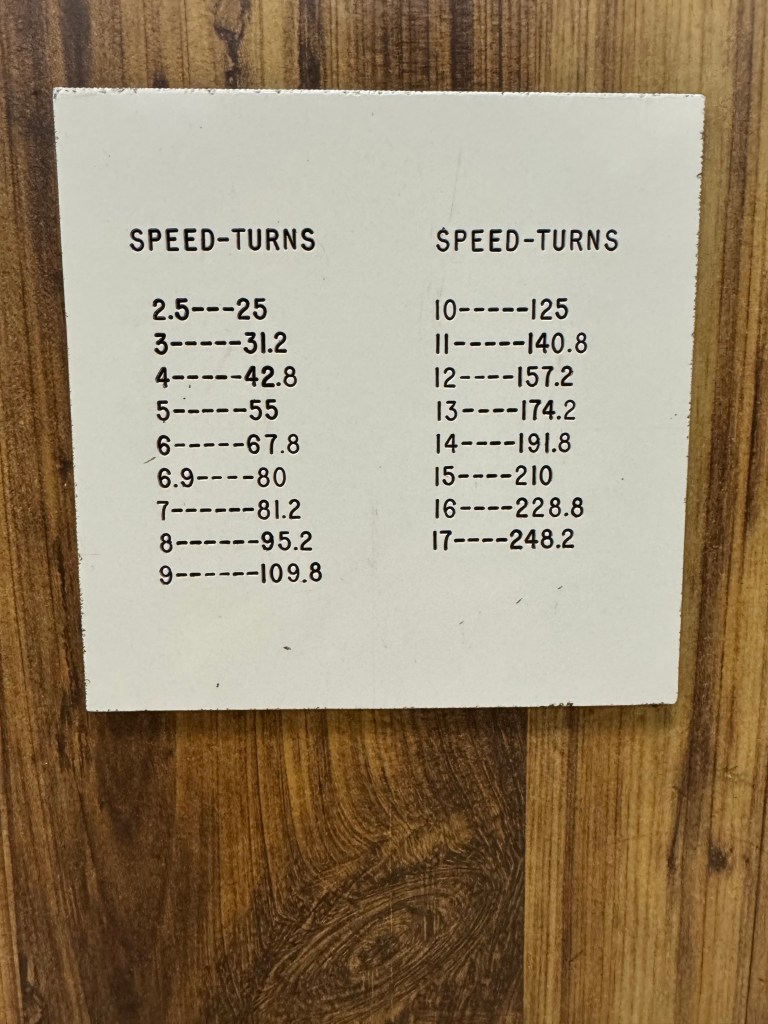
Much like older vessels, and modern nuclear-powered ones (submarines and aircraft carriers), from what I have been told, there is no direct control of the speed from the control room. Instead, the engine order telegraph (below the clock) would indicate the desired speed. There is a set speed (and RPM) for each order on the engine order telegraph. If the sub’s flank speed is 21 knots, then each bell would be 4.2 knots.
There are two engine order telegraphs. One is up in the control room, operated by the helmsman, and one is down in the maneuvering room, operated by the throttle man.
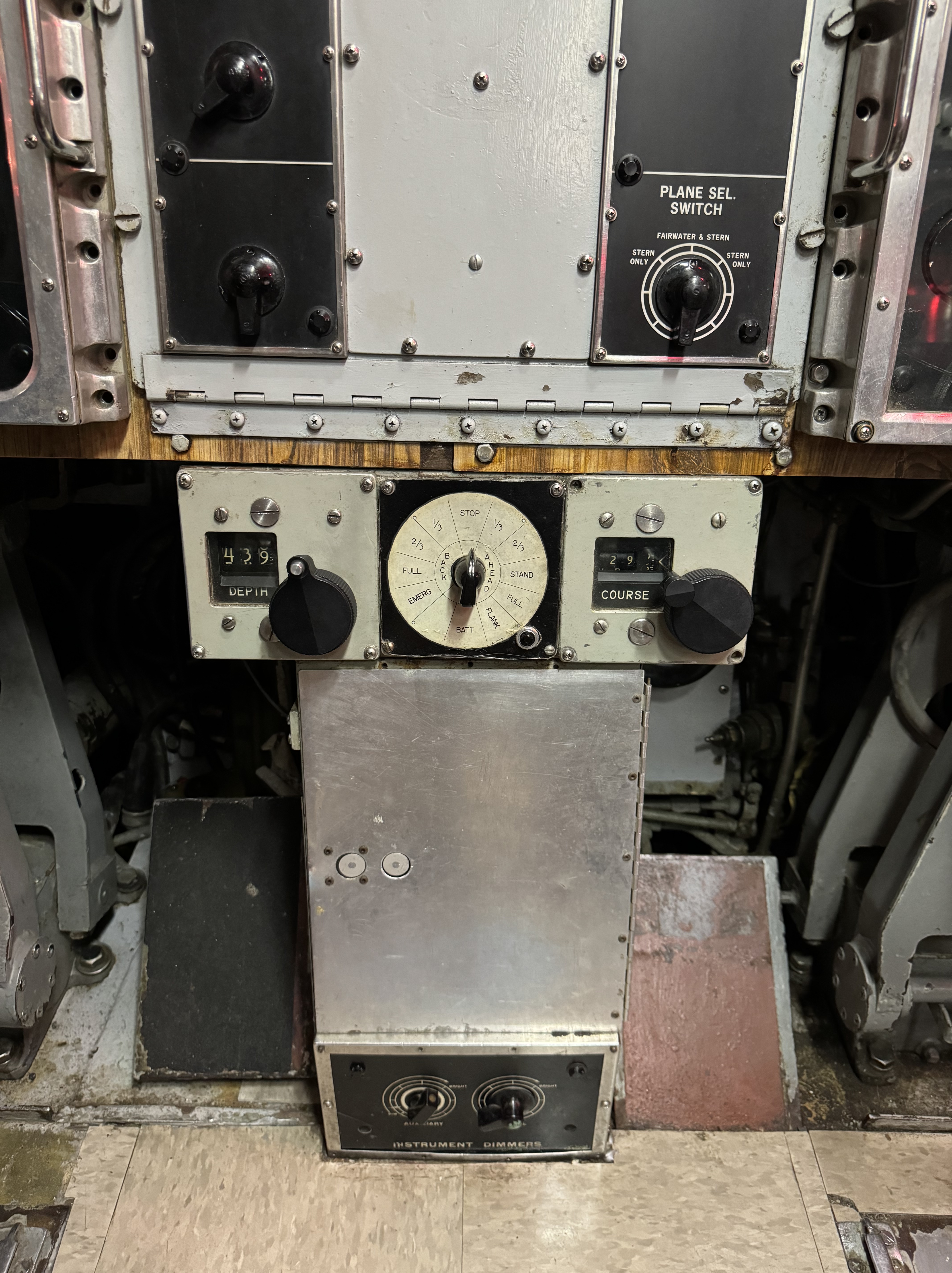
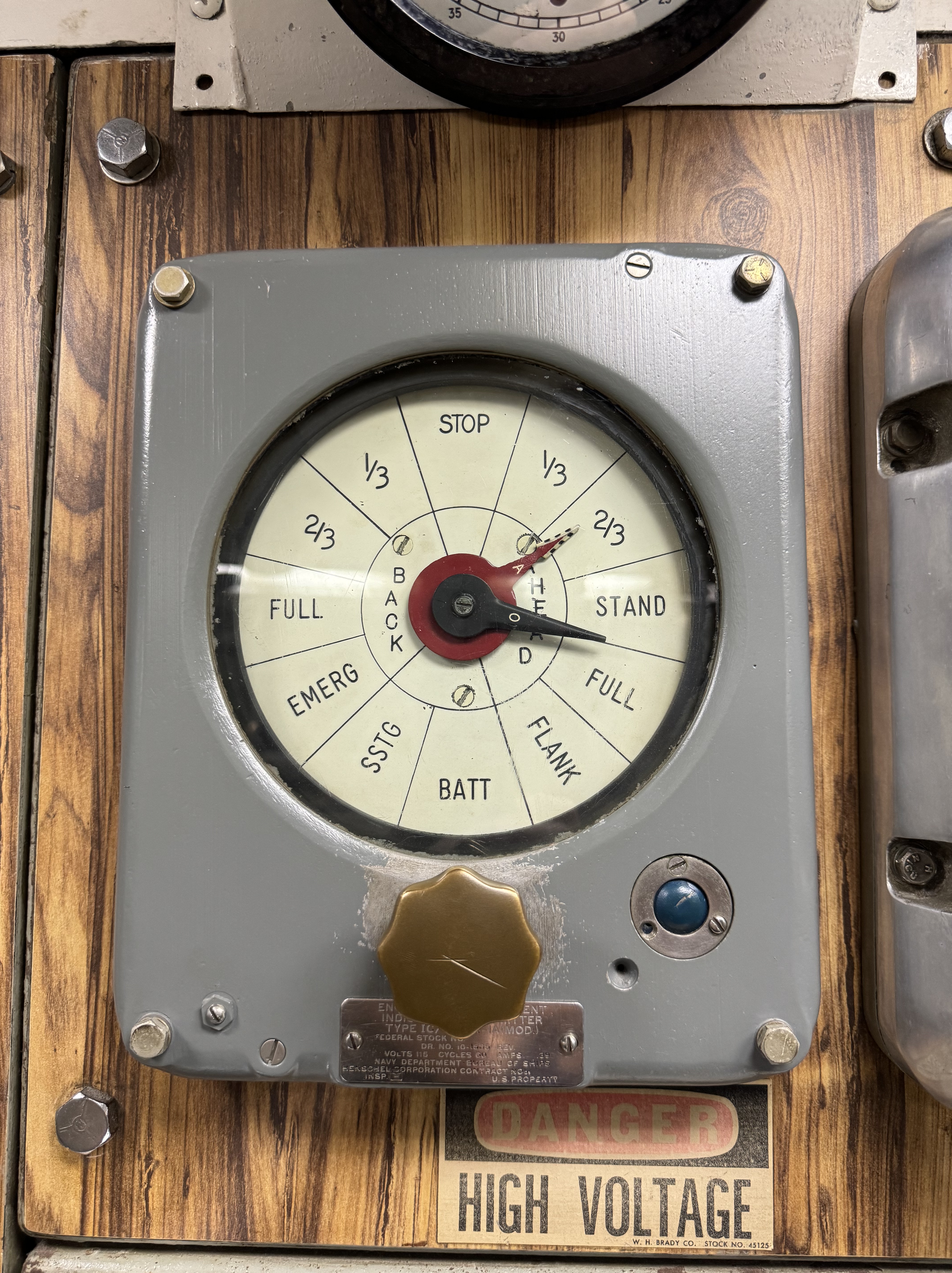
Here is how the process basically works:
- In the control room, the Officer of the Deck (OOD) orders a certain speed, such as ahead 1/3.
- The helmsman turns the knob on his engine order telegraph so the black pointer (labeled “O” for “order”) is on ahead 1/3.
- (An audible bell dings for every position the pointer moves. That is why they’re called “bells” and the helmsman “rings up an order.”)
- As this is happening up in the control room, the black pointer on the engine order telegraph in the maneuvering room simultaneously moves to the matching order.
- In the maneuvering room, the Senior Controller Man answers the order by turning the knob on his engine order telegraph to make the red arrow (labeled “A” for acknowledge/answer) to the same position.
- This is known as “answering bells.”
- The Senior Controller Man will turn the appropriate wheel in the appropriate direction to create the desired speed.
Aside from the engine order telegraph, communication of speed changes can also be done via a microphone circuit (such as the 7MC for maneuvering) over a “squawk box” or a sound-powered phone. For example, the OOD can order a specific speed, such as 4 knots, and will call the maneuvering room by saying, “Maneuvering, Conn, make turns for 4 knots.” The Engineering Officer of the Watch (EOOW) will then acknowledge by saying, “Make turns for 4 knots, Conn Maneuvering, Aye.” The specific speed on the shaft would be set as ordered.
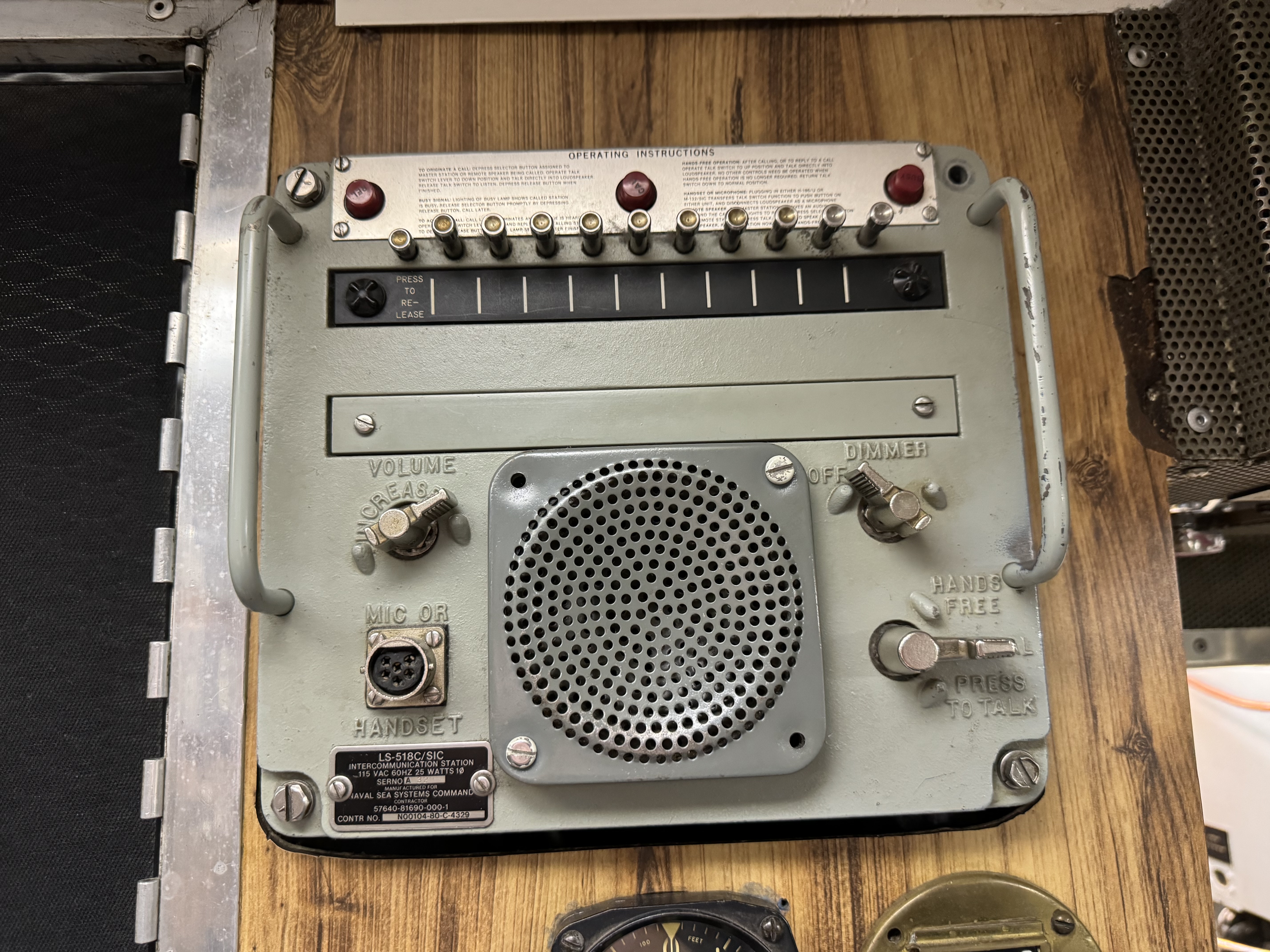
Like other U.S. Navy diesel-electric submarines, Blueback‘s diesel engines use indirect drive. The diesel engines are simply turning three generators to produce electricity. When surfaced, the power from the generators charges the batteries but can be routed to the electric motor (AKA propulsion motor) in the Auxiliary Machinery Space (AMS), AKA shaft alley. The electric motor is what directly turns the propeller shaft. When submerged, the batteries power the electric motor. In other words, it is not a direct-drive diesel powerplant (such as on WWII German U-boats). The entire submarine runs on electricity and is propelled by the electric motor. It is also worth noting that submarines before the Tench-class had bulky reduction gears between their electric motors and propeller shafts. The purpose of these was to slow down the electric motor’s RPMs to a more appropriate speed for the propeller shafts. Diesel-electric submarines after that did not need reduction gears as the electric motors could operate at slow speeds.
The indirect drive system was chosen by the U.S. Navy for its flexibility. This also mitigated some of the issues of vibration at certain speeds because the diesel engines do not directly drive the shaft and therefore do not need to change speed. Since they are connected to generators, they can be run at an optimal speed at all times. The downside of this system is that it is heavier and more complex than direct drive systems.93
One interesting object here is the “white rat speaker.” It is an eavesdropping speaker, but it has nothing to do with clandestine work. It allows the men inside the maneuvering room to hear the sound of the engines to ensure that they are running properly without having to enter the engine room.
The top speed of the submarine on the surface is about 14 -17 kts (16 – 20 mph). She is faster underwater, with a top speed of about 21 kts (24 mph), but if she went that fast, the batteries would be drained in about 35 minutes. If it slows down to 4 kts (5 mph), then the batteries can last 105 hrs (>4 days). Blueback once set a submerged distance record for a diesel-electric submarine. In September 1961, over 22 days, she transited from Yokosuka, Japan, to San Diego, California, across the Pacific Ocean. More than 5,340 miles completely underwater. That said, the only time she got near the surface was every 2 – 3 days when she came up to 59 feet below the surface, raised her snorkel, and lit off the diesel engines to recharge her batteries and refresh the air inside the sub.94 Blueback has a maximum operating speed of 14 knots when snorkeling.
Since modern nuclear-powered submarines do not require air for the operation of the reactor, they create their own air through the process of electrolysis. An electric current is run through the seawater, which breaks the bonds between the hydrogen and oxygen atoms. Thus, they can have an unlimited amount of fresh air, and the hydrogen goes through a diffuser before it is vented overboard. That said, the oxygen level in the air is generally kept lower than what you normally breathe. This is done to reduce the risk of fire.
The Plexiglas panel on the floor looks down into the pump room. This room is about the size of a closet, and it houses the pumps and air compressors for the high-pressure air systems on this submarine. I had to crawl down into this room one time to change a light bulb because I was a person of ideal size to fit through the hatch.
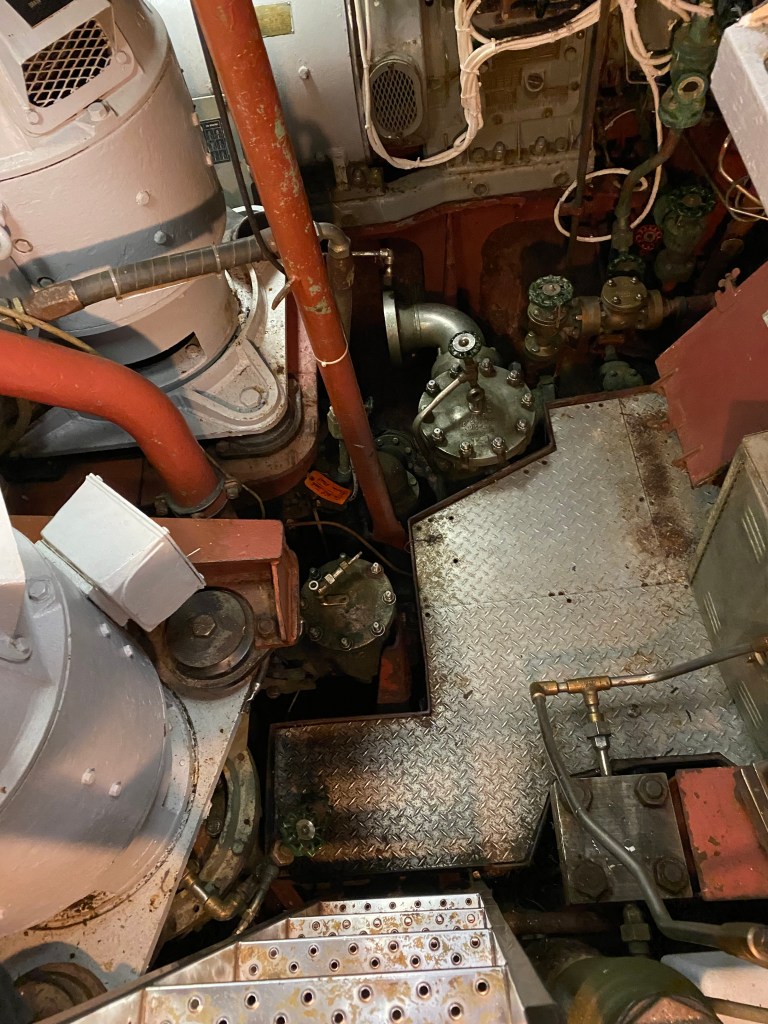
Auxiliary Machinery Space (AMS) AKA Shaft Alley
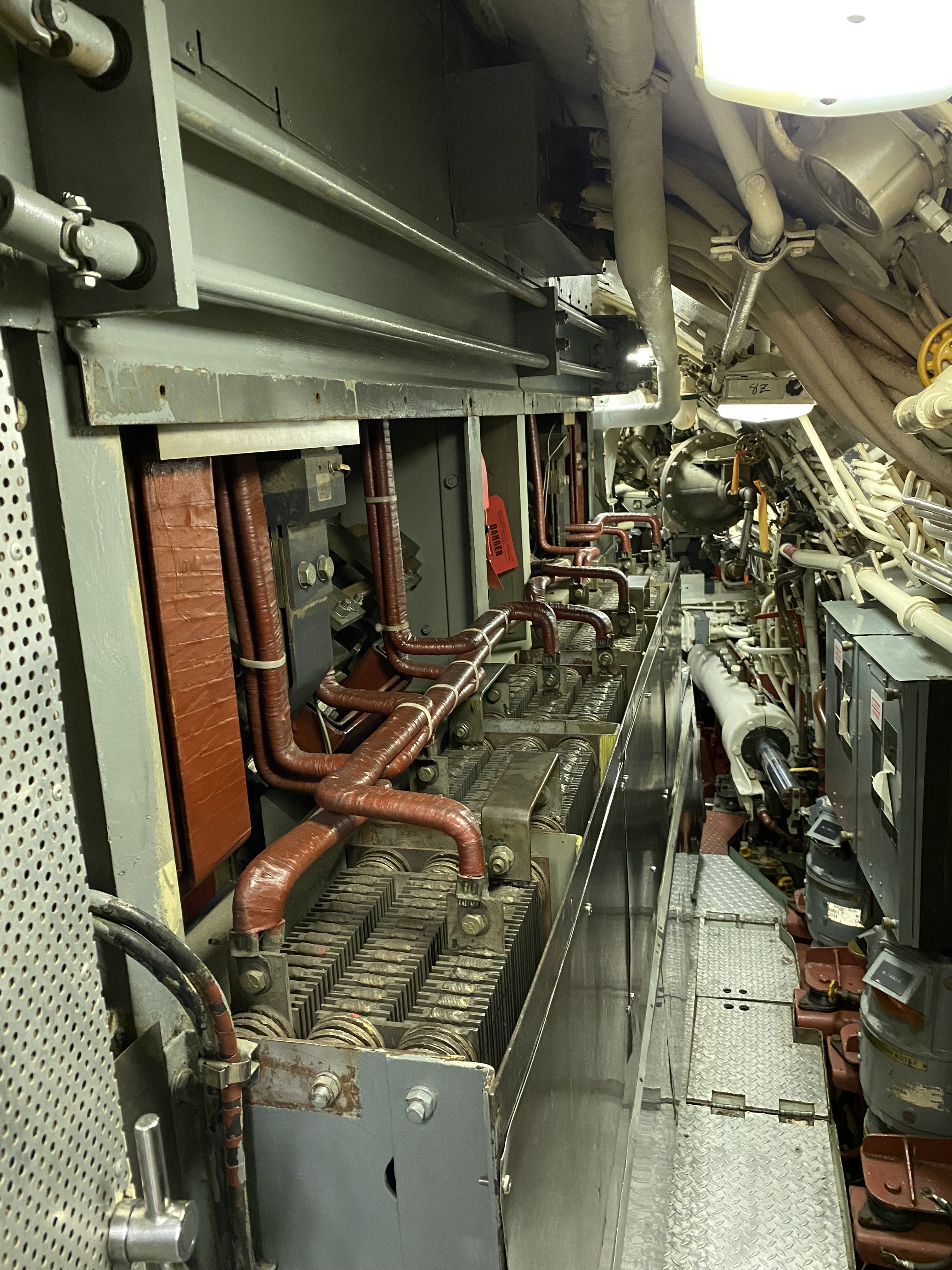
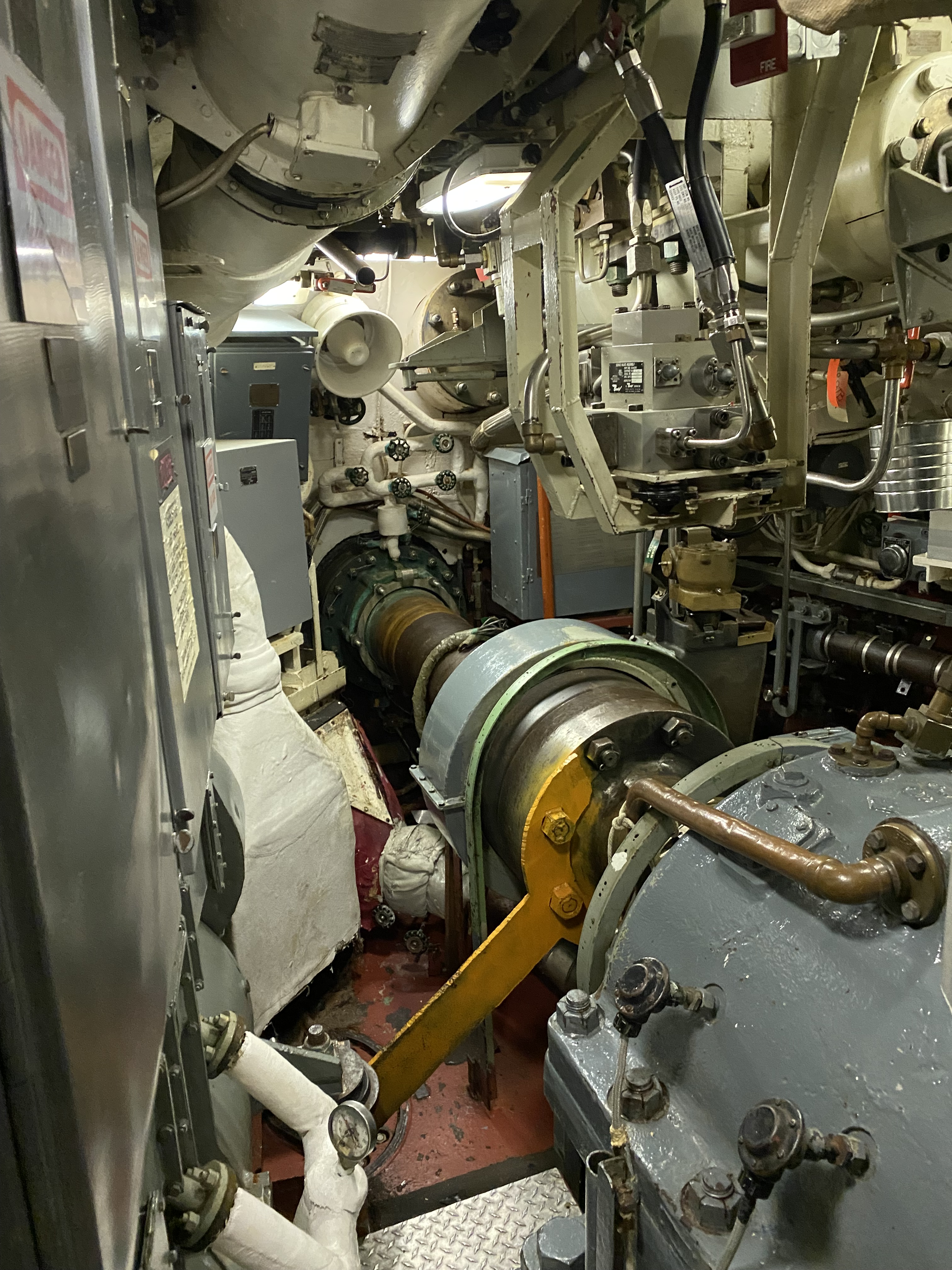
This is the aftmost section of the submarine, also known as Shaft Alley. Back here is the electric propulsion motor, which produces a total of 6,440 shp. This electric motor is technically two electric motors put end-to-end, creating two armatures producing around 3,220 shp each. That is why you will occasionally see publications on the submarine showing 2 electric motors with each drawing over 400 volts, but for all intents and purposes, it visually appears as a single motor. You will also notice hydraulic rams back here, which control the rudder and stern planes.
This electric motor is more powerful than the ones used on WWII fleet boats. Older fleet boats used less power when underwater and had dual electric motors (driving two shafts), but they only used half of each motor when submerged. The need for high-speed underwater endurance meant doubling the battery capacity and using the entire motor when submerged.95
The speed of the electric motor (and thus the propeller) is dependent on voltage and amperage (i.e. current). A fleet boat’s propeller turns at 280 RPMs at 415 volts and 2,700 amps. However, tests demonstrated that the electric motors could carry up to 3,000 amps continuously. Further testing showed that higher voltages could be handled if all batteries were in series. At a 1/2 hour rate of discharge, a total of 6,500 shp (or more) could be attained compared to 4,700 shp at the 1-hour discharge rate.96 Compare this to Blueback’s motor, which turns a larger single screw at 212 RPM and generates a total of 6,440 shp at 880 volts and 5,950 Amps total. The electric motor is designed to operate its two armatures with a total power consumption rate of up to 5,400 amps with the batteries in series for up to four hours. The motor can vary the speed of the propeller from about 25 – 230 RPMs. The motor itself is enclosed in an air cooler, which is cooled with seawater. The lubricating oil is also cooled with seawater.
The propeller shaft is 29 feet 10 inches long and 12.5 inches in diameter. It is designed to turn at 230 RPM at 7,780 shp and 162 RPM at 3,150 shp for continuous duty. The axial load of the shaft itself acts upon a Kingsbury thrust bearing. Essentially, this thrust bearing is what the screw and shaft are pushing against and moving the submarine forward. Without it, the screw would literally push the shaft right through the electric motor.
Conclusion
So that was basically an extremely in-depth version of my tour of USS Blueback. It is worth noting that my tour has changed quite a bit over time as I have become more experienced at giving tours and have learned more information about the boat itself. If you are ever in the Portland, Oregon area, feel free to come down to OMSI and purchase a ticket for a tour.
As always, you can find more information about the Oregon Museum of Science and Industry (OMSI), as well as USS Blueback, on the museum’s website at omsi.edu. OMSI is a non-profit organization that receives support from various sources, including community partners, and generous donations from people like you.
Notes
- At the time, the U.S. Navy still named submarines after aquatic life, so Blueback is actually another name for a Sockeye salmon. ↩︎
- Scott C. S. Stone, Blueback (Virginia Beach, VA: Donning Co, 2000), 32. When adjusted for inflation, she would cost over $233 million in 2025. ↩︎
- Technically, the last diesel-electric submarine in the U.S. Navy was USS Dolphin (AGSS-555), which was decommissioned in 2007. However, that was a research submarine and not a combat vessel. The Barbel-class (including Blueback) are the last diesel-electric attack submarines, with all subsequent fast-attack and ballistic/guided-missile submarines in the U.S. Navy being nuclear-powered. ↩︎
- Stone, 63. The story I was told about how OMSI got Blueback originally involved just a torpedo. However, the President of OMSI at the time did not want to display a torpedo because it is a weapon (albeit inert) and therefore related to warfare. Additionally, there was the fear that children would climb on it and potentially hurt themselves. So the President stipulated that OMSI would only display the torpedo if they had a submarine, but figured that such an event would never happen. However, Senator Mark O. Hatfield, himself a Navy veteran, along with local organizations, had previously acquired the decommissioned submarine, but the Navy stipulated that they needed a place to display it. Thus, with the submarine and torpedo, the community was able to bring Blueback to the museum. ↩︎
- Theoretically, Blueback could be bought back into service in roughly one year, provided that you undid all of these aforementioned alterations, but it would be economically unfeasible and technologically impractical. For some perspective, I have been told that it would be cheaper to simply buy a brand new diesel-electric submarine with all modern, state-of-the-art equipment from a country that still makes them (like Germany or Japan), than it would be to refit Blueback and put it back into service. Even at the end of her service, crewmen described Blueback as “a Model T amongst Cadillacs.” One tour guide also told me a story about how one of the electric motor’s armatures caught fire at the end of Blueback‘s service. While the fire did cause some damage to the propulsion motor, it thankfully did not sink the vessel. After putting the fire out, the Navy reportedly debated about what to do with Blueback, but eventually, they decided that it was simply cheaper to decommission her. In all likelihood, Blueback would only have served another year had the fire not occurred, so she would have been decommissioned sometime in 1991 anyway. Thus, Blueback was decommissioned in 1990 and left the U.S. Navy with an entirely nuclear-powered submarine fleet. Since that fire, however, Blueback has never again moved under her own power and has always been towed. In other words, she would never be put back into service! ↩︎
- In the history of the U.S. Navy using HY steels to construct submarines, the steel has never failed (i.e. resulted in the sinking of a submarine). That said, for submarines that have sunk and imploded, what has failed first is something else, such as a valve or hull penetration. ↩︎
- Dan Anderson, “Oregon Historic Site Record USS Blueback” (Oregon Historic Preservation Office, September 18, 2008). However, a photo dated 20 January 1963 shows her with sailplanes. Also, an earlier newspaper clipping dated 5 May 1962 from Seattle shows Blueback still having bowplanes. ↩︎
- While the planes operate similarly to the control surfaces on an aircraft, the submarine cannot do any crazy maneuver underwater like a fighter plane. If the submarine were to flip over underwater, that would be catastrophic because all the batteries at the bottom would come through the deck. ↩︎
- Former Bonefish and Blueback crewmember, Rick Neault, told me that when he served on board, they always referred to this as the “superstructure.” Technically, it is; however, he concedes that the term turtleback makes more sense and is easier for visitors to understand. ↩︎
- Reportedly, everything was in place to drydock the boat in 2019, but the COVID pandemic shut everything down. ↩︎
- Rob Downie, “BLUEBACK SCUTTLEBUTT Jun. 2022” 3, no. 6 (June 2022). ↩︎
- Rob Downie, “BLUEBACK SCUTTLEBUTT Jul. 2022” 3, no. 7 (July 2022). ↩︎
- “Submarine Independent Duty Corpsman,” accessed May 24, 2025, https://www.med.navy.mil/Navy-Medicine-Operational-Training-Command/Naval-Undersea-Medical-Institute/Submarine-Independent-Duty-Corpsman/. ↩︎
- Flint Whitlock and Ron Smith, The Depths of Courage: American Submariners at War with Japan, 1941-1945, 1st pbk. ed (New York: Berkley Pub Group, 2008), 166 – 167. ↩︎
- Tom Clancy, Submarine: A Guided Tour Inside a Nuclear Warship, 2nd ed (New York: Berkley, 2002), 21 – 27. ↩︎
- This Los Angeles-class boat is specifically modeled on USS Memphis (SSN-691), which was the model-maker’s boat. It includes anhedral stabilizers under the stern planes, but they’re hard to see in the photo. ↩︎
- Reportedly, one Typhoon will be opened as a museum ship in St. Petersburg, Russia. ↩︎
- There were technically submarines before USS Holland, such as CSS Hunley or the Turtle, but USS Holland was the first commissioned boat. ↩︎
- Bonefish could not launch Regulus missiles, but the missiles required another platform along their flight path to guide them to the target. ↩︎
- Norman Friedman, U.S. Submarines since 1945 Revised Edition: An Illustrated Design History (Annapolis, MD: Naval Institute Press, 2018), 52. ↩︎
- Norman Friedman, U.S. Submarines since 1945, 26. ↩︎
- I am not sure exactly what kind of periscopes these are that replaced the originals, but they are both attack scopes. The museum technically has a third one in storage, but it is not on the boat. ↩︎
- Friedman, U.S. Submarines since 1945, 52. ↩︎
- Friedman, U.S. Submarines since 1945, 18. ↩︎
- Alas, we have had to lock the side-to-side and forward-and-back movement of these steering columns since kids on the tours have played with them so much over the past 30+ years that they have pretty much broken. The indicator gauges used to move with the wheels, but that function has been lost. ↩︎
- The location of a thermocline and the behavior of sound waves in water vary depending on factors such as temperature, salinity, etc. Simply getting below the thermal layer does not guarantee a submarine is hidden from sonar, as sound waves can still penetrate it, just not as well. ↩︎
- Norman Friedman, U.S. Submarines since 1945, 52. ↩︎
- 1MC stands for 1 Main Circuit, which is the general announcing system throughout a vessel. It is used for transmitting information and alarms to all spaces on a ship. Numerous main circuits exist depending on the vessel and what systems/spaces are aboard. For example, 7MC is for engineering, and 27MC is for the submarine’s combat systems (sonar, radar, ECM, etc.). ↩︎
- One tour guide who qualified as Chief of the Watch on his boat told me that the normal diving angle would be about 6 degrees. ↩︎
- Reportedly, three blasts on the diving alarm would indicate an emergency surface to the crew. ↩︎
- I have confirmed with former Blueback Quartermaster, Rick Neault, that while GPS did exist when he served aboard her back in the late 1980s, it wasn’t used on Blueback. He only used NAVSAT. ↩︎
- Conversely, Robert Talbert told me that Loran-C was very reliable on his submarines, provided that they were streaming an appropriate length of radio cable behind the boat to receive a strong enough signal. ↩︎
- Friedman, U.S. Submarines since 1945, 35. ↩︎
- Polmar & K.J. Moore, Cold War Submarines: The Design and Construction of U.S. and Soviet Submarines (Dulles, VA: Brassey’s Inc., 2004), 16. In the U.S. military designation system, B = underwater (i.e. submarine) installation. Q = sonar. R = receiving (a passive detection set). S in the third position = an active pinging sonar set. ↩︎
- Norman Polmar & Moore, 5 – 15. ↩︎
- Norman Friedman, U.S. Submarines since 1945, 14; Norman Friedman, U.S. Naval Weapons (Annapolis, MD: Naval Institute Press, 1983), 260. ↩︎
- Norman Friedman, U.S. Naval Weapons, 260. Polmar and Moore credit the BQR-2 with a range up to 10 nm with a bearing accuracy of 1/10th of a degree.) ↩︎
- Norman Friedman, U.S. Submarines since 1945, 272n6. ↩︎
- All it does is play the sounds of dolphins, whales, shrimp, active sonar pings, and ship propellers on a loop for ambiance. Of course, our tour guide Trekkie nerd put one Star Trek reference in the sound loop. ↩︎
- Friedman, U.S. Submarines since 1945, 14 – 17. ↩︎
- Friedman, U.S. Naval Weapons, 263; Friedman, U.S. Submarines since 1945, 13. ↩︎
- Friedman, U.S. Naval Weapons, 138. ↩︎
- Friedman, U.S. Submarines since 1945, 14. ↩︎
- Friedman, U.S. Naval Weapons, 259. ↩︎
- David Miller, The Illustrated Directory of Submarines of the World (Zenith Press, 2002), 312. ↩︎
- Interestingly, the Ship Information Book (SIB) shows that there are three showers rather than the actual two. It could be that this is one of the differences between USS Barbel (SS-580) and USS Blueback (SS-581). Then again, the SIB is not 100% accurate and is sometimes called the “Ship Suggestion Book.” ↩︎
- Dario Leone, “US Navy Submariner Explains Why Sailors Aboard Nuclear Submarines Smell of Ammonia,” The Aviation Geek Club, July 28, 2024, https://theaviationgeekclub.com/us-navy-submariner-explains-why-sailors-aboard-nuclear-submarines-have-a-fishy-ammonia-smell/. ↩︎
- Along with the nuclear-powered Skipjack-class, and the George Washington-class SSBNs, the Barbel-class were the last attack submarines to mount six torpedo tubes directly in the bow in this configuration. All subsequent submarines had their torpedo tubes moved to amidships and angled outboard because the bow of these submarines contains the BQQ sonar dome. ↩︎
- James LaPorta and Eleanor Watson, “Torpedo That Struck Iranian Warship Was Fired by USS Charlotte, U.S. Officials Say,” CBS News, March 5, 2026, https://www.cbsnews.com/live-updates/us-iran-war-spreads-azerbaijan-israel-strikes-tehran-lebanon/. ↩︎
- USS Tang (SS-306) was sunk by a circular running torpedo on 25 October 1944. This just happened to be the last torpedo she had. ↩︎
- Friedman, U.S. Naval Weapons, 117 – 118. ↩︎
- Friedman, U.S. Naval Weapons, 268. ↩︎
- “Post-World War II Torpedoes of the United States of America – NavWeaps,” accessed April 14, 2025, http://www.navweaps.com/Weapons/WTUS_PostWWII.php. ↩︎
- “Post-World War II Torpedoes of the United States of America – NavWeaps,” accessed October 7, 2024, http://www.navweaps.com/Weapons/WTUS_PostWWII.php. One tour guide is adamant that this is actually a Mark 48 torpedo. However, after a close inspection of the rear of the torpedo and comparing it with photos of other Mark 45 torpedoes, this is definitely not a Mark 48. The fins are different, and it lacks the propulsor of the Mark 48. The yellow propeller guard is covering the two contra-rotating screws, and Mark 48s have always used propulsors. ↩︎
- Reportedly, the term “bridal suite” stems from sleeping in the torpedo room of ballistic missile subs. There was enough space for the mattresses to be laid side-by-side. ↩︎
- Some countries deploy special ops personnel out of the torpedo tubes by using them as an escape trunk, but they simply flood the tube and equalize the pressure, then the outer door is opened, and they swim out. They are not “shot” out of the torpedo tubes. ↩︎
- Submarine Escape Immersion Equipment (SEIE) replaced Steinke Hoods in the late 2000s. These are full-body suits that provide thermal insulation and include a one-person life raft. They can be used down to roughly 600 feet. ↩︎
- Wikipedia says that this scene was cut from the film, but this is incorrect. It is definitely there, but it is a “blink, and you will miss it” shot. There were additional scenes filmed in Blueback‘s torpedo room that involved loading and unloading torpedoes, but those scenes were cut. ↩︎
- After 2015, the system on modern U.S. submarines changed to a 24-hour day of three 8-hour watches. ↩︎
- I have also been told that modern Ohio-class ballistic missile submarines and Virginia-class attack submarines “usually” have enough racks for each sailor to have their own, so the practice of hot racking is not really done anymore (they still could if needed, though). ↩︎
- As a mess crank, you probably will not be doing much actual cooking (since that is what the cooks do), but you will fetch food, help prepare the ingredients, and do whatever else is needed. ↩︎
- Submarine Research Center, Submarine Cuisine (Bangor Silverdale, WA: Submarine Research Center, 2004), 21. ↩︎
- Submarine Research Center, 144. ↩︎
- Submarine Research Center, 145. ↩︎
- Submarine Research Center, 146. ↩︎
- According to a couple of recent former submariner Culinary Specialists I have met on my tours, one of them a woman who served on USS Jimmy Carter (SSN-23), said CS A school is about 1 month long, and the culinary school they attend only lasts about 2 months. This is because the curriculum is largely designed to teach them how to make food that will not kill people. Things like proper cooking temperatures and food storage, avoiding cross-contamination, etc. The rest of what they learn about cooking occurs when they get to a submarine in the fleet. Additionally, the CSs that are sent to culinary school are usually Petty Officers 1st Class or Chiefs, so the culinary school would be more advanced mid-career training. ↩︎
- Reportedly, one of the White House cooks is usually a Navy submarine cook. U.S. Navy and U.S. Coast Guard Culinary Specialists usually operate the galleys at the White House and Camp David. ↩︎
- Submarine Research Center, 53 – 54. ↩︎
- Submarine Research Center, 55. ↩︎
- Submarine Research Center, 19. ↩︎
- Submarine Research Center, 40 – 41. Even then, heavy or stormy seas on the surface when entering or leaving a port mean the boat will be very unstable. ↩︎
- One tour guide (and submarine veteran) tells me that they always talk about the great things about serving on submarines and none of the bad things. We never talk about mopping up vomit off the decks, eating gross food out of cans, or constantly cleaning up oil and hydraulic fluid leaking from that one piece of equipment. ↩︎
- A further examination of the deck logs from this time period shows that Blueback was actually in port at Pearl Harbor for the entire month of October 1970 and receiving services from ashore. It is no wonder the meals are so good for this menu. ↩︎
- Submarine Research Center, 139 – 141. ↩︎
- Submarine Research Center, 33. ↩︎
- Submarine Research Center, 65. ↩︎
- Submarine Research Center, 19. ↩︎
- Submarine Research Center, 144. ↩︎
- The Ship Information Book states that Blueback would carry 30 days of chilled food (which could be frozen), 60 days of frozen food, and 75 days of dry goods. Whether that means about 175 days’ worth of provisions, or all of that combined accounts for 90 days, is unknown. I recently met a former Blueback supply officer who was aboard in the 1970s and asked him how many tons of food they would load on board, hoping that he would be able to verify if it was indeed 14+ tons. Sadly, he doesn’t recall the weight, but he said they would provision for 90 days at sea. In contrast, another former Blueback officer we’ve met estimates the amount of food carried for 90 days was around 15 tons, lending credence to the Ship Information Book. ↩︎
- The reason for these widely different numbers is that children often have no concept of what a ton of weight is. So we will say pounds instead. The 14,000 lbs. (7 tons) does seem a little low for a full 90-day patrol. Why we do not convert the 14 tons to 28,000 lbs. is beyond me. ↩︎
- I have no idea what those other stores would be. ↩︎
- Tony Capitano told me that the freezers would be filled with roughly 4 tons of frozen meat. ↩︎
- Another submariner told me that on his boat, they would dip the eggs in paraffin wax to seal them and keep them fresh for longer. ↩︎
- Submarine Research Center, 61. ↩︎
- Submarine Research Center, 18. ↩︎
- Submarine Research Center, 20. ↩︎
- Robert Genat and Robin Genat, Modern U.S. Navy Submarines, Enthusiast Color Series (Osceola, WI, USA: Motorbooks International, 1997), 90 – 92. ↩︎
- Submarine Research Center, 55. A volunteer tour guide, and former nuclear machinist’s mate aboard USS Memphis (SSN-691), told me that if his boat was doing training in friendly waters (like the warm Caribbean), then the sub could surface and the crew would have a swim call and a steel beach picnic. He recalls playing “King of the Dome,” which is King of the Hill on the sonar dome on the sub’s bow. ↩︎
- One nuclear engineer who served on an LA-class boat told me that a non-vanilla flavor of hard-pack ice cream (the kind in tubs or cartons that you buy at stores) would be carried on his boat for special occasions. He said strawberry ice cream was particularly popular. ↩︎
- The Captain also relates a story of how a batch of smoked oysters (or something of that nature) somehow made it into the soft serve machine on USS Ohio (SSBN-726) as it changed from Blue to Gold crews. The tradition is for the outgoing crew to play a prank on the incoming crew. Yummy! Naturally, the crew was very upset, and nobody ate ice cream for the whole patrol! That said, when I asked him about it several months later, he told me the story may be apocryphal. ↩︎
- Taylor Freezer also supplied soft serve machines to McDonald’s, and according to one visitor, this same model was used at the branch where they worked. Reportedly, they were pretty temperamental and needed constant maintenance. Other submarine sailors have related stories of how the soft serve machine on their boats rarely worked. So the constant availability of ice cream is all relative. ↩︎
- Tom Clancy, Submarine: A Guided Tour Inside a Nuclear Warship, 2nd ed. (New York, NY: Berkley Books, 2002), 95. ↩︎
- Friedman, U.S. Submarines since 1945, 34. ↩︎
- According to CDR R.L. Murrill, who was the boat’s Captain at the time, the reason for this underwater transit was that the bow planes were stuck in the down position and the boat could not fully surface. They simply crossed the Pacific submerged and got technicians aboard when they neared San Diego to fix the bow planes. ↩︎
- Friedman, U.S. Submarines since 1945, 33 – 34. ↩︎
- Friedman, U.S. Submarines since 1945, 275. ↩︎
Bibliography
Anderson, Dan. “Oregon Historic Site Record USS Blueback.” Oregon Historic Preservation Office, September 18, 2008.
Clancy, Tom. Submarine: A Guided Tour Inside a Nuclear Warship. 2nd ed. New York, NY: Berkley Books, 2002.
Downie, Rob. “BLUEBACK SCUTTLEBUTT Jun. 2022” 3, no. 6 (June 2022).
Downie, Rob. “BLUEBACK SCUTTLEBUTT Jul. 2022” 3, no. 7 (July 2022).
Friedman, Norman. U.S. Naval Weapons. Annapolis, MD: Naval Institute Press, 1983.
Friedman, Norman. U.S. Submarines since 1945, Revised Edition: An Illustrated Design History. Annapolis, MD: Naval Institute Press, 2018.
Genat, Robert, and Robin Genat. Modern U.S. Navy Submarines. Enthusiast Color Series. Osceola, WI, USA: Motorbooks International, 1997.
LaPorta, James, and Eleanor Watson. “Torpedo That Struck Iranian Warship Was Fired by USS Charlotte, U.S. Officials Say.” CBS News, March 5, 2026. https://www.cbsnews.com/live-updates/us-iran-war-spreads-azerbaijan-israel-strikes-tehran-lebanon/.
Leone, Dario. “US Navy Submariner Explains Why Sailors Aboard Nuclear Submarines Smell of Ammonia.” The Aviation Geek Club, July 28, 2024. https://theaviationgeekclub.com/us-navy-submariner-explains-why-sailors-aboard-nuclear-submarines-have-a-fishy-ammonia-smell/.
Middleton, Drew. Submarine: The Ultimate Naval Weapon; Its Past, Present & Future. 1. ed. A Playboy Press Book. Chicago, Ill: Playboy Pr, 1976.
Miller, David. The Illustrated Directory of Submarines of the World. Zenith Press, 2002.
Polmar, Norman and K.J. Moore. Cold War Submarines: The Design and Construction of U.S. and Soviet Submarines. Dulles, VA: Brassey’s Inc. 2004.
“Post-World War II Torpedoes of the United States of America – NavWeaps.” Accessed October 7, 2024. http://www.navweaps.com/Weapons/WTUS_PostWWII.php.
Stone, Scott C. S. Blueback. Virginia Beach, VA: Donning Co, 2000.
“Submarine Independent Duty Corpsman.” Accessed May 24, 2025. https://www.med.navy.mil/Navy-Medicine-Operational-Training-Command/Naval-Undersea-Medical-Institute/Submarine-Independent-Duty-Corpsman/.
Submarine Research Center. Submarine Cuisine. Bangor Silverdale, WA: Submarine Research Center, 2004.
Whitlock, Flint, and Ron Smith. The Depths of Courage: American Submariners at War with Japan, 1941-1945. 1st pbk. ed. New York: Berkley Pub Group, 2008.
 Fair Winds & Following Seas