
Disclaimer: The views expressed here are the presenter’s own and do not necessarily reflect the official policies or positions of either the Oregon Museum of Science and Industry (OMSI), the United States Navy, or the United States Government. While strong efforts are made to ensure accuracy, all information is subject to change without notice. All personal statements, opinions, omissions, and errors are the commentators’ own.
More information about the Oregon Museum of Science and Industry (OMSI), as well as USS Blueback, can be found on the museum’s website at omsi.edu. OMSI is a non-profit organization that receives support from various sources, including generous donations from people like you.
This is my first interview with one of the paid Blueback staff and the second person who is also not a submarine veteran. In this post, we have a conversation with another guide from the surface side! A sonar technician and Gulf War veteran.
Featured Tour Guide – Scott Thingelstad – STG3, U.S. Navy

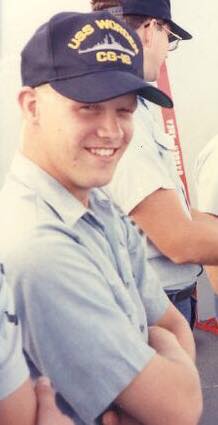
Our featured tour guide in this post is Scott Thingelstad. Scott served in the U.S. Navy as a Sonar Technician (Surface) 3rd class (STG3). His time in the Navy included duty aboard USS Fletcher (DD-992) and USS Worden (DLG/CG-18) during the Gulf War (Operations Desert Shield/Storm, and during Operation Southern Watch). Following his time in the Navy, Scott did several odd jobs and attended college in the 1990s before joining the Blueback crew at OMSI in 2002.
Scott is something of a fixture on Blueback with 23 years of experience (and counting) as an OMSI employee. He is the longest continuously working tour guide in Blueback‘s history as a museum ship. With Scott’s extensive experience as a Blueback tour guide, he knows far more about its history as a museum ship than any of us. The only people who have more technical knowledge of the submarine would be the submarine sailors who qualified and served on it.
If you’re wondering why he chose STG instead of STS (Sonar Technician, Submarines)? Well, in Scott’s own words, “There’s not enough money in the Navy to get me on an active submarine, and as they say, STG really is an acronym for ‘Second To God.'”
When he’s not working on Blueback, Scott gives back to the community by volunteering in promotional events and charities as a Clone Trooper in the 501st Legion of Star Wars costuming fans.
Transcript
Tim:
Hello, welcome back to Down Periscope, Up Periscope. So I got another interview with you; our first paid staff member, I’m here with Scott Thingelstad, a Sonar Technician Third Class. So we’re just gonna talk a little bit with Scott about what he did in the Navy and some of his thoughts on giving tours on Blueback since he has been here for a very long time. So welcome, Scott!
Scott:
Hello!
Tim:
First of all, what made you join the Navy and what rating did you originally want?
Scott:
I joined in 1988. Two years after the greatest recruiting film ever made. You might have heard of it. Top Gun. I wanted to be a naval aviator, just like everybody else that saw Top Gun, and the Navy decided that my eyesight wasn’t good enough to fly multi-million dollar airplanes, so they offered me a bunch of stuff and ended up working on becoming a sonar technician.
Mainly because sonar school was two and a half years in San Diego. And I joined originally [for] a wide variety of reasons. I think because wanted to get out of the house. I wanted to do a better job than I was doing at the time. Serve the country and all that kind of stuff. So it was kind of the right opportunity at the right time and I jumped on that and went in as a sonar technician. Six years in, and was forced to live in really horrible places like San Diego and Hawaii. I had to go to places like Australia and Hong Kong and Singapore. You know, places that no one really wants to go to.
Tim:
Well, yeah!
Scott:
Yeah, they’re horrible places – no. The Navy was really fun about going into various ports and just being around people. I’ve still got good friends that I haven’t seen from or heard from for like 30 years, but I run into every once in a while. It’s like I got out yesterday.
Tim:
I see what ships were you on in the Navy?
Scott:
First one was the USS Fletcher (DD-992), which was a destroyer, and the second one was USS Worden (CG-18), which is a cruiser.


Tim:
And I understand you served in the Gulf War?
Scott:
I did! The original Gulf War. I was in Desert Storm and…well, Desert Shield and Desert Storm and then Southern Watch which was ’93. ’92 – ’93. When I was in Desert Storm I was on the small arms team. So our job? The last line of defense if something’s coming at the ship. I always hoped the CIWS worked perfectly.
Tim:
Kind of what were your feelings as you were heading over to the Persian Gulf when you found out you were getting deployed there?
Scott:
I knew I was going! I was stationed on the West Coast and all West Coast ships at the time would go to the Persian Gulf. So it was just every 18 months we went to the Persian Gulf. Our time – we were supposed to head over in, I think August of ’90, and when Saddam Hussein went into Kuwait, we got put on 72-hour standby. So if anything would happen in 72 hours, we would have been on our way, but nothing did so we went on our normal time. And then we got extended a little bit for Desert Storm. I think in January when Desert Storm started I think we didn’t pull in any ports for a month and then we hit a port. Which I know the sub guys are going, “A month, really?”
Tim:
So granted that the Gulf War is not known for having a lot of naval battles, but do you have any interesting experiences of your time over there during the Gulf War?
Scott:
Um well, as far as I knew all we did is float around on the Persian Gulf for a month and a half. Or three months. You know, the three months we were there. I found out later that there was a book out called Shield and Storm, and it’s what the Navy did during Desert Shield and Desert Storm. And usually, when I find a book that talks about Desert Storm, I look in the appendix to see if my ship is listed and I go look at it. It was in this particular book that has got us listed like seven or eight times and apparently, my ship fell under attack by MiG and Mirage aircraft. A couple different times we were hit by a chemical attack, or similar to that, and I was like, nope! Nope! I float around the ocean for three months. I don’t know what you’re talking about!
Tim:
(laughing) All right. Well, I think you mentioned one time to some of us [that] you’ve personally tracked a number of Russian submarines. Do you recall which ones?
Scott:
I… I tracked one. It was the Akula. The other seven that I’ve tracked…Uh, three of them were US Los Angeles classes and four of th em were US Ohio class. The first time I found one was USS Michigan off the coast of Washington and my supervisor asked what I had and I was like, “I dunno, a submarine?”
He goes, “Which one?”
And I was like, “I don’t know. It’s a submarine! That’s the signal that came up.” And so that was my first one.
Tim:
Was there anything kind of unique about the Akula because I’ve read that they’re fairly quiet?
Scott:
They are very quiet, and they just happened to be at the right time at the right place, and I picked her up. We were off of the Gulf of Alaska, so that’s very cold water, so sonar travels very well in that. She was coming out of Vladivostok and we picked her up. And I tracked her for four hours and then my shipmate lost her two hours later.
Tim:
What would you say, as a sonar tech, what is the best and worst thing about being one?
Scott:
That’s a good question. The best part about it is just listening to the really unique sounds in the ocean because sonar is picking up all those sounds, and so you get to listen to everything from submarines to surface ships to whales and dolphins and whatever else happens to be in the ocean. The worst? I was a third class so all the bad jobs I got to do, as well, like scrubbing toilets and doing dishes and loading stores and that kind of thing.
Tim:
So you got the Navy and eventually, you came to OMSI. What made you come to OMSI?
Scott:
I got out of the Navy, or I got out of college with a degree in animation, and in the process of trying to find animation work, I decided I needed a job. And so I applied for the submarine tour guide and then forgot that I applied for the submarine tour guide, and I got a call from the manager saying, “You know you want to come down here for their interview?”
And I was like, “For what?”
He goes, “Because you applied for a submarine job.”
And I was like, “Oh…oh, yeah, I guess I did!” And so I came down here and interviewed and been here ever since.
Tim:
I see. Have you always been a tour guide on Blueback; your entire time at OMSI?
Scott:
Most of the time, yeah. There was a few spots where we lost a manager, we lost a supervisor, and I filled in that role until somebody else came in.
Tim:
I see. And what year did you start at OMSI?
Scott:
2002.
Tim:
So, kind of in your general opinion, have the tours changed substantially since when you started back in the early 2000s?
Scott:
As far as the tours themselves, not so much. We would give basically the same tour. The people that have come down have changed. I’m not gonna go into details, better or worse, I’m just saying they’ve gotten different. I don’t want to slam on anybody but…
Tim:
So every so often we have former Barbel-class sailors come down from Barbel, Blueback, and Bonefish. And from what I’ve heard you’ve met a number of the former skippers of Blueback?
Scott:
I think I’ve met five of them, five or six of them, one of them told me about how he did a dive down to like 1,020 feet or something like that. He actually did it twice. One was a mechanical problem; the other one was he did it on purpose. I had one that was a former captain that never mentioned that he was a captain. I’m pointing out the officer’s stateroom and he’s like, “Oh, yeah, that was my room,” and I’m like, “Oh, Okay.”
Another one mentioned that he was a – I said, “This is where the captain lives,” and he said, “And in Colorado!” and I’m like, “Oh, you’re another one of our captains. Okay.”
We’ve got some tin cans hanging around. I met that captain that told me that why they’re there. Oh, he came down and said it looked better than when he served on board except there’s no tin cans to collect the fluid. I actually had a chance to meet the first one.
Tim:
Gautier?


Scott:
Yeah, Gautier.
Yeah, he came down, got a tour of the boat, and pointed out things. We did an open boat where we had around four or five hundred B-girl sailors that came down and they told me their various stories, and some of them I still tell today.2 Some of them I had to edit to tell today.
Tim:
So there’s a rather famous factoid about Blueback that in September of ’61, under Commander Murrill, she crossed the Pacific from Yokosuka to San Diego for 5,340-some odd miles completely submerged, and from my understanding, there’s more to that story that you know of.3 There was a reason for why they had to do that.
Scott:
I actually talked to that captain. So the captain said that they were coming from Japan to San Diego and They had a problem with some sort of mechanism that prevented them from surfacing.
But he was like, “I’m not gonna worry about it. I can come up to snorkeling depth. I can bring in the air and recharge the batteries. I don’t have to bring the sub all the way to the surface.” And he did that until he got just outside of San Diego and realized that he had better fix the boat or have that part fixed, or they were gonna be pulling in the San Diego submerged and have to figure out how to get the boat out of the water and you don’t want to do that. So his details are a lot more than mine, but that’s pretty much what he said. Interesting guy.
Tim:
Well, Scott you’ve been here for longer than any of us, for decades literally, and as far as I can tell, do you have any plans to quit or go on to anything else?
Scott:
Nah.
Tim:
You definitely have a wealth of experience as a tour guide here.
Scott:
I was actually – I’m one of the unique ones. Not only have I been here for 23 years, almost, but I was trained by the COB (Chief of the Boat) of this boat. So a lot of the details that I got are from an actual sailor that was the Chief of the Boat, for this boat. So that’s pretty interesting and I’ve met people that have been through here when he was on board and they’re like, “Yeah, I remember him!”
Tim:
Well, thank you very much for your time, Scott. I appreciate it. Well, that concludes it for now. So until then.
End of Transcript
Project 971 – Akula-class Submarines

Exactly which Akula submarine Scott tracked is unknown, as there are two different major variants.4 Project 971 (NATO name: Akula AKA Akula I) began as a steel-hulled version of the titanium-hulled Sierras, owing to production delays. Using AK-32 steel, which added over 1,000 tons to the surface displacement, these boats retained the 1,970-foot test depth of the Sierras. While they had the same OK-650 reactor, given the greater displacement, the maximum submerged speed was reduced to 33 knots. The Akulas had a more advanced MGK-540 sonar along with four 533mm and four 650mm torpedo tubes. Additionally, more efforts were made to reduce the noise of the Akulas, including modular isolated decks and active noise cancellation. The first Akula boat, Karp, was built by Komsomol’sk shipyard and commissioned on 30 December 1984. These boats became the standard third-generation nuclear subs of the Soviet Navy. Quieting features improved throughout the design of the class, and on 8 January 1996, the first improved Akula II called the Vepr’, was commissioned, and built by Sevmash (formerly Severodvinsk Shipyard). These Akula IIs had a modified pressure hull which made them some 230 tons greater in displacement and 8 feet longer. Their enhanced quieting features also made them the first Russian subs that were quieter at slow speeds than the Improved Los Angeles-class of U.S. subs.5
Given the date of commissioning, Scott most likely tracked one of the Akula I boats since he had left the Navy by the time the first Akula II entered service.
The advancement of Soviet submarine quieting features in the 1980s was of great concern to Western naval intelligence. The reasons for the leap forward are commonly attributed to several sources. First, U.S. Navy Chief Warrant Officer John A. Walker sold technological secrets (including submarine information) to the Soviets from 1967 – 1985 when he was arrested and sentenced to life imprisonment. Secondly, from 1983 to 1984, the Japanese company, Toshiba, sold advanced nine-axis milling equipment to the USSR, and the Norwegian state-owned arms firm, Kongsberg Vaapenfabrikk, sold computer equipment to the USSR for milling machinery. However, naval analysts Norman Polmar and K.J. Moore opine that these reasons are an oversimplification since the Sierra and Akula submarines, and their propellers, were developed well before these events. At best, the Japanese and Norwegian sales of equipment merely increased the efficiency of submarine propeller production in the Soviet Union.6
Operation Desert Shield/Storm
On 2 August 1990, the Iraqi Army invaded the neighboring country of Kuwait over disputes regarding the latter’s alleged slant drilling into Iraq’s oil fields and to cancel the debt Iraq owed to Kuwait following the recent Iran-Iraq War. Led by Saddam Hussein, with some 800,000 troops; 4,700 tanks; 3,700 artillery guns; and an advanced air defense network, Iraq possessed, by some calculations, the fourth-largest army in the world at the time and the largest in the Middle East.7 Iraq quickly occupied Kuwait, and the subsequent UN Security Council Resolutions 660 and 661 demanded Iraq’s immediate withdrawal and the imposition of international sanctions against Iraq. In response, a U.S.-led Coalition of some 33 nations, the largest military alliance since World War II, commenced Operation Desert Shield. Thanks to military ties built up with friendly Arab nations over the previous 40 years, U.S. ground and air forces were able to quickly move into the region. A massive (and rapid) sealift effort involving over 240 ships moving more than 18.3 billion pounds of supplies gradually built up troops and equipment in neighboring Saudi Arabia. In less than two weeks after the Iraqi invasion of Kuwait, U.S. Marines were on the ground in Saudi Arabia with enough supplies to sustain them for 30 days. Additionally, over 21,000 U.S. Navy reservists were called to active duty to serve in the Persian Gulf or fill vacancies on the home front. Simultaneously, the ships of Joint Task Force Middle East, which had maintained a presence in the region since 1949, were placed on alert. The carrier battle groups USS Independence (CV-62) and USS Dwight D. Eisenhower (CVN-69) were ordered to move from the Indian Ocean and Eastern Mediterranean to the Gulf of Oman and the Red Sea, respectively, to prepare for combat operations.8 Ultimately, the naval buildup in the region would see the largest concentration of aircraft carriers since the Vietnam War, with the carriers USS America (CV-66), USS John F. Kennedy (CV-67), USS Saratoga (CV-60), and USS Theodore Roosevelt (CVN-71) operating in the Red Sea, while USS Midway (CV-41) and USS Ranger (CV-61) operated in the Persian Gulf. Operation Desert Shield lasted until 17 January 1991. Following Saddam Hussein’s rejection of diplomatic efforts, it was decided to liberate Kuwait by military force.
Operation Desert Storm began at midnight on 17 January 1991, when U.S. Army AH-64 Apache gunships crossed the Saudi border into Iraq and destroyed two radar installations. Simultaneously, U.S. Navy warships and submarines in the Persian Gulf and eastern Mediterranean Sea launched Tomahawk cruise missiles at various targets.9 The cruiser USS San Jacinto (CG-56) actually fired the first cruise missiles of the Gulf War.10 (The submarines USS Pittsburgh (SSN-720) and USS Louisville (SSN-724) fired some 14 Tomahawk missiles in Desert Storm.11) What followed was a 42-day air campaign to establish air superiority over Iraq and strike various ground targets. Meanwhile, amphibious forces offshore kept tens of thousands of Iraqi troops in Kuwait occupied in their positions by convincing them that they were preparing to conduct an amphibious assault. The actual ground offensive into Iraq kicked off on 24 February 1991 when the U.S. Army’s VII Corps and XVIII Airborne Corps swept through the desert in southern Iraq. The ground war in Iraq was over in just 100 hours. Already tired, hungry, and exhausted from six months of an economic blockade that began during Desert Shield, along with a month-long bombing campaign from Air Force and naval aircraft, Iraqi troops surrendered in droves, and those that put up a fight were quickly neutralized. A mere seven months after Iraq invaded Kuwait, the Coalition forces had won and Kuwait was liberated on 28 February 1991.12 So much for having the fourth-largest army in the world.
At its peak, there were some 100 U.S. naval ships and 50 naval ships from 17 other countries involved in Desert Storm. All in all, U.S. carrier aircraft flew only 24 percent of the combat sorties and dropped around 28 percent of U.S. air weapons used in the war. Even then, only 9 percent were precision-guided munitions, the rest were “dumb bombs.”13
USS Worden was deployed to the Persian Gulf from 28 October 1990 to 15 February 1991.14 I haven’t found any official U.S. Navy history of USS Worden that discusses what she did beyond the Vietnam War. As far as I can tell, she never fired any missiles, tracked any submarines, engaged any surface vessels, or provided any naval gunfire support during the Gulf War. She likely just provided an anti-air and anti-submarine screen to naval task forces in the Persian Gulf. As Scott said, he just floated around the Persian Gulf for a few months.
Gulf War Naval Battles
What? There were naval battles during the Gulf War? Well…sort of.
Not counting the Kuwaiti coastline, the portion of Iraq that borders the Persian Gulf is very small. To say that Iraq had a navy might be something of a joke, but Coalition forces were concerned about Iraq’s fast attack craft, some of which were armed with anti-ship missiles. All that said, the naval actions that occurred during the Gulf War were extremely limited. At the start of Operation Desert Storm, American, British, Canadian, and Kuwaiti naval forces moved to establish sea control of the Persian Gulf.
One of the major naval actions began two days after the start of the air campaign. The guided-missile frigate USS Nicholas (FFG-47) led the Kuwaiti guided-missile patrol boats Istiqlal and al-Sanbouk into the northern Gulf toward oil platforms in the al-Dorra field. After finding the oil platforms occupied by Iraqi troops, radars, and guns, U.S. Army Kiowa Warrior helicopters attacked with Hellfire missiles, followed by USS Nicholas and Istiqlal attacking other positions with guns and rockets. Five Iraqis were killed while the remainder surrendered with 23 taken as POWs.15
Another notable naval action, known as the “Bubiyan Turkey Shoot,” occurred on the night of 29 January 1991. Two A-6 Intruders flying from USS Ranger spotted four Iraqi missile boats, making 15 – 18 knots with lights out, headed toward Iran. Receiving permission to engage, they dropped 500-pound laser-guided bombs on the boats which stopped three and set them afire. A Canadian CF-18 strafed the fourth boat which managed to limp to safety to an Iranian port.16 What followed was the obliteration of whatever was left of the Iraqi Navy by coalition forces. Some seventeen Iraqi naval craft were spotted near the Saudi Arabian city of Khafji. Lynx helicopters from HMS Gloucester, HMS Cardiff, and HMS Brazen opened fire with Sea Skua missiles destroying the craft, but more arrived. These were identified as a T43, several TNC-45 type fast attack craft armed with Exocet missiles, and a Spasilac and Polnochny craft armed with Styx missiles. These were similarly engaged with Sea Skua missiles from aircraft of Task Group 321.1.17 Ultimately, the neutralization of this surface threat allowed coalition warships to move further north toward Kuwait.18
The only air attack on Coalition naval forces during the Gulf War occurred on 24 January 1991 when two Iraqi F1 Mirage jets carrying anti-ship missiles were spotted approaching Coalition warships. However, these jets violated Saudi Arabian airspace and were shot down by a Saudi F-15C before they could reach the naval task force to launch their missiles. One British source noted that there were actually three jets. Two MiG-23 Floggers and one F1 Mirage. After the Floggers were shot down by the F-15C, the Mirage fired its missile out of range and fled the area.19 There was also the instance on 25 February 1991 when two shore-based Silkworm anti-ship missiles were fired at the battleship USS Missouri. The first splashed harmlessly into the sea, and the second one was intercepted by two missiles fired by HMS Gloucester.20 Apart from these events, there were no air raids on Coalition warships in the Gulf War.
More serious was the threat of some 1,300 naval mines of varying types sowed by the Iraqis throughout the Persian Gulf. These consisted of acoustic, magnetic, and contact mines. While attempts were made to clear a path through the minefield, USS Tripoli (LPH-10) and USS Princeton (CG-59) struck mines. Thankfully no crew were killed, but the damage to these ships was substantial.


From a naval standpoint, Desert Storm seems pretty tame. There weren’t any big naval battles like WWII, and even Dave Pierce’s experiences on a destroyer in Vietnam, ranging up and down the coast while getting shot at by shore batteries and firing back seem intense by comparison.
All in all, the Gulf War was a very short and very one-sided conflict. The coalition and U.S. victory was something of a morale boost, you might say, given that the U.S. military was still feeling sore after the loss of the Vietnam War some 15 years prior.
Recent Memory
For me personally, even though it occurred over 35 years ago, the Gulf War still feels very recent since it was the first major conflict that I was alive for, albeit a little kid at the time. I grew up in the relative tranquility of the 1990s, but remember seeing news reports of conflicts in Somalia, Bosnia, and Kosovo. I vividly recall that morning on September 11, 2001, when the World Trade Center Towers came down. By the time I graduated high school, we were a couple of years into the War on Terror, and had my life taken a different course, I could’ve very well found myself in the streets of Iraq or the mountains of Afghanistan. One can only imagine a young 18-year-old Scott Thingelstad joining the Navy in 1988 and finding himself in a warzone two years later. By the time Scott was aboard USS Worden in the Persian Gulf, I was just 3 years old.
Amusingly, Scott mentioned in the interview how one book, titled Shield and Storm, claims his ship came under air and chemical attack several times. After following up with him, he doesn’t recall the exact book. A Google search shows a book called Shield & Storm: Personal Recollections of the Air War in the Gulf edited by John Godden. But Scott said this wasn’t the book he read because the book covered the naval part of the war. Another possibility is a book called Shield and Sword: The United States Navy and the Persian Gulf War by Edward Marolda and Robert Schneller which may be the book he read. Then there’s also the book titled From Shield to Storm: High-Tech Weapons, Military Strategy, and Coalition Warfare in the Persian Gulf by James Dunnigan and Austin Bay. This is essentially a wargaming book about the Gulf War by famed wargame creator James Dunnigan. If this was the book Scott read, I suspect Dunnigan may have wargamed out several scenarios involving hypothetical attacks on Coalition naval forces, and Scott may have thought that Dunnigan was recounting historical events.
In the end, it doesn’t really matter which book it was, but assuming that Scott correctly remembers what he read, and the author was writing about historical events and not about hypothetical scenarios, it sounds like the classic case of someone extrapolating events that they heard about secondhand. Imagine an author interviewing veterans after the Gulf War and one of them says;
If we didn’t establish air superiority over the Gulf, then there would’ve been three or four air attacks on U.S. warships in the Persian Gulf. Not only that, the Iraqis used chemical weapons in their last war against Iran, and there was a fear that they would’ve used it against Coalition forces. The USS Worden was providing air defense for these ships and she would’ve come under attack…
And so on.
Often, statements like these get decontextualized to the point where they’re no longer a probability, but rather, an actuality. It’s the classic case of someone saying, “I think event XYZ may have occurred, or at least we came really close to it happening.” And then somebody overhears that and says to a friend, “Hey, I heard from this guy who said that event XYZ actually happened!” Umm…no, that’s not what was said. The listener needs to pay closer attention to the details and not jump to conclusions.
In Scott’s case, he remembers none of this supposed action, and as far as he’s concerned, USS Worden just sat around the Persian Gulf for a few months. My research indicates only one air raid on Coalition warships was ever attempted, it was defeated with no damage being done to any ships, and USS Worden isn’t even mentioned in these accounts. I’m apt to believe Scott’s version since you’d definitely remember if your ship came under attack.
A Veteran Tour Guide
Funny enough, I’d seen Scott before I even met him. Back around 2015, when I was still living abroad, I was feeling a bit nostalgic one day and decided to look up YouTube videos on Blueback. I found a video of Scott leading a tour (see below). At the time, it was one of the only videos online that showed an entire tour, although the camera work leaves a lot to be desired. Scott’s characteristic voice can be heard, and he’s surprisingly clean-shaven in the video.

Fast forward to 2023 when I joined the crew, I figured there was no way he’d still be working there, so imagine my surprise when he still was. The reason is that the submarine generally doesn’t suffer as much turnover compared to other departments in the museum. That said, the COVID pandemic really did a number on the museum and Scott, being a full-time employee, was one of the lucky ones who didn’t get laid off. (Only a couple of tour guides who were laid off returned to the boat after the pandemic.)
Anyway, Scott has been working on Blueback for a long time. As in, long enough to have outlasted multiple managers and supervisors on the submarine! As he mentioned in his interview, he’s filled in as the interim manager/supervisor on the submarine at least a couple of times. He currently serves as the Lead Submarine Educator, a position roughly akin to, in his words, “the Chief of the Boat (COB),” and reports directly to the supervisor. Given the sheer amount of experience he has as a tour guide on Blueback, there’s pretty much nothing that can happen on the boat that hasn’t already happened on his watch. It would be stupid of me not to listen to his advice, so I frequently consult with him whenever I encounter an issue since there’s no need to reinvent the wheel when he probably already has a solution for the problem or has seen it happen.21 In short, Scott is a person I have tremendous respect for.
Not only is Scott an excellent tour guide, but he’s probably one of the nicest people you’ll ever meet. He’s very easygoing and sociable. And I’m not saying this just to say it, either, because there have been other tour guides in the history of Blueback who weren’t nearly as friendly. I’ve only heard stories about these people since they left before I joined, but Scott (and others) have plenty of horror stories to share about them. Suffice it to say that there have been some pretty toxic personalities on Blueback in the past, and Scott thankfully isn’t one of them.
Conclusion
While Scott’s time in the Gulf War wasn’t action-packed or particularly noteworthy, he’s got many stories to tell from his time in the Navy and even more stories to tell from his 23+ years as a Blueback tour guide. He has a wealth of knowledge and an affable attitude to go with it.
As always, I encourage anyone to come down for a tour of USS Blueback if you’re in the Portland area. Regardless of whether it’s your first time or you’ve taken multiple tours of the boat before, we all give different tours and have different stories to tell. If you can’t take a tour, you can always donate to the museum which goes a long way toward supporting OMSI as an institution. More information about the Oregon Museum of Science and Industry (OMSI), as well as USS Blueback, can be found on the museum’s website at omsi.edu. OMSI is a non-profit organization that receives support from various sources, including generous donations from people like you.
Footnotes
- Lieutenant Commander Robert Henry Gautier would be Blueback‘s commanding officer from 15 October 1959 to 29 July 1961. ↩︎
- The Barbel-class is colloquially known as the “B-girls.” ↩︎
- Commander Robert Lawrence Murrill was the commanding officer of Blueback from 29 July 1961 to 13 July 1963. ↩︎
- Akula is the Russian word for shark. There’s occasionally confusion about which submarines akula refers to since Akula is the NATO reporting name for these attack subs. However, the Soviet/Russian Akula-class actually refers to what NATO calls the Typhoon-class of ballistic missile subs. ↩︎
- Norman Polmar and Kenneth J. Moore, Cold War Submarines: The Design and Construction of U.S. and Soviet Submarines, 1. ed (Dulles, Va.: Potomac Books, 2005), 284 – 285. ↩︎
- Norman Polmar and Kenneth J. Moore, Cold War Submarines: The Design and Construction of U.S. and Soviet Submarines, 1. ed (Dulles, Va.: Potomac Books, 2005), 285 – 286. ↩︎
- Norman Polmar and Minoru Genda, Aircraft Carriers: A History of Carrier Aviation and Its Influence on World Events. Vol. 2: 1946 – 2006, 2. ed, vol. 2 (Washington, DC: Potomac Books, 2008), 374. ↩︎
- “Desert Shield/Desert Storm,” accessed May 21, 2025, https://www.history.navy.mil/research/library/online-reading-room/title-list-alphabetically/u/us-navy-in-desert-shield-desert-storm/desert-storm-overview-the-role-of-the-navy.html. ↩︎
- Norman Polmar and Minoru Genda, Aircraft Carriers: A History of Carrier Aviation and Its Influence on World Events. Vol. 2: 1946 – 2006, 2. ed, vol. 2 (Washington, DC: Potomac Books, 2008), 374 ↩︎
- “Appendix H: Surface Warfare,” Accessed June 5, 2025, https://www.history.navy.mil/research/library/online-reading-room/title-list-alphabetically/u/us-navy-in-desert-shield-desert-storm/appendix-h-surface-warfare.html. In total, U.S. Navy warships would fire some 288 Tomahawk cruise missiles during Desert Storm. ↩︎
- Tom Clancy, Submarine: A Guided Tour Inside a Nuclear Warship, 2nd ed. (New York, NY: Berkley Books, 2002), 107. ↩︎
- “Desert Shield/Desert Storm,” accessed May 21, 2025, https://www.history.navy.mil/research/library/online-reading-room/title-list-alphabetically/u/us-navy-in-desert-shield-desert-storm/desert-storm-overview-the-role-of-the-navy.html. ↩︎
- Norman Polmar and Minoru Genda, Aircraft Carriers: A History of Carrier Aviation and Its Influence on World Events. Vol. 2: 1946 – 2006, 2. ed, vol. 2 (Washington, DC: Potomac Books, 2008), 374-375. ↩︎
- “Appendix B: Participating Naval Units,” accessed May 16, 2025, https://www.history.navy.mil/research/library/online-reading-room/title-list-alphabetically/u/us-navy-in-desert-shield-desert-storm/naval-units-in-desert-shield-storm.html. ↩︎
- W. J. Holland, The Navy, Beaux Arts ed (Washington, D.C., Washington Navy Yard: Naval Historical Foundation ; Hugh Lauter Levin Associates, 2000), 197. ↩︎
- W. J. Holland, The Navy, Beaux Arts ed (Washington, D.C., Washington Navy Yard: Naval Historical Foundation ; Hugh Lauter Levin Associates, 2000), 197. ↩︎
- John Roberts, Safeguarding the Nation: The Story of the Modern Royal Navy (Annapolis, MD: Naval Inst. Press, 2009), 213. ↩︎
- W. J. Holland, The Navy, Beaux Arts ed (Washington, D.C., Washington Navy Yard: Naval Historical Foundation ; Hugh Lauter Levin Associates, 2000), 197. ↩︎
- J. Michael Kennedy, “Aerial Duel Over Gulf: Saudi F-15 Foils Bombing Raid, Downs 2 Iraqi Jets,” Los Angeles Times (Los Angeles, CA), Jan. 24, 1991. ↩︎
- W. J. Holland, The Navy, Beaux Arts ed (Washington, D.C., Washington Navy Yard: Naval Historical Foundation ; Hugh Lauter Levin Associates, 2000), 199. ↩︎
- True for most military organizations, as well. A commanding officer who doesn’t listen to their senior enlisted advisor is asking for trouble. On surface ships, it’s the Command Master Chief, on submarines, it’s the Chief of the Boat. ↩︎
Bibliography
“Appendix B: Participating Naval Units.” Accessed May 16, 2025. https://www.history.navy.mil/research/library/online-reading-room/title-list-alphabetically/u/us-navy-in-desert-shield-desert-storm/naval-units-in-desert-shield-storm.html.
“Appendix H: Surface Warfare.” Accessed June 5, 2025. https://www.history.navy.mil/research/library/online-reading-room/title-list-alphabetically/u/us-navy-in-desert-shield-desert-storm/appendix-h-surface-warfare.html.
Clancy, Tom. Submarine: A Guided Tour Inside a Nuclear Warship. 2nd ed. New York, NY: Berkley Books, 2002.
“Desert Shield/Desert Storm.” Accessed May 21, 2025. https://www.history.navy.mil/research/library/online-reading-room/title-list-alphabetically/u/us-navy-in-desert-shield-desert-storm/desert-storm-overview-the-role-of-the-navy.html.
Holland, W. J. The Navy. Beaux Arts ed. Washington, D.C., Washington Navy Yard: Naval Historical Foundation ; Hugh Lauter Levin Associates, 2000.
Kennedy, J. Michael. “Aerial Duel Over Gulf: Saudi F-15 Foils Bombing Raid, Downs 2 Iraqi Jets.” Los Angeles Times (Los Angeles, CA), Jan. 24, 1991.
Polmar, Norman, and Kenneth J. Moore. Cold War Submarines: The Design and Construction of U.S. and Soviet Submarines. 1. ed. Dulles, Va.: Potomac Books, 2005.
Polmar, Norman, and Minoru Genda. Aircraft Carriers: A History of Carrier Aviation and Its Influence on World Events. Vol. 2: 1946 – 2006. 2. ed. Vol. 2. Washington, DC: Potomac Books, 2008.
Roberts, John. Safeguarding the Nation: The Story of the Modern Royal Navy. Annapolis, MD: Naval Inst. Press, 2009.
 Fair Winds & Following Seas