
Topic & Content
One of Tom Clancy’s non-fiction works. This is part of a series of military reference books that examine the workings and organization of various military units. Others include Carrier, Armored Cav, Fighter Wing, Marine, Airborne, and Special Forces.
Originally published in 1993, this updated edition was published in 2002. This book examines the U.S. Navy and British Royal Navy submarine forces, and their training, and gives an in-depth description of several boats (the Improved Los Angeles-class, USS Miami (SSN-755) for the USN and the Trafalgar-class HMS Triumph (S-93) for the RN. This updated version was published in 2002 and includes information on the (then new) Seawolf-class and the (then upcoming) Virginia-class submarines.
The book is organized as follows:
- The Silent Service
- Building the Boats
- The Boat: A Tour of USS Miami (SSN-755)
- The British Boats: A Tour of HMS Triumph (S-93)
- Roles and Missions
- The End of History: Submarines in the Post-Cold War World
- Other People’s Submarines
Thesis
The objective of the book is to describe the world of submarines, how people live inside of them, and how submarines contribute to national defense.
Author’s Background
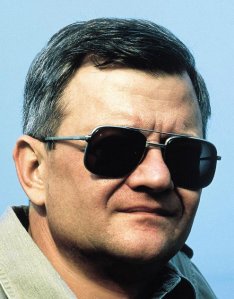
Tom Clancy (1947 – 2013) was born in Baltimore, Maryland. He attended Loyola College (now Loyola University) and majored in English Literature. While in school he enrolled in the Army Reserve Officer Training Corps (ROTC) program, but he was ineligible to serve due to his poor eyesight. Upon graduating, Clancy worked as an insurance agent and wrote in his free time. The Hunt for Red October started his career as a novelist. Clancy would go on to write or co-author nearly 20 fiction books, most of which feature the character Jack Ryan. Additionally, he would author numerous non-fiction works on military topics and technology.
Tom Clancy passed away in 2013 near his home in Baltimore due to heart failure at the age of 66. Even before then, his name was licensed to endorse movies, TV shows, and video game series; particularly those dealing with espionage, military intelligence, and technical topics. Despite not having any professional background in intelligence or as a naval officer, Clancy was known for doing extensive research for his works and popularizing the military fiction and techno-thriller genre.
Critical Observations
Positives
The best thing about the book is that it’s a detailed rundown of the inside of an improved Los Angeles-class submarine (AKA 688i), its main systems, and how it functions as a warship. There are some interesting factoids about some of the systems that I didn’t know. For example, the capacity of the freshwater distillation plant or the targeting systems of the boat. Clancy also details what is involved in becoming a submariner in the United States Navy, both as an enlisted person and as an officer. Additionally, he talks about the steps required to become a submarine captain. Most books only touch on the former, but not the latter.
In addition to USS Miami, the tour and comparison of HMS Triumph is also interesting since there’s a lot of commonality between the two boats and the services, but there are cultural differences in how each country operates its submarines, the technology, training, and tactical viewpoints. Not to mention that British submarines actually have alcohol available on tap for the off-watch sailors.
The book also provides a good layman’s explanation of how a nuclear submarine’s reactor works and propels the boat, by using the analogy of mousetraps and flying ping-pong balls… it makes sense in context. He also makes the point that a nuclear reactor isn’t a nuclear weapon. Since the nuclear reaction is controlled, it can’t release all of its energy at once like in a nuclear explosion. Naval reactors are also extremely overengineered with high safety margins, and there are several redundant systems.1
In addition to the submarines, it also details the weapons used by the boats and some hypothetical scenarios about how a submarine would fulfill certain roles and missions, such as stalking a ballistic missile boat, striking an airfield, or defending an aircraft carrier.
Negatives
One notable criticism I have of this book deals with the paperback version I have. While the book retains some 16 pages of glossy photos, the in-text photos and diagrams of the equipment of USS Miami have been completely removed from this edition. (Probably because this is the mass-market paperback edition with smaller pages than the trade paperback version.)
The book itself, even though revised, is now 23 years old at the time of this review. Even at that, the boats that are examined in the book are no longer in service. Miami was severely damaged in a fire while in overhaul in 2012 and stricken the following year, and Triumph was taken out of service in late 2024. Still, much of the information generally holds true today, but the technology and capabilities have somewhat changed.
The book’s jacket mentions that it contains “Tom Clancy’s controversial views on submariner tactics and training methods.” Umm…no. There’s nothing controversial in Clancy’s writing about submarine tactics and training. He does make a comparison between the U.S. and British systems for training prospective submarine skippers and notes that the U.S. Prospective Commanding Officer (PCO) course is meant to create good engineers and submariners, while the British Perisher course is meant to create good captains and leaders. Clancy admits that one system is not necessarily better than the other, and each country’s system is designed to meet its needs. On the flip side, one article written in 2009 by Lieutenant Commander Kelly Laing points out that the U.S. system is so focused on the technical nature of submarines, to keep the U.S. submarine service at the forefront of technology, that it often sacrifices the time and training to inculcate good leadership skills in submarine officers. Laing notes several instances where this myopic focus on technical skills has created toxic leadership in submarine captains. By comparison, the British system builds better leaders.2
At the time of the book’s writing, no U.S. submarine officer had taken and passed the Perisher, but that changed in 2001 when Rear Admiral Stephen Mack (then a Commander) became the first U.S. submarine officer to attend and pass the course.3 I haven’t found anything about a British Royal Navy submarine officer attending the U.S. PCO course.
Perhaps the biggest issue with this book, and many others like it, is that it only gives the reader a very tiny slice of what submarines are like and what kind of people the crew are. Clancy is somewhat known for overstating the capabilities of the military in his fiction books, and even this non-fiction book takes on an almost reverent tone at times. It all seems very clinical and perfect, but in reality, it isn’t. Not every submarine captain is some inspirational leader, and not every crew runs like a well-oiled machine. Even the machines themselves have drawbacks and limitations. Something as complex as a surface warship or a submarine needs constant attention to keep running because things don’t always work as advertised and often break down. Furthermore, submarines cannot do everything under the sun. (Although Clancy does cover some limitations of the boats he examines.) In the end, submarines are just one tool in the entire U.S. military; strong in some areas and weak in others.
Evaluation (Does the content support the thesis?)
The book does what it says on the tin. It gives you a rundown of two nuclear-powered submarines. While this book won’t change your perspective on submarines or reveal any amazing historical thesis, it does provide a lot of good factoids about submarine systems. Still, the slightly dated discussion on the respective countries’ system for training submarine skippers points to changing attitudes and methods.
Rating:
Very Good/Worth your time
Notes
- Clancy notes that the entire reactor plant is some 400% to 600% more robust than it needs to be to ensure that it cannot suffer catastrophic failure. This sturdiness and the additional backups are the result of the loss of USS Thresher in 1963. ↩︎
- Kelly L. Laing, “Leadership in Command Under the Sea” (Air Command and Staff College Air University, April 2009). ↩︎
- Sunil Parmar, “THE SUBMARINE COMMUNITY – SUBMARINE HEROES IN AUSTRALIA,” NSL Archive (blog), December 23, 2021, https://archive.navalsubleague.org/2008/the-submarine-community-submarine-heroes-in-australia. ↩︎
Bibliography
Laing, Kelly L. “Leadership in Command Under the Sea.” Air Command and Staff College Air University, April 2009.
Parmar, Sunil. “THE SUBMARINE COMMUNITY – SUBMARINE HEROES IN AUSTRALIA.” NSL Archive (blog), December 23, 2021. https://archive.navalsubleague.org/2008/the-submarine-community-submarine-heroes-in-australia.
 Fair Winds & Following Seas