Topic & Content
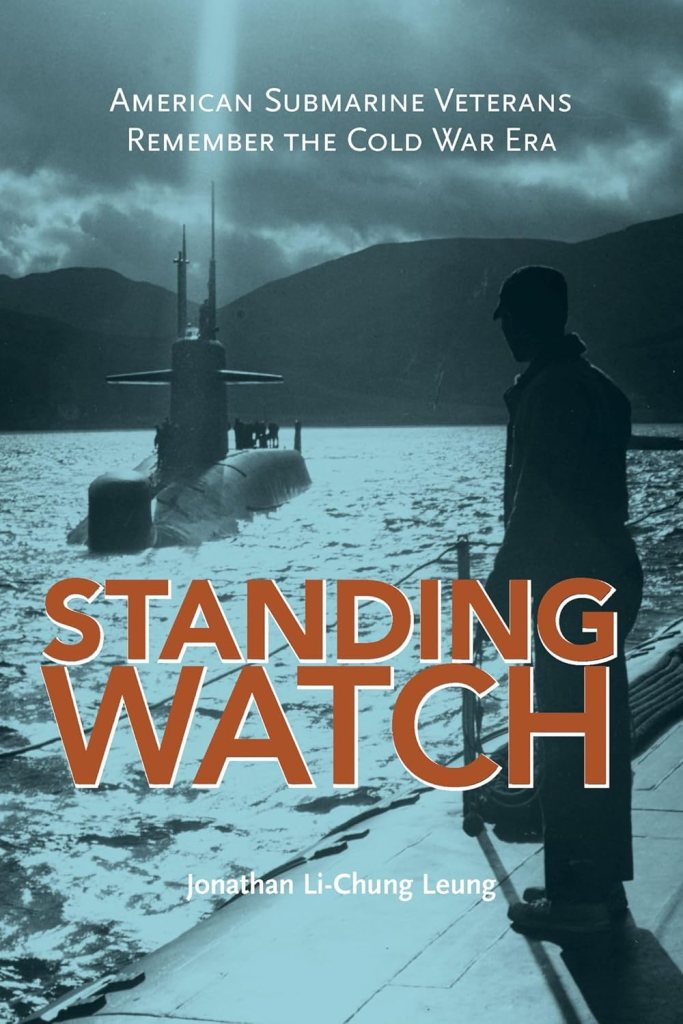
This book covers various submarine-related topics from the perspective of 17 Cold War-era submarine veterans interviewed by the author. As more of a collection of oral histories, the interviewees discuss their memories of joining the U.S. Navy and submarines, service on different submarines, visiting different ports, and the general life of submarine sailors. The book is organized as follows:
- Adventure’s Beginning
- Underway
- A Unique Culture
- Fighting the War
- Foreigner
- Looking Back
- Epilogue: Parting Legacies
The interviewees for this book are:
- Fred Carneau, ENCS (SS)
- Elbert “Collie” Collins, HMC (SS)
- Robert Austin “Bob” Jackson, EN3 (SS)
- William “Bill” Bryan, Jr., EN3 (SS)
- Robert “Bob” Walters, FTU3 (SS)
- Robert “Bob” Sumner, BT3 (SS)
- Gary Webb, SOS2 (SS)
- Herbert “Herb” Herman, ETR2 (SS)
- David Meade “Dave” Vrooman, EM1 (SS)
- Evert Charles “Chuck” Nelson, ETCS (SS)
- Richard “R.G.” Walker, CS2 (SS)
- Garth Lascink, MT2 (SS)
- Christopher “Chris” Stafford, MM2 (SS)
- Michael “Mike” Stephens, MTC (SS)
- Alan Nolan, STS2 (SS)
- Mark Manzer, STS3 (SS)
- Charles Fredrick “Chuck” Macaluso, CWO2
*Note: (SS) = Submarine qualified, which all these men are.
It’s important to note that all of the veterans interviewed in this book are/were involved with the museum ship USS Blueback in Portland, Oregon. Only two of the interviewees served on any of the three Barbel-class submarines (Chris Stafford on USS Barbel and Chuck Nelson on USS Blueback). This is because these were the volunteers that the author had access to. The restrictive pool of available interviewees also means that they were all men, and all enlisted sailors, except one (Chuck Macaluso), who rose to the rank of CWO2. Originally, a junior officer was going to be interviewed, but they dropped out at the last minute, so no commissioned officers were interviewed.
Author’s note: In my time working on USS Blueback as the supervisor and a tour guide, I have directly worked with the author of this book and Mark Manzer; both still give tours on the boat, although the former only occasionally. Additionally, I know a number of these interviewees, either by reputation or from brief meetings. R.G. Walker is one of the former Blueback supervisors, Mike Stephens (AKA Chief Mike) and Garth Lascink are former tour guides, and I’ve met the late Fred Carneau’s son.
Thesis
The simple thesis of this book is to tell the story of the submarine force during the Cold War from the perspective of the submariners themselves.
Author’s Background
Jonathan Li-Chung Leung began volunteering on USS Blueback back in the early 2000s and was part of the maintenance crew from 2002. He currently works as an air traffic controller in Honolulu, HI. On occasion, when he’s back in Portland, he still volunteers and gives tours on the submarine.
Critical Observations
Positives
As a collection of oral histories, this book is great at giving the reader an enlisted sailor’s perspective on submarines. Like any oral history, the narrative provides a strong sense of personal agency and emphasizes the human elements of submarines and Navy life. Aside from submarines, there are a handful of interesting factoids in this book, mostly owing to the fact that the interviewees’ experiences cover multiple decades and boats. For example, the U.S. Navy dive school is also covered since some of these men also qualified as divers.
Perhaps one of the best things about this book is the fact that the interviewees’ experience spans multiple decades; the majority during the Cold War from 1950 to 1990. This allows the reader to get a good sense of the institutional changes that occurred in the submarine service during this time. For example, the transition to a nuclear-powered submarine force was very gradual. In the 1960s, it was rare to see officers who were nuclear-qualified, but within 10 years, they were common. This institutional change goes to show that one sailor’s experience (either during a certain time or on a particular boat), while sharing many commonalities, isn’t necessarily identical to another sailor’s experience.1
The writing itself is decent, although nothing amazing. The author notes that he edited the interviews to make them flow better and omit any extraneous words. He also kept in a lot of the terminology and common English phrases, even those that weren’t necessarily grammatically correct, as long as they preserved the overall intent of the speaker.
Negatives
The book is topically organized, but the interviews are scattered throughout in tiny snippets. A lot of this has to do with the fact that the author chose to conduct the interviews in a group setting. This means that as they moved through the topics under discussion, the veterans would chime in with their experiences and add on to what others said. As a result, it gives the reader the feeling that the narrative is a little disorganized. That said, the author does address the limitations of oral history and group interview format. They note that the group interviews had the benefit of allowing the veterans to interact with each other and provide reinforcing or contrasting viewpoints.
This book is largely an oral history of submarine life; it’s not a history of Cold War geopolitics, proxy wars, or submarine operations. Anyone familiar with submarine history or submarine life probably won’t find anything revelatory in this book. This isn’t a book on the technical aspects of submarine construction, operations, or tactics. There are no examinations of secret submarine missions or projects like in the book Blind Man’s Bluff. This book is really just a collection of guys reminiscing about the old days on submarines in the Cold War. Readers expecting more of a technical overview would do well to look elsewhere.
Evaluation (Does the content support the thesis?)
Overall, the book is a fairly standard oral history collection centered around submarine sailors in the Cold War. The decades of experience represented by the interviewees give the reader a good overview of submarine life, what’s entailed in joining submarines, and how institutional changes have occurred. The organization of the book could be better, but the author chose to format the interviews in a certain way. Furthermore, the information presented in this book is nothing really new. Readers looking for a history of the Cold War, proxy conflicts, or technical information on submarines should find other works.
Rating:
Good/Borrow from a library.
- On a personal note, I occasionally encounter submarine veterans taking tours on Blueback who seem to assume that they’re the world’s expert on all submarines, and therefore, what occurred on their submarine must apply to Blueback, as well. While these submariners may be well-versed on their particular boat, they don’t know much about Blueback, a 1950s-vintage non-nuclear diesel-electric attack boat. A variation of this is when a veteran assumes that certain policies or practices still apply, when in fact things have changed. The reality is that most sailors aren’t historians, and the naval history that was taught to them was taught without much nuance. For example, I’ve met more than one sub vet who thinks women are still only serving on ballistic missile subs (AKA boomers). While it’s true that women initially started out only on boomers, today, there are over a dozen fast attack subs with women on them. I’ve even met one who was aboard USS Jimmy Carter. ↩︎
 Fair Winds & Following Seas