Well…nothing good.
A lot of people might be under the impression that the implosion of a submarine would be a slow and visible crushing of the hull. As you go deeper, the bulkheads and fixtures start creaking, groaning, and everything slowly buckles inwards. The space inside the submarine tightens and becomes more and more claustrophobic until everyone inside is slowly squeezed to death. Well, no. Now, a submarine hull will creak and groan as it makes significant changes in depth since the water is compressing it (this is actually depicted in a couple of films like The Hunt for Red October when USS Dallas dives down to 1,200 feet, and in Down Periscope when they dive down and a the string that’s tied across the hull noticeably sags), but the implosion of a submarine would be an instantaneous event.

For reference, the human eye blinks in about 100 milliseconds. The implosion of a submarine from the catastrophic failure of the pressure hull would occur in maybe half that time…give or take. We can demonstrate this with a soda can, a burner, and some ice water. We’ll conduct a little experiment and actually do some science here. See the video below.
As was seen, the implosion of the soda can was not a gradual process.
Here’s what happened:

As the water in the can was heated, it vaporized into gas (i.e. steam), creating more kinetic energy. Since the can was open at the top, the pressure equalized with the atmosphere, and the can didn’t bulge outward or turn into a bomb. When the can was turned over and the top was submerged in ice water, the can was now sealed. The ice water caused some of the water vapor inside to condense back into liquid, meaning there were fewer gas molecules inside the can. This decrease in kinetic energy also lowered the pressure inside the can, and now the atmospheric pressure (14.7 psi) on the outside was far greater, crushing the can.
Now, you might be wondering how this is the same as a submarine implosion since this soda can experiment involves 1 atmosphere of pressure, and the other involves many atmospheres of water pressure. You also don’t heat the air inside a submarine up to boiling temperature on the stove. Well, both air and water are fluids and operate on the same principles. The differences are in density, viscosity, compressibility, etc. This experiment used heat and cold to create a sudden pressure differential to the point where the atmospheric pressure on the outside was far greater than the pressure on the inside, and the thin aluminum can couldn’t withstand that outside pressure.
This experiment works with aluminum cans since aluminum cools very rapidly and is a very weak material. If you tried this with something denser, it won’t necessarily implode. Variations of this experiment can be done with a sealed container that is rapidly cooled. There’s also that famous Mythbusters episode number 239 (in the 2016 season), where they attempted to implode a railroad tanker car. However, they were only able to do it after dropping a 3,200-pound concrete block on it, putting a large dent in the thing and damaging the structural integrity of the tanker. Those things are designed to withstand a lot of pressure. Same thing with a well-designed submarine.
Described much more graphically to me by a former submariner, what happens during a submarine implosion is:
In about 50 milliseconds (probably less), the pressure hull gives way to the water pressure, and everything inside it gets crushed into a solid mass. Simultaneously, the collapsing pressure hull compresses all the air and other flammable liquids and fuels, creating the diesel effect where everything ignites in a flash. It may not burn everything to a crisp, but the temperature is about to get much warmer, and all the human-flavored goo inside of what were once people will be heated up. Then the water rushing in contributes to the crush and also has the added bonus of putting the fire out.
If it’s any consolation or comfort, you wouldn’t know what hit you. You’d be alive one instant, and then all of a sudden, you’d be standing at the entrance of the afterlife of your choice and wondering how you got there.
Diving Depth of Submarines
At sea level, you’re experiencing 1 atmosphere of pressure, which is about 14.7 psi. For every 33 feet you descend, the pressure increases by 1 atmosphere.
Now, the pressure hull of Blueback is made of HY80 steel that’s 1.5” thick.

The HY means it’s a high-yield steel, which is a low-carbon alloy composed of nickel, chromium, and molybdenum (with other trace elements). The 80 means that it can withstand 80,000 psi of pressure. This gives Blueback a test depth of around 712 feet and a crush depth of 1,050 feet. At that depth, there’s about 32 atm or 366 psi of pressure.
But wait, you just said the steel can withstand 80,000 psi, so shouldn’t it be able to go deeper?
In theory, yes, but at extreme risk to the submarine.
In fact, in the spring of 1960, USS Skipjack (a submarine with the same test depth and crush depth as Blueback) actually exceeded her crush depth and survived. While demonstrating the sub’s ability to some observing British Royal Navy officers, including the First Sea Lord, Admiral Sir Caspar John, Skipjack performed a hard dive and starboard turn at greater than 20 knots. However, the controls jammed, and the submarine took a nearly 30-degree down angle. Only after the crew managed to manually reverse the turbines did the sub recover and return safely to the surface.1
To my knowledge, in the history of the U.S. Navy using HY steels to make submarine pressure hulls, it has never failed and resulted in the loss of a submarine. This is because the steel isn’t what fails. What fails is something else, like a weld, a hull penetration (such as a valve), or something that damages the boat. It’s also worth noting that the crush depth of a submarine isn’t absolute. It doesn’t mean that once you hit crush depth, the submarine will automatically implode, but you don’t want to find out where that depth really is.

Now, the U.S. Navy has indeed lost submarines made from HY80 steel, the most recent ones being USS Thresher in 1963 and USS Scorpion in 1968, but it wasn’t because their pressure hulls failed. The use of HY80 steel extensively in U.S. submarines (both attack, ballistic missile, and research submarines) throughout the Cold War points to the quality of the material and to the conservatism of the U.S. Navy. The Thresher/Permit class boats, also with HY80 steel pressure hulls, had significantly deeper test depths of 1,300 feet than the earlier Skipjack and Barbel-classes due to improved welding techniques, piping, and other related improvements.2 Their hulls were likely thicker, as well. Even research submarines like USS Dolphin (AGSS-555) and NR-1, a nuclear-powered submarine, which had operating depths of 3,000 feet, were constructed of HY80. But their hulls were significantly thicker.3


When comparing U.S. and Soviet submarine designs, Norman Polmar and K.J. Moore note that U.S. submarine design and construction, along with their operations to some extent, became very conservative following the loss of USS Thresher. There was no significant increase in test depths of submarines, and even the Los Angeles-class had a decrease in test depth. The U.S. Navy’s heavy reliance on HY80, rather than stronger variants like HY100 or HY130, from the Skipjack-class all the way to the Los Angeles-class, including ballistic missile submarines, was due to submarines becoming “weight critical.” The increase in propulsion plant size, along with the difficulty in working with higher grades of HY steel, meant they stuck with using HY80. Had higher grades of steel been used, U.S. submarines during the Cold War could’ve had deeper operating depths, improved shock resistance, better compartmentalization, an increase in reserve of buoyancy, and improved weight margins to accommodate future growth. In contrast, Soviet submarines during the same time had increasingly deeper operating depths and more innovative designs. However, they also note that U.S. submarines were much safer, quieter, and had far better personnel training.4

The three submarines of this class were designed to be the ultimate Cold War attack submarines, with hulls made of HY100 steel. USS Jimmy Carter (SSN-23) was extensively modified to carry out classified missions, previously conducted by USS Parche (SSN-683).
There are even higher grades of HY steels, such as HY100 and HY130. The three Seawolf-class submarines were made out of HY100, and two Los Angeles-class boats (SSN-755 and SSN-756) had HY100 inserts to test the steel.5 HY100 gave the Seawolfs an operating depth of around 1,300 feet.6 Had we built more Seawolf boats, we would’ve used HY130 starting with the fourth one. The problem is that the higher up in grades of HY steel you go, the more difficult it is to weld. In fact, cracks in the welds significantly delayed the construction of the Seawolf subs, and we only ended up building 3 anyway.7

I’m not sure what the current Virginia-class boats are made of, but Polmar and Moore write that it’s HY100. This likely gives them a test depth of around 1,300 feet, as well.8 Tom Clancy writes that the Virginia and Seawolf boats are constructed of the same steel, but the former can’t dive as deep because the hulls aren’t as thick. However, this shouldn’t be construed as the Virginia boats being less capable. For one thing, the thinner hulls resulted in lower costs and weight than the Seawolfs. The Virginia boats also have more modern equipment and are specifically designed to operate more effectively in the littoral areas than the Seawolfs.9 A Google search gives differing answers; some sources say HY100, others say HY130. One blog article from 2011 notes that the hulls are made of HY120, reportedly giving them a test depth of 1,600 feet.10 However, take that with a grain of salt.
Titanium Hulls
There are even submarines, such as some Soviet/Russian boats, which had titanium pressure hulls that gave them significantly deeper operating depths.
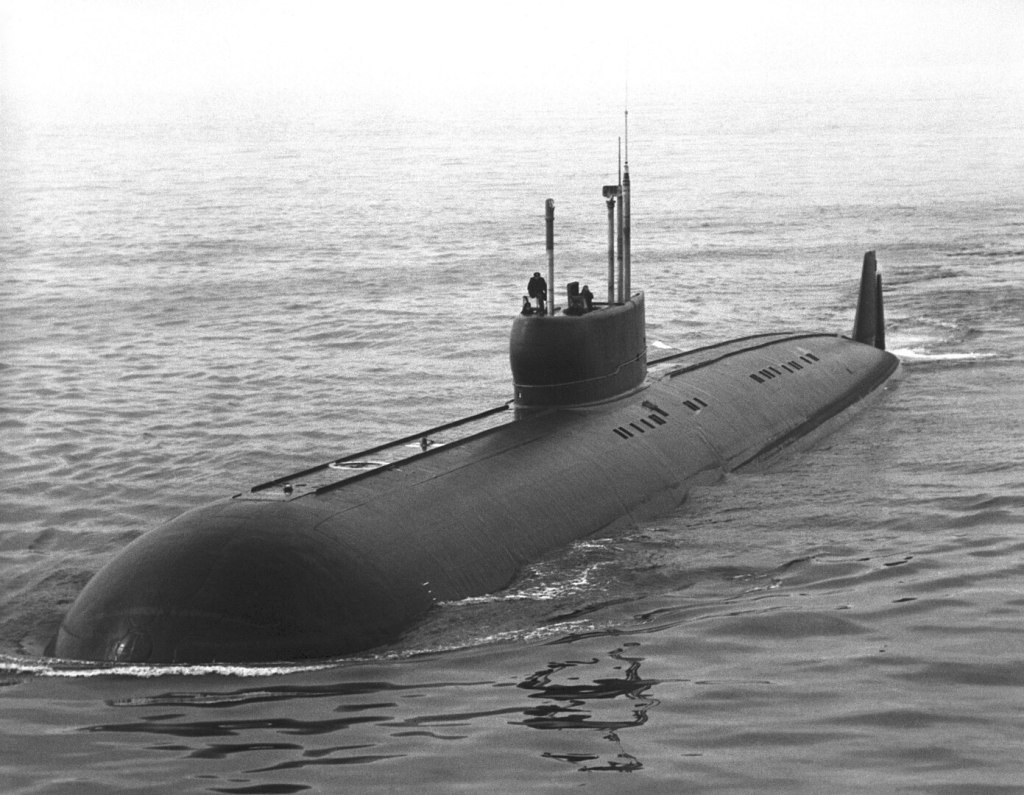


The Papa-class (Project 661) and Alfa-class (Project 705) boats had test depths of 1,300 feet.11 The same as the U.S. Permit and Sturgeon-classes. The Sierra-class had test depths of 1,970 feet.12 None of these matched the one-off Mike-class (Project 685) submarine K-278 Komsomolets, which had a test depth of 3,280 feet. Designed to test emerging technologies, the submarine was commissioned in 1984 and successfully reached test depth on 5 August 1985. Unfortunately, a fire sank K-278 on 7 April 1989, and 42 of the 69 crew aboard (including the commanding officer) were lost. However, for a brief time, it was the deepest diving combat submarine in the world.13
Mind you, I’m not a physicist, metallurgist, or engineer, so I don’t know squat about building submarines, but from what I’ve been told, titanium, while extremely strong, lightweight, and corrosion resistant, gets brittle over time as it fatigues. So while those subs had very deep diving depths, every time they dove down to test depth, the test depth got a little bit shallower each time. Additionally, titanium requires a lot of specialized equipment and skills for shipyards to work on. This limits the shipyards (foreign or domestic) that are available to maintain and repair a titanium hull. Even HY steels have limits and will fatigue over time. Norman Polmar notes that a submarine can dive to test depth roughly 300 times over the course of its life and still be expected to survive.14
Also bear in mind that I’m not discussing rescue submersibles like the DSRVs, which could dive to 5,000 feet, or bathyscaphes like Trieste and Trieste II, which could reach depths of 20,000+ feet.15
“What about that submarine that tried to reach the Titanic?”
Now, let’s talk briefly about the Titan submersible.
AKA how not to build a submersible, AKA how hubris and mismanagement can get you killed in the face of Mother Nature (who gives no F*cks).
A lot of people ask us tour guides about the Titan submersible incident. We don’t have any particular insight into that. The Titanic wreck is at about 12,500 feet down, and there’s about 400 atmospheres or just under 6,000 psi of pressure at that depth. Recall that Blueback is designed with a crush depth of about 1,050 feet. That’s not even 10% of the depth the Titanic is at, so it’s basically no comparison, and I know of no combat submarine that can dive down to the Titanic wreck. The only way that Blueback (or any modern combat submarine) is getting down to the Titanic is if it dives down, implodes, and sinks directly over the wreck site. At that point, you’ll never return, and you won’t live to see the wreck anyway.

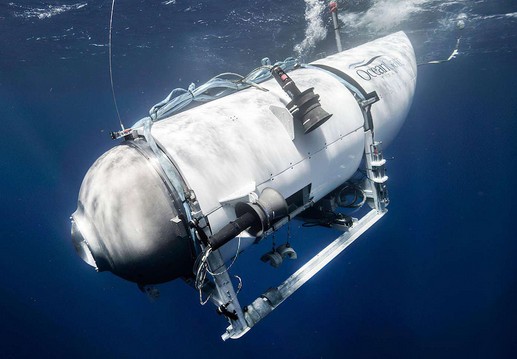
Now, there’s a lot that’s been said about the late Stockton Rush, Oceangate’s founder and Titan’s inventor/pilot. This guy had a Princeton education, a Bachelor of Science degree in aeronautical engineering, and an MBA from the University of California, Berkeley. He designed and piloted the Titan and got 5 people killed, including himself. From what I’ve read, he was originally interested in space exploration, but turned to undersea exploration.
The Titan submersible had a carbon fiber pressure hull capped with titanium domes at the ends. Both of these titanium endcaps were recovered, and the most common conclusion from the investigations points to a failure of the carbon fiber pressure hull. Photos and video of the wreckage show that Titan’s carbon fiber pressure hull was completely crushed by the implosion. It’s practically disintegrated.
The U.S. Coast Guard report of the incident concluded that the accident was completely preventable. Despite many employees voicing concerns about the company and the design of the submersible, they were all ignored or intimidated by Stockton Rush to keep silent. The disregard of safety regulations, neglected maintenance, a toxic company culture, and poor management by Rush led to the disaster. He flaunted a lot of regulatory oversight by saying that these expeditions were “scientific” in nature, but the reality was that they were glorified tourist expeditions.
Remind you that I’m no engineer, but suffice it to say that carbon fiber is not a great material to make submarines out of since it’s not a contiguous material like steel or titanium. Rush (with his aeronautical engineering degree) may have been better off designing aircraft or spacecraft out of carbon fiber since those don’t have to withstand tremendous external pressures. However, given his track record for poor management and overconfidence in his abilities, I suspect his inventions would’ve gotten people killed eventually, regardless. If not from poor design and engineering, then from poor management. They say that safety procedures are written in blood, and Rush simply added to the long history that supports that saying. Suffice it to say that I have zero sympathy for Stockton Rush. He got himself and 4 others killed due to his arrogance and idiocy.
Notes
- Norman Polmar and Kenneth J. Moore, Cold War Submarines: The Design and Construction of U.S. and Soviet Submarines, 1. ed (Dulles, Va.: Potomac Books, 2005), 136. ↩︎
- Polmar and Moore, Cold War Submarines, 150. ↩︎
- Polmar and Moore, Cold War Submarines, 209, 277. ↩︎
- Polmar Moore, Cold War Submarines, 324. ↩︎
- Norman Friedman, U.S. Submarines since 1945: An Illustrated Design History, Revised edition. Printed case edition, with Jim Christley (Naval Institute Press, 2023), 213. ↩︎
- Polmar and Moore, Cold War Submarines, 322. ↩︎
- Polmar and Moore, Cold War Submarines, 309. ↩︎
- Polmar and Moore, Cold War Submarines, 324. ↩︎
- Tom Clancy, Submarine: A Guided Tour Inside a Nuclear Warship, 2nd ed. (Berkley Books, 2002), 239. ↩︎
- admin, “USS VIRGINIA SSN 774-A NEW STEEL SHARK AT SEA,” ATI Courses, July 19, 2011, https://aticourses.com/uss-virginia-ssn-774a-new-steel-shark-at-sea/. ↩︎
- Polmar and Moore, Cold War Submarines, 146. ↩︎
- Polmar and Moore, Cold War Submarines, 291. ↩︎
- Polmar and Moore, Cold War Submarines, 287-88. ↩︎
- Polmar and Moore, Cold War Submarines, xx. ↩︎
- Polmar and Moore, Cold War Submarines, 208. ↩︎
Bibliography
Clancy, Tom. Submarine: A Guided Tour Inside a Nuclear Warship. 2nd ed. Berkley Books, 2002.
Friedman, Norman. U.S. Submarines since 1945: An Illustrated Design History. Revised edition. Printed case edition. With Jim Christley. Naval Institute Press, 2023.
Polmar, Norman, and Kenneth J. Moore. Cold War Submarines: The Design and Construction of U.S. and Soviet Submarines. 1. ed. Dulles, Va.: Potomac Books, 2005.
admin. “USS VIRGINIA SSN 774-A NEW STEEL SHARK AT SEA.” ATI Courses, July 19, 2011. https://aticourses.com/uss-virginia-ssn-774a-new-steel-shark-at-sea/.
 Fair Winds & Following Seas
Well, Tom, I sailed on a “target” ( the old USS Wasp). Your very thoughtful post raised my level of knowledge about subs by close to 100%. Thank you very much!
LikeLike