
Topic & Content
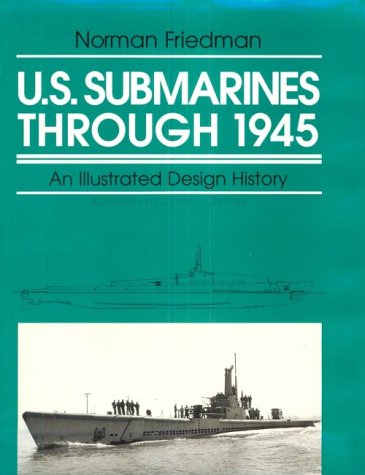
Published in 1995, this book chronicles the design of U.S. submarines from the Turtle in the American Revolution, through the 1800s, and ending with the Fleet Boats of World War II. The book is organized as follows:
- 1. Introduction
- 2. Beginnings: The Age of Manpower
- 3. Holland and His Rivals
- 4. Harbor Defense
- 5. The General Board’s Coastal Defense Submarines
- 6. Fleet Submarines
- 7. The S-Boats
- 8. World War I
- 9. Submarines for a Pacific War
- 10. Submarines for Mobilization
- 11. Detour: The Return to Limited Dimensions
- 12. World War II
- Appendices
- A. Submarine Propulsion
- B. Periscopes
- C. U.S. Submarines Through 1945
- D. Submarine Data
In some ways, this book is similar to John Alden’s The Fleet Submarine in the U.S. Navy. However, it covers more submarine classes, including earlier ones, whereas Alden’s book only focuses on WWII fleet subs.
Thesis
Oddly enough, for a Norman Friedman book, there’s no real thesis, but it’s a description of U.S. submarine development through WWII. By the end of World War II, a different kind of submarine was needed that wasn’t a surface ship that could submerge simply to hide. (The continued postwar development of U.S. submarines is covered in Friedman’s later volume, U.S. Submarines Since 1945.)
Author’s Background
Norman Friedman is a prominent naval analyst and theorist. Earning a Ph.D. in physics from Columbia University, Friedman specializes in strategic and technical issues, has consulted with various U.S. government agencies, and has served as the deputy director of national security studies at the Hudson Institute. His eight-book series on U.S. warship designs, of which this book is part, has been highly regarded as a standard reference on U.S. naval warship development.
Critical Observations
Positives
As with all of Friedman’s design histories, this book is a very detailed examination of the design and development of U.S. submarines from their beginnings through WWII. Be warned, however, that these books are not examinations of operational history. In addition to covering how submarine hulls changed, this volume also examines the development of associated systems related to submarines, such as propulsion, sensors, and weapons.
The book is well illustrated with extensive use of photos and line drawings. Naturally, for submarines prior to the advent of photography, only line drawings and illustrations were provided. That said, submarines like Turtle, Alligator, and Hunley, prior to John Holland’s designs, are only covered in roughly the first chapter (roughly 10 pages). As the book progresses, submarine designs are shown to advance until the U.S. designed the penultimate fleet boats used in WWII. Unlike other books on fleet boats, Friedman also goes into detail about the changing outfit of submarines throughout the war. Superstructures were cut down, antennas changed, and equipment added.
The footnotes of the book are extensive, as to be expected. Some of the more interesting information is the comparisons made between U.S. submarines and captured German U-boats. In many ways, German engineering resulted in better submarines, although they had fewer amenities than U.S. boats, and there were some design choices that the U.S. Navy found deficient.
Negatives
Since this book is part of Friedman’s design histories series, the writing and editing leave something to be desired. The writing is dry, and the transitions from topic to topic are abrupt. The organization of the book could be better within the chapters, and as a result, the overall narrative seems a bit disjointed or hard to follow. However, this is the same for all of the books in this series.
There’s surprisingly not much written about the design of the fleet boats from the Gato-class onward. So it’s almost like details about the fleet boats were left out. Unfortunately, even though the technology of these submarines was antiquated and declassified by the time of this book’s writing, there are few descriptions or photos of the interior of submarines apart from designers adding a few more feet for engines or other pieces of equipment.
Perhaps because submarines prior to the 1940s aren’t as relevant to today, I didn’t find this book as informative compared to Friedman’s second book on U.S. submarines post 1945. This book is only slightly longer than the second volume, including the appendices, even though it covers a much larger time period.
Evaluation (Does the content support the thesis?)
Overall, this is a very detailed history of U.S. submarines up to WWII. Friedman’s research shows that the development of U.S. submarines was very gradual and focused on increasing the power, endurance, armament, and sensors of submarines.
Rating:
Very good/worth your time
 Fair Winds & Following Seas