Topic & Content
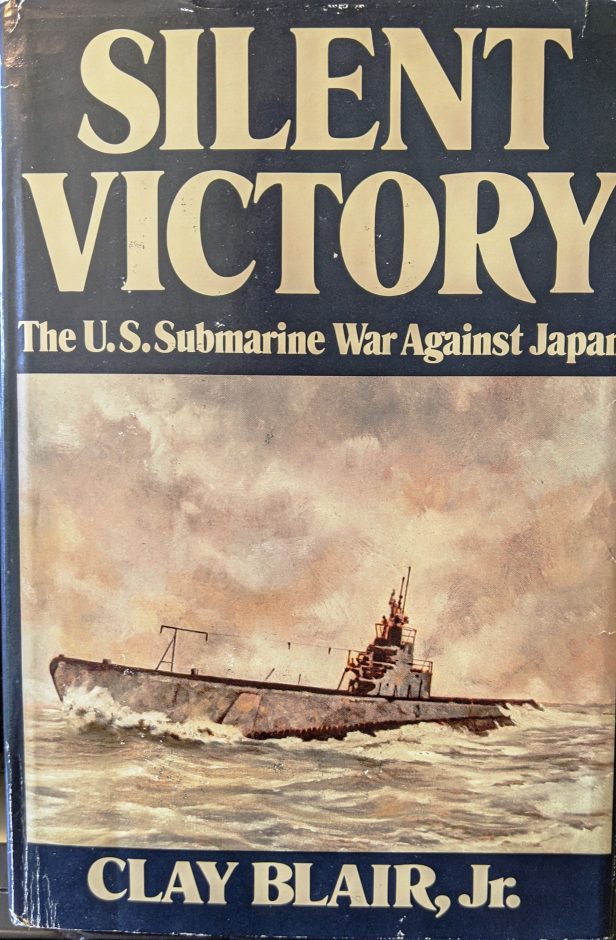
Published in 1975, the book covers the U.S. Navy’s submarine war in the Pacific Theater against Imperial Japan in World War II. The book is organized as follows:
Part I
- Background for War (Early developments – Progress in Europe – Submarines in World War I – Submarines and Politics I – Secret Enterprises – Submarines and Politics II – New Deal for the Navy – War in Europe – The Main Enemy – Plans in the Far East – Intercepted Mail)
Part II
- Pearl Harbor, December 1941 (The Japanese Attacks on Pearl Harbor and Midway – First Patrols to Empire Waters – First Patrols to the Marshalls – The Sinking of I-173 – Results of the First Patrols – The Japanese Attack on Wake Island)
- Manila, December 1941 (The Japanese Attack on Clark Field – The Japanese Attack on Cavite and Manila – The First Patrols from Manila – The “Battle” of Lingayen Gulf – The Loss of Manila)
Part III
- Java and Australia, January through April 1942 (The Japanese Drive to the Malay Barrier – Special Submarine Missions – The “Defense” of Java – Retreat to Australia – Evaluation and Decision)
- Pearl Harbor, January through March 1942 (January Departures – February Departures – March Departures)
- Brisbane, April and May 1942 (Arrival of More S-Boats – The Battle of the Coral Sea)
- Pearl Harbor, April through June 1942 (April Departures – The Hunt for “Wounded Bear” – The Battle of Midway – June Departures)
- Washington, June and July 1942 (The Midway Security Leak – Changes the Codebreaking Operation – H.O.R. Engine Problems)
- Alaska, 1942 (Japanese Landings on Kiska and Attu – Submarine Patrols in Alaskan Waters)
- Fremantle, April through August 1942 (Torpedo Tests and Experiments – Personnel Changes – Departing Patrols)
- Brisbane, May through September 1942 (The Battle of Savo Island – May, June, and July Departures – Battle of the Eastern Solomons – August and September Departures)
- Pearl Harbor, July through December 1942 (July, August, and September Departures to Truk – Patrols to Empire, East China Sea, and Alaskan Waters, July through October – Subversive Literature – Battles of Esperance and Santa Cruz – October, November, and December Patrols to Truk – November and December Patrols to Empire and East China Sea Waters)
- Brisbane, October through December 1942 (The Battle of Guadalcanal – Submarine Patrols – Changes in Personnel)
- Fremantle, September through December 1942
- Summary, 1942
Part IV
- Submarine Command, January 1943
- Brisbane, January through May 1943 (The Death of Admiral Yamamoto – “Playing Checkers” with Submarines – Wahoo’s January Patrol – The Palau-Rabaul Convoy Route)
- Fremantle, January through July 1943 (Experiment at Exmouth Gulf – Patrols and Losses)
- Pearl Harbor, January through March 1943 (The Casablanca Conference – Submarine Command Credits and Debits – Departing Patrols)
- Alaska, 1943 (The U.S. Invasions of Attu and Kiska – Patrols from Dutch Harbor)
- Pearl Harbor, April through August 1943 (Additions to the Pacific Fleet – Ultra-directed Patrols – Final Isolation of the Mark XIV Torpedo Defects – The H.O.R. Boats – Some Good Patrols, and Some Bad Ones – First Forays into the Sea of Japan)
- Brisbane, June through December 1943 (Surface-Force Engagements in the Solomons – More Boats for Australia – Single Patrols – Cooperative Efforts)
- Fremantle, August through December 1943 (Tankers and Targets – More Cooperative Efforts – Crevalle’s First Two Patrols – Mixed Bags and Special Missions – Puffer’s First Patrol – Loss of Capelin and Cisco – Final Deactivation of the Mark VI Exploder)
- Pearl Harbor, September through December 1943 (The U.S. Invasion of the Gilbert Islands – Improvements in Submarine Weapons and Strategies – Wahoo’s Last Patrol – Ultra-directed Patrols – Davenport, Dornin, and Cutter – Special Missions – More Ultra Information – Patrols Good and Not So Good – The First Three Wolf Packs – Changes in Command)
- Summary, 1943
Part V
- Pearl Harbor, January through April 1944 (The U.S. Invasion of the Marshall Islands – Interceptions in the Marshalls and Other Missions – Action During the Palaus Air Strike – Transfers to Fremantle – Empire and East China Sea Patrols – The Polar Circuit – Wolf Packs Four and Five – Patrols to the Marianas – Patrols to Okinawa)
- Australia, January through March 1944 (Codebreaking and the New Guinea Campaign – Patrols from Fremantle)
- Australia, April through June 1944 (Showdown in the Marianas – The Joint Strike on Surabaya – Patrols to Tawi Tawi and Davao – The Japanese Reinforcements of Biak)
- Pearl Harbor, May and June 1944 (Patrols to the Marianas – The Battle of the Philippine Sea)
- Pearl Harbor and Australia, June to July 1944 (The Fight for Saipan – Patrols from Pearl Harbor – Search for the Nickel Ship – Wolf Packs in Luzon Strait – Patrols in the East and South China Seas)
- Washington, Summer 1944
- Pearl Harbor and Australia, July and August 1944 (Debate over Pacific Strategy – Patrols from Pearl Harbor – Four Wolf Packs in Luzon Strait – Patrols from Australia – The Loss of Harder)
- Pearl Harbor and Australia, September to October 1944 (The U.S. Invasions of the Palaus and Morotai – Pearl Harbor Support of the Landings – Wolf Packs from Pearl Harbor – Single Patrols from Pearl Harbor – Australian Support of the Landings)
- Pearl Harbor and Australia, October to November 1944 (Air Strikes on Formosa and the Philippines – The U.S. Invasion of Leyte – The Battle of Leyte Gulf – Patrols from Pearl Harbor – Patrols from Australia)
- Pearl Harbor and Australia, November and December 1944 (New Inventions for U.S. Boats – Burt’s Brooms – The U.S. Invasions of Mindoro and Luzon – Patrols from Australia – Patrols from Pearl Harbor)
- Submarine Command, December 1944
- Summary, 1944
Part VI
- Pearl Harbor and Guam, January through March 1945 (The U.S. Invasions of Iwo Jima and Okinawa – Patrols from Guam – Attacks from the Air – Tirante’s First Patrol)
- Fremantle and Subic Bay, January through August 1945 (The Move to Subic Bay – Pursuit of Ise and Hyuga – The Remaining Targets: Isuzu, Haguro, Ashigara, and Takao)
- Pearl Harbor and Guam, April through August 1945 (New Forays in the Sea of Japan – Rescues and Targets – The Japanese Surrender)
Part VII
- After the War
Appendicies
- A. World War II Submarine Squadron Commanders, Pacific
- B. World War II Submarine Skippers Selected to Flag Rank
- C. Postwar Commanders of Submarines Atlantic Fleet
- D. Postwar Commanders of Submarines Pacific Fleet
- E. Submarine War Patrols, Atlantic
- F. Submarine War Patrols, Pacific
- G. Top Skippers of World War II
- H. Best War Patrols by Numbers of Ships Sunk
- I. Best War Patrols by Tonnage of Ships Sunk
- J. Top Submarines by Number of Ships Sunk
- K. Top Submarines by Tonnage of Ships Sunk
- L. Submarine Losses in World War II
Thesis
The book contends that had it not been for command weaknesses, misconceptions, and technical defects, the naval war in the Pacific might have taken a different course, and submarines may have been able to shorten the war in the Pacific by many months.
Author’s Background
Clay Blair, Jr. was a U.S. military historian and journalist. He served in the U.S. Navy as a submariner (Quartermaster, 2nd Class), initially aboard the submarine tender USS Sperry (AS-12) and then aboard USS Guardfish (SS-217) for her final two war patrols and into 1946, after which he left the Navy. Following the war, Blair attended both Tulane University and Columbia University, but did not graduate from either school.
His time as a journalist saw him writing for both Time and Life magazines, as well as the Curtis Publishing Company and The Saturday Evening Post. Later, he became a freelance writer and military historian, writing over 20 fiction and non-fiction books. Silent Victory: The U.S. Submarine War Against Japan is probably his most highly regarded work, and his history on the Korean War, The Forgotten War: America in Korea, 1950–1953 (1987), was also well-received. That said, some of his other military history books have been criticized for containing inaccurate narratives, being heavily biased, or failing to make use of non-English sources.
Blair died in 1998 at the age of 73.
Critical Observations
Positives
Some versions of the book come in two volumes, but if you can get your hands on the 1000+ page hardcover doorstopper, that is the single volume, then all the better. The best thing about this book is that it has benefited from updated research. This is especially true when you compare some of the stories and information in this book versus Theodore Roscoe’s U.S. Submarine Operations in World War II. For example, Blair debunks some of the myths and fantastical stories of submarine patrols that have been shared throughout time following the war. Still, Blair’s work is a treasure trove of information regarding U.S. submarine patrols in the Pacific.
The sources listed in the bibliography are far more varied and make use of both primary and secondary sources. Additionally, Blair’s writing is more accessible and far less dry than Roscoe’s.
Negatives
As with any book, there are always downsides. The first 50 to 60 pages of the book are completely unnecessary since they give the reader an early history of submarines in the U.S. Navy and elsewhere. It literally discusses the little submersible Turtle in the American Revolution, submarine developments in the 1800s, USS Holland, and submarines in WWI. Once you get into the narrative of the Pacific War, that early history of submarines is largely irrelevant to the course of the conflict. In reality, that whole first 60 pages could probably be excised from the book, and it wouldn’t suffer.
Unlike Roscoe’s work, which chronicles all U.S. submarine operations in the entirety of World War II, this book only covers the Pacific War, and the only mention of U.S. submarines in the Atlantic is in the appendices. Additionally, Roscoe’s work contains more detailed information on specific submarine tactics involving different methods of approaching and attacking a target. While Blair included a bibliography, there are no footnotes or endnotes in this book to find out where he attributed his information.
My final critique is that Clay Blair’s narrative somewhat lacks cohesion to effectively make his case and support the book’s thesis. This may be due to the fact that the narrative covers the entire Pacific War, and therefore, is really long. There is an ongoing discussion of the relieving of ineffectual (i.e. non-aggressive) sub skippers, admirals trying to micromanage submarine operations, and the infamous defects of the Mk. 14 torpedo, but those topics are only a small fraction of the whole book. The vast majority of it is simply discussing submarine operations and patrols. It almost seems like the thesis was simply tacked on as an afterthought, and Blair doesn’t really demonstrate how the war in the Pacific could’ve been shortened had the opposite been the case.
Evaluation (Does the content support the thesis?)
Despite my issues, Clay Blair’s work stands as a testament to the work done to chronicle the efforts of the U.S. submarine force in World War II. The benefit of hindsight allowed him to create a narrative that is less colored by the immediate postwar bravado that is present in other works. More recent research also debunks some of the more common myths/sea stories about submarines that have come up over the years, as well. Still, the beginning chapters of the book are totally unneeded, and the thesis, while there, could’ve been supported better.
Rating:
Very good/Worth your time
 Fair Winds & Following Seas