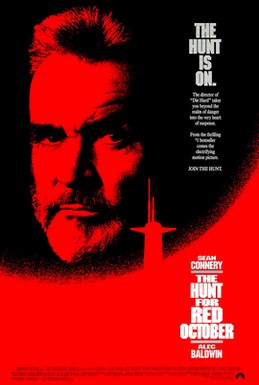
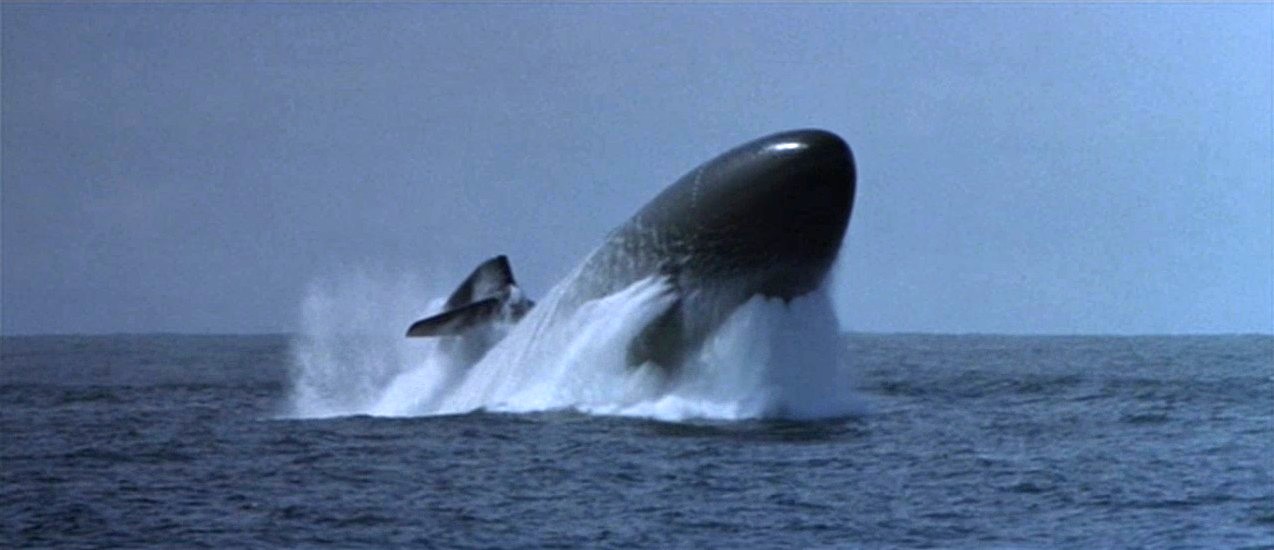
In November of 1984, shortly before Gorbachev came to power, a Typhoon-class Soviet sub surfaced just south of the Grand Banks. It then sank in deep water, apparently suffering a radiation problem.
Unconfirmed reports indicated some of the crew were rescued. But according to repeated statements by both Soviet and American Governments, nothing of what you are about to see…ever happened.
Opening text
- Director: John McTiernan
- Producer: Mace Neufeld
- Starring: Sean Connery, Alec Baldwin, Scott Glenn, James Earl Jones, Sam Neill
- Released: 2 March 1990 (United States)
Captain Marko Ramius (Sean Connery) has just taken command of the Soviet Navy’s newest ballistic missile submarine, Red October, which is equipped with a revolutionary new “Caterpillar Drive” that renders it nearly silent. Intentions unknown and with a set of fake orders, Ramius is headed across the Atlantic, possibly to fire his missiles on the U.S. As the Soviet Navy pursues Red October, American CIA analyst Jack Ryan (Alec Baldwin) deduces that Ramius is actually attempting to defect to the West. It’s just a question of who will find Red October first.
Plot
*FULL SPOILERS AHEAD!!!
Note: The film follows the book’s plot (see my review here) fairly closely with some major differences.

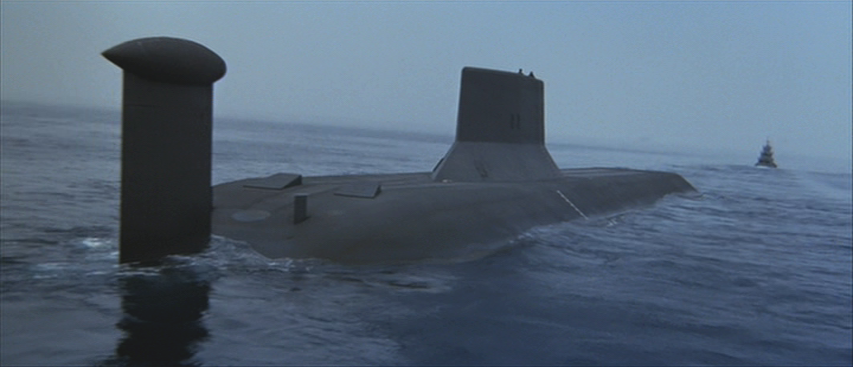
Captain First Rank Marko Ramius takes command of the Soviet Navy’s newest Typhoon-class ballistic missile submarine, Red October, and heads to sea from Polyarny Inlet near Murmansk. Renowned as the best submarine skipper in the Soviet Navy, Ramius has captained the lead boat in every submarine class for the past 10 years and trained many of the attack boat skippers. Unlike other Typhoon-class boats, Red October is a larger experimental variant equipped with the new “Caterpillar Drive,” which is hoped to provide the Soviet Navy with a technological edge over the U.S. Navy.

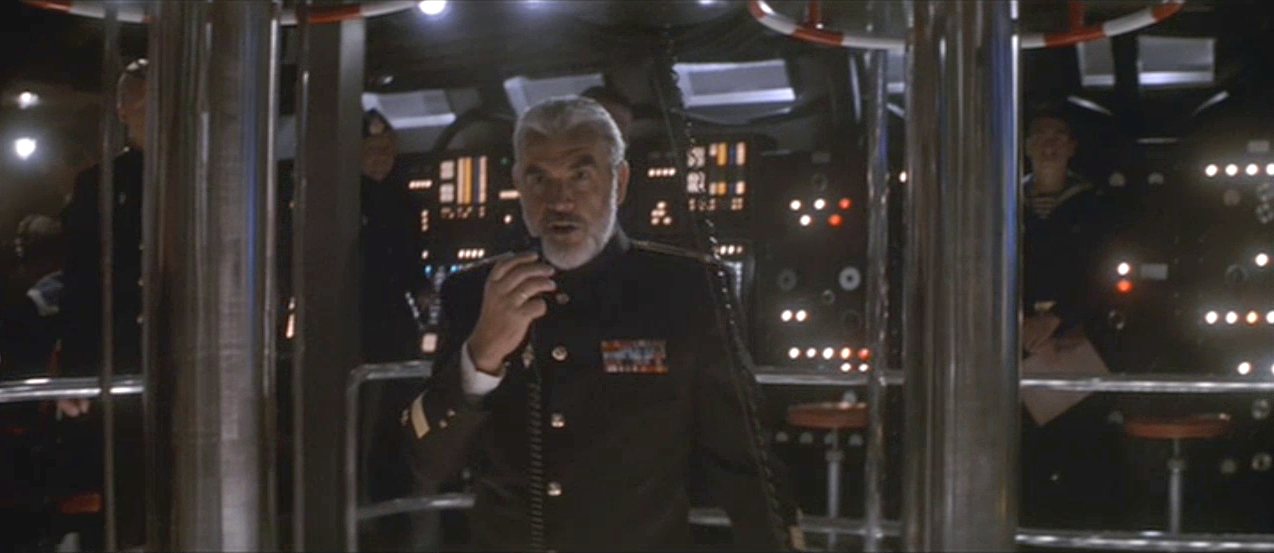
Ramius briefs his crew about their mission. Sean Connery clearly didn’t bother with attempting a Russian accent…but we don’t hold that against him. (The character Ramius isn’t Russian; he’s Lithuanian. But that doesn’t sound like Scottish, either.)

Although their orders specify rendezvousing with the Alfa-class submarine, V.K. Konavolov, for several days of exercises, Ramius kills Red October‘s political officer and takes his missile launch key, making sure several crewmen witness him do so. Producing a set of fake orders, Ramius gives his crew the impression that they’re going to conduct missile drills and sets a course for the U.S. East Coast. As it leaves Polyarny, Red October is detected by the nearby patrolling American Los Angeles-class fast attack submarine USS Dallas under the command of Commander Bart Mancuso (Scott Glenn). Sonar Technician 2nd Class Ronald “Jonesy” Jones (Courtney Vance) hears Red October but loses contact when it engages its Caterpillar drive.

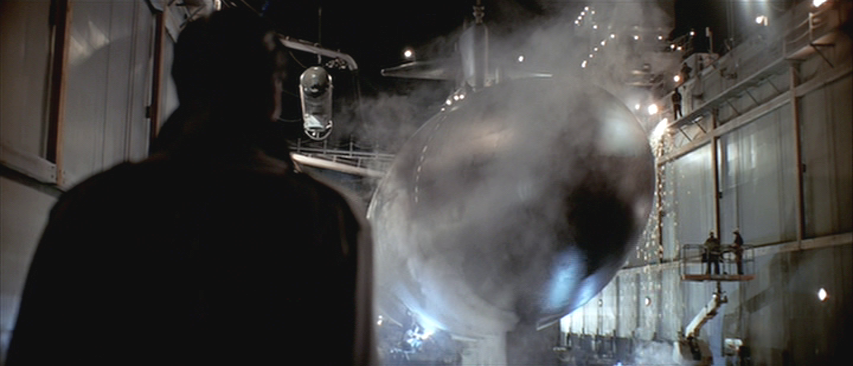
Before sailing, Ramius sent a letter to Admiral Yuri Padorin, his late wife’s uncle, and announced his actual intentions. Alarmed, the Soviet Northern Fleet, including Konavolov, sets sail in pursuit of Red October with orders to sink her. Meanwhile, Dr. Jack Ryan, a naval historian and CIA analyst, leaves London, England, and meets Admiral James Greer at CIA Headquarters to discuss new photographs of Red October recently obtained from British Intelligence. Upon showing the photos to Skip Tyler, a former submarine commander, the men conclude that Red October has a “Caterpillar Drive” that utilizes magnetohydrodynamic propulsion. Such a drive system has no moving parts and would make the submarine extremely quiet and difficult to detect by sonar.

Having confirmed the existence of Red October‘s new drive system, Ryan briefs the National Security Advisor, Jeffrey Pelt, and the Joint Chiefs of Staff on the situation at the White House. Based on the movement of the Soviet Northern Fleet, they initially conclude that Ramius has gone rogue and intends to launch an unauthorized nuclear strike on the U.S. However, Ryan deduces that Ramius, having recently lost his wife and being Lithuanian, with no ties to the Soviet Union, is actually attempting to defect to the United States. Thus, Ryan recommends that they take advantage of the situation and seize the Soviet submarine. Despite the incredulity of the Joint Chiefs, Pelt gives Ryan three days to prove his theory and dispatches him to the aircraft carrier USS Enterprise in the North Atlantic in hopes of eventually making contact with Ramius and determining what his intentions really are before the U.S. Navy will be forced to sink Red October.


Reviewing the sonar recordings of Red October, Jonesy discerns a distinct background noise which the sonar computer initially classified as magma displacement. However, Jonesy notes that the sound has a faint harmonic rumble that is too rhythmic to be natural. Now with the ability to track the Red October, Dallas reports to SUBLANT (Submarines Atlantic) that they have detected a new submarine that is headed for the canyons in the Reykjanes Ridge, known as Red Route One, off the Iceland coast, and continue the pursuit to intercept.

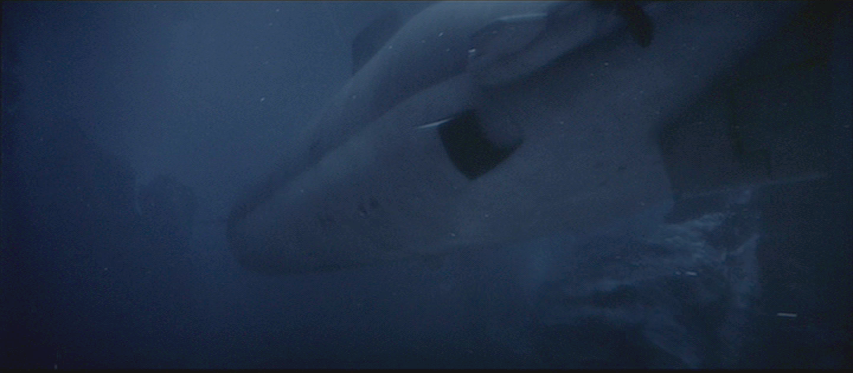


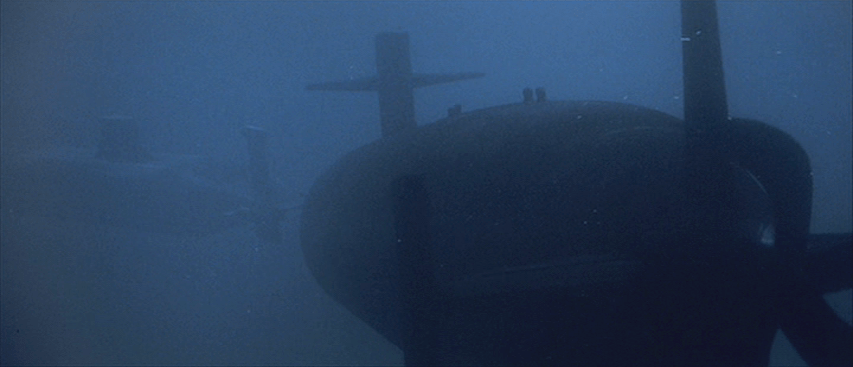
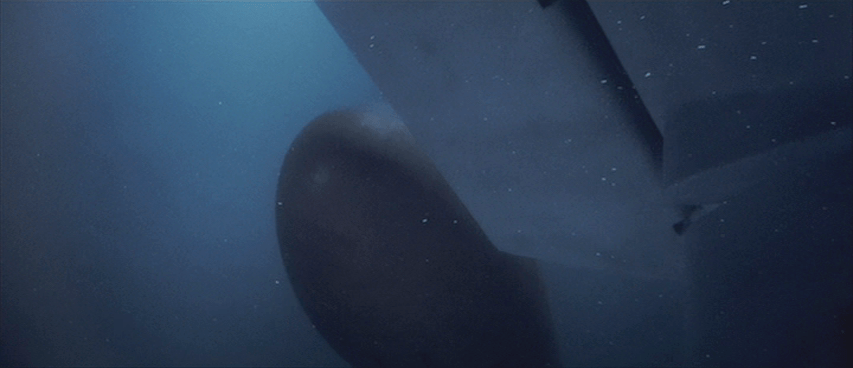


While transiting the canyons, the caterpillar drive suffers a malfunction due to an unknown saboteur, which forces Red October to run on normal propulsion. Subsequently, the sub is detected and forced to evade a torpedo dropped by a Soviet bomber. Emerging from the canyons, Red October is again detected by USS Dallas, which begins trailing the submarine; however, they’re forced to break off their pursuit to surface and take aboard Ryan, who has flown out to their position from USS Enterprise.
“Give me a ping, Vasily. One ping only, please!”
-Captain First Rank Marko Ramius


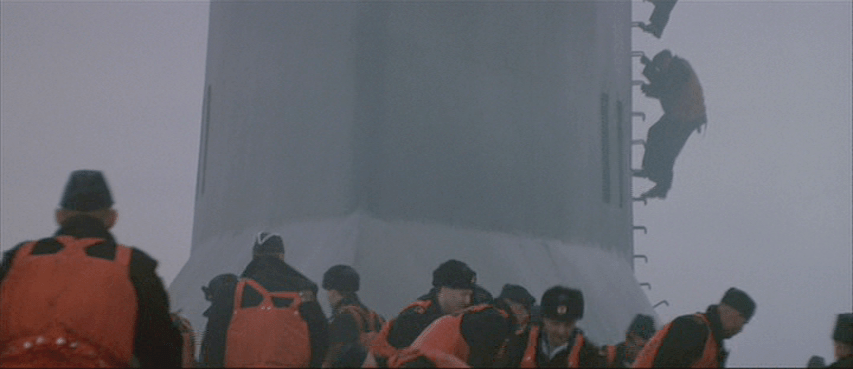
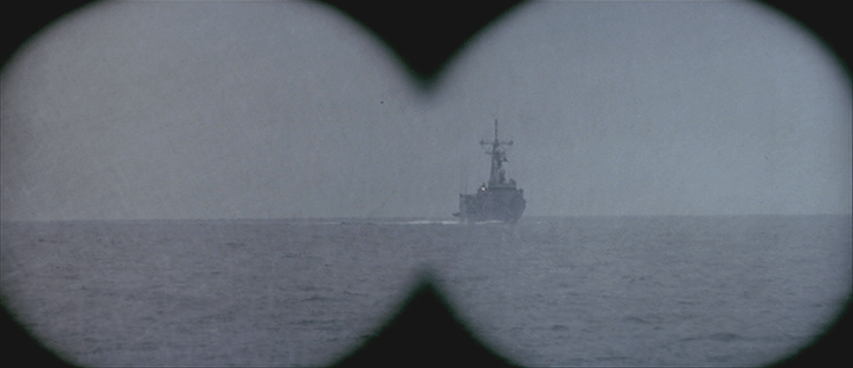
Ryan initially struggles but manages to convince Commander Mancuso of Ramius’s actual plans to defect by providing insight into his life and tactics. After establishing contact with Red October, the two submarines proceed to the Laurentian Abyss, an area of deep water off the Grand Banks. Upon reaching the area, a radiation accident is faked on Red October, which forces the submarine to the surface where they’re discovered by the nearby U.S. frigate, USS Reuben James. As the crew evacuates via lifeboats, Ramius and his defecting officers stay behind under the pretense that they’ll submerge and scuttle the boat. Meanwhile, the evacuated Red October crewmen are taken aboard Reuben James.


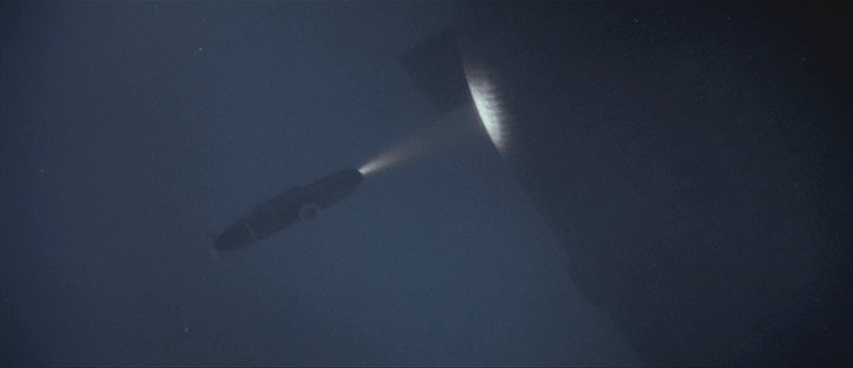
Ryan, Mancuso, and Jonesy board Red October via the DSRV Mystic, which has been transferred to Dallas, and confirm that Ramius and his officers wish to defect to the U.S. Unbeknownst to the men, Red October‘s cook, Igor Loginov, in reality, a loyal GRU agent, has stayed behind during the crew evacuation. Loginov kills Borodin, Red October‘s Executive Officer, wounds Ramius, and attempts to destroy the sub by blowing up a missile inside its tube; however, Ryan kills him before he can do so. Meanwhile, Red October is attacked by the Soviet submarine Konavolov, which has caught up with them.

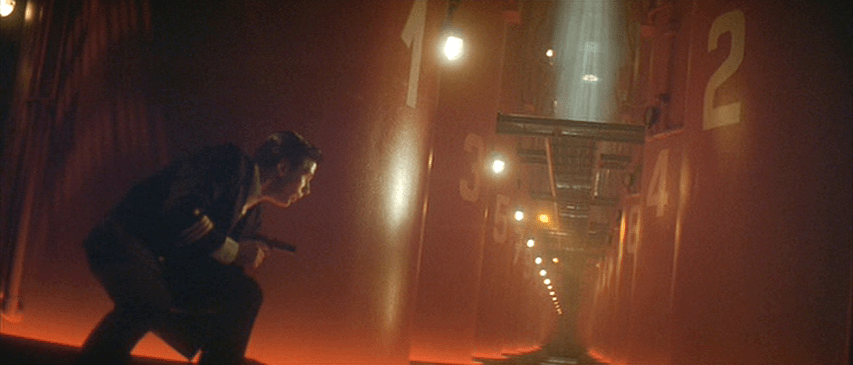

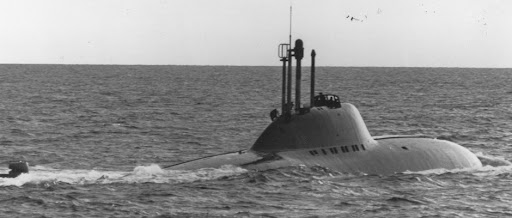




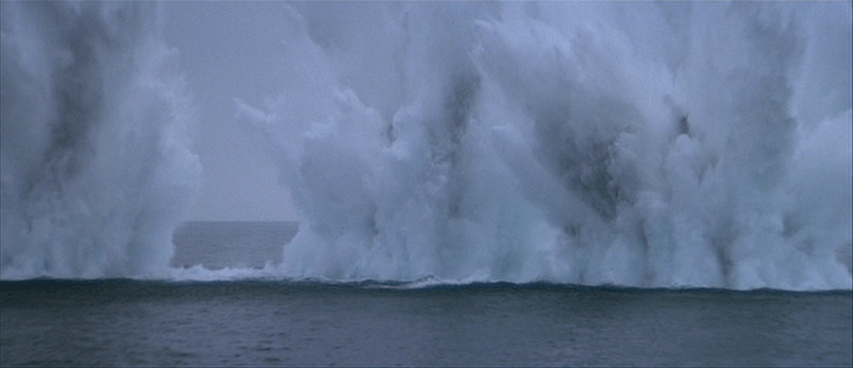
During the tense underwater battle, USS Dallas, unable to fire at Konavolov because of the rules of engagement, decoys one of Konavolov‘s torpedoes and gives Red October enough time to maneuver around and head directly for Konavolov, turning just before colliding, resulting in Konavolov‘s own torpedo sinking the sub.


Having reached the United States, Red October is hidden in a river in Maine to avoid detection by satellites. Ramius explains to Ryan his reason for defecting is that he is disturbed by the nuclear first-strike capability of Red October. Ryan welcomes Ramius to America and heads back home to London.
Historical Accuracies
There’s not much to talk about in the way of historical accuracy since this is a fictional story, but it does take place within the historical context of the late Cold War. Of course, according to the opening text, none of this ever really happened…or did it? Even in 2024, Cold War submarine operations are still cloaked in a great deal of secrecy.
As mentioned in my review of the book, Tom Clancy reportedly based the plot of The Hunt for Red October on a Master’s thesis he read about the real-life mutiny that occurred aboard the Soviet frigate Storozhevoy in November 1975. However, in that case, the mutineer, Valery Sablin, wasn’t attempting to defect, but rather was a staunch Leninist and was attempting to start another revolution. Still, the Soviet media presented the mutiny as an attempt to defect to Sweden.
As far as submarine movies go, The Hunt for Red October is probably one of the best. If Das Boot is the ultimate WWII submarine film, then this film is the ultimate Cold War submarine thriller. Director John McTiernan had recently come off the success of Predator and Die Hard in the late 1980s, so he was no stranger to action films. Like the book it’s based on, the film is relatively accurate to Cold War submarine operations. In many ways, the shadowing and stalking of Red October play out like the real-life submarine espionage operations written about in Blind Man’s Bluff. Given the technical (and secretive) nature of submarine technology and tactics, the film does a good job of explaining things to the viewer. For example, the baffles directly behind a vessel are a blind spot for hull-mounted sonars, and the Crazy Ivan is/was a real tactic (AKA baffle-clearing maneuver) and may have resulted in several collisions between U.S. and Soviet submarines. Although it’s been somewhat rendered obsolete with the use of towed sonar arrays. USS Dallas nearly colliding with Red October while trailing it is also accurate, and that’s why U.S. submarine skippers learned to trail Soviet submarines at a different depth (above or below) so they would lessen the risk of collision.
Another thing that the film does fairly accurately is the portrayal of the submarine captains, particularly Scott Glenn’s character, Commander Bart Mancuso. Glenn, himself a U.S. Marine Corps veteran, changed his demeanor when he and Alec Baldwin went aboard USS Salt Lake City (SSN-716) for an overnight trip prior to filming. Glenn shadowed the commanding officer, Commander Thomas Fargo, and was allowed to give commands to the crew under Fargo’s direction. The crew was given instructions to act as if Glenn were the captain and treat him deferentially. In the director’s commentary, John McTiernan noted that Glenn came back from his trip with a very different attitude in that he was much more soft-spoken, quiet, serious, and considerate of others. McTiernan compares submarine skippers to college presidents and the atmosphere on a submarine to that of a library because people are constantly studying; they speak in hushed tones, very directly, and very sparsely. Statements from other submarine veterans attest to this attitude. One former submarine veteran, who later joined the U.S. Army and retired as a Lieutenant Colonel, said that he never saw sub sailors on his boat get into a physical altercation. The worst was people getting in each other’s faces and exchanging some harsh language. In contrast, as an Army officer, he constantly saw soldiers getting into physical fights over petty things. This is because the U.S. submarine service heavily screens prospective submarine sailors for things like aggression. Sailors wanting to go into submarines go through a battery of physical and psychological evaluations to ensure that they’re mentally stable and fit enough to serve on submarines, given the cramped and challenging environment. After all, they’re not signing up for the infantry, and submarines do not need macho Rambo guys, but rather intellectuals. The world submarines operate in is very abstract. It does take a certain type of person to serve on submarines, and they don’t need loose cannons and hotheads.
Historical Inaccuracies/Oddities
For whatever reason, the film moves the events up to the year 1984 compared to the book’s (likely) 1982. The film was released in March 1990, at the tail end of the Cold War, and relations between the U.S. and the Soviet Union had thawed considerably at that point…not to mention that the Cold War was in its final year and the Soviet Union at that point had all but collapsed.
While the production crew had access to the submarines USS Chicago (SSN-721) and USS Portsmouth (SSN-707) for reference in set design, the interiors of the submarine sets seem a bit too roomy in some areas. Again, much of this could simply be handwaved because it would be highly impractical (if not nearly impossible) to film inside an actual submarine. For whatever reason, the interior of Red October is dimly lit when there’s no reason for it to be, and it’s also depicted as having a large compartment filled with missile tubes that’s accessible by the crew. In reality, the missile tubes on a Typhoon are situated between the two pressure hulls. Although, to be fair, we didn’t know much about the interior of the Typhoon-class subs at the time.

The film states that the Caterpillar drive on Red October uses magnetohydrodynamic propulsion. While I’m not a physicist or engineer, this is a real-world concept and several prototypes have been tested. Essentially, it uses a magnetic field to move water and propel the vessel. The problem is that water has a weak magnetic dipole, so to propel a submarine that’s even larger than a regular Typhoon at speeds of up to 25+ knots would require it to generate an enormous magnetic field that could easily be detected by anti-submarine forces with their Magnetic Anomaly Detectors (MAD). Additionally, it would not be quiet or energy-efficient in operation. Red October is better off using its traditional screws to stay stealthy. This is in contrast to the book which specifically calls it a “tunnel drive” which operates pump jets with impellers.
Red October navigating through the underwater canyon requires some suspension of disbelief. While Kamarov and Jonesy note that the Soviets had hyper-accurate surveys of the canyons, the reality is that submarines avoid underwater seamounts like the plague. USS San Francisco and USS Connecticut, both attack subs, found this lesson out the hard way when they collided with seamounts in 2005 and 2021, respectively. Even if you had the most accurate charts out there, once a submarine is submerged at depth, it’s reliant on dead reckoning and inertial navigation (gyroscopic compasses and accelerometers) to determine its position. I hope Red October had a really good navigational fix; otherwise, it would’ve slammed right into a mountain. And all this while traveling at 26 knots (and even flank speed when chased by the torpedo). Ramius got really lucky by turning at just the right time at Neptune Massif to evade that torpedo.
When initially tracking Red October, Jonesy correctly identifies the plant noise as that of a Typhoon. (A lot of what makes noise on a nuclear-powered submarine with a pressurized water reactor is the machinery and pumps of the reactor plant which is what Jonesy is hearing.) Then, when they lose contact after it engages the Caterpillar Drive, they don’t hear anything. In reality, the reactors on Red October would still be running, but they’re just powering the Caterpillar and not the screws, so Jonesy should hear the plant noise even more clearly and still be able to track them. Even then, once Jonesy identifies the unique sound that the Caterpillar drive makes, it effectively negates any stealth advantage that Red October had. Caterpillar or not, the Typhoons were noted to be particularly noisy, and further advancements in quieting technology on Soviet ballistic missile boats didn’t really come along until the development of the Delta IV-class.1 So all the time and money the Soviets invested in this technological project was rendered moot by a really good U.S. Navy sonar technician.
Ryan’s description of Red October changes throughout the film. For some perspective, Typhoons were the largest submarines ever built, at 564 feet long and over 74 feet at the beam.2 They have a submerged displacement nearly as much as the Titanic.3 Early in the film, Jack Ryan states to Admiral Greer that Red October is 12 meters longer and 3 meters wider than the standard Typhoon. This would make it 603 feet long and 84 feet at the beam. Strangely, when briefing the Joint Chiefs, Ryan states that it’s approximately 650 feet long with a submerged displacement of ~32,000 tons. “Roughly the same size as a WWII aircraft carrier.” Neither of these figures makes sense. Where did that extra 47 feet come from? Additionally, if a standard Typhoon is approximately 48,000 tons submerged, it already has a far larger displacement than a “WWII aircraft carrier” (Ryan is probably referring to an Essex-class carrier that displaces roughly 32,000+ tons4). Since Red October is even larger than a regular Typhoon, its submerged displacement would probably be closer to the Titanic‘s than a WWII aircraft carrier. He may have said that to give his audience (the National Security Advisor and Joint Chiefs) an easy mental comparison.
Another funny thing in the film is the ships used. The frigate USS Reuben James (FFG-57) is anachronistic to the events of the film. The film takes place in late 1984, and Reuben James was commissioned in 1986. She’s also in the wrong ocean. She was assigned to the Pacific Fleet, not the Atlantic Fleet. Since the film was shot on the West Coast, most of the ships were with the Pacific Fleet since it’s more convenient (and probably cheaper). USS Houston, portraying USS Dallas in the film, was homeported in Bremerton, WA, while Dallas at the time was homeported in Groton, CT.

Positive Criticisms
Author’s Note: Admittedly, this review won’t be very fair since I’m already very biased in favor of this film. I grew up watching it, and I’ve always enjoyed it, even if I didn’t understand the technical details and espionage elements of it as a kid. This film (and author Tom Clancy) pretty much codified our mental image of Cold War submarine operations and exciting underwater submarine battles.
The film follows the book fairly closely, and I think the film does one better by tightening up the story given the medium. The political maneuvering by the U.S. President, along with the subplots involving the CIA agent CARDINAL, the sinking of the Alfa-class sub E.S. Politovskiy, and the role of USS Pogy are absent from the film. In my opinion, these didn’t add much value to the plot of the novel and would’ve made the film needlessly complex had they been included.
One particularly good change to the film was the way the subterfuge was maintained with the crew of Red October. Upon reaching the Laurentian Abyssal, Red October suffers a “radiation leak,” and the boat surfaces. The crew then evacuates via lifeboats to the frigate USS Reuben James, which “totally wasn’t there by coincidence.” Ramius and the officers then dive the boat under the pretense that they’re going to scuttle it to prevent its capture by the Americans. Later on, when Konavolov is sunk by its own torpedo, the crew witnesses the explosion on the surface and assumes that it’s Red October. Thus, the illusion is maintained, and the crew believes it never fell into U.S. hands. This was pointed out by Admiral Painter earlier in the film when he asked Ryan about what they were going to do about the crew once they seized the sub. In the book, the crew was evacuated via the DSRV, so they knew something funny was going on.
The ending battle is changed in that Mancuso accompanies Ryan aboard Red October and performs the chicken maneuver with Konavolov, unlike in the book where he stays aboard Dallas. The film shows Konavolov being sunk by its own torpedo rather than being rammed by Red October like in the book. In the film’s ending, Red October is hidden in a river in Maine, whereas the book has her hidden in a drydock in Norfolk. Although the film takes several liberties with technology and condenses the storyline, I feel that it’s acceptable.
Regarding the casting, all of the actors feel natural in their roles, even if Sean Connery doesn’t seem in the least bit Lithuanian. Funny enough, Klaus Maria Brandauer was originally cast to play Ramius but dropped out of filming due to scheduling conflicts. Brandauer and Connery acted together in several other spy films like The Russia House and the unofficial James Bond film Never Say Never Again. Kevin Costner and Harrison Ford were the first choices for Jack Ryan, but eventually, it went to Alec Baldwin. Ford would later play Ryan in Patriot Games and Clear and Present Danger. I think Brandauer would’ve made a good Ramius since he’s Austrian, and I think he could more easily pass as an Eastern European. Kevin Costner would’ve probably made a good Ryan, in my opinion, although I do find his acting to be occasionally flat. Personally, I’m not a huge fan of Harrison Ford as Ryan since he’s so recognizable as Han Solo and Indiana Jones. He has too much on-screen charisma, and Ford doesn’t really play the everyman very well. In contrast, Alec Baldwin is really good at portraying Ryan as this former Marine and lowly CIA analyst who has clearly found himself in over his head. In any case, all the actors put in good performances. When I was reading the book, I could only hear in my head the voices of Connery as Ramius, Baldwin as Ryan, James Earl Jones as Admiral Greer, and Scott Glenn as Mancuso.
The best thing I have to say about this film is that it doesn’t hold your hand. It gives you pieces of the story and forces you to make inferences. There are no big bad villains in the film, just a lot of Cold War submarine espionage. In many ways, it’s a very cerebral action film, encapsulating the idea that submarines are very technical and abstract in their operations.
Negative Criticisms
I don’t have many criticisms of this film, but there are a few.
For some reason, the film completely omits the role that the British Royal Navy plays in the hunting of Red October. In the novel, Ryan goes aboard HMS Invincible, and they make the initial contact with Ramius, rather than USS Dallas as portrayed in the film. In the book, the American and British forces were there to counter the Soviet naval forces pursuing Red October, particularly the Kirov battle group. The film makes the titular hunt an entirely American effort, and the only mention of the British is that the first photos of Red October were obtained from British Intelligence. That’s it.
Ramius’s reasons for defecting are different in the film compared to the book. In the film, it’s merely implied that he’s disturbed by the purpose of Red October being a first-strike nuclear platform and the fact that it could shift the balance of power in the Cold War, but in the novel, he’s upset that his wife died at the hands of an incompetent doctor with good Party connections. So the film has him defect for more geopolitical, rather than personal reasons. My issue is that removing the personal reasons lessens the impact of Ramius’s motivations because ballistic missile subs were nothing new at this time.
Now, there are those who believe we should attack the United States first. Settle everything in one moment. Red October was built for that purpose.
Yeah, so are all ballistic missile submarines. Their entire purpose is to go out, hide, and be ready to launch their nuclear missiles should they receive orders to do so. Red October is no different, and apart from the new drive system, there’s nothing particularly unique about it, other than its large size.
In terms of special effects, the torpedo scenes used early CGI, which is evident in the bubbles and cavitation left in their wakes. Growing up viewing this on VHS, most of the underwater shots are really dark and hard to see. The film used models for the exterior underwater shots and dry for wet shooting. What looks like water is actually smoke and particulates. Other odd shots include showing the classic footage of the F9F Panther crashing onto the deck of the carrier instead of what’s supposed to be an F-14 Tomcat. The end shot of Ramius and Ryan talking about fishing while hiding the sub in the river is obviously bluescreen, as shown through their hair lines.
There are a host of other technical inaccuracies in the film, but they don’t detract from my enjoyment of it.
Final Verdict
The film follows the book fairly closely, although it does alter or omit a number of major plot points. Despite these changes, I find the film to have a much tighter and more coherent storyline. It cuts out a lot of what dragged the narrative of the novel down and focuses the story on a handful of characters. While it has some technical inaccuracies, most of these could be chalked up to either artistic license or the fact that details of Soviet submarines weren’t known at the time. All of the actors do well in their roles, and the film provides a good visual medium for the audience to visualize a submarine thriller. All in all, The Hunt for Red October still stands as one of the best Cold War submarine thrillers out there.
4.5 out of 5. Very good/Worth your time.
Notes
- Polmar & K.J. Moore, Cold War Submarines: The Design and Construction of U.S. and Soviet Submarines (Dulles, VA: Brassey’s Inc., 2004), 197. ↩︎
- For comparison, the largest U.S. submarines, the Ohio-class, are 560 feet long and 42 feet at the beam. The upcoming Columbia-class which will replace the Ohio-class are the same size, but 1 foot wider. Nearly two of these side-by-side will fit inside the outer hull of a Typhoon! ↩︎
- “Titanic FAQs: What Was Titanic’s Displacement? | Atlantic Liners,” accessed December 11, 2024, https://atlanticliners.com/white_star_home/titanic_home/titanic-faqs-what-was-titanics-displacement/. Titanic displaced roughly 52,000 tons and a Typhoon has a submerged displacement of roughly 48,000 tons! ↩︎
- Norman Friedman, U.S. Aircraft Carriers: An Illustrated Design History (Annapolis: Naval Institute Press, 1985), 394. ↩︎
Bibliography
“Titanic FAQs: What Was Titanic’s Displacement? | Atlantic Liners.” Accessed December 11, 2024. https://atlanticliners.com/white_star_home/titanic_home/titanic-faqs-what-was-titanics-displacement/.
Friedman, Norman. U.S. Aircraft Carriers: An Illustrated Design History. Annapolis: Naval Institute Press, 1985.
Polmar, Norman, and Kenneth J. Moore. Cold War Submarines: The Design and Construction of U.S. and Soviet Submarines. 1. ed. Dulles, Va.: Potomac Books, 2005.

