Topic & Content
Not to be confused with the somewhat similarly titled Tom Clancy novel Red Storm Rising.
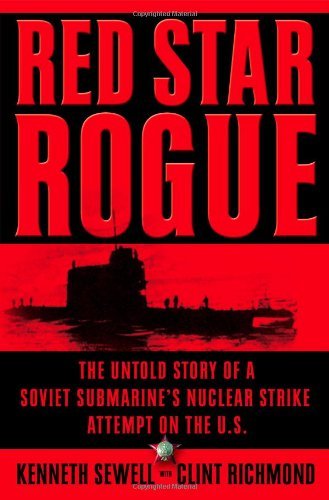
Published in 2005, Red Star Rogue covers the events that led to the sinking of the Golf II-class Soviet ballistic missile submarine K-129 and its attempted recovery by the CIA. Author Kenneth Sewell posits the theory that the submarine had gone rogue after having been taken over by a group of KGB spetsnaz/osnaz commandos who were attempting to launch an unauthorized nuclear strike on Hawaii. This rogue nuclear attack would then be blamed on the People’s Republic of China which possessed a similar submarine, and a subsequent retaliation by the U.S. against China would allow the Soviet Union to move in and restore order. Additionally, Sewell asserts that the eventual discovery and recovery of the submarine by the CIA using the Hughes Glomar Explorer was in fact far more successful than has been publicly admitted.

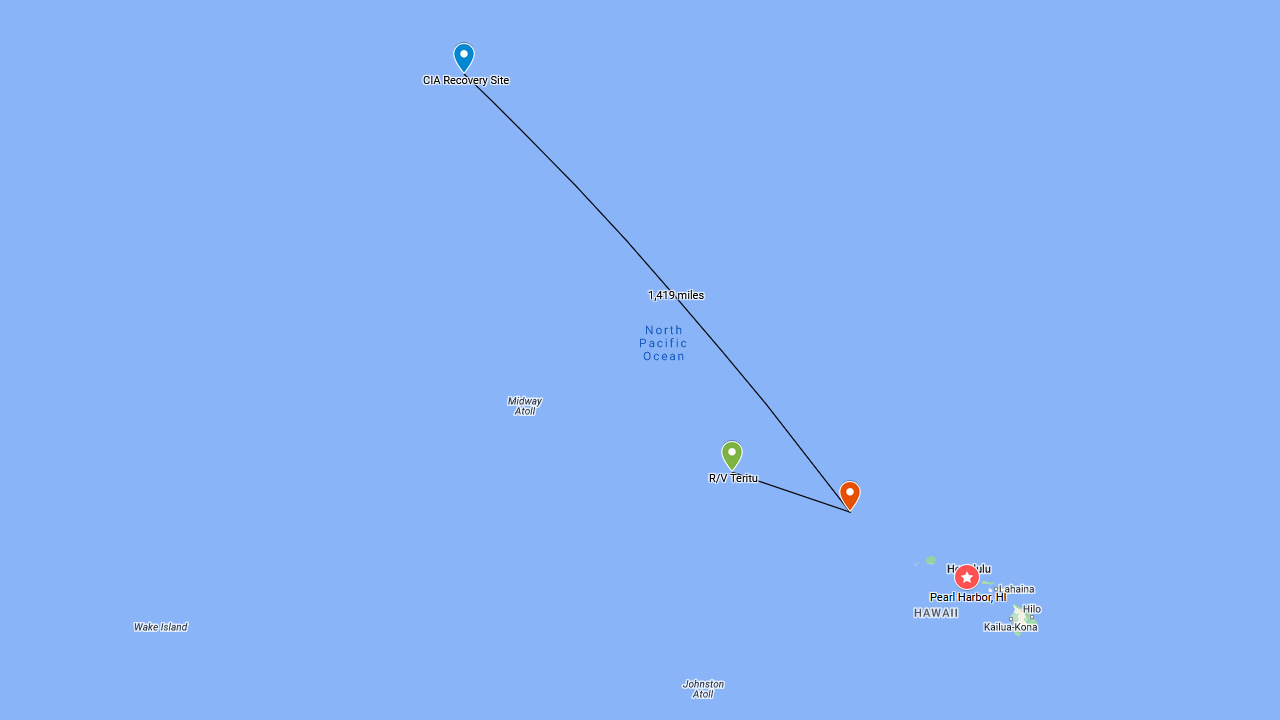
Sewell claims that the CIA Recovery Site of the K-129 wreck (blue marker) at 40°N 180°E, on the International Date Line, is a cover-up and that the actual location of the wreck (red marker) is about 1,419 miles further SE at 24°N 163°W. The sub was at a launch position for a nuclear strike on Pearl Harbor, HI (star). His main piece of evidence for this closer position is the discovery of a radioactive diesel oil slick (some 344 miles long) discovered by the R/V Teritu (green marker) at approximately 25°N 168°W sometime in March 1968.
Thesis
The thesis is not well-defined but the author is attempting to answer the remaining questions about the last mission of K-129. He basically states that only a handful of people knew just how close the world came to a nuclear armageddon in 1968.
Author’s Background
According to the biographical blurb on the dust jacket, Kenneth Sewell is a U.S. Navy submarine veteran and nuclear engineer who spent five years aboard USS Parche (SSN-683).1 Following his time in the Navy, Sewell has worked for the Department of Defense and the Department of Energy with security clearances in both.
Critical Observations
Positives
Unfortunately, I don’t have many positive things to say about this book. On the upshot, the writing is decent and Sewell cites the information in the book with endnotes, so anyone doing follow-up research can track down his sources. Some of the sources are authoritative, which does lend some weight to his arguments, but that’s all that can be said for that.
At best, Sewell has an interesting theory, and this book serves as an alternative interpretation of the events, but I have far more problems with the historiography of this book than with the narrative.
That’s where the positives end.
Negatives
Alternative Interpretation or Conspiracy Theory?
My biggest issue with the book, and why I don’t really buy into Sewell’s version of the events, is that it reads like conspiracy theory schlock (albeit decently written…I’ll give it that).2 The reader is supposed to believe that this submarine was taken over by KGB commandos and there was a failed nuclear launch and explosion that sank the sub in deep water much nearer to Hawaii than officially claimed. Since there’s no solid evidence of what actually happened on the boat among the crew prior to its sinking, this section of the book is pretty much pure speculation.
Additionally, Sewell claims that the CIA has covered up the actual location of the wreck site and (using the Glomar Explorer) was successful in raising the entire submarine off the seabed, analyzing it, and then secreting it away once they returned to the U.S.3 Since then, an airtight lid has been kept on this whole thing for reasons of national security and the potentially dangerous political fallout that could occur should the truth get out.
Sewell’s writing reminds me of people who always assume that these types of events are driven by furtive backroom, behind-closed-door deals, and sinister conspiratorial plots.4 In short, Sewell’s interpretation of the sinking and recovery of K-129 reads as wildly speculative at best and conspiratorial at worst.
Dubious Claims & A Lack of Evidence – “Can neither confirm nor deny…”
Part of what historians do is find connections to determine causal links between events using verifiable sources, but the historiography and credibility of the sources used in this book are questionable. While Sewell does provide some solid evidence, most of which is cited, it all seems like he’s clutching at straws and trying to find connections to link these events together. The problem is that all the evidence and sources used are cherry-picked, and what verifiable evidence he does use only conforms to his theory (i.e. confirmation bias). It all fits very neatly into this grandiose story that has somehow been kept under wraps despite multiple attempts to uncover any solid documentation on it.5
While endnotes are provided, there is no bibliography for the book. Apart from that, the big issue is that much of the evidence that forms the crux of Sewell’s theory is derived from sources he interviewed or contacted who were supposedly high-ranking government intelligence officials (or people in the know), but “requested to remain anonymous” or were otherwise sworn to secrecy. In analyzing the sources used, I counted at least 20 instances where the information was derived from an anonymous/classified source, based on speculation, or simply no citation was given. 11 of these related to the secret mission of K-129 and the mysterious new crewmembers, 1 was about the cause of the sinking, 2 were about the location of the wreck, and 6 related to the CIA’s recovery of the wreck (and what materials were salvaged).6
There’s always a danger in relying solely on oral testimony or personal anecdotal evidence because the interviewee could be misremembering things, forgetting details, or recalling decades-old facts that have become muddied through time. At worst, they could just as easily fabricate their own version of the story and bias it in their favor. The problems compound when the source used is an anonymous person who can neither confirm nor deny the facts. The problem is that their deniability means that they don’t have to provide any documentation or physical evidence of their claims. So the reader has only this anonymous source’s word to go off of, making it all just a bunch of hearsay. An anonymous and unverifiable source is really just no source at all. It’s poor historical practice on Sewell’s part and he should’ve made it clear at the start of the book that his theory is really just a lot of speculation.
Effectively, Sewell’s claims are based on an appeal to ignorance and an argument from silence.7 While the people involved were sworn to secrecy (which is likely true to some extent), it’s conveniently all a big cover-up. If the evidence effectively no longer exists then we can’t prove or disprove Sewell’s claims. This means it’s not only irrefutable but also unreliable. It opens things up to a lot of speculation and doesn’t make for good history because it can’t be verified.
There’s no doubt that K-129 sank, and what we do know about Glomar Explorer and the CIA’s attempt to recover the submarine is already fantastical, but verifiable, nonetheless.8 The reasons for the government’s continued silence and deniability of the events may point to something less fantastic than a rogue submarine and a failed nuclear strike on Hawaii in the middle of the Cold War. The reality may just be very mundane.
Counterarguments
Another serious issue with the book is that Sewell doesn’t take time to address counterarguments, apart from saying that K-129 wasn’t sunk in a collision with USS Swordfish (SSN-579) or due to a hydrogen explosion. His whole argument is that what really happened aboard K-129, the location of the wreck, how much, and what was recovered is all a big lie fabricated by the government. Since the whole thing is classified, the truth will never get out. (i.e. His theory is the only correct one and good luck trying to disprove it because nobody knows.)
Yet, despite this secrecy, other firsthand accounts have come to light that discredit Sewell’s version of the events. One reviewer on Amazon.com by the name of Ray Feldman, who was a former Lockheed engineer aboard Glomar Explorer during the recovery, debunks most of Sewell’s claims.9 Specifically:
- K-129 did in fact sink at 40º N 180º E on the meridian. “The location of the recovery site was not restricted to “ranking members of the Glomar crew and the CIA managers” as Mr. Sewell claims.” Feldman also states “Other and I would frequently visit the bridge where we could observe the Transit NAVSAT position being displayed on the navigation console.”
- Only the forward 38-foot section of the bow was recovered, NOT the whole sub, and not in multiple sections, as Sewell claims.
- Only 6 bodies were recovered rather than the 60 or more Sewell claims.
- The ship’s bell was recovered in the bow of the submarine where it was stored. Sewell claims it was found in the conning tower. While the bell is mounted in the conning tower when entering and leaving port, it’s stowed when underway to prevent ringing.10
- There were no missiles, warheads, codebooks, or encryption equipment recovered.
- Only the forward section of the wreck was intended to be recovered and no more than one trip was planned.
- The interior of the forward section was compacted into a dense mass and appeared much like an archaeological site.
- The recovered section was radioactively contaminated with weapon’s grade plutonium debris. Feldman speculates that seawater leaked into the missile tube and reacted with oxidizer residue that started a fire and caused a breach in the fuel and oxidizer tanks of a missile. The resulting explosion inside a missile tube is what sank the submarine. (i.e. not a failed launch attempt.)
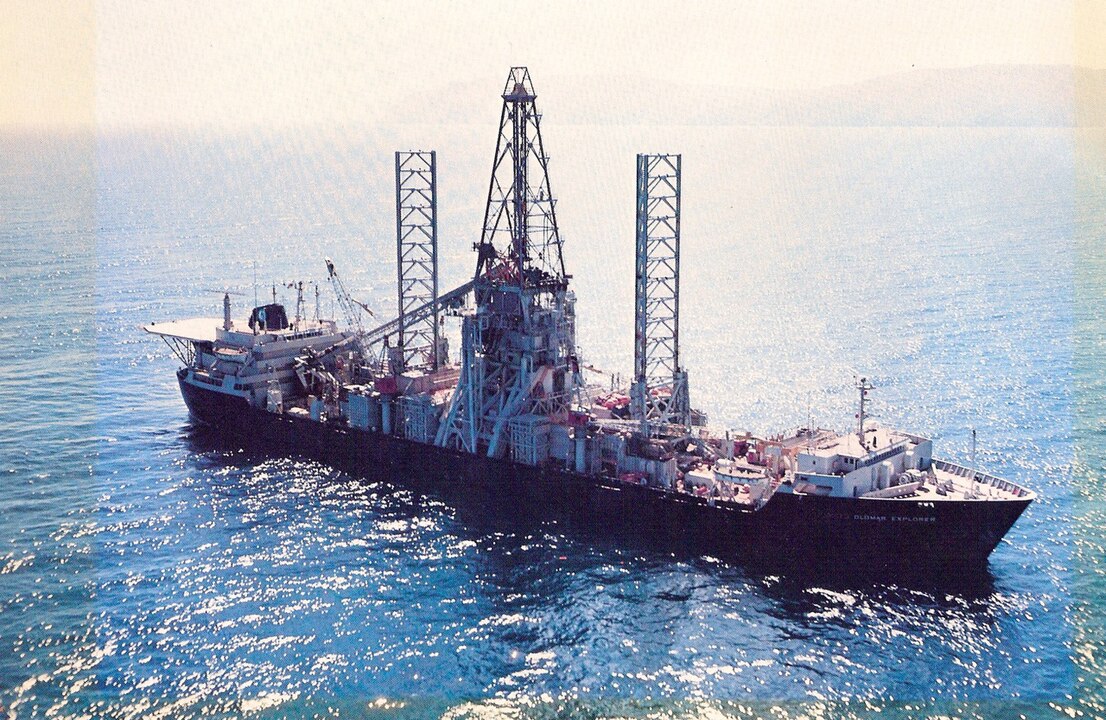
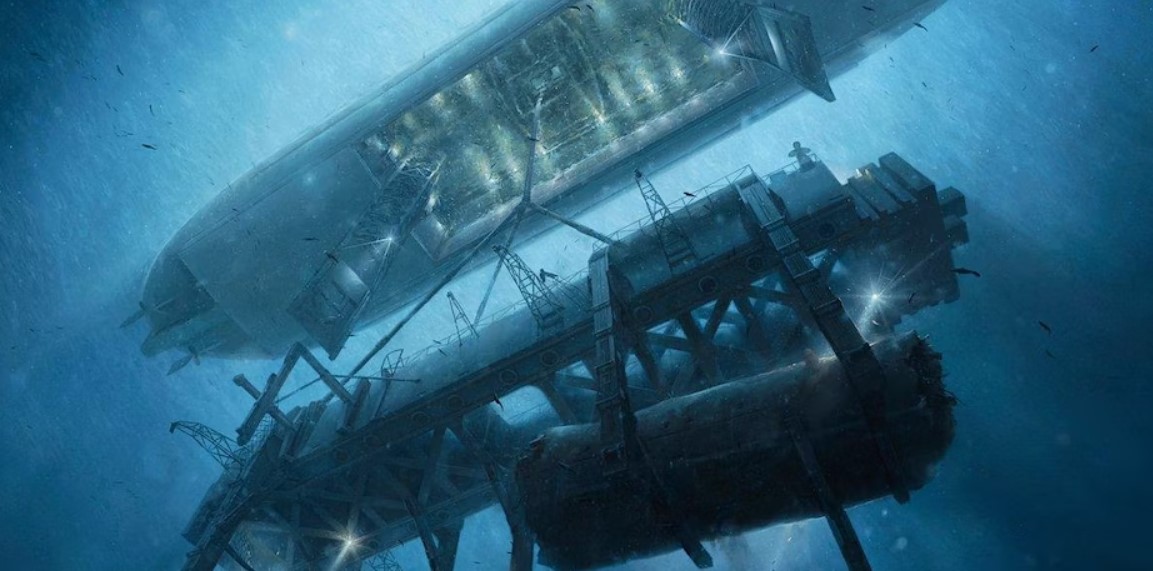
Of course, Sewell claims that the CIA recovered the whole submarine and took pains to cover up the exact wreck location (i.e. everyone involved in the operation who knew the location has been sworn to secrecy or otherwise ordered to lie about it), so even if anyone did know the exact location of the wreck and had the equipment to dive down there, they wouldn’t find anything.
Thankfully, Sewell’s book isn’t the only interpretation and other books have been published on this particular subject, some of which Sewell cites. For example, he occasionally cites Roy Varner and Wayne Collier’s A Matter of Risk, published in 1978, as well as John Craven’s The Silent War, published in 2002. The late John Craven was the Chief Scientist in the U.S. Navy’s Special Projects Office. Anybody who’s read Blind Man’s Bluff will be familiar with his name. That said, Craven was just a civilian scientist and not an intelligence officer, and while he did accomplish many great technical feats for the Navy, his book is lambasted as being self-aggrandizing.
Other, more recent, works that cover the sinking and recovery of K-129 are W. Craig Reed’s 2010 book Red November, Norman Polmar and Michael White’s 2010 book Project Azorian, and Josh Dean’s 2018 book The Taking of K-129. Some of these works provide new or similar theories to Sewell’s, but personally, my money is on Polmar and White’s book which I would be interested in reading.11
Other Issues
The book also suffers from being repetitive and another round of editing would be warranted. I’d say a good 50 or so pages could be excised to tighten up the narrative a bit because either the material is extraneous or has already been said. Yes, Sewell, we get it! Everyone had to sign lifetime confidentiality agreements and the sources were high-ranking, anonymous intelligence officials! The records have been sealed and it’s all a cover-up!
I would contend that Sewell’s book is better listed as historical fiction more akin to a Tom Clancy novel. The idea of a Soviet submarine going rogue and launching an unauthorized nuclear strike on the U.S. is nothing new. In fact, this plot thread serves as the basis for Tom Clancy’s novel The Hunt for Red October. With this in mind, Red Star Rogue reads more like an alternate history or a thriller and would probably serve as a decent basis for a submarine thriller film.

Evaluation (Does the content support the thesis?)
Admittedly, I’ve really torn into this book and shown no mercy, but I honestly can’t abide nonsense like this. I really wanted to like this book and started off willing to give it the benefit of the doubt, but the more I read, the more I couldn’t buy into what Sewell was claiming. The sources and historiography of the book are very suspect and rely too much on unverifiable accounts and shaky evidence. While some parts are decently written and the story is definitely thrilling, Sewell’s theory hinges too much on leaps of logic and far-fetched speculation. The reality is that we’ll probably never know exactly what happened to K-129, and it’s unlikely the CIA will open up about the exact details of their recovery operation anytime soon. While the story may be open to speculation, that’s not an excuse to break out the conspiracy theory kit and publish a work under the guise of history.12 Red Star Rogue is better read under the guise of a fictional submarine thriller novel than a work of factual history.
Rating:
1 out of 5. Poor. Probably not worth the paper it’s printed on.
Notes
- We should be careful about construing an author’s background as indicative of all-encompassing expertise. Kenneth Sewell may be a submarine veteran who served on USS Parche (a very renowned and highly decorated spy boat), but that doesn’t automatically make him a historian or an expert on Soviet subs and K-129. Granted that there’s a lot of institutional knowledge that’s passed down to submariners (regardless of nationality), but at the end of the day, the only people who truly know about what happened on K-129 are gone. ↩︎
- As I’ve written before, conspiracy theories could be called simple answers to complex problems. Sadly, times have changed since I was a kid in the 1990s. Back then, conspiracy theories were all about extraterrestrials, the Illuminati, and the JFK assassination. I was a big fan of The X-Files TV show (and still am) and people seemed to treat conspiracy theories as light entertainment and fun brain exercises at best. Nowadays, extremist ideologies seem to have co-opted conspiracy theories to justify their actions. ↩︎
- No doubt the wreck is probably sitting in crates in some non-descript, heavily guarded warehouse in Redwood, CA, where some man in a black suit occasionally walks down the aisles to check on the contents. Right next to it is probably the Ark of the Covenant recovered by Indiana Jones. ↩︎
- AKA the furtive fallacy. ↩︎
- The CIA has indeed denied every Freedom of Information Act request regarding this event, but that’s not the only way to uncover information on an event. ↩︎
- Even the most convincing piece of evidence concerning the discovery of a radioactive oil slick by the University of Hawaii’s R/V Teritu off the French Frigate Shoals, which would point to a different location of the wreck site than officially claimed, is all sealed up and classified. So even that can’t be confirmed. ↩︎
- In historical research, the burden of proof is on the historian who needs to demonstrate sufficient probabilistic causation. From my understanding, Sewell’s other book, All Hands Down, about the sinking of USS Scorpion in 1968, has similar problems with demonstrating convincing evidence and is also marred by many technical inaccuracies. ↩︎
- I don’t mean to imply that the government never lies to people (yeah…right! I’m not that naive.), but the way the events align into a nifty conspiracy is too good to be true. ↩︎
- “Ray Feldman, ‘Another half-baked conspiracy theory!,’ Review of ‘Red Star Rogue,’ by Kenneth Sewell. Amazon.com, Accessed January 21, 2025, https://www.amazon.com/Red-Star-Rogue-Submarines-Nuclear/product-reviews/0743261127/ref=cm_cr_arp_d_viewpnt_rgt?ie=UTF8&reviewerType=all_reviews&filterByStar=critical&pageNumber=1.” Feldman was also interviewed for Norman Polmar and Michael White’s 2010 book Project Azorian, which was later made into the documentary Azorian: The Raising of the K-129. ↩︎
- It’s strange that Sewell continuously refers to this as a conning tower. WWII submarines had conning towers, but modern submarines refer to this area as the sail or fairwater. The purpose of the sail is to house the masts, and in the case of Golf-class submarines, the tops of the missile tubes. There’s a lot of pedantry that goes around when it comes to naval terminology, and submariners are no exception. Why Sewell, a sub sailor with experience aboard USS Parche would make this linguistic mistake is unknown. ↩︎
- The book Project Azorian uses all verifiable sources (no anonymous/secret mystery men) and the information used basically debunks all of Sewell’s wild claims. It even includes a whole chapter addressing various conspiracy theories about the sinking of K-129 (including Sewell’s). Norman Polmar is something of a household name in naval history and technical literature. His works are prolific and extremely well-researched. He’s not perfect, but it’s hard to go wrong with Polmar. ↩︎
- Alas, I suspect that the publishing industry is very similar to the film industry. Movies get greenlit when studio executives are convinced they’ll make money (logic and accuracy be damned). Publishers probably pick up manuscripts as long as they feel that they’ll sell and make money. For all of the good books out there, there are tons of trashy ones. ↩︎

