Topic & Content
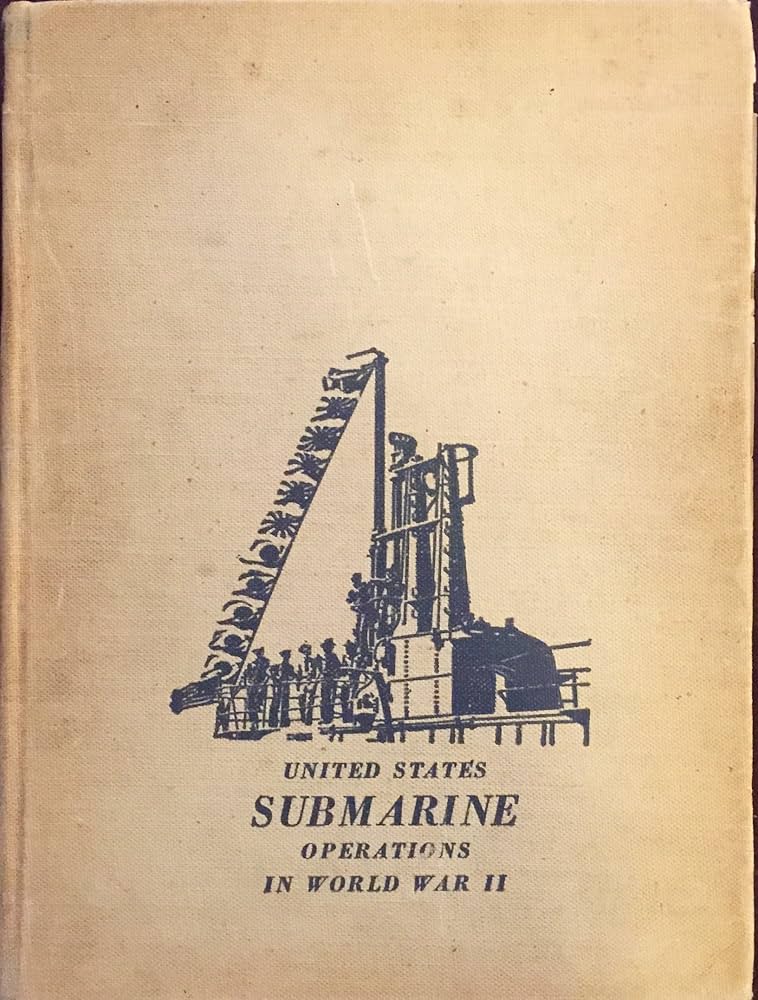
Published in 1949 (shortly after the end of World War II), this book covers U.S. submarine patrols, operations, and tactics in World War II. It’s based on the official operational history compiled under the direction of ComSubPac by Captain R.G. Voge, Captain W.J. Holmes, Commander W.H. Hazzard, and (for SubLant) Lieutenant Commander D.S. Graham. Additional material was gathered from Lieutenant H.J. Kuehn, as well as from patrol reports, historical data, and interviews with submarine officers. Statistics and assessments came from the Submarine Operations Research Group (SORG), the U.S. Strategic Bombing Survey, and the Joint Army-Navy Assessment Committee (JANAC). The final book was prepared by Theodore Roscoe.
The book is organized as follows:
- Part I: Submarines to War (December 1941)
- Ch. 1: Holocaust at Pearl Harbor
- Ch. 2: Central Pacific Front
- Ch. 3: Philippines Invasion
- Ch. 4: Undersea Lanes to Victory
- Part II: The Fighting Defense (1942)
- Ch. 5: Pioneers Pacific
- Ch. 6: Pioneers SOWESPAC
- Ch. 7: Battle for the Malay Barrier
- Ch. 8: Submarines Atlantic
- Ch. 9: Thunder Down Under
- Ch. 10: Stand Tide
- Ch. 11: The Battle of Midway
- Ch. 12: The Aleutian Maelstrom
- Ch. 13: Counter-Offensive
- Ch. 14: Guadalcanal Campaign
- Ch. 15: The Empire Blockade
- Part III: All-Out Attrition (1943)
- Ch. 16: Battle Beneath the South Seas
- Ch. 17: Japanese Anti-Submarine War
- Ch. 18: Drive on Dai Nippon
- Ch. 19: Aleutian Conclusion and Atlantic Tidal Turn
- Ch. 20: Torpedo!
- Ch. 21: Southwest Pacific Push
- Ch. 22: Central Pacific Offensive
- Part IV: Pacific Sweep (1944)
- Ch. 23: Oceanic Housecleaning
- Ch. 24: Convoy and Wolf-Pack
- Ch. 25: Submarine Support of Fleet Operations
- Ch. 26: Submarines Vs. The Japanese Navy
- Ch. 27: Submarines Vs. The Japanese Navy (Continued)
- Ch. 28: Bisecting the Empire
- Part V: Japanese Sunset (1945)
- Ch. 29: Tokyo Approach
- Ch. 30: Submarine Lifeguarding
- Ch. 31: Mission Accomplished
Thesis
The purpose of the book is to serve as an informative, instructional, and inspirational text for those in the Naval Service who are interested, directly or indirectly, in submarines. While not meant to be read as a straight textbook, it’s written as an epic story of the U.S. submarine war against the Axis.
Author’s Background
According to Wikipedia, the late Theodore Roscoe (1906 – 1992) was an American biographer, historian, novelist, and short story writer. In addition to his pulp fiction, adventure, and fantasy works, Roscoe was commissioned by the United States Naval Institute to write the books United States Submarine Operations in World War II (1949) and United States Destroyer Operations in World War II (1953). Roscoe also wrote several other books on naval history and collected volumes of stories.
Critical Observations
Positives
While not quite a primary source, this book is easier to get ahold of than the deck logs of a WWII submarine. Since it was published within a few years of the conclusion of the war, the recency of the events, along with the availability of the submariners, and their memories, means this book is an excellent reference for those studying WWII submarine history. Roscoe’s writing is decent and gives a good chronological overview of the Pacific War without feeling like it’s going off on tangents. This is to say that the narrative is written in such a way as to allow the reader to understand how submarines played an integral role in the war.
The book is nicely illustrated with a variety of drawings and glossy photos. In many ways, the illustrations are necessary to provide the reader with some context since photos of the submarines conducting operations are somewhat limited. Most photos of submarines were taken when the boat was in port or alongside a tender. Even photographs taken through the periscopes are somewhat rare and forget about ones taken at night.
Lastly, the appendices of this book are a treasure trove of information. The data is well-tabulated and everything from lost submarines, citations and commendations awarded, vessels sunk per submarine, U.S. wolf packs, submarine tenders, submarine special missions, top submarine skippers, and a statistical summary of Japanese shipping losses (and more) are included.
Negatives
While Roscoe did make the text more readable, it’s not exactly on the same level as Samuel Eliot Morison because many parts of it get very repetitive. I guess there are only so many ways you can make the torpedoing and sinking of a ship seem interesting. After a while, it starts to read like this;
USS Ustafish was on patrol and got off two torpedoes at a merchant ship. Down she went; all 3,000 tons of her. Two days later, zap, down went another ship. Add 3,500 tons to the score! Then she sank another 5,000-ton ship on 12 December. It was a great patrol under the command of a fine captain!
The repetitiveness of the narrative does drag it down a bit and can be tiring for the reader. However, it’s important to remember that since the primary role of submarines in this era was anti-shipping, it makes sense that they would naturally be sinking lots of ships. Even then, it just starts to read like one ship is the same as the last ship, with some exceptions. Given that U.S. submarines accounted for over 50% of Japanese merchant shipping sunk during the war, accounting for every single ship sunk by submarines would be even more boring.1 Perhaps for this reason, the book doesn’t cover every single sinking in every single war patrol conducted by every single U.S. submarine during the war. No doubt there were many patrols where submarines never encountered a single ship, so the patrol was entirely uneventful.
My final criticism is that the book has suffered from the inevitable progression of time. Undoubtedly, new information on WWII U.S. submarine operations has arisen in the 75+ years since this book was published. Apart from this book, the other major work on WWII U.S. submarine warfare is probably Clay Blair’s Silent Victory. Not to mention the wealth of information on official U.S. Navy history websites as well. So any historian would do well to corroborate the information in this book with more modern research.
Evaluation (Does the content support the thesis?)
All in all, the book gives a good overview of U.S. submarine operations in WWII, largely focused on the Pacific Theater, but also touching on Atlantic and Mediterranean operations. The writing is decent, and the book contains a wealth of information about submarine operations during the war. However, it’s bogged down by repetitiveness and dated information.
Rating:
Very Good/Worth your time
- The statistical summary in the book indicates submarines sank over 4,800,000 tons, or 1,150 vessels over 500 gross tons. In reality, they sank even more if you account for the vessels sunk that were under 500 gross tons. ↩︎

