
Topic & Content
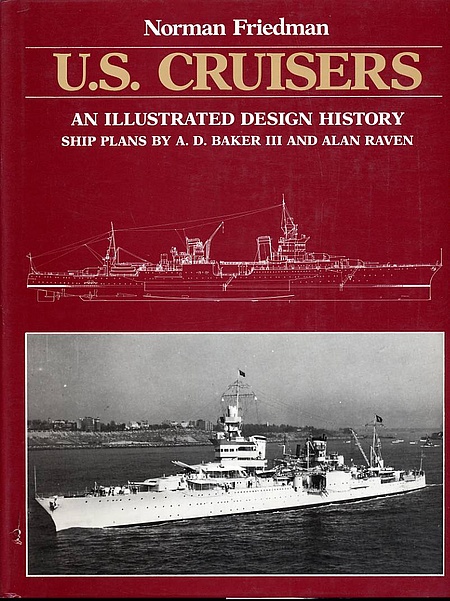
Published in 1984, this book chronicles the design of U.S. cruisers from the late 1880s to the postwar missile cruisers through the 1980s. The book is organized as follows:
- 1. The New Navy, 1883 – 98
- 2. The Postwar Cruiser Navy
- 3. The General Board’s Scouts, 1903 – 21
- 4. The Treaty and the “Tinclads”
- 5. Second Generation Treaty Cruisers
- 6. The London Treaty of 1930: Admiral Pratt’s Navy
- 7. The Brooklyn Class
- 8. The Second London Treaty
- 9. The War Programs
- 10. The Post-Treaty Generation
- 11. Cruisers at War, 1941 – 45
- 12. Wartime Cruiser Designs
- 13. Into the Missile Age
- The Command Cruisers
- Appendices
- A. Cruiser Designations
- B. Names and Dates List
- C. Cruiser Characteristics
Thesis
Friedman’s thesis is that modern cruisers represent a type of fleet warfare that never occurred, but they were interwar designs that existed in a strange limbo between destroyers and battleships. They ended up performing the latter’s role more often than not, and the true cruisers that once existed are no more.
Author’s Background
Norman Friedman is a prominent naval analyst and theorist. Earning a Ph.D. in physics from Columbia University, Friedman specializes in strategic and technical issues, has consulted with various U.S. government agencies, and has served as the deputy director of national security studies at the Hudson Institute. His eight-book series on U.S. warship designs, of which this book is part, has been highly regarded as a standard reference on U.S. naval warship development.
Critical Observations
Positives
As with all of Friedman’s design histories, this book is a very detailed examination of the design and development of modern U.S. cruisers from their beginnings in the New Navy of the 1880s through WWII and into the 1980s. Be warned, however, that these books are not examinations of operational history. Additionally, Friedman covers how cruiser designations changed from the 1880s with the introduction of the naval treaties in the 1920s and 1930s, and the development of guided-missile cruisers and command cruisers following WWII.
One of the more interesting thematic threads in this book is how Friedman discusses the odd limbo in which cruisers exist. They’re not as big and powerful as battleships, and not as small as destroyers. Still, like battleships, they represent a compromise between speed (propulsive power), armor, and gun armament. In many instances throughout the Pacific Theater of WWII, cruisers essentially operated in the role of battleships. Yet, they must also fulfill many additional roles. They’re expected to be able to conduct their own independent operations, protect task forces, conduct shore bombardment, provide scouting for the fleet, etc. Additionally, Friedman notes that the cruisers designed during the interwar years (i.e. the true gun cruisers) don’t really exist anymore. For example, the Ticonderoga-class guided-missile cruisers were originally designed as destroyers, but reclassified as cruisers and built on modified Spruance-class destroyer hulls. The interwar-designed gun cruisers have since been replaced by large destroyers and frigates with guided missiles.
The book is well illustrated with extensive use of photos and line drawings. Friedman chronicles the many different designs of cruisers that never made it past the drawing board, as well as the changes made to cruisers in service. The final chapter also examines the rather interesting role of command cruisers and the flagship roles that cruisers were envisioned to embody.
Negatives
Since this book is part of Friedman’s design histories series, the writing and editing leave something to be desired. The writing is dry, and the transitions from topic to topic are abrupt. The organization of the book could be better within the chapters, and as a result, the overall narrative seems a bit disjointed or hard to follow. However, this is the same for all of the books in this series.
It should also be noted that some ships that started as destroyers or other types, but were later redesignated as guided-missile cruisers in the 1970s (ex. Ticonderoga and Leahy-classes) are not included in this volume. Those are discussed in Friedman’s book on destroyers.
Evaluation (Does the content support the thesis?)
Overall, this is a very detailed history of U.S. cruisers. Friedman’s research shows that the development of U.S. cruisers was very gradual and similar to battleships. focused on increasing the power, armor, and armament, and attempting to find an appropriate role for cruisers. However, gone are the days of true gun cruisers, and missile cruisers (i.e. big guided-missile destroyers) will carry on the designation of cruisers in name only.
Rating:
Very good/worth your time
 Fair Winds & Following Seas