Topic & Content
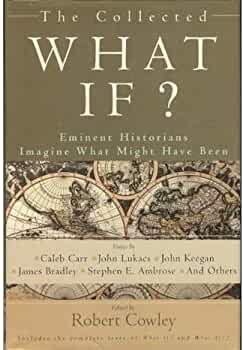
Previously published as two separate volumes (What If? and What If? 2), The Collected What If? is a series of essays by historians on counterfactual history examining the possible alternative ways that famous historical events could’ve played out.
As far as I know, the essays are not abridged, and the book is literally the contents of the two What If? books, just bound together. The first half of the book is What If? and the second half is What If? 2. Since the essays in those volumes are topically presented chronologically, it can be a little jarring when halfway through this book, the timeline suddenly jumps back to ancient history because it’s the beginning of the second volume. The book is organized as follows:
What If?
- Infectious Alternatives: The Plague That Saved Jerusalem, 701 B.C. – William H. McNeill
- No Glory That Was Greece: The Persians Win at Salamis, 480 B.C. – Victor D. Hanson
- Conquest Denied: The Premature Death of Alexander the Great – Josiah Ober
- Furor Teutonicus: The Teutoburg Forest, A.D. 9 – Lewis H. Lapham
- The Dark Ages Made Lighter: The Consequences of Two Defeats – Barry S. Strauss
- The Death That Saved Europe: The Mongols Turn Back, 1242 – Ceclia Holland
- If Only It Had Not Been Such a Wet Summer: The Critical Decade of the 1520s – Theodore K. Rabb
- The Immolation of Hernan Cortes: Tenochtitlan, June 30, 1521 – Ross Hassig
- The Repulse of the English Fireships: The Spanish Armada Triumphs, August 8, 1588 – Geoffrey Parker
- Unlikely Victory: Thirteen Ways the Americans Could Have Lost the Revolution – Thomas Fleming
- What the Fog Wrought: The Revolution’s Dunkirk, August 29, 1776 – David McCullough
- Ruler of the World: Napoleon’s Missed Opportunities – Alistair Horne
- If the Lost Order Hadn’t Been Lost: Robert E. Lee Humbles the Union, 1862 – James M. McPherson
- A Confederate Cannae and Other Scenarios: How the Civil War Might Have Turned Out Differently – Stephen W. Sears
- The What Ifs of 1914: The World War That Should Never Have Been – Robert Cowley
- How Hitler Could Have Won the War: The Drive for the Middle East, 1941 – John Keegan
- Our Midway Disaster: Japan Springs a Trap, June 4, 1942 – Theodore F. Cook, Jr.
- D Day Fails: Atomic Alternatives in Europe – Stephen E. Ambrose
- Funeral in Berlin: The Cold War Turns Hot – David C. Large
- China Without Tears: If Chiang Kai-shek Hadn’t Gambled in 1946 – Arthur Waldron
What If? 2
- Socrates Dies at Delium, 424 B.C.: The consequences of a single battle casualty – Victor D. Hanson
- Not by a Nose: The triumph of Antony and Cleopatra at Actium, 31 B.C. – Josiah Ober
- Pontius Pilate Spares Jesus: Christianity without the Crucifixion – Carlos M. N. Eire
- Repulse at Hastings, October 14, 1066: William does not conquer England – Cecelia Holland
- The Chinese Discovery of the New World, 15th Century: What the expeditions of a eunuch admiral might have led to – Theodore F. Cook, Jr.
- Martin Luther Burns at the Stake, 1521: “O God, is Luther dead?” – Geoffrey Parker
- If Charles I Had Not Left Whitehall, August 1641: As a starter, no English civil war – Theodore K. Rabb
- Napoleon’s Invasion of North America: Aedes aegypti takes a holiday, 1802 – Thomas Fleming
- If Lincoln Had Not Freed the Slaves: The inevitable results of no Emancipation Proclamation – Tom Wicker
- France Turns the Other Cheek, July 1870: The needless war with Prussia – Alistair Horne
- The Election of Theodore Roosevelt, 1912: Brokering an earlier end to World War I – John Lukacs
- The Great War Torpedoed: The weapon that could have won the war for Germany in 1915 – Robert L. O’Connell
- No Finland Station: A Russian Revolution without Lenin? – George Feifer
- The Luck of Franklin Delano Roosevelt: Seven might-not-have-beens on the road to the presidency – Geoffrey C. Ward
- The War of 1938: Chamberlain fails to sway Hitler at Munich – Williamson Murray
- Prime Minister Halifax: Great Britain makes peace with Germany, 1940 – Andrew Roberts
- The Boys Who Saved Australia, 1942: Small events can have large results – James Bradley
- Enigma Uncracked: The Allies fail to break the German cipher machine – David Kahn
- Pius XII Protests the Holocaust: Could the wartime pope have prevented the Final Solution? – Robert Katz
- VE Day – November 11, 1944: The unleashing of Patton and Montgomery – Caleb Carr
- The Fuhrer in the Dock: A speculation on the banality of evil – Roger Spiller
- No Bomb: No End: The Operation Olympic disaster, Japan 1945 – Richard B. Frank
- The Presidency of Henry Wallace: If FDR had not dumped his vice president in 1944 – James Chace
- A Tale of Three Congressmen, 1948: America without Nixon, Johnson, and Kennedy – Lance Morrow
- What If Pizarro Had Not Found Potatoes in Peru?: The humble roots of history – William H. McNeill
Counterfactual history is something of a dirty word in the field. It’s often confused with alternative history, which is a genre of speculative fiction, or historical revisionism, which challenges the established narrative (for better or worse). Additionally, to the layperson, the term counterfactual history implies an author going off on wild and fantastical tangents about how the entire course of human history could be different “for want of a nail,” so to speak. Similar ideas regarding causality include the Butterfly Effect in chaos theory and the Domino Theory in Cold War geopolitics.
One of the issues is that counterfactual history is rooted in events that have already occurred in a certain way, and the counterfactual subsequently stretches the causal nodes. An alternative history arguably stretches causality to implausible extremes. At its most unsightly, it can become historical negationism, which historians highly frown upon. Effectively, it becomes a conspiracy theorist’s fantasy about how the world “should” have turned out but didn’t, and now they’re salty about it. Historical myths and misconceptions/misinformation can also arise from people clutching at the straws of causality if you will.
Put another way, British historian Hugh Trevor-Roper writes:
Myths are not like truths; they are the triumph of credulity over evidence.1
Going further, Trevor-Roper writes:
The form of a myth is indeed externally conditioned by facts; there is a minimum of evidence with which it must comply, if it is to live; but once lip-service has been paid to that undeniable minimum, the human mind is free to indulge its infinite capacity for self-deception… When we consider upon what ludicrous evidence the most preposterous beliefs have been easily, and by millions, entertained, we may well hesitate before pronouncing anything incredible.2
Of course, in the book, Trevor-Roper’s quotes are used in relation to the counterfactual of Hitler possibly not committing suicide and continuing to live on, but his ideas still hold.
Thesis
This book isn’t really a work of scholarship, but a loosely defined thesis for the first half (What If?) could be that it’s an examination of certain events in military history from a counterfactual standpoint. The second half (What If? 2), has no real defined thesis in its introduction. However, it does say that the selection of essay topics is broader and encompasses both political and religious historical events.
Editor’s Background
According to the biographical blurb on the dust jacket, Robert Cowley, in addition to authoring a number of essays in the book, is the founding editor of MHQ: The Quarterly Journal of Military History.
Critical Observations
Positives
In the first half of the book, the essays are almost purely related to military history. However, the second half includes a more diverse selection of topics, including religious and political counterfactual history.
Since the topics covered span the breadth of history from the Classical Era to the Cold War, there’s usually something in there to interest most historians. My personal favorite essays are (in no particular order):
- No Bomb: No End: The Operation Olympic disaster, Japan 1945 – Richard Frank
- How Hitler Could Have Won the War: The Drive for the Middle East, 1941 – John Keegan
- Our Midway Disaster: Japan Springs a Trap, June 4, 1942 – Theodore F. Cook, Jr.
- The War of 1938: Chamberlain fails to sway Hitler at Munich – Williamson Murray
- The Chinese Discovery of the New World, 15th Century: What the expeditions of a eunuch admiral might have led to – Theodore F. Cook, Jr.
- What If Pizarro Had Not Found Potatoes in Peru?: The humble roots of history – William H. McNeill
Obviously, most of the essays I liked are centered around the topics of WWII and Asian history. In particular, “No Bomb: No End” by Richard Frank, my favorite Asian-Pacific War historian, is a well-thought-out examination of what might have happened had we not dropped the atomic bombs on Japan. Essentially, it’s a condensed version of part of his book, Downfall: The End of the Imperial Japanese Empire. Interestingly, only the last essay is related to food and trade history; specifically that of the potato.
The vast majority of the authors are academics, so the writing is professional, and most don’t veer too heavily into fantastical versions of history. While I didn’t necessarily enjoy every essay, there’s something interesting in most of them.
A final positive is that an interested reader only needs to buy this one book, rather than the previous two volumes since it’s unabridged.
Negatives
This book is hard to evaluate without giving away spoilers, but it’s largely meant for the popular history market, given its historiography. Since most people are only familiar with history as a chronological timeline of events that happened in one particular way, I don’t feel that the book adequately introduces readers to what exactly counterfactual history is and what it isn’t. There is some discussion on it in the introduction, but it’s really slim. As such, I wish there was more explication in the introduction about the concept of counterfactual history.
Most of the essays give the reader a good sense of context and details about how the actual historical events unfolded before going into the counterfactual, but sometimes the counterfactual is only covered in a page or two. This can sometimes leave the reader wanting more. If the reader was expecting a wildly speculative alternative history, then they’ll be sorely disappointed and should instead check the fiction section of a bookstore. Still, sometimes the counterfactual can seem a bit lacking or underdeveloped.
Another issue is that, since it’s a collection of essays, the writing style isn’t always consistent. Some of the essays are better written and easier to follow than others, and some do occasionally ramble on. I certainly don’t expect a masterful treatise of historical writing, but the essays in this book seem to demonstrate that not every historian is an expert at wordsmithing. (On the upshot, the writing doesn’t dramatically shift from essay to essay.) Then again, publishing a counterfactual essay in a popular history book probably isn’t a high-priority item on a scholar’s to-do list.
Unfortunately, none of the essays contain any citations. There are also no footnotes, endnotes, or bibliography to be found. You would think that since (almost all) the essays are written by established scholars and professors, they would include more bibliographic citations. But nope.
Finally, not every essay will interest the reader, but more broadly, as a survey of historical topics, most of the essays cover history from a very Western-centric point of view. This may be a bit off-putting to some if you’re looking for a different perspective.
Evaluation (Does the content support the thesis?)
Overall, The Collected What If? was an interesting read, but it didn’t blow me away. There are some very interesting topics covered and some interesting speculation done on the possible what-ifs of history. The writing is passable, if a little dull in some essays, but easily accessible. For readers looking for a good survey of history from a very different perspective that challenges the common narratives with some hypothetical scenarios, then this book should scratch that itch. However, if the reader expects a well-cited scholarly study of events, then they best look elsewhere.
Rating: 3.5 out of 5. Good. Borrow from a library.
Notes
- Roger Spiller, “The Fuhrer in the Dock,” in The Collected What If?, ed. Robert Cowley, 744-765 (New York, NY: G.P. Putnam’s Sons, 2001), 761. ↩︎
- Spiller, 765. ↩︎
Bibliography
Spiller, Roger. “The Fuhrer in the Dock.” In The Collected What If?, edited by Robert Cowley, 744-765. New York, NY: G.P. Putnam’s Sons, 2001.
 Fair Winds & Following Seas
Three American Presidents (Kennedy, Ford, and Bush) had close calls during WWII. I’ve often wondered what would have been the consequences of those stories going the other way, and what might have been among those that were lost.
LikeLike
That’s right. JFK’s PT boat got run over by the Amagiri destroyer, Bush got shot down over Chichijima and rescued by submarine, and Ford nearly went over the side and into the drink during Typhoon Cobra. All three were Naval officers. We can probably say that, had they not survived, they wouldn’t of had aircraft carriers named after them.
LikeLiked by 1 person