
Game Introduction
Subject, Scope, & Scale
| General Purpose | Analytical |
| Scope and Level | Range of Command Levels Tactical Military Services Involved U.S. NavyNational Reconnaissance Office Type of Operations Anti-Satellite (ASAT)Area of Operations Northern Pacific Ocean & Low Earth Orbit |
| Number of Sides | 2 |
| Amount of Intelligence | Open |
| Method of Evaluation | Rigid |
| Basic Simulation Technique | Computer |
Historical Background
U.S. Anti-Satellite (ASAT) weapons programs have been around since at least the late 1950s and early 1960s, with the test of ballistic missile-launched ASAT weapons. It wasn’t until 1985 that the first really practical ASAT weapon was demonstrated when a modified F-15A Eagle fired an ASM-135 ASAT missile that destroyed satellite Solwind P78-1. However, technical delays and growing costs ultimately canceled that project in 1988. Other ASAT weapons, including a co-orbital weapon, were being researched as part of the Strategic Defense Initiative (SDI), derisively known as the Star War Program, during the Reagan Administration, since the technology required to target and destroy satellites also had the potential for defenses against ballistic missiles. However, the end of the Cold War saw those programs being canceled.1
On 14 December 2006, reconnaissance satellite USA-193 (AKA NROL-21) was placed into orbit, but within hours had failed. While it was deemed that the satellite posed no immediate risk, on 4 January 2008, President George W. Bush ordered the satellite destroyed. While satellites and debris are normally allowed to burn up on reentry and pose no serious risk, the official reason for USA-193‘s destruction was the concern over the potential damage from the hydrazine fuel and the beryllium-lined fuel tank aboard the satellite. Should the fuel tank rupture or survive reentry, it could potentially spread the 1,000 pounds of toxic fuel over a large area. Within several weeks of the order being given, USS Lake Erie (CG-70), USS Decatur (DDG-73), and USS Russell (DDG-59) had their Aegis systems modified and crews trained for the mission. Additionally, three SM-3 missiles had their heat-seeking sensors modified to allow them to acquire the satellite’s infrared signature, which is lower than that of a ballistic missile. By late January 2008, the satellite’s orbit was confirmed to be decaying and that it would crash into the Earth in early March.2
USS Lake Erie was chosen to conduct the shootdown since she had participated in a dozen mostly successful interceptions of mock ballistic missiles over the previous six years. Given the decay of the satellite, it would be at a distance of about 150 miles, or just above Earth’s atmosphere, when the Lake Erie fired. Publicly, officials believed there was a high probability of successfully intercepting the satellite, but privately, they admitted to being somewhat anxious. However, the consequences of a miss were far less since it wasn’t a wartime scenario, and the fuel posed minimal risk to humans if it did reenter the atmosphere.3
David Wright with the Union of Concerned Scientists expressed concern about the potential damage to other objects in low orbit from the debris of the satellite should the shootdown be successful. That said, he put the odds of a successful interception at no greater than 50 percent. Furthermore, he voiced concern about the diplomatic risks, since other countries would construe the shootdown as a test of an anti-satellite weapon. Having considered these concerns, the U.S. State Department instructed U.S. diplomats to state that the operation was solely for the purpose of protecting people from the hazardous fuel aboard the satellite.4
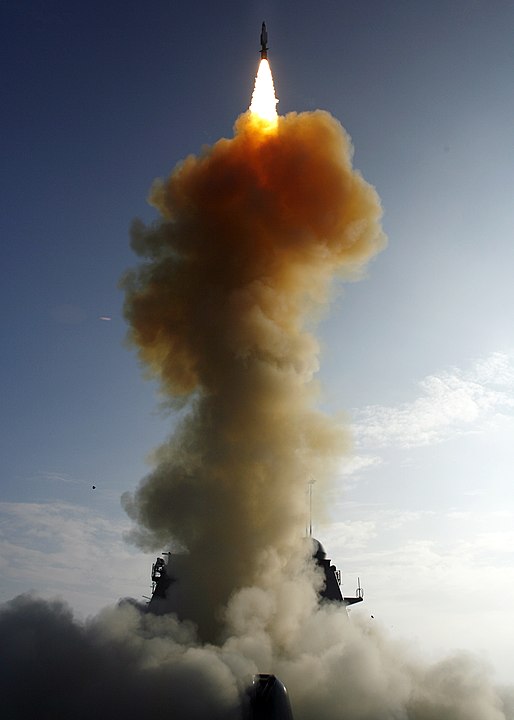
On 20 February 2008 at 1300 EST, Secretary of Defense Robert Gates approved the mission. USS Lake Erie fired the missile at 22:26 EST, which successfully intercepted the satellite a few minutes later. Numerous sensors and radars confirmed that the hydrazine fuel tank was hit, with nearly 100% of the satellite’s debris burning up on reentry within 48 hours and the remainder within the next few days.5
Game Objectives
This wargame will simulate USS Lake Erie shooting down satellite USA-193.
Our essential question(s) are:
- Can USS Lake Erie successfully intercept the satellite with an SM-3 missile?
Game Setup
Situation
20 February 2008. Defunct NRO satellite USA-182 (substituting for USA-193) is orbiting at an altitude of 718 km with a speed of 14,567 knots. It will pass over USS Lake Erie on 20 February 2008. Since it will crash into Earth in the coming weeks, the U.S. Navy guided-missile cruiser, USS Lake Erie, has been tasked to destroy it before it reenters the atmosphere.
Forces
| U.S. Navy [Player/A.I.] | NRO [A.I.] |
|---|---|
| 1x Ticonderoga-class guided missile cruiser (USS Lake Erie (CG-70)) | USA-193 (NROL-21) |
| Weapons & Ammo: (I’m only listing the anti-air missiles) 48x RIM-66M-5 SM-2MR Blk IIIB Guided Missile 32x RIM-174A ERAM SM-6 Dual I ABM, Anti-ASBM Guided Missile 24x RIM-162A ESSM Guided Missile 16x RIM-161E SM-3 NTW Blk IIA Guided Missile | Weapons & Ammo: None |
Mission
Destroy satellite USA-182.
Execution
USS Lake Erie will fire 1x RIM-161E SM-3 at USA-182 and destroy it.
Important Notes on Game Abstractions
- USA-193 doesn’t exist in the game’s database, so I’ve substituted USA-182 for it. Although USA-182 is orbiting 471 km higher, it’s a Lacrosse radar imaging satellite operated by the National Reconnaissance Office (NRO). These have similar orbital inclinations that USA-193 had and nearly the same velocity.
- USS Lake Erie is in her 2018 configuration (according to the game’s database). The reason for this is that when I’ve attempted this scenario with the 2008 version of Lake Erie (with the Blk IA SM-3 missiles), the game won’t allow me to fire on the target.
- The SM-3 missile on the 2018 Lake Erie is the Blk IIA rather than the more realistic Blk IA that would’ve been in service at the time. The Blk IIA has a higher max target altitude compared to the Blk IA.
- Since the destroyers Decatur and Russell played no active part in the shootdown, apart from being on standby and providing support should Lake Erie have a problem, I didn’t put them in the scenario.
Video
Note that the video only shows the successful interception.
Analysis & Evaluation
Statistics
Note that the following statistics represent ten different gameplay sessions.
2/20/2008 3:35:11 AM – Weapon: RIM-161E SM-3 NTW Blk IIA #6 is attacking USA 182 with a base PH of 85%. PH adjusted for distance: 82% (pure-aerodynamic attitude control). PH adjusted for actual target speed (14574 kts): 32%. Intercept angle is 344 deg – hit probability adjusted to 29%.Final PH: 29%. Result: 64 – MISS
2/20/2008 3:35:16 AM – Weapon: RIM-161E SM-3 NTW Blk IIA #6 is attacking USA 182 with a base PH of 85%. PH adjusted for distance: 83% (pure-aerodynamic attitude control). PH adjusted for actual target speed (14574 kts): 33%. Intercept angle is 333 deg – hit probability adjusted to 28%.Final PH: 28%. Result: 48 – MISS
2/20/2008 3:35:12 AM – Weapon: RIM-161E SM-3 NTW Blk IIA #6 is attacking USA 182 with a base PH of 85%. PH adjusted for distance: 82% (pure-aerodynamic attitude control). PH adjusted for actual target speed (14574 kts): 32%. Intercept angle is 343 deg – hit probability adjusted to 29%.Final PH: 29%. Result: 42 – MISS
2/20/2008 3:35:10 AM – Weapon: RIM-161E SM-3 NTW Blk IIA #6 is attacking USA 182 with a base PH of 85%. PH adjusted for distance: 82% (pure-aerodynamic attitude control). PH adjusted for actual target speed (14574 kts): 32%. Intercept angle is 333 deg – hit probability adjusted to 27%.Final PH: 27%. Result: 59 – MISS
2/20/2008 3:35:10 AM – Weapon: RIM-161E SM-3 NTW Blk IIA #6 is attacking USA 182 with a base PH of 85%. PH adjusted for distance: 82% (pure-aerodynamic attitude control). PH adjusted for actual target speed (14574 kts): 32%. Intercept angle is 343 deg – hit probability adjusted to 29%.Final PH: 29%. Result: 84 – MISS
2/20/2008 3:35:10 AM – Weapon: RIM-161E SM-3 NTW Blk IIA #6 is attacking USA 182 with a base PH of 85%. PH adjusted for distance: 82% (pure-aerodynamic attitude control). PH adjusted for actual target speed (14574 kts): 32%. Intercept angle is 343 deg – hit probability adjusted to 29%.Final PH: 29%. Result: 55 – MISS
2/20/2008 3:35:10 AM – Weapon: RIM-161E SM-3 NTW Blk IIA #6 is attacking USA 182 with a base PH of 85%. PH adjusted for distance: 82% (pure-aerodynamic attitude control). PH adjusted for actual target speed (14574 kts): 32%. Intercept angle is 340 deg – hit probability adjusted to 29%.Final PH: 29%. Result: 33 – MISS
2/20/2008 3:35:16 AM – Weapon: RIM-161E SM-3 NTW Blk IIA #6 is attacking USA 182 with a base PH of 85%. PH adjusted for distance: 83% (pure-aerodynamic attitude control). PH adjusted for actual target speed (14574 kts): 33%. Intercept angle is 333 deg – hit probability adjusted to 28%.Final PH: 28%. Result: 65 – MISS
2/20/2008 3:35:16 AM – Weapon: RIM-161E SM-3 NTW Blk IIA #6 is attacking USA 182 with a base PH of 85%. PH adjusted for distance: 83% (pure-aerodynamic attitude control). PH adjusted for actual target speed (14574 kts): 33%. Intercept angle is 333 deg – hit probability adjusted to 28%.Final PH: 28%. Result: 94 – MISS
2/20/2008 3:35:10 AM – Weapon: RIM-161E SM-3 NTW Blk IIA #6 is attacking USA 182 with a base PH of 85%. PH adjusted for distance: 82% (pure-aerodynamic attitude control). PH adjusted for actual target speed (14574 kts): 32%. Intercept angle is 343 deg – hit probability adjusted to 29%. Final PH: 29%. Result: 26 – HIT
2/20/2008 3:35:10 AM – Weapon: RIM-161E SM-3 NTW Blk IIA #6 has impacted USA 182.
2/20/2008 3:35:10 AM – [NRO] USA 182 has been destroyed!
Insights & Issues
What do the data/decisions show us?
I had to play the scenario 10 times before I was able to get a hit on the satellite (i.e. the first 9 games were misses). Most of the Final PH were around 27 – 29%. (Recall that the game needs to roll on or below the calculated final PH on the 100-sided die to achieve a hit.) Basically, there was a roughly 1 in 3 chance of hitting the target. Interestingly, this seems to hold with scientist David Wright’s prediction of the Navy having less than a 50% chance of successfully hitting the satellite. However, whether or not he was basing that prediction on actual calculations or just a rough guess is unknown.
Still, much like real life, the SM-3 in the game is modeled with a kinetic penetrator. So it had to physically impact the satellite to destroy it.
Specific ideas linked to major game decisions or events
The official reason for the destruction of USA-193 was to destroy the hydrazine fuel tank and prevent it from spreading its toxic fuel over a large (and potentially populated) area. Reactions by other countries and commentators to the shootdown were varied. Many believed that this was a response to a Chinese ASAT weapon test conducted the previous year (the destruction of FY-1C by a modified DF-21 missile on 11 January 2007) and that it was also a test of an ASAT weapon and the Aegis Ballistic Missile Defense system. However, officials have denied this was a response to that event since the U.S. already demonstrated its ability to shoot down a satellite with the 1985 destruction of Solwind P78-1. Apart from the official reason for destroying the hydrazine fuel tank, it’s also been noted that since the exact nature of the satellite’s sensors is classified, its destruction could have been meant to prevent sensitive ISR equipment from being exploited by others should it have survived reentry.6 However, official statements deny that any of these theories was the reason for destroying the satellite.7
Others have countered that this was the first ASAT test the U.S. had conducted since the end of the Cold War, but it didn’t represent the standard capability of these weapons since the Aegis radar and the SM-3 fired by USS Lake Erie were both heavily modified, and no other modified SM-3s exist within the U.S. inventory.8
To summarize the answer to our Essential Question:
Yes, it is possible for USS Lake Erie to successfully intercept the satellite with an SM-3 missile; however, the exact satellite, as well as the ship and weapon modifications used during the actual event, aren’t replicated in the game’s database.
Additional Thoughts on the Simulation
How valid is the game?
While we can certainly replicate the general premise of the operation, arguably, this wargame isn’t the most valid because we can replicate the exact circumstances that occurred. The database doesn’t have the actual satellite (USA-193) that was shot down, nor can the game model the decay of a satellite’s orbit. Additionally, we don’t know the exact modifications to the Aegis combat system and the SM-3 missiles that were conducted to allow them to achieve the actual results. This is partially because that information would be classified, and in our case, the game doesn’t really model such minute details.
Topics for further research
A discussion on the current militarization of space and space warfare is quite a broad topic and one that I’m in no position to speak intelligently about, but theorists have already written about it, so I’ll summarize their thoughts. While we haven’t reached the era of the science-fiction space battles of Star Wars or Star Trek, several countries currently have the capability to destroy objects in Earth’s orbit. Given the abundance of satellites (both civilian and military) and their usefulness as platforms for navigation, communications, C2 (Command and Control), and ISR (Intelligence, Surveillance, and Reconnaissance), there’s a genuine concern that they could become targets in a future conflict, not to mention the long-spoken fear of them being used as orbital platforms for conventional weapons. (The Outer Space Treaty prohibits the placement of nuclear weapons in orbit or on celestial bodies.) Arguably, destroying another country’s satellites might be considered an act of war, and such destruction would significantly hinder certain aforementioned capabilities.9 Similarly, the late American naval theorist Captain Wayne Hughes identifies six sequential steps required for a successful attack:
- strategic detection
- tactical detection
- tracking
- targeting
- attacking
- damage assessment
A defeat, delay, or disruption in any part of that chain at its weakest point would lengthen the time it takes to attack or nullify the attack.10 This process is sometimes referred to as “breaking the kill chain.” With that in mind, satellites can perform several steps of that attack chain. Therefore, the destruction or disruption of said satellite(s) would disrupt the entire attack. Additionally, take a moment to ponder what would happen if all the GPS and communications satellites suddenly stopped working! Most of us get upset if the lights go out, or we lose internet service, or our phone reception for a short period of time.
All this said, the following scenarios would be interesting to examine using C:MO:
- Celestial Eagle: The destruction of Solwind P78-1 by an F-15A firing the ASM-135 missile in 1985. (Unfortunately, given the way that the game currently models radar, it’s impossible to recreate this shootdown despite that F-15A and that missile being in the game database. Also, the specific satellite doesn’t exist in the game database, so you’ll need to substitute one with a similar orbit.)
- The 2007 Chinese destruction of the FY-1C satellite by their DF-21 missile would be interesting.
- A test of the Chinese DF-21D anti-ship ballistic missiles. These are claimed to be “carrier killers” and reportedly rely on satellites for targeting information.
Notes
1.
- Sam Tangredi, Anti-Access Warfare (Annapolis: MD, Naval Institute Press, 2013), 102 – 103. ↩︎
- Robert Burns, “Satellite Shootdown Plan Began in Jan,” AP, February 15, 2008, https://web.archive.org/web/20080302042653/http://ap.google.com/article/ALeqM5h-LGWDsbeGibIxXzslvQKZrVIW2gD8UR1JKG0. ↩︎
- Burns. ↩︎
- Burns. ↩︎
- “Aegis Ballistic Missile Defense One-Time Mission: Operation Burnt Frost,” Missile Defense Agency, October 18, 2023, https://web.archive.org/web/20120214031001/http://www.mda.mil/system/aegis_one_time_mission.html. ↩︎
- Tangredi, 103. ↩︎
- Kristin Roberts, “Pentagon plans to shoot down disabled satellite,” Reuters, February 14, 2008, https://www.reuters.com/article/idUSN1447206620080214?sp=true. ↩︎
- Tangredi, 103. ↩︎
- James Dunnigan, How to Make War, 4th ed. (New York, NY: Quill, 2003), 394 – 409. ↩︎
- Wayne Hughes and Robert Girrier, Fleet Tactics and Naval Operations, 3rd ed. (Annapolis, MD: Naval Institute Press, 2018), 100 – 101. ↩︎
Bibliography
Burns, Robert. “Satellite Shootdown Plan Began in Jan.” AP. February 15, 2008. https://web.archive.org/web/20080302042653/http://ap.google.com/article/ALeqM5h-LGWDsbeGibIxXzslvQKZrVIW2gD8UR1JKG0.
Dunnigan, James. How to Make War. 4th ed. New York, NY: Quill. 2003.
Hughes, Wayne and Robert Girrier. Fleet Tactics and Naval Operations. 3rd ed. Annapolis, MD: Naval Institute Press. 2018.
“Aegis Ballistic Missile Defense One-Time Mission: Operation Burnt Frost.” Missile Defense Agency. October 18, 2023. https://web.archive.org/web/20120214031001/http://www.mda.mil/system/aegis_one_time_mission.html.
Roberts, Kristin. “Pentagon plans to shoot down disabled satellite.” Reuters. February 14, 2008. https://www.reuters.com/article/idUSN1447206620080214?sp=true.
Tangredi, Sam. Anti-Access Warfare. Annapolis: MD, Naval Institute Press. 2013.
 Fair Winds & Following Seas