
This is also a segment of the Down Periscope, Up Periscope: Tales of Submarine Tours Podcast.
Disclaimer: The views expressed here are the presenter’s own and do not necessarily reflect the official policies or positions of either the Oregon Museum of Science and Industry or the United States Government. While strong efforts are made to ensure accuracy, all information is subject to change without notice. As such, all personal statements, opinions, omissions, and errors are the commentators’ own.
Every vessel, be it a surface ship or a submarine goes through a testing period known as sea trials, or a shakedown cruise, following their fitting out. The purpose is to test the general seaworthiness of the vessel, including its safety equipment, speed, and maneuverability before it’s delivered and formally commissioned into service.
There are a lot of things that could go wrong on a submarine, so sea trials are very important, but you know things are about to go very wrong when the admiral has a problem with his underwear.
Let’s hear a story about that.
The Father of the Nuclear Navy
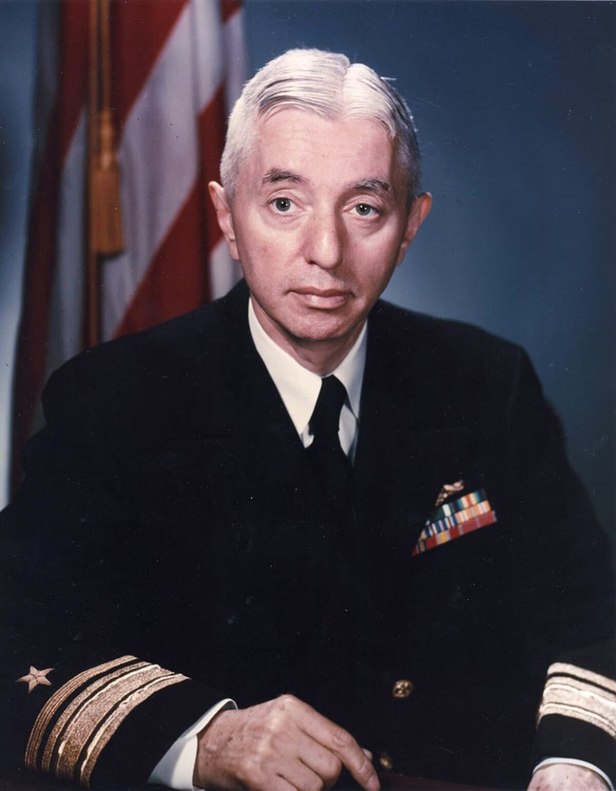
We’re going to talk about someone known (jokingly) as the “Kindly Old Gentleman” or “The Father of the Nuclear Navy.” Yes, I’m referring to Admiral Hyman Rickover. A man whose very name sends feelings of trepidation into many. A man who interviewed thousands of officer candidates for [Navy] Nuclear Power School, and I believe he went out on the shakedown runs of [all] nuclear-powered submarines (during his tenure).
Now, there are many adjectives to describe Rickover, and “kindly” probably is not one of them. Most would probably say abrasive, acerbic, blunt…you might say. But, our good Captain here has a rather interesting story about the Admiral.
Featured Tour Guide – The Captain – CAPT (ret.), U.S. Navy
Note: The interviewee has asked to remain anonymous for reasons of privacy. Additionally, among the Blueback tour guides, this story ranks among our favorites.
The Captain, as his title implies, is a retired O-6, having spent some 30 years in the U.S. Navy. While he didn’t serve on any of the Barbel-class submarines, he is still eminently qualified to discuss submarine operations, having served as the Commanding Officer (CO) of two nuclear-powered submarines. One was a Los Angeles-class fast attack and the other was an Ohio-class ballistic missile submarine. Given his experience, he has a great many sea stories to tell us, some of which are true.


That time the Captain lent Admiral Rickover some underwear
Transcript
Captain
Well, it was my pleasure to have gone to sea twice with Admiral Rickover. Now, Admiral Rickover, from the [USS] Nautilus on it was his policy to ride and observe every nuclear-powered ship on its initial sea trials after it was built. These sea trials, generally, the way they took place is, the Admiral would arrive the night before the ship was ready to get underway. And then the ship would get underway early in the morning, sometimes when it was dark outside, and go to sea and conduct those trials which would generally take a little over two days.

Captain
Now, on one particular trial, everything was going smoothly, the Admiral had boarded the ship, and then in the morning, just as the ship was getting ready to back out from the pier at its construction yard, the Chief of the Boat [COB] comes up to the bridge, and says, “Captain, we have a problem.”
“Well, what is it?”
“Admiral Rickover did not bring his spare underwear.”
Well, I thought for a couple of minutes, and since I was close to the size of Admiral Rickover, I told the Chief of the Boat, “Well, go down to my cabin, and underneath my bunk, you will find my spare underwear and see if that suffices.”
He did that and I heard nothing after that. The sea trials went very fine. The Admiral made his usual speech after the trials. We came into port. The Admiral disembarked and then we continued our subsequent sea trials. So, I did not think anything of it.
Except about two weeks later, I received in the mail a package, and it was marked from Naval Sea Systems Command. A small package. I opened it up and inside was a letter and two pairs of Navy-issue white underwear very similar to what I lent to Admiral Rickover. In that, the Admiral basically said, “Thank you for the underwear, and good luck on your sea trials.”
So that’s just one little story, and I think the reason I was told that he didn’t bring his underwear was that his wife was gone at the time and she was not available to pack the clothes that he needed.
Tim
Well, at least the Admiral was good enough to return the favor and give you back two new pairs.
Captain
Yes, he was. So that’s one of those stories about Admiral Rickover. People sometimes have a little concern or fear when the Admiral is around, but he had this ability to think about the people who served under him. It did not always show, but it was there.
Tim
And indeed, they say that probably due to Rickover, the U.S. Navy has never lost any submarine or ship to a nuclear accident. They have an unparalleled safety record when it comes to nuclear power. Unfortunately, the same cannot be said for the civilian sector, or the Soviets or Russians. For all of his faults, Rickover was very big on safety and responsibility.
Captain
Oh, certainly he was. He set the standards and we still follow them today.
[End of Interview]
On a further note, we have debated as to why exactly the Chief of the Boat came to the Captain with such a seemingly trivial matter. The Captain of a vessel is the person in charge of its operations, so you want to go to the Captain if there’s a problem concerning that and be conscious of not wasting the Captain’s time. Why the Chief of the Boat couldn’t have just solved the problem with the Admiral’s underwear himself is unknown.
Rickover on Education and Responsibility
While Rickover passed away before my time, I’ll conclude here with some thoughts on the man.
Rickover served for some 63 years on active duty in the U.S. Navy and almost 30 of those years were at flag rank (an admiral). He was known to be a workaholic and extremely intelligent. By some standards, he was not an easy man to get along with, and some would no doubt argue that by the time he was forcibly retired in 1982 at the age of 82, he was getting a bit long in the tooth. Still, Rickover was known for having little time for mediocrity, and zero tolerance for stupidity. During his tenure, Rickover emphasized high-quality education and personal responsibility for those who would operate nuclear-powered vessels. By extension, his views apply to the citizens of the United States itself. But that’s all I’ll say about that.
In 1961 at the 87th Congress, as part of the Joint Committee on Atomic Energy, Radiation Safety and Regulation, Rickover had the following to say:
Responsibility is a unique concept… You may share it with others, but your portion is not diminished. You may delegate it, but it is still with you… If responsibility is rightfully yours, no evasion, or ignorance or passing the blame can shift the burden to someone else. Unless you can point your finger at the man who is responsible when something goes wrong, then you have never had anyone really responsible.
 Fair Winds & Following Seas
One of my early memories as a seaman was having Rickover pointed out to me. The chief I was with commented that his uniform had so many decorations and gold braid that he’d sink if he fell in the water.
LikeLike
That wouldn’t surprise me. Haha! No doubt he’s be clutching a reactor as he sank.
LikeLiked by 1 person