Topic & Content
Published in 2023, this book is number 392 of Osprey’s “Campaign” series. It details the initial aircraft carrier raids of the Pacific War conducted by the U.S. Navy in the first three months of 1942 following the Japanese attack on Pearl Harbor. The book is broadly organized as follows:
- Origins of the Campaign
- Pearl Harbor and aftermath, December 7 – 10, 1941
- Failed Wake Island relief, December 14 – 23
- Yamamoto’s Submarine Offensive against Hawaii and the U.S. West Coast, December 1941
- Reforming the U.S. Pacific Fleet 1941 – 42
- Reinforcing the Central and South Pacific
- Chronology
- Opposing Commanders
- Japanese, United States
- Opposing Forces
- Japanese, United States
- Marshalls-Gilberts raid orders of battle, February 1, 1942
- Opposing Plans
- Japanese, United States
- The Campaign
- Commander Michimune Inaba’s I-6 torpedoes Saratoga, January 11, 1942
- U.S. Pacific Fleet carrier plans, January 1942
- Operation R: the Japanese Invasion of Rabaul and Kavieng, January 20 – 23, 1942
- Brown’s aborted Task Force 11 raid against Wake, January 23, 1942
- Halsey and Fletcher raid the Marshalls and Gilberts, February 1, 1942
- U.S. Pacific Fleet strategy, February 1942
- Japanese carrier actions, February 1-19, 1942
- Action off Bougainville, February 20, 1942
- Halsey’s Task Force 16 raids Wake Island, February 24, 1942. Halsey strikes Marcus Island, March 4, 1942
- Shokaku and Zuikaku redeploy to defend the Home Islands
- The Japanese invasion of Lae and Salamaua, March 8, 1942
- Brown and Fletcher strike Lae and Salamaua, March 10, 1942
- Aftermath
- The Battlefields Today
Thesis
Simply put, the book aims to cover the U.S. carrier air raids of early 1942 and the Japanese reactions to them. The author notes that these initial carrier raids weren’t the amphibious assaults or large-scale carrier task force raids that came later in the war, but instead were relatively small-scale hit-and-run affairs.
Author’s Background
According to the biographical blurb, Brian Lane Herder has a Bachelor of Arts in History from the University of Kansas and a Masters of Library Science from Emporia State University. He works as a legislative librarian for the Kansas state government and his research interests include World War II military and naval history.
Critical Observations
Positives
In a similar vein to Brian Lane Herder’s book on late-war carrier task force tactics, this is a detailed examination of the early U.S. Navy carrier raids in the months immediately following the Japanese attack on Pearl Harbor. Unlike that book, this one isn’t a technical volume and instead focuses more on the historical narrative of the early operations in 1942 (it only covers a few months). Most other books on the Pacific War largely write these events off as mere sidenotes in the history of this theater or fail to mention them at all. Thankfully, this book gives them some good treatment and notes the strategic and morale-boosting importance they had as the Japanese were steamrolling over everyone in the Pacific and Asia during those first six months of the war. Additionally, it gave the carrier task forces and the naval aviators valuable combat experience when they badly needed it.
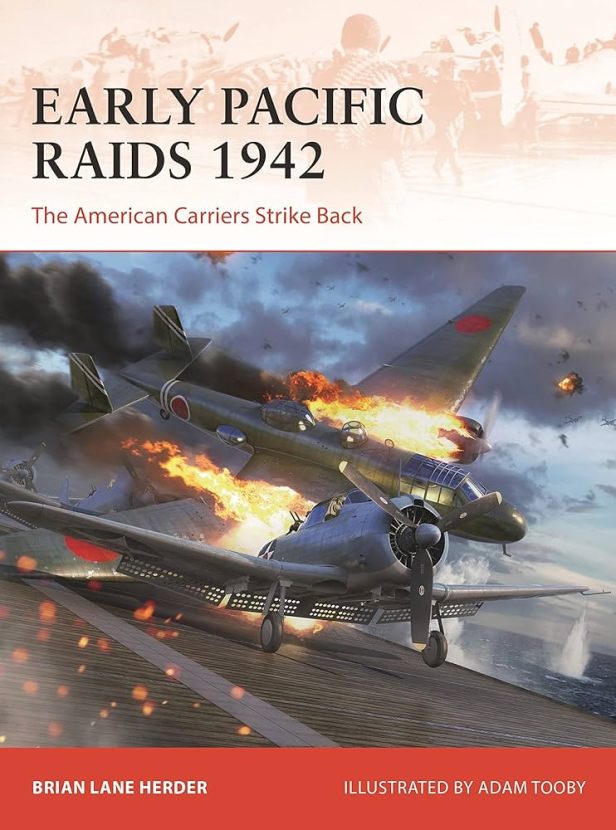
The author writes well and the narrative is easy to follow and well illustrated. The cover illustration depicts a Mitsubishi G3M “Nell” bomber clipping the flight deck of USS Enterprise (CV-6) after being shot down; missing Bruno Gaido, who was returning fire from the rear gunner’s seat, in the SDB Dauntless by mere feet. This 1 February 1942 event was depicted in the 2019 film Midway.
As with other Osprey paperback books, this one is short (<100 pages) and reads fast. This can be a pro or a con, depending on what type of reader you are and how you like your history, but Osprey generally caters to the popular history market. As a result, their books are easily digestible.
Negatives
Thematically, this book isn’t as strong as his book on late-war carrier task forces. It’s mostly a simple recounting of a handful of carrier raids in early 1942. Don’t expect to find the Battle of the Coral Sea or the Battle of Midway here. As a result, it can come off as a bit of a simplistic rehash of what others have already covered. The difference is that it’s a more recent reappraisal of the events.
A good chunk of the start of the book is spent explaining the strategic situation at the start of the Pacific War. To anyone familiar with the conflict, this can feel unnecessary (but again, these books are written for the layperson).
Evaluation (Does the content support the thesis?)
Overall, the book does what it says. It covers the first few months of the Pacific War and the U.S. carrier raids that probed the outer perimeter of the Japanese Empire. While by no means decisive in their strategic import, these raids provided the carriers and aviators with valuable experience in conducting air raids and managing their forces early on when the situation appeared desperate. Herder’s writing is easy to follow and the book is excellently illustrated with many photos and maps that allow the reader to get a good picture of the people and equipment.
Rating:
4.5 out of 5 (Great/Highly Recommended)

