
In a previous post, I wrote about my passion for libraries and why reading is so important to me. Simply put, knowledge is power; reading builds not only intelligence but also empathy. A visit to a library or bookstore is pretty much a weekly occurrence for me and reading is a daily habit. My personal library continues to grow and the subsequent increase in volumes means I occasionally need to invest in more shelving space. This also means my “to-be-read” pile is stacking up on the floor. But this post isn’t about my strange addiction or land-based libraries, but the ones that exist at sea.
Anyone who’s been on a cruise probably knows that ships have libraries. That’s assuming they took the time to seek it out.


Libraries at sea aren’t limited to cruise ships, naval vessels also have libraries for their crews, but they’re less lavish and much more utilitarian. Naturally, the size of the library is heavily dependent on the size of the vessel and the available space for it. So let’s examine how U.S. Navy ships got libraries and how they evolved over time.
Early Naval Libraries
Before the days of the internet, being on a ship at sea was basically being cut off from the world. Sailors had to find ways to entertain themselves, otherwise they’d become bored sailors with time on their hands. They would read books, play cards, or dice games.
According to the Morale, Welfare, and Recreation Department, U.S. Navy libraries began in 1820 with a budget of $800 (~$21,721 in 2025) and a donation of 1,500 books for USS Franklin. This actually required a separate space for the library and a crew-appointed librarian. Eight years later, the Navy began subsidizing shipboard libraries, one for the officers, and one for the enlisted crew with the chaplain overseeing them. Navy regulations also stated that the navigation officer would be in charge of the library in the absence of a chaplain.1
From the 1830s-40s, there were 36 standard titles aboard warships including the Encyclopedia Britannica, two atlases, the Federalist Papers, the Bible, and various books on navigation, history, and law. A young sailor on USS United States in the 1840s named Herman Melville, the author of Moby Dick, said that the ship’s library was kept in a barrel which meant it had to be dumped out onto the deck to see what was in it.2
Between the Civil War and the end of WWI, sailors were expected to educate themselves, and the Navy reached out to the American Library Association for help. By 1919, the 6th Division of the Bureau of Navigation, which oversaw libraries, was changed to the Morale Division and created the first MWR program in the Navy. They had an annual budget of $60,000; a traveling collection from the Fleet Supply Base in Brooklyn, NY; and college-level courses offered aboard 15 vessels. Fast forward to 1943, there were more than 1,500 libraries throughout the Navy, both afloat and ashore. Congress approved a budget of $2,710,840 for the library program based out of the Naval Supply Depots in Norfolk and San Diego. A typical ship’s collection was about one-third non-fiction and two-thirds fiction. Other forms of media included movies and radio programs. The program even coordinated sporting events.3
Naval Libraries in World War II
Additional information from the Naval History and Heritage Command notes that in World War II the Navy supplied libraries to all ships upon their commissioning, with the exception of tugs and other small craft. The following partial list shows an allowance of books for various types of ships:4
| Ship Type | Number of volumes |
|---|---|
| Battleships | 1,100 – 2,000 |
| Aircraft carriers | Light cruisers, tenders, and repair ships |
| Heavy cruisers and light cruisers (10,000 ton) | 900 |
| Light cruisers, tenders and repair ships | 600 |
| Destroyers | 150, 200, 300 |
| Submarines, minesweepers, and river gunboats | 150 |
| Gunboats | 400 |

Ships were also supplied a monthly allowance of books from the appropriation libraries with the exception of submarines, tugs, and small craft. Worn, damaged, or obsolete books could also be replaced upon request.5 The Morale, Welfare, and Recreation Department notes that Westerns were the most popular genre during WWII.6
Aside from popular titles, copies of Navy Department publications were also allotted to ships. Using the Landing Force Manual as an example, battleships and aircraft carriers would be allotted 25 copies. Cruisers and tenders received 15 copies. Gunboats had 5, destroyers had 2, submarines minesweepers, and tugs had 1 copy. All other auxiliaries would get 2 copies.7
Shore libraries operated similarly. All libraries, afloat and ashore maintained a card catalog of their titles. Included was an author list and title list of fiction books, and a classified list of non-fiction books.8
There’s a funny scene in the 1957 film The Enemy Below where an officer is seen reading a Little Orphan Annie comic book, and next to him is an enlisted sailor reading Volume 1 of Edward Gibbon’s The History of the Decline and Fall of the Roman Empire; a classic six-volume work of history written during the Enlightenment. It’s never explained if they got these books from the ship’s library or if they brought them on board themselves and who brought which. Logically, the more well-educated officer would be reading the history book while the enlisted man would be reading the comic book. However this choice of reading material could just be their preference at the time, or it could mean they finished these books and traded with each other. Occasionally, you want something easier or more challenging to read.
Other Perspectives
All this being said, that was during WWII. More and more books are published every year. Reading preferences change throughout a person’s lifetime and fluctuate based on the public interests of the times. Of course, sailors can bring their own reading material aboard. (i.e. Some of which wouldn’t be found/authorized in a library. Often the raunchier, the better.) Personal reading materials can be stored in their coffin lockers under their racks, at least as much as space will allow.
Today, naval shore installations have digitized catalogs that can be accessed anywhere at over 30 installations throughout the world. In addition to reading materials, sailors have access to audiobooks, films, and other training materials.9

Modern ships still have libraries that contain a multitude of popular titles, reference works, as well as music, movies, digital media, and computer workstations. On large ships like aircraft carriers, the libraries are dedicated spaces that are large and well-stocked. On smaller ships, a library may not be something so formal as a room with shelves and a circulation desk. It may just be one or two boxes of books thrown in the corner of a room…and nobody ever touches them.


Talking with other Navy sailors, one who was on the guided-missile cruiser USS Worden (CG-18) said the library on his ship was about the size of an officer’s stateroom. It had several bookshelves and a desk for the librarian. Another who served on USS Hamner (DD-718), a Gearing-class destroyer, said that his ship didn’t have a library, but magazines (e.g. Playboy), along with cigarettes and toiletries, could be purchased at the ship’s store.
A Submarine’s Library

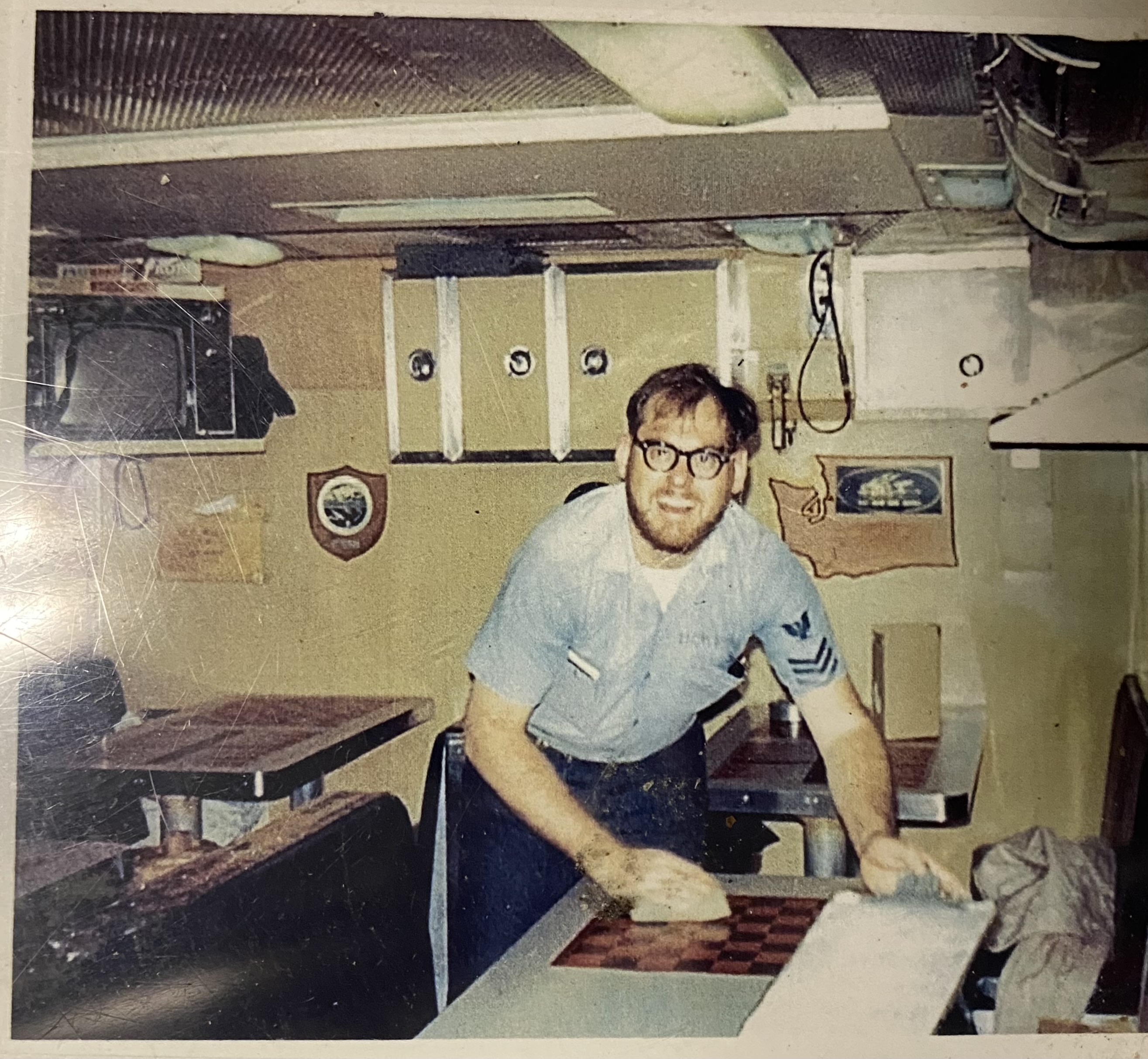
The submarine USS Blueback (SS-581), now a museum ship in Portland, OR, has a very small library in the crew’s mess which consists of a cabinet filled with popular fiction titles. As far as we can tell, this is the original location of the ship’s library, but whether or not it was always there is debatable. Photographic evidence suggests otherwise and a volunteer tour guide on Blueback, who formerly served on her sister boat USS Barbel (SS-580), says that he doesn’t recall if there was a library in this location on Barbel, but he said that most sailors brought their own books and stuck them in the locker beneath their racks. Although he does recall that there were small jukeboxes on the outboard tables in the crew’s mess that could play 45 rpm records. They still had to pay for the records, though.


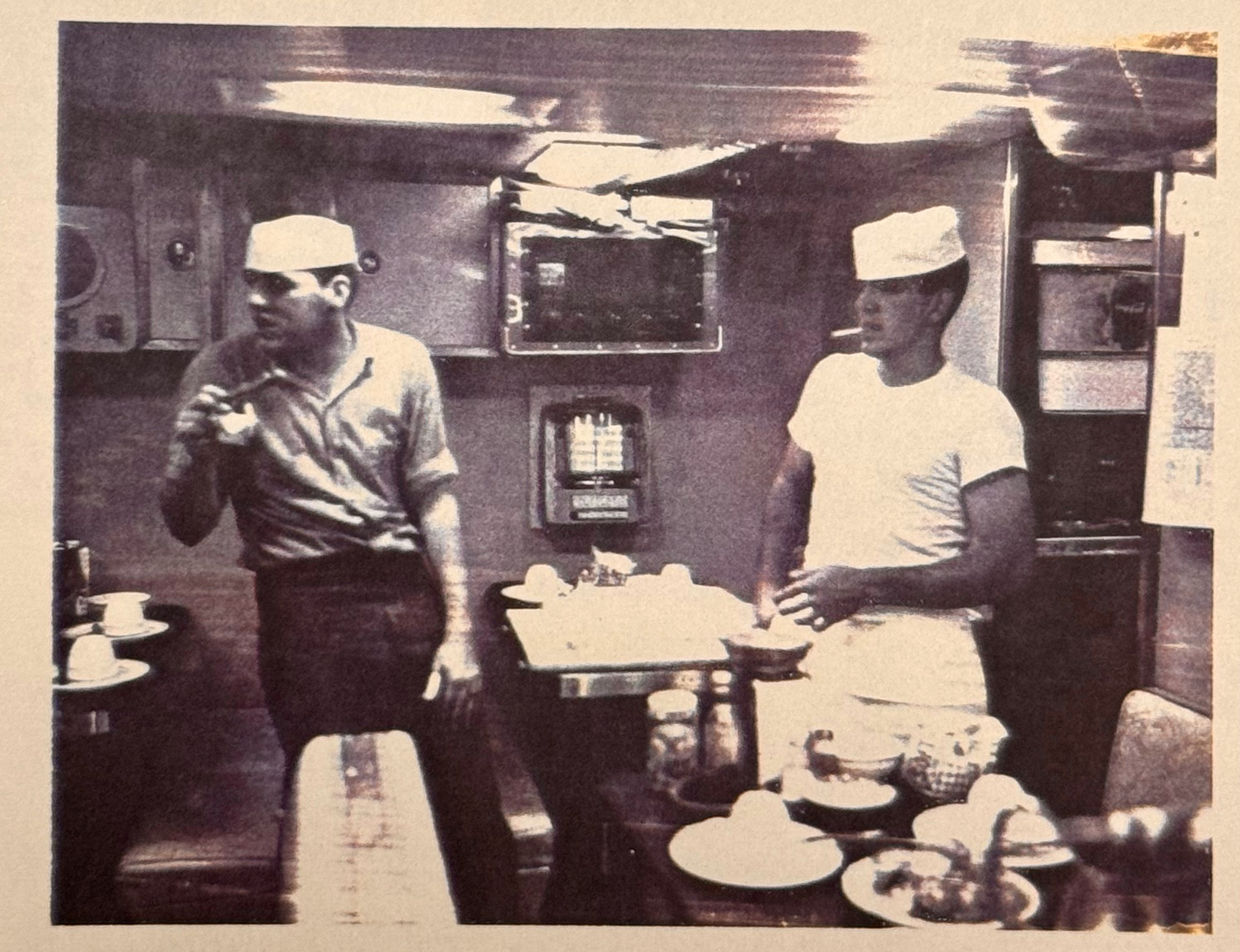
Furthermore, whether or not the books in this cabinet are original to the submarine is also debatable. Some of the books in the library are definitely not original and others are likely just donations to the museum. No doubt the volumes in the library changed throughout the 31 years that Blueback was in service.

There’s another library on the submarine, but we’re pretty sure it wasn’t originally a library because it has a lock on the cabinet. Most likely it stored equipment or possibly chemicals of some sort. While a cabinet would indeed be used to store books to prevent them from sliding around and falling all over the deck, there would be no reason to lock up books since classified materials would be kept in a safe. Currently, however, the locker stores books and is a reference library for the staff to access. (It’s kept locked so visitors can’t access it and steal the books.)

Other spaces on the submarine (ships, as well) would have books stored in them. Aside from the aforementioned personal lockers for the crew to put their own books, technical reference materials would be available and stored on various shelves throughout the vessel. These could be equipment manuals, technical diagrams, and other materials that relate to the vessel and its operation. Copies of Jane’s reference books are also found on ships.
The Reality: Read or Make Yourself Useful!
Let’s be realistic, life on a warship is generally filled with work. It’s not a cruise ship or luxury yacht, after all. There’s always work to be done since the vessel operates around the clock. Your average day is filled with time spent on-watch (doing your job), then time spent off-watch, mostly doing paperwork, maintenance, cleaning, and studying. Then you find time during the rest of the 24-hour day to eat and sleep. Of course, there are also drills and training to be done, qualifications to work on, etc. It’s not unheard of for people to only get 4 hours of sleep each night, or pull an all-nighter because they’re busy working on a report or repairing that one machine that’s always breaking down. (Staying up for 2 – 3 days straight is always fun!) This rotation of watchstanding, off-watch duties, sleeping, and eating repeats every day. By the time you finish your duties, you just want to go to sleep. The last thing you want to do is spend more time awake trying to read a book since you’re so tired already. Whatever free time you actually have during the day is usually spent getting more sleep because you’re already sleep-deprived. So the reality is that most sailors probably never even touch the books in the ship’s library and some may not even be aware there is a library on their ship. So the books just end up collecting dust.
That being said, when sailors do actually have free time, they spend it playing card games and board games, or watching movies. And yes, some even read books. Some sailors also bring video game consoles on board, as well. Computers with internet access are available, but you wouldn’t spend all day browsing the web or playing online multiplayer games. Internet access is limited based on the tactical situation, security concerns, and the fact that the combat systems of the vessel take priority.
Submarines are even more restricted since any outgoing signals are purely limited to tactical communications, and radio silence is maintained while underway to avoid detection. Once underwater, there is no internet; only Very Low Frequency (VLF) and Extremely Low Frequency (ELF) radio signals can reach the boat.10 The bandwidth on these signals is so limited that no audio or video can be transmitted on them, either. The only outside communication a submariner would receive from loved ones is a “family gram” every so often. These messages are limited to about 50 words, so the subsequent word salad becomes interesting to decipher, and all messages are heavily screened.
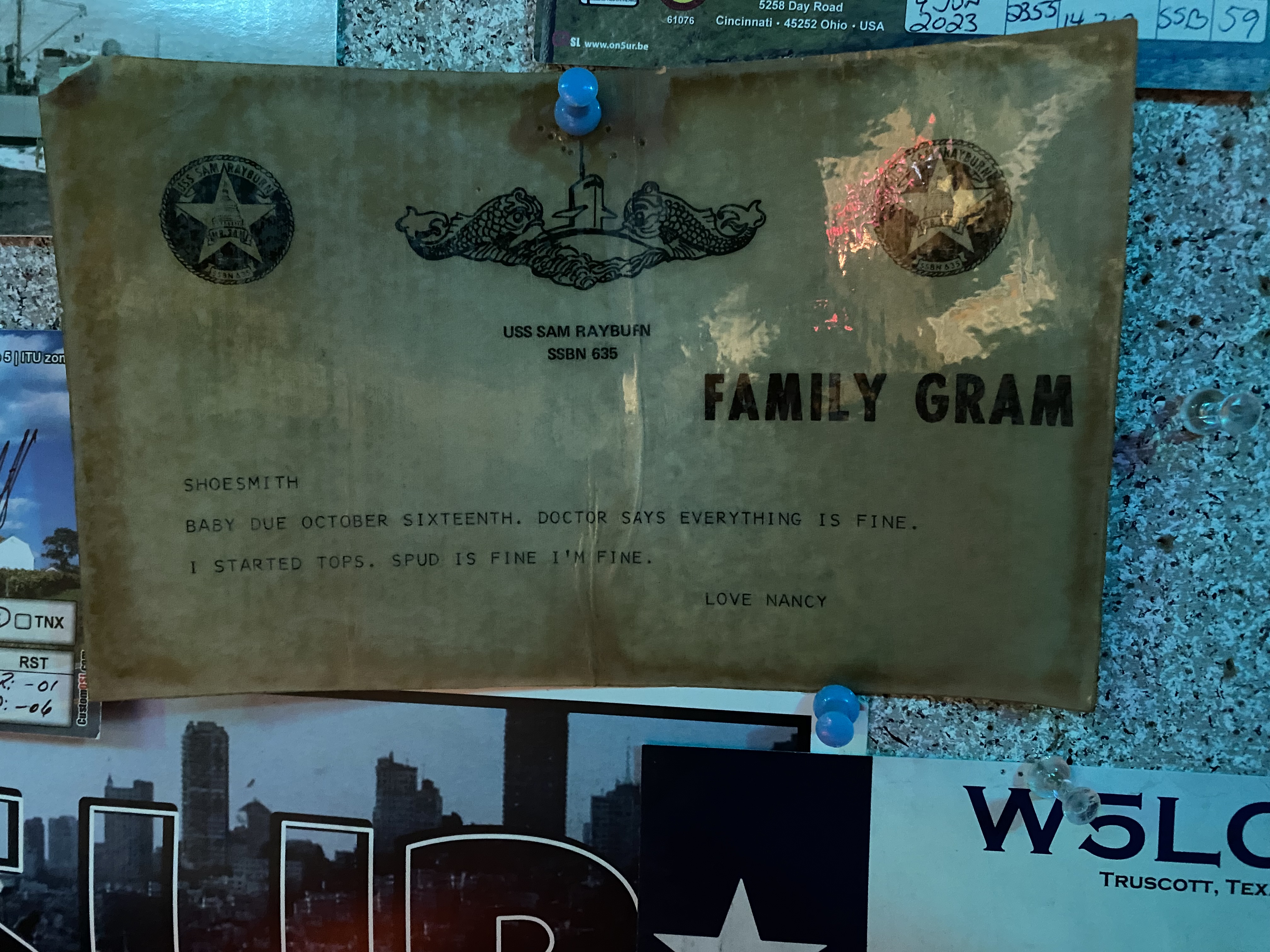
Keep this in mind since most of us landlubbers don’t go more than a few hours without looking at a device of some sort. Once the submarine submerges, you are basically cut off from the outside world, and some patrols can last for 60 – 90 days at a time before the submarine pulls into a port. That means up to three months with no internet, no phones, no tablets, no computers, and no social media! Zero, nada, zip!11 Every 12 – 18 months, USS Blueback would get deployed on WESTPAC (Western Pacific) patrols which lasted anywhere from 4 – 6 months with a port call in between before it got back to its homeport.
So what do you do without an internet connection and phones?
You find ways to entertain yourself. You read, study, play games, and make yourself useful.
When Blueback was in service, U.S. submarines were still typically operating on an 18-hour day broken up into three six-hour long watches. That meant six hours of sleep (if you’re lucky you get it all at once), six hours on watch, and six hours off watch; most of which involved doing maintenance around the boat, studying, training, and then maybe having a few hours of free time. This was if things were ideal.
Having free time on a submarine is also dependent on whether or not you’re qualified and have your dolphins. If you’re a “non-qual” AKA a NUB (Non-Useful Body), then you wouldn’t be allowed to read books for pleasure, play games, eat ice cream, or watch movies in your free time. If you were reading a book for fun, then someone would probably snatch that book out of your hands and replace it with a technical manual and tell you to read that instead. Perhaps if you were doing really well on your qualifications, then you’d be allowed to relax and maybe have some ice cream, but there better be someone there to vouch for you. In short, if you’re a NUB, you better be working on your qualifications, and making yourself useful, otherwise someone will find something for you to do. In any case, if you’re ever bored on a warship, just go to one of the Chief Petty Officers and tell them you have nothing to do. They will make sure you’re entertained. Trust me!
So that’s a little bit about libraries on naval warships.
Notes
- “Navy Libraries, Then & Now | Navy MWR Library,” accessed March 13, 2025, https://navy.dodmwrlibraries.org/our-story. ↩︎
- “Navy Libraries, Then & Now | Navy MWR Library,” accessed March 13, 2025, https://navy.dodmwrlibraries.org/our-story. ↩︎
- “Navy Libraries, Then & Now | Navy MWR Library,” accessed March 13, 2025, https://navy.dodmwrlibraries.org/our-story. ↩︎
- “US Navy Libraries,” accessed March 13, 2025, http://public2.nhhcaws.local/research/library/online-reading-room/title-list-alphabetically/u/us-navy-libraries.html. ↩︎
- “US Navy Libraries,” accessed March 13, 2025, http://public2.nhhcaws.local/research/library/online-reading-room/title-list-alphabetically/u/us-navy-libraries.html. ↩︎
- “Navy Libraries, Then & Now | Navy MWR Library,” accessed March 13, 2025, https://navy.dodmwrlibraries.org/our-story. ↩︎
- “US Navy Libraries,” accessed March 13, 2025, http://public2.nhhcaws.local/research/library/online-reading-room/title-list-alphabetically/u/us-navy-libraries.html. ↩︎
- “US Navy Libraries,” accessed March 13, 2025, http://public2.nhhcaws.local/research/library/online-reading-room/title-list-alphabetically/u/us-navy-libraries.html. ↩︎
- “Navy Libraries, Then & Now | Navy MWR Library,” accessed March 13, 2025, https://navy.dodmwrlibraries.org/our-story. ↩︎
- Reportedly, since 2004 the U.S. Navy no longer operates ELF transmitters. ↩︎
- Personally, I’d pay money to see a middle schooler or high schooler try to go even 3 hours without any device, internet, or social media. As a former middle school and high school teacher, I’ve seen more than my share of meltdowns after taking phones away from kids. It just goes to show how screen-addicted the young generations are today. Not only that, some of them don’t read and can’t read! Much less write. It shows how pathetic our society has become and what has happened to the younger generations. ↩︎
Bibliography
“Navy Libraries, Then & Now | Navy MWR Library.” Accessed March 13, 2025. https://navy.dodmwrlibraries.org/our-story.
“US Navy Libraries.” Accessed March 13, 2025. http://public2.nhhcaws.local/research/library/online-reading-room/title-list-alphabetically/u/us-navy-libraries.html.

